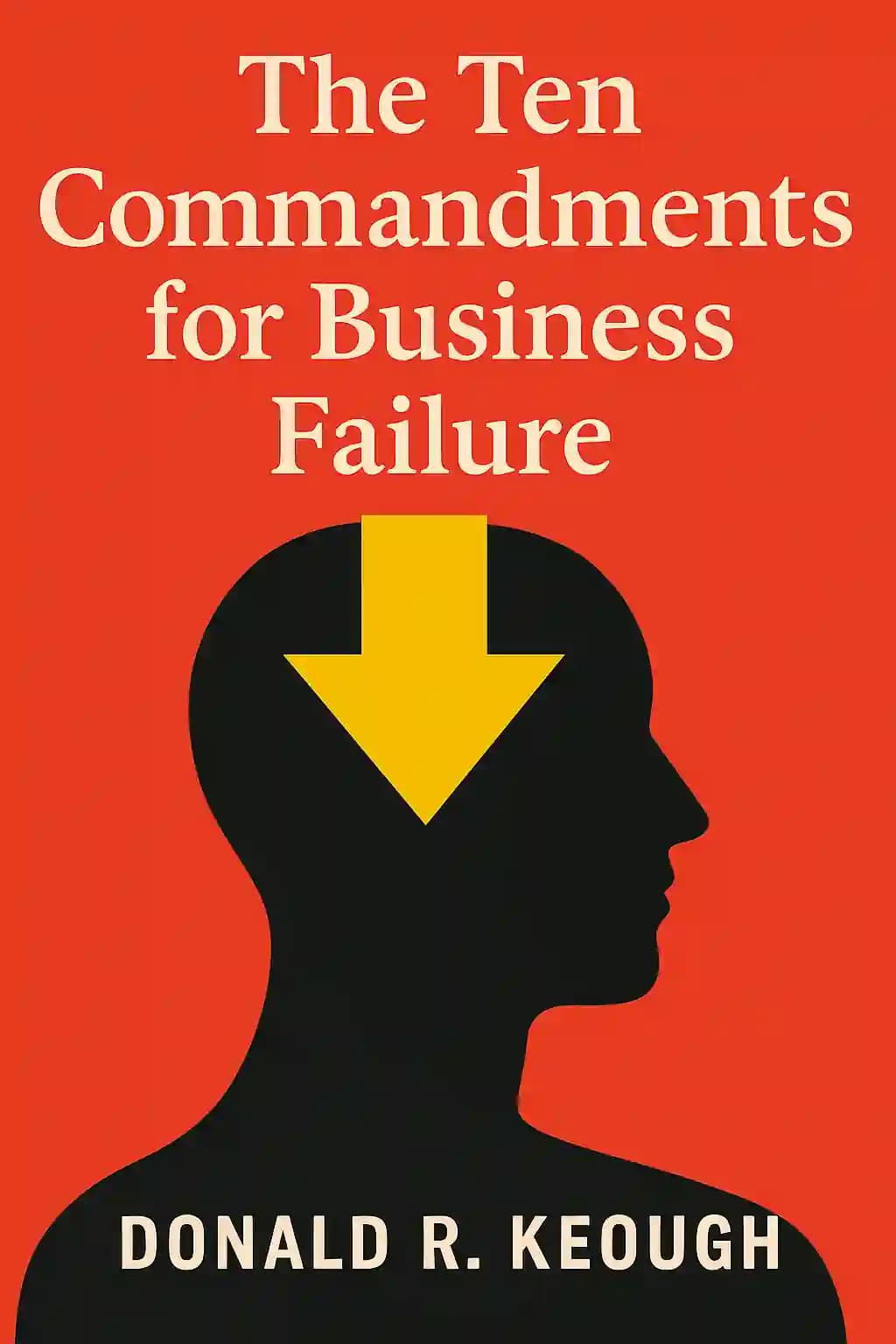
Ten Commandments for Business Failure
Visão geral de Ten Commandments for Business Failure
Ever wonder why businesses fail? Donald Keough, Coca-Cola veteran who navigated the "New Coke" disaster, reveals ten guaranteed paths to failure. With Warren Buffett's foreword and insights from Bill Gates and Jack Welch, this contrarian masterpiece teaches success by avoiding catastrophe.

Temas principais em Ten Commandments for Business Failure
- corporate complacency
- risk aversion
- strategic inflexibility
- executive isolation
- organizational failure
Citações de Ten Commandments for Business Failure
Be inflexible. Always do it the way it was done before.
Assume infallibility. Never admit a mistake.
The last thing IBM needs is a vision.
Don't bring me anything but trouble. Good news weakens me.
Personagens de Ten Commandments for Business Failure
- Donald R. KeoughAuthor and former president of Coca-Cola
- Robert WoodruffFormer Coca-Cola leader who expanded the brand
- Michael KeoughThe author's great-grandfather and Irish migrant
- Lou GerstnerCEO who led the transformation of IBM
Baixar resumo de Ten Commandments for Business Failure
Obtenha o resumo de Ten Commandments for Business Failure como PDF ou EPUB gratuito. Imprima ou leia offline a qualquer momento.
Perguntas Frequentes Sobre Este Livro
The Ten Commandments for Business Failure is a counterintuitive guide to avoiding corporate collapse by examining common leadership mistakes. Through anecdotes from his Coca-Cola career and other infamous failures (like New Coke), Keough outlines 10 pitfalls such as avoiding risks, resisting change, and over-relying on experts. Framed as a "how-not-to" manual, it emphasizes humility and adaptability as antidotes to hubris.
This book is essential for executives, entrepreneurs, and managers seeking to recognize self-sabotaging behaviors in leadership. It’s also valuable for business students studying crisis management or organizational psychology. Keough’s humor and real-world examples make it accessible to anyone interested in corporate strategy or avoiding career-limiting decisions.
Yes—its reverse-engineering of failure offers timeless insights for navigating uncertainty. Keough’s firsthand accounts (including Warren Buffett collaborations) and actionable warnings about inflexibility or fear-driven decisions make it a pragmatic read. The Wall Street Journal praised it as “devastatingly blunt,” while industry leaders cite its lessons on balancing confidence with humility.
Key commandments include:
- Quit taking risks (stagnation guarantees decline).
- Be inflexible (resist market shifts, like Coca-Cola’s initial resistance to new packaging).
- Assume infallibility (ignore feedback, as seen in the New Coke disaster).
- Fear the future (prioritize short-term safety over innovation).
Others involve over-relying on consultants, sending mixed messages, and undervaluing customers.
The 1985 New Coke debacle exemplifies assuming infallibility and ignoring customer sentiment. Keough admits Coca-Cola’s leadership dismissed public attachment to the original formula, nearly eroding brand loyalty. The crisis reinforced his belief in humility—the company reinstated “Coca-Cola Classic” within months, turning failure into a recovery case study.
Keough condemns arrogance (“CEOs who confuse their speeches with Shakespearean soliloquies”) and rigidity. He warns against leaders who isolation themselves from frontline employees or dismiss dissent, comparing inflexible management to “dinosaur logic in a startup world”.
Unlike formulaic success manuals, Keough focuses on avoiding preventable errors rather than chasing vague “winning strategies.” His approach mirrors Warren Buffett’s inversion principle: “Tell me where I’ll die, so I’ll never go there.” This pragmatic lens prioritizes risk mitigation over untested ambition.
Beyond New Coke, Keough critiques:
- Companies that stagnated by avoiding smart risks (e.g., legacy brands outpaced by agile startups).
- Leaders who overdelegated to experts without understanding core operations.
- Organizations paralyzed by pessimism about the future, like Kodak’s delayed digital pivot.
Absolutely. For example:
- Send mixed messages: Inconsistent branding confuses niche audiences.
- Isolate yourself: Founders who ignore employee feedback miss critical operational flaws.
Keough argues small firms often fail faster by repeating these errors, making vigilance even more vital.
“Quit taking risks” seems illogical but underscores how complacency erodes competitiveness. Keough explains that calculated risks (like Coca-Cola’s global expansion) drive growth, while excessive caution leaves firms vulnerable to disruptors. His twist: Avoiding all risk is the riskiest move.
He links toxic cultures to commandment 7: Send mixed messages. Inconsistent priorities or hypocrisy from leadership (e.g., touting transparency while hiding setbacks) breed distrust. Keough advocates for “truth-telling” cultures where employees can challenge decisions without fear.
In an era of AI disruption and economic volatility, Keough’s warnings about rigidity and fear-driven决策 resonate. The book’s emphasis on adaptability (e.g., “look at the cow, not the cowboy”) aligns with modern needs for agile leadership and customer-centric innovation.