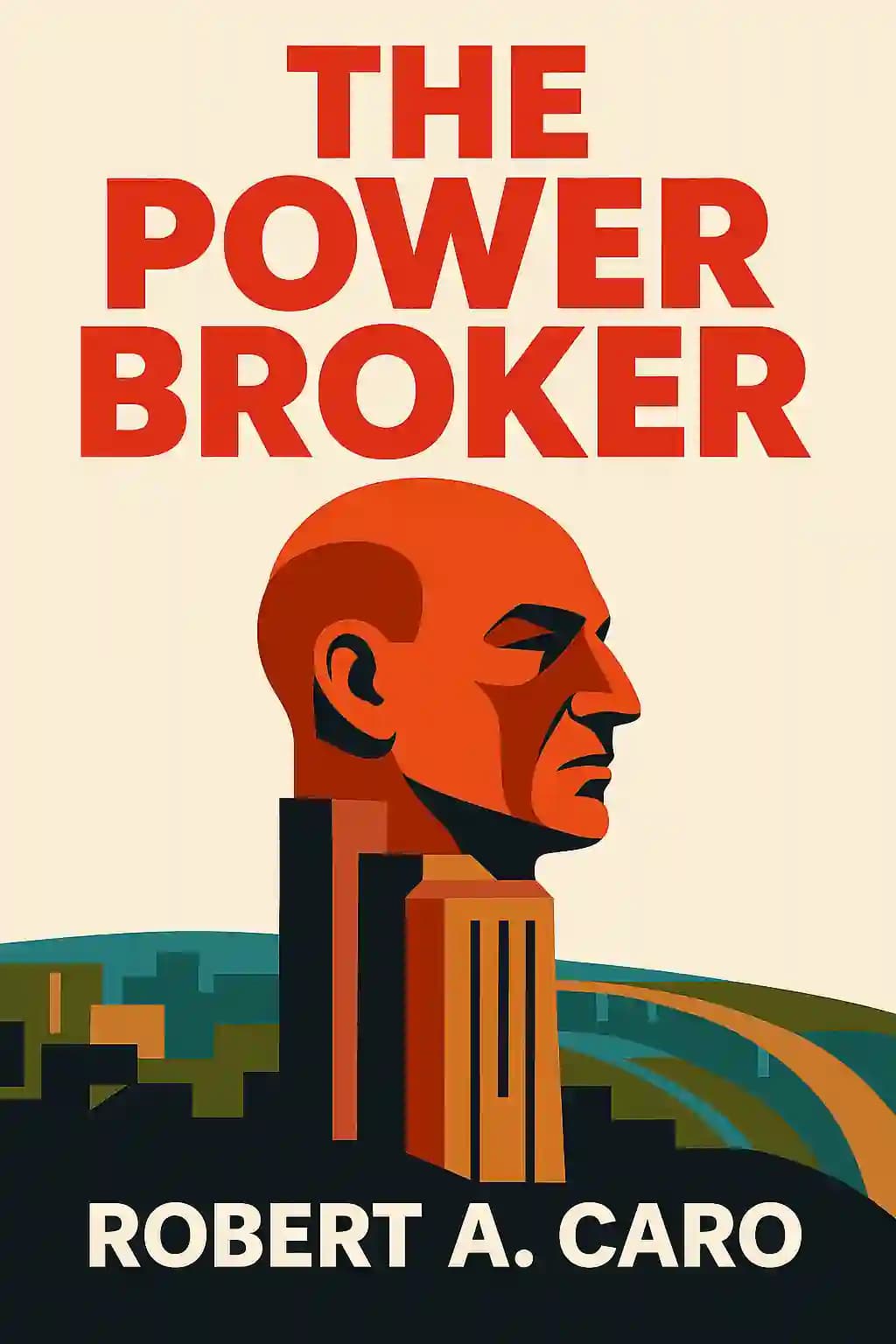
The Power Broker reveals how one unelected official reshaped New York through 1,336 pages of political genius and ruthlessness. Winner of the Pulitzer Prize, this epic exposes how cities are truly built - and why Jane Jacobs called it "an immense public service."
Robert Allan Caro, Pulitzer Prize-winning author and historian, is renowned for his meticulously researched biographies exploring political power and urban development. His seminal work, The Power Broker: Robert Moses and the Fall of New York, revolutionized political biography by exposing how unelected officials shape cities, earning the 1975 Pulitzer Prize and recognition as one of the Modern Library’s 100 greatest nonfiction books of the 20th century.
A Princeton graduate and former investigative reporter for Newsday, Caro’s seven-year investigation into Moses’s infrastructure empire established his reputation for unflinching detail and narrative depth.
Caro’s multivolume series The Years of Lyndon Johnson—including The Path to Power, Means of Ascent, Master of the Senate, and The Passage of Power—has garnered two National Book Awards and a National Humanities Medal from President Barack Obama. His work is celebrated for blending rigorous archival research with gripping storytelling, dissecting how ambition and institutional leverage redefine American democracy.
Translated into over 20 languages, The Power Broker remains a cornerstone of political and urban studies, routinely cited in academia and journalism for its timeless analysis of power dynamics.
The Power Broker chronicles Robert Moses' rise as New York's unelected "master builder," detailing how he shaped the city’s infrastructure through parks, highways, and public works while accumulating unprecedented political power. The Pulitzer Prize-winning biography exposes Moses' authoritarian methods, his clashes with figures like FDR, and the lasting urban crises caused by his projects, from displaced communities to congestion.
Urban planners, political science students, and history enthusiasts will gain insights into power dynamics and urban development. It’s ideal for readers interested in meticulously researched biographies or critiques of institutional corruption. Journalists and policymakers can learn from its lessons on governance and the consequences of unchecked authority.
Yes. Praised as a "modern American classic," its 1,200+ pages offer a gripping study of ambition and power. Caro’s investigative rigor—drawing on seven years of research—reveals how Moses manipulated systems to control New York, making it essential for understanding urban policy and political influence.
Moses leveraged public agencies like the Triborough Bridge Authority to control funding and bypass accountability. He forged alliances with banks, unions, and media, intimidating opponents through legal tactics and patronage. His ability to deliver projects quickly earned bipartisan support, even as his methods eroded democratic oversight.
Some argue Caro overly vilifies Moses, downplaying his early achievements like Jones Beach. Others note the book’s length can deter casual readers. However, its depth and unflinching critique of Moses’ legacy—particularly how highways and housing policies deepened racial divides—are widely acclaimed as groundbreaking.
Caro portrays Moses as a tragic figure: an idealist turned autocrat. While his parks and bridges initially modernized New York, later projects like the Cross-Bronx Expressway destroyed neighborhoods and prioritized cars over public transit. The book frames his career as a cautionary tale about centralized power and urban planning’s human cost.
Reviewers liken the biography to “a great Russian novel” for its epic scope and moral complexity.
Unlike shorter biographies, Caro’s work blends granular detail with narrative sweep, akin to Doris Kearns Goodwin’s Team of Rivals. It set a new standard for exposing systemic power abuses, influencing works like Jane Jacobs’ The Death and Life of Great American Cities.
The book warns against prioritizing infrastructure over communities, highlighting how Moses’ projects exacerbated segregation and pollution. It underscores the need for transparency in public projects and the dangers of conflating progress with scale.
As cities grapple with climate resilience and equitable development, Moses’ legacy illustrates the stakes of planning decisions. The book remains a touchstone for debates about public investment, housing policy, and balancing growth with community needs.
Caro spent seven years interviewing Moses’ associates, analyzing sealed archives, and visiting construction sites. His wife, Ina, transcribed thousands of documents. This exhaustive process uncovered Moses’ secretive deal-making and cemented the book’s reputation for precision.
It received the 1975 Pulitzer Prize for Biography, the Francis Parkman Prize, and a National Book Award finalist spot. Modern Library ranked it among the 20th century’s top 100 nonfiction books.
Sinta o livro através da voz do autor
Transforme conhecimento em insights envolventes e ricos em exemplos
Capture ideias-chave em um instante para aprendizado rápido
Aproveite o livro de uma forma divertida e envolvente
Moses created the modern American city's automobile-centered paradigm.
Moses remains a deeply controversial figure.
Moses was very theoretical, always wanting to do exactly what was right.
Moses secured unprecedented powers.
Moses dismissed the idea, ensuring that his magnificent creation would remain primarily available to middle and upper-class white families.
Divida as ideias-chave de The Power Broker em pontos fáceis de entender para compreender como equipes inovadoras criam, colaboram e crescem.
Experimente The Power Broker através de narrativas vívidas que transformam lições de inovação em momentos que você lembrará e aplicará.
Pergunte qualquer coisa, escolha seu estilo de aprendizagem e co-crie insights que realmente combinam com você.

Criado por ex-alunos da Universidade de Columbia em San Francisco
"Instead of endless scrolling, I just hit play on BeFreed. It saves me so much time."
"I never knew where to start with nonfiction—BeFreed’s book lists turned into podcasts gave me a clear path."
"Perfect balance between learning and entertainment. Finished ‘Thinking, Fast and Slow’ on my commute this week."
"Crazy how much I learned while walking the dog. BeFreed = small habits → big gains."
"Reading used to feel like a chore. Now it’s just part of my lifestyle."
"Feels effortless compared to reading. I’ve finished 6 books this month already."
"BeFreed turned my guilty doomscrolling into something that feels productive and inspiring."
"BeFreed turned my commute into learning time. 20-min podcasts are perfect for finishing books I never had time for."
"BeFreed replaced my podcast queue. Imagine Spotify for books — that’s it. 🙌"
"It is great for me to learn something from the book without reading it."
"The themed book list podcasts help me connect ideas across authors—like a guided audio journey."
"Makes me feel smarter every time before going to work"
Criado por ex-alunos da Universidade de Columbia em San Francisco

Obtenha o resumo de The Power Broker como PDF ou EPUB gratuito. Imprima ou leia offline a qualquer momento.
Robert Moses transformed New York without ever holding elected office. For over four decades, he wielded extraordinary power, building 627 miles of roads, 658 playgrounds, 13 bridges, and reshaping an area inhabited by 12 million people. Though he never learned to drive, Moses created the automobile-centered paradigm that defines American cities to this day. His projects include beloved landmarks like Jones Beach, the Triborough Bridge, and Lincoln Center, yet his methods displaced hundreds of thousands, primarily poor minorities. What makes his story so compelling isn't just the physical transformation he engineered but what it reveals about power itself-how it's acquired, wielded, and the price we pay for progress. Have you ever wondered how our cities came to be designed around cars rather than people? The answer begins with Robert Moses.
Born in 1888 to wealthy Jewish parents, Moses developed both passionate idealism and overwhelming arrogance-traits that would define his career. At Yale and later Oxford, he transformed from a shy bookworm into someone with a clear vision of public service, albeit one that believed in the natural superiority of the educated class. His opportunity came in 1919 when Governor Al Smith appointed him to the State Reconstruction Commission, where Moses learned crucial political lessons about the gap between idealistic reforms and political feasibility. When walking along Riverside Drive with his future wife, Moses would gaze at the decrepit waterfront and envision "the most beautiful thing in the world"-parks, highways, and recreational facilities replacing the ugly railroad tracks. These weren't idle dreams; they were blueprints waiting for power. And in 1924, when Governor Smith appointed him president of the Long Island State Park Commission, Moses secured unprecedented authority through carefully drafted legislation that few bothered to read closely. This pattern-identifying a goal, pursuing it with single-minded determination, and overcoming opposition through legal maneuvering-would define his approach for decades to come.
Jones Beach stands as Moses' most beloved achievement. Where others saw a desolate sandbar, he envisioned "a bathing beach such as America had never seen." The transformation required moving 40 million cubic yards of sand, planting millions of beach grass clumps by hand, and building the Wantagh Causeway for access. When it opened in August 1929, newspapers proclaimed it "the finest seashore playground ever given the public anywhere in the world." Yet even this triumph revealed Moses' troubling vision of who constituted "the public." He deliberately designed Jones Beach to be accessible only by automobile, with bridges too low for buses to pass underneath. When questioned about public transportation access, Moses dismissed the idea, ensuring his magnificent creation would remain primarily available to middle and upper-class white families with cars, while excluding poor and minority New Yorkers who relied on public transit. Isn't it striking how something as seemingly neutral as a bridge height could be weaponized to enforce social segregation?
When Fiorello La Guardia became mayor in 1934, Moses was appointed Parks Commissioner. His immediate impact was stunning. Within months, he transformed the city's decrepit parks-every structure repainted, every tennis court resurfaced, every lawn reseeded. He planted 11,000 new trees, pruned 62,000 others, and opened fifty-two new playgrounds in his first year alone. The press was ecstatic, calling his achievements "little short of miraculous." Children at park openings would chant: "Two, four, six, eight-who do we appreciate? Mr. Moses! MR. MOSES!! MR. MOSES!!!" His most ambitious project was the Triborough Bridge, a massive traffic machine linking three boroughs. The scale was staggering: enough concrete to pave a highway from New York to Philadelphia, enough steel to reopen fifty Pennsylvania mills. Beyond its size, Triborough's significance was immense-it would tie together three boroughs as large as cities themselves, eliminating countless hours of needless travel. But as Moses accumulated more positions-eventually holding twelve simultaneous titles-he discovered that public authorities could generate revenue through tolls, creating an independent power base beyond elected officials' control. By carefully structuring bond resolutions and embedding his powers in contracts protected by the Constitution, Moses created what one observer called "a government within a government."
The Cross-Bronx Expressway devastated East Tremont, a stable middle-class Jewish neighborhood. When residents found an alternative route that would displace only 19 families instead of 1,530, Moses rejected it. The years-long construction transformed a vibrant community into an urban wasteland, marked by abandoned buildings and rising crime as families fled. This pattern repeated citywide. Moses' urban renewal projects displaced thousands of families with minimal support. A City Planning Commission study found over a third of displaced families were listed as "Disappeared-whereabouts unknown." Moses' response was callous: "You can't make an omelet without breaking eggs." His transportation policies favored highways over mass transit, with lasting impact. When airport planner F. Dodd McHugh suggested a subway link to Idlewild (now JFK) Airport, Moses blocked it, building instead the perpetually congested Van Wyck Expressway.
Moses' power seemed unassailable until 1956, when a small protest over a parking lot expansion at Tavern-on-the-Green unexpectedly snowballed into a public relations disaster. What began with a few mothers pushing baby carriages grew into front-page news, forcing Moses to back down for the first time in decades. More challenges followed-his attempt to force Joseph Papp's free Shakespeare in the Park to charge admission backfired spectacularly, with Eleanor Roosevelt joining the criticism. His 1964-65 World's Fair became another disaster. His financial projections proved wildly optimistic, and by December 1964, outside auditors delivered devastating news: contrary to Moses' claimed $12.7 million surplus, the Fair had a $14 million deficit. The final defeat came at the hands of Governor Nelson Rockefeller in 1968, who created the Metropolitan Transportation Authority to absorb Moses' empire. After forty-four years in power, Moses was left with only a ceremonial role.
In his final years, Moses grew bitter about perceived public ingratitude, once remarking at a park dedication: "Someday, let us sit on this bench and reflect on the gratitude of man." His name, once representing progress, became linked to traffic problems and neighborhood destruction. Moses' legacy defies simple judgment. Jones Beach, welcoming over a billion visitors, became a democratic haven for working-class families. His parks, playgrounds, and pools provided vital recreation spaces, while his bridges and highways remain crucial to New York's infrastructure. His most significant legacy may be what he revealed about power in democracy-how an unelected official could amass unprecedented authority through public authorities beyond democratic oversight. His story stands as both achievement and cautionary tale, showing what determination can accomplish while warning of the costs when that power loses touch with public needs. His imprint endures in every bridge and park in New York, physical reminders of one man's sweeping vision.