Capítulo 4
The Supernatural Element: Power and Its Price
Meilin's struggle takes on supernatural dimensions when she discovers she possesses forbidden spirit power connected to a jade pendant left by her mother. The pendant links her to Qinglong, an enormous sea dragon who feeds on greed and ambition. Through dreams and visions, Meilin enters the spirit realm where Qinglong reveals she has the rare ability to command water - a power that marks her as a spirit medium.
This revelation forces Meilin to confront whether her mother, whom everyone believed mad, actually possessed genuine supernatural abilities. The parallel between them is unmistakable: both women possess powers that society deems dangerous and unnatural, especially in female hands.
When Meilin's emotions surge during combat training, her untrained powers manifest violently - water buckets explode, injuring her opponent. Horrified by her lack of control, she flees, only to later encounter a drunken soldier named Red. When she confronts him about his irresponsibility before battle, her anger triggers another uncontrolled surge of power: "Water from a puddle encircled his throat as the dragon urged me to compel him."
This incident reveals the corrupting nature of spirit power - it feeds on and amplifies negative emotions like anger and greed. The dragon's voice encourages her to dominate others, pushing her toward becoming the very type of tyrant she despises. After forcing Red to forget and leave, Meilin vomits upon seeing her veins turned black, physical evidence of how the power is changing her.
"I feared imprisonment, torture, or even death if discovered," she reflects, understanding that possessing "black magic" is strictly forbidden in the Three Kingdoms. This supernatural element adds another layer to Meilin's deception - not only must she hide her gender, but also these forbidden abilities that would mark her for execution regardless of her sex.
The relationship between Meilin and Qinglong becomes increasingly complex as the dragon offers power while attempting to influence her decisions. This internal struggle mirrors her external battles, raising profound questions about the nature of power itself. Is any power worth the corruption it brings? Can Meilin use these abilities without becoming a monster herself?
Capítulo 5
War and Politics: The Larger Canvas
Against the backdrop of Meilin's personal struggles, a larger conflict unfolds between the Three Kingdoms. What initially appears to be a straightforward war reveals itself as a complex web of political machinations, supernatural forces, and ancient prophecies.
The conflict centers around Chancellor Sima of Ximing, who possesses a jade seal connected to Zhuque, the Vermillion Bird spirit that feeds on vengeance. Sima's unnatural powers manifest as inexplicable wildfires that burn even through rainfall, devastating villages and armies alike. When Meilin witnesses the aftermath of these attacks - burned villages, ravaged farmlands, and terrified survivors - the human cost of the supernatural conflict becomes painfully clear.
Through conversations with Sky, Meilin learns about the rivalry between brothers for the throne and the complex politics driving the war. When they discover that Ximing forces are targeting the capital of Chuang Ning by sea rather than engaging in direct battle, Meilin proposes a daring plan: send most forces to defend the capital while a smaller group targets Chancellor Sima, who she believes is heading to Mount Fuxi seeking another jade seal.
The political landscape grows more complicated with the introduction of Prince Lei of Ximing, who captures Meilin after she retrieves a jade piece from the sea. Initially appearing as a cruel enemy, Lei gradually reveals more complex motivations. He opposes his father's war declaration and secretly works to destroy the phoenix seal that grants Sima his destructive power.
"I don't believe power should be concentrated in the hands of a few," Lei admits during a private conversation with Meilin, revealing political ideals that contradict his apparent role as enemy prince. His traumatic past - watching his mother's execution ordered by his own father - adds depth to his character and complicates Meilin's perception of the conflict.
The war storyline culminates in a confrontation at Mount Fuxi, where Meilin faces Chancellor Sima in supernatural combat. Their battle transcends physical conflict, becoming a struggle between different philosophies of power. Sima represents power through domination and vengeance, while Meilin increasingly questions whether any power is worth its corrupting influence.
Capítulo 6
Complicated Relationships: Love, Loyalty, and Betrayal
Meilin's journey is shaped by her complex relationships with those around her. Her connection with Prince Liu Sky evolves from mentor-student to potential lovers. Sky's acceptance of her true gender and spirit abilities offers rare understanding in a world that would condemn her for both. When he confesses his feelings and mentions marriage after the war, Meilin feels both touched and conflicted, unable to imagine a conventional future.
"I would give anything to bring you back to Chuang Ning, to keep you safe," Sky tells her. "I'm only fighting with half a mind because the other half is looking for you, making sure you're okay." His protectiveness, while genuine, reflects societal assumptions about women needing male protection - assumptions Meilin has fought against her entire life.
Her relationship with Prince Lei of Ximing proves even more complicated. Despite being enemies, they develop an undeniable attraction during her captivity. Lei's complexity fascinates Meilin - he's both cruel and vulnerable, capable of poisoning an innocent lighthouse keeper yet haunted by witnessing his mother's execution as a child.
Their dynamic reaches a crescendo when Lei summons Meilin to his chambers and orders her to undress, revealing he knows her true identity. Though he allows her to dress again without harm, the power imbalance remains stark. Later, when Lei kisses her, Meilin feels herself "melting, questioning how I can enjoy his touch when so much is at stake." This internal conflict highlights the messy reality of attraction that defies neat categorization into love or hate.
Betrayal emerges as a recurring theme throughout Meilin's journey. When she returns to the Anlai army after escaping Lei's captivity, her comrades Tao and Sparrow react with fear and suspicion upon learning of her spirit abilities. This rejection wounds her deeply after all they've survived together.
The most devastating betrayal comes at the novel's conclusion. After Meilin helps defeat Chancellor Sima and end the war, she's summoned by the warlord who initially praises her valor. However, Tao and Sparrow reveal her true gender, forcing the warlord to offer an impossible choice: live confined as a "proper woman" or face imprisonment. Choosing prison over surrendering her freedom, Meilin realizes "everyone saw this coming except me."
This bitter ending subverts the traditional Mulan narrative where the female warrior returns to conventional womanhood after her service. Instead, Meilin faces punishment precisely because she refuses to relinquish the power and freedom she's tasted. As she reflects in her cell: "I understand why I'm considered dangerous - a woman who can kill, think independently, and take power threatens their entire social order."
Capítulo 7
The Spirit World: Ancient Powers and Modern Conflicts
The supernatural elements in The Night Ends with Fire aren't merely decorative - they form an integral part of the world's metaphysics and directly shape the political conflict. The spirit realm exists parallel to the human world, accessible to those with special abilities like Meilin. This realm is home to ancient beings like Qinglong the sea dragon and Zhuque the Vermillion Bird, who seek influence in the human world through spirit mediums.
Each spirit embodies specific traits - Qinglong feeds on greed and ambition, while Zhuque thrives on vengeance. These characteristics influence their human hosts, gradually corrupting them. Chancellor Sima's obsession with revenge grows more consuming the longer he wields Zhuque's power, while Meilin struggles against Qinglong's influence pushing her toward domination and control.
The jade seals serve as physical connections between spirits and humans. Meilin's mother's pendant contains Qinglong's seal, while Sima possesses pieces of Zhuque's seal. When Meilin learns that "a seal can only be unmade by its wielder" and that destroying a seal kills its host, the stakes of the supernatural conflict become clear - Sima would have to sacrifice himself to destroy the phoenix seal.
This metaphysical system creates moral complexity beyond simple good versus evil. The spirits aren't inherently malevolent but represent natural forces that become destructive when wielded by humans. As Meilin discovers more about her powers, she begins questioning Qinglong's motives: "Has he been manipulating me all along?"
The spirit world also connects to cultural practices and beliefs within the Three Kingdoms. In Anlai, spirit mediums are considered practitioners of black magic deserving execution, while Ximing maintains state-funded collections of lixia (spirit power) texts. This cultural difference reflects contrasting philosophies toward power - Anlai fears and suppresses it, while Ximing seeks to harness it regardless of consequences.
During her final confrontation with Sima, Meilin appeals not to nobility but to "the boy he once was" before corruption. This approach recognizes the humanity beneath supernatural influence and suggests redemption remains possible even for those deeply corrupted by spirit power. When Sima ultimately chooses to destroy his seal and himself with it, he demonstrates that human will can triumph over spiritual corruption.
Capítulo 8
Freedom and Constraint: The Paradox of Power
At its philosophical core, The Night Ends with Fire explores the paradoxical relationship between power and freedom. Meilin begins her journey seeking liberation from societal constraints, yet each new form of power she acquires brings its own limitations and responsibilities.
Her initial escape from arranged marriage through military service trades one form of constraint for another. Army life demands strict conformity: "Days blur into weeks as training continues, with individuality condemned and differences purged." Though she's escaped marriage to Master Zhu, she must now submit to military discipline and hide her true self.
The supernatural power Meilin discovers through her connection to Qinglong offers tremendous abilities but threatens her autonomy in new ways. The dragon's voice in her mind pushes her toward domination and control, making her question whether she's exchanged external constraints for internal corruption.
During her captivity by Prince Lei, Meilin experiences yet another paradox of power. Though physically imprisoned in luxurious quarters with iron manacles dampening her spirit abilities, she discovers new forms of influence through manipulation and strategic thinking. Her captivity becomes a laboratory for developing different kinds of power - observation, deduction, and psychological insight.
The novel repeatedly questions whether true freedom is possible in a world structured around hierarchies and obligations. When Meilin contemplates her mother's life, she wonders "whether true freedom exists amid our duties to family, emperor, and society." This philosophical question finds no easy answer as Meilin navigates competing loyalties and obligations.
The story's conclusion offers a stark assessment of freedom's limits in a patriarchal society. Despite helping win the war, Meilin faces imprisonment specifically because she refuses to return to conventional womanhood. The warlord's impossible choice - confinement as a "proper woman" or prison - reveals that society fears nothing more than a woman who claims power for herself.
Yet even in her cell, Meilin maintains her defiance: "I vow never to relent." This final resistance suggests that true freedom may exist not in external circumstances but in refusing to surrender one's internal autonomy. Though physically constrained, Meilin remains unbroken in spirit - perhaps the only freedom ultimately available to her.
Capítulo 9
Legacy and Memory: Rewriting History's Silences
The novel opens with an epigraph from "Dream of the Red Chamber": "All those whom history called great left only empty names for us to venerate." This philosophical statement sets the tone for a narrative concerned with whose stories survive and whose are erased from historical memory.
Meilin's journey represents countless women whose ambitions and achievements have been systematically excluded from official histories. The traditional Mulan legend ends with the warrior returning to conventional womanhood, effectively erasing her martial accomplishments from public record. By refusing this ending, Meilin challenges the historical pattern of female erasure.
The relationship between Meilin and her mother forms another exploration of legacy and memory. Initially believing her mother mad, Meilin gradually discovers that her supernatural abilities were real, forcing a reevaluation of a woman dismissed by society. This personal revelation parallels larger questions about whose perspectives are deemed credible in historical narratives.
Prince Lei reveals that his mother was Ruan with "second sight" who prophesied a golden-eyed girl would change his fate. This connection between maternal figures with supernatural abilities suggests an alternative lineage of female power existing beneath official histories - women whose gifts were labeled madness or witchcraft rather than recognized as legitimate forms of knowledge.
The novel's conclusion, with Meilin imprisoned despite her heroism, reflects the historical reality that women who refuse to conform often face erasure or vilification. Yet the very existence of her story, preserved in the novel we're reading, suggests resistance against this erasure. By centering a woman who refuses to accept society's limitations, The Night Ends with Fire reclaims space for female ambition in both historical imagination and contemporary consciousness.
As K.X. Song notes in her author's note, traditional Chinese versions of the Mulan legend often end tragically, with the female warrior facing execution or suicide rather than acceptance. By acknowledging this darker tradition while creating a protagonist who remains defiant even in defeat, Song connects her narrative to a long history of female resistance against patriarchal constraints.
Capítulo 10
When Night Ends: The Cost and Value of Ambition
The Night Ends with Fire ultimately asks a profound question: "What does our ambition cost us?" For Meilin, the price is extraordinarily high - imprisonment, betrayal by comrades, and constant danger. Yet the novel refuses to suggest she should have chosen differently or accepted her predetermined role.
Meilin's journey transforms her relationship with her own ambition. Initially, she sees her desire for freedom and power as aberrant - something shameful that sets her apart from proper women. "I don't want to just survive. I want to be the best," she admits in a moment of private honesty, as if confessing a sin.
As her story progresses, Meilin gradually embraces her ambition as integral to her identity. When the warlord offers her the choice between conventional womanhood and imprisonment, she chooses the latter without hesitation, refusing to surrender the self she has fought to become.
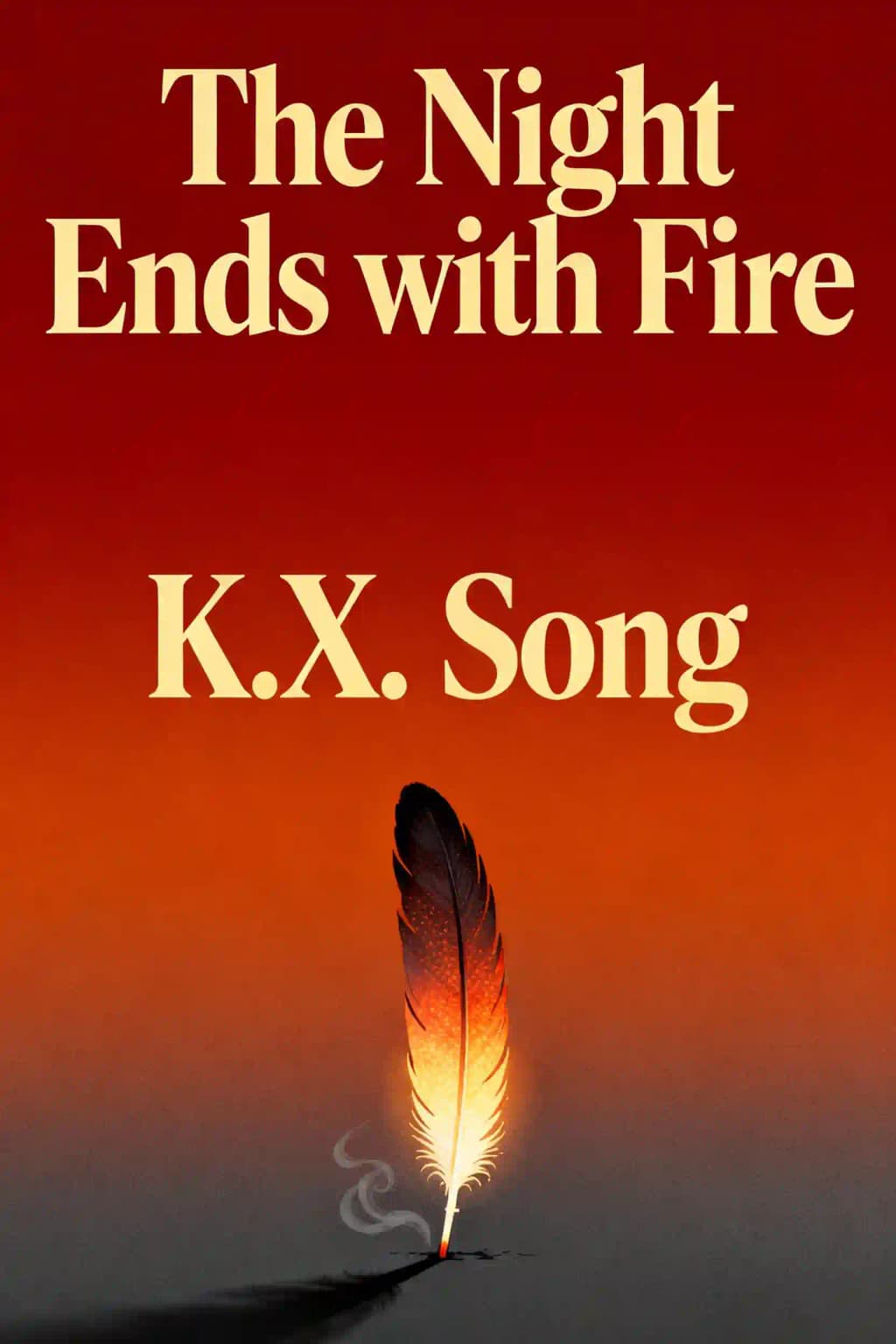
The novel's title - The Night Ends with Fire - suggests both destruction and illumination. Fire consumes but also provides light and warmth. Similarly, Meilin's ambition brings suffering but also clarity and purpose. The metaphor of night ending implies a new dawn, perhaps suggesting that Meilin's defiance, though personally costly, might help create a world where women's ambitions no longer require such sacrifices.
In her prison cell, Meilin understands precisely why society fears her: "A woman who can kill, think independently, and take power threatens their entire social order." This realization doesn't diminish her resolve but strengthens it. Her final vow - "I will never relent" - suggests that ambition's true value lies not necessarily in achievement but in the refusal to surrender one's authentic desires.
Through Meilin's journey, K.X. Song offers a nuanced exploration of female ambition in a world designed to suppress it. Neither glorifying ambition uncritically nor condemning it as hubris, the novel presents it as both burden and blessing - a complicated human drive that can lead to corruption but also to transformation and growth. In a world that still struggles with ambitious women, Meilin's story resonates as both historical fantasy and contemporary commentary on the ongoing fight for women to define themselves beyond society's limitations.