Capítulo 4
The Support Group in Room 204: Finding Community in Shared Fate
Room 204 at Connelly Academy becomes a sanctuary for those with short strings-a place where they can speak freely about their fears, frustrations, and hopes without the pitying or uncomfortable glances they receive elsewhere. This support group brings together an unlikely assembly of individuals united only by the length of their strings: Ben, an architect whose girlfriend left him after secretly checking his string; Maura, struggling to reconcile her shortened life with her relationship with Nina; Hank, a physician hiding the true brevity of his string; Lea, pregnant with twins she knows she won't see grow up; and others seeking connection in their shared circumstance.
The group evolves from a collection of strangers to a tight-knit community. They celebrate Lea's pregnancy with an impromptu baby shower, discuss celebrities suspected of having short strings, and debate philosophical questions about how to make meaning of their truncated lives. When Hank is killed trying to prevent an assassination attempt, they gather at his funeral, confronting the reality that his death is a preview of what awaits them all.
What makes this group so powerful is how it transforms isolation into solidarity. As Ben reflects during his first meeting: "It sucks to be us. But at least there is an us." In a world increasingly divided between long-stringers and short-stringers, Room 204 becomes a place where people can be defined by more than just the length of their strings-by their dreams, their fears, their personalities, and their connections.
The support group also becomes a space for philosophical exploration. Nihal discusses his Hindu parents' belief in reincarnation, which offers them comfort that his soul will continue after death. Ben shares his architectural philosophy of incorporating elements from demolished buildings into new designs-preserving memory through transformation. These conversations reveal how different cultural and personal frameworks help people make sense of mortality.
Through this community, Erlick shows how shared vulnerability can create profound bonds. The members of Room 204 don't just support each other through their shortened lives-they help each other live those lives more fully, finding meaning and even joy despite their circumstances.
Capítulo 5
The Politics of Predetermined Mortality: Discrimination and Resistance
As society fully acknowledges the reality of the strings, fear and prejudice emerge with alarming speed. Short-stringers face escalating discrimination across all aspects of life - denied jobs despite qualifications, refused housing applications, excluded from insurance coverage, and stripped of basic dignity based solely on their string length. Major corporations begin quietly implementing hiring policies that favor long-stringers, while landlords add subtle string-length requirements to rental applications. Politicians debate various "solutions" to what they term the "short-stringer issue," ranging from mandatory registration to segregated public spaces. Media outlets amplify this fear, sensationalizing isolated incidents of violence by short-stringers while downplaying similar incidents involving long-stringers.
Anthony Rollins, an ambitious presidential candidate initially polling in single digits, exemplifies this cynical exploitation of fear. After surviving an assassination attempt during which his security guard Hank (a short-stringer) sacrifices himself to save Rollins, his popularity skyrockets. Rather than honor Hank's sacrifice, Rollins leverages the incident to propose sweeping legislation targeting short-stringers. His signature policy, the Safety Through Advance Recognition (STAR) Initiative, bars short-stringers from serving in law enforcement, military leadership, and key government positions. He also champions laws preventing short-stringers from purchasing firearms, arguing they're more likely to act recklessly given their limited lifespans.
This systematic discrimination reveals humanity's deep-seated tendency to categorize and marginalize those perceived as "other." Long-stringers increasingly avoid social interaction with short-stringers, moving to exclusive neighborhoods and withdrawing their children from integrated schools. As Ben observes in a poignant letter to his sister, "Society has conditioned us to expect happiness as our birthright. The strings' random cruelty challenges this assumption, making it easier to believe short-stringers must somehow deserve their fate."
However, powerful resistance emerges through the "Strung Together" movement. Senator Wes Johnson, a short-stringer who refuses to hide his status, campaigns on a platform of radical equality, drawing massive crowds with his message that "a life's value isn't measured in years." Jack Hunter, Anthony's nephew and campaign manager, publicly breaks with his uncle, releasing damaging documents showing the campaign's deliberate exploitation of anti-short-stringer sentiment. Grassroots activists organize global demonstrations celebrating short-stringers' contributions, with massive video screens displaying their achievements: "Discovered cure for childhood leukemia," "Founded homeless shelter network," "Saved entire family from house fire."
Through this political dimension, Erlick draws devastating parallels to real-world discrimination based on characteristics beyond individual control. The strings become a powerful metaphor for any immutable aspect of identity that societies have historically used to divide and discriminate - race, gender, sexuality, disability, or socioeconomic status. By creating this fictional form of discrimination, she forces readers to confront how easily societies can normalize prejudice and how resistance requires both individual courage and collective action. The narrative suggests that building truly equitable communities demands not just legal equality but a fundamental shift in how we value human life and potential.
Capítulo 6
The Military Deception: Jack and Javier's Fateful Switch
One of the novel's most compelling storylines follows Jack Hunter and Javier Garcia, military academy roommates who face a moral dilemma when the STAR Initiative mandates string disclosure for service members. After measuring their strings, they discover Jack has a long string while Javier has a short one-meaning Javier would be barred from combat roles despite his superior abilities.
Jack, the reluctant scion of a prestigious military family, proposes they switch strings, arguing Javier deserves the opportunity he's earned. Though initially hesitant about the illegal deception, Javier agrees, driven by his ambition and desire to serve. This decision sets in motion a chain of events with far-reaching consequences.
The string switch becomes even more complicated when Anthony Rollins-Jack's uncle and the presidential candidate behind the STAR Initiative-publicly claims his nephew has a short string to gain political advantage. Jack, living with Javier's short string, is furious at being exploited by the very family member responsible for creating the policy that forced their deception.
Years later, the truth of their deception is revealed in the most tragic way possible. Javier, serving as a helicopter pilot, sacrifices himself to save wounded civilians, including Dr. Anika Singh. The army, believing him to be a long-stringer based on Jack's string, is baffled by his unexpected death. Javier leaves behind a letter explaining his decision to switch strings to serve his country more meaningfully.
Jack, who had been living aimlessly after requesting reassignment away from D.C., finally finds purpose in Javier's sacrifice. He brings a copy of Javi's letter to the Johnson Foundation, an organization fighting for short-stringer rights, hoping to expose the injustice of policies preventing brave short-stringers from serving and damage President Rollins' reelection campaign.
This storyline powerfully illustrates how arbitrary restrictions based on string length (or any immutable characteristic) deprive society of valuable contributions from talented individuals. Javier's heroism proves that the length of one's life has no bearing on one's courage, skill, or worth-a truth that challenges the very foundation of the discriminatory policies Anthony Rollins champions.
Capítulo 7
The Anonymous Letter Writers: Finding Connection Through Words
One of the novel's most tender subplots involves the anonymous correspondence between "A" and "B"-eventually revealed to be Amie (Nina's sister) and Ben. Their exchange begins when Ben leaves a letter in Room 204 at the school where Amie teaches, and she finds it while collecting materials from the classroom.
Their correspondence creates a safe space to express fears and hopes they struggle to voice elsewhere. Ben shares his experiences as a short-stringer, while Amie, who hasn't opened her box, contemplates what it means to live with or without knowledge of one's fate. Their letters become increasingly personal and philosophical, touching on questions of happiness, mortality, and how we measure a meaningful life.
What makes their correspondence so powerful is the freedom it provides from societal expectations and judgments. Without knowing each other's identities, they can be completely honest about their vulnerabilities. Ben admits his growing isolation as a short-stringer, while Amie confesses her discomfort with her own tendency to treat short-stringers as fragile and different.
When Ben eventually discovers Amie's identity-realizing she's Nina's sister whom he met while setting up an art project in Nina and Maura's apartment-he faces a dilemma. He's developed feelings for her both through their letters and their in-person interactions, but he knows his short string might make her hesitant to pursue a relationship. In a brave act of vulnerability, he writes her a final letter revealing his identity and his short-stringer status.
Amie struggles with this revelation, torn between her growing feelings for Ben and her fear of inevitable loss. During Nina and Maura's wedding reception, she imagines a future with Ben-scenes in Central Park, painting an apartment, marriage, children-but these visions are followed by darker ones of widowhood and single parenthood. A serendipitous moment hearing "Que Sera, Sera" from a passing cyclist gives her the courage to take a chance on their relationship despite her fears.
Their story culminates in marriage and children, building a normal family life despite their unusual circumstances. Though Ben dies as predicted by his string, their love story challenges the notion that relationships with predetermined endings are less worthy of pursuit. Their connection, formed first through words and ideas before physical attraction, demonstrates how authentic communication can bridge even the most difficult circumstances.
Capítulo 8
The Measure of a Life Well-Lived: Legacy and Memory
As the novel progresses toward its conclusion, it explores how we might measure the value of a life beyond its length. Through characters like Hank, who sacrifices himself to save others, and Javier, who dies rescuing wounded civilians, Erlick suggests that a life's worth lies not in its duration but in its impact.
This theme culminates in a powerful scene at the "Strung Together" global event celebrating short-stringers' accomplishments. Screens display tributes highlighting meaningful contributions: "Saved two hundred lives in surgery," "Raised three children on her own," and "Ran for president." Rather than the somber memorial Ben expected, the event becomes a joyful celebration of life and unity, with people worldwide coming together in recognition that the measure of a life transcends its temporal boundaries.
The novel further explores this theme through Ben's visit to the park where Hank died. There, he encounters a young woman who received Hank's donated lungs-a living testament that Hank's influence continues beyond his death. Similarly, when Nina delivers Maura's eulogy, she celebrates their decade together as a complete love story rather than one cut short, honoring Maura's legacy through the Johnson Foundation's continued work for short-stringer rights.
Perhaps the most poignant exploration of legacy comes through the tree sculpture at the exhibition commissioned by Strung Together. Made from five hundred donated strings with names inscribed on its base, the sculpture treats all strings equally regardless of length. As the artist explains, it serves as a testament that these humans "were here"-that their existence mattered regardless of its duration.
Through these various expressions of legacy, Erlick challenges readers to reconsider how we measure the value of a life. If not by years, then by what? By relationships formed? By lives touched? By work created? By courage shown in the face of adversity? The novel suggests that perhaps the true measure of our lives lies not in their length but in their depth-in how fully we engage with our time, however much or little we may have.
Capítulo 9
Living with Uncertainty: The Choice to Know or Not Know
Throughout the novel, characters face a fundamental choice: to open their boxes and know their fate, or to leave them closed and embrace uncertainty. This decision represents different philosophical approaches to life itself.
Nina and Maura choose to know, facing the difficult truth of Maura's shorter string. Their knowledge shapes their decisions-prompting their marriage and trip to Venice-but also casts a shadow over their relationship. Ben likewise opens his box, discovering his string will end in his mid-forties. This knowledge costs him his relationship with Claire but eventually leads him to Amie and a life lived with purpose and intention.
In contrast, Amie initially refuses to open her box, preferring to focus on life's ordinary pleasures rather than its endpoint. She explains to Nina: "I'd rather live my life not knowing when it will end, just like people have been doing since the beginning of time." Her choice represents a more traditional relationship with mortality-accepting its inevitability without seeking to quantify it.
The Italian mask shop owner in Venice offers yet another perspective when he reveals many Italians chose not to look at their strings, explaining they already prioritized "art, food, passion and family-we did not need the strings to tell us what is most important." His comment suggests that perhaps the strings merely accelerate a process of prioritization that a well-lived life already includes.
By the novel's conclusion, a poll shows more people choosing not to view their strings, suggesting a cultural shift toward embracing uncertainty. As Nina reflects, perhaps the length doesn't matter-that while beginning and end may be predetermined, the middle remains ours to shape.
This tension between knowledge and uncertainty speaks to fundamental questions about human existence. Is it better to know what's coming and prepare accordingly, or does uncertainty preserve hope and possibility? The novel offers no definitive answer, instead suggesting that either choice can lead to a meaningful life if approached with intention and courage.
Capítulo 10
The Inheritance of Hope: Future Generations and Lasting Change
The novel's epilogue, set several years after the main events, offers a glimpse of how society continues to evolve in response to the strings. Though discrimination persists, the initial panic about short-stringers has largely faded. The Johnson Foundation continues its work for equality, and former president Rollins rarely appears in the news.
Nina, now raising her sister's children after Amie and Ben die in a car accident, wears Maura's two-string pin daily as a talisman. Watching children play together in the park, she wonders if this generation might retain their natural empathy into adulthood, suggesting hope for a more equitable future.
This forward-looking perspective is reinforced by the revelation that future generations will view the boxes as mere history, just as Nina's grandparents spoke of WWII. The strings become not an ongoing crisis but a historical event that shaped society before being integrated into its fabric.
The novel's final message is one of cautious optimism. Though the strings revealed harsh truths about mortality and exposed humanity's capacity for discrimination, they also inspired movements for equality, deepened relationships, and prompted many to live more intentionally. As Nina considers living more boldly despite her long string, embracing the unexpected with her newfound family, she embodies this hopeful perspective-that even in a world where death is predetermined, life remains ours to shape.
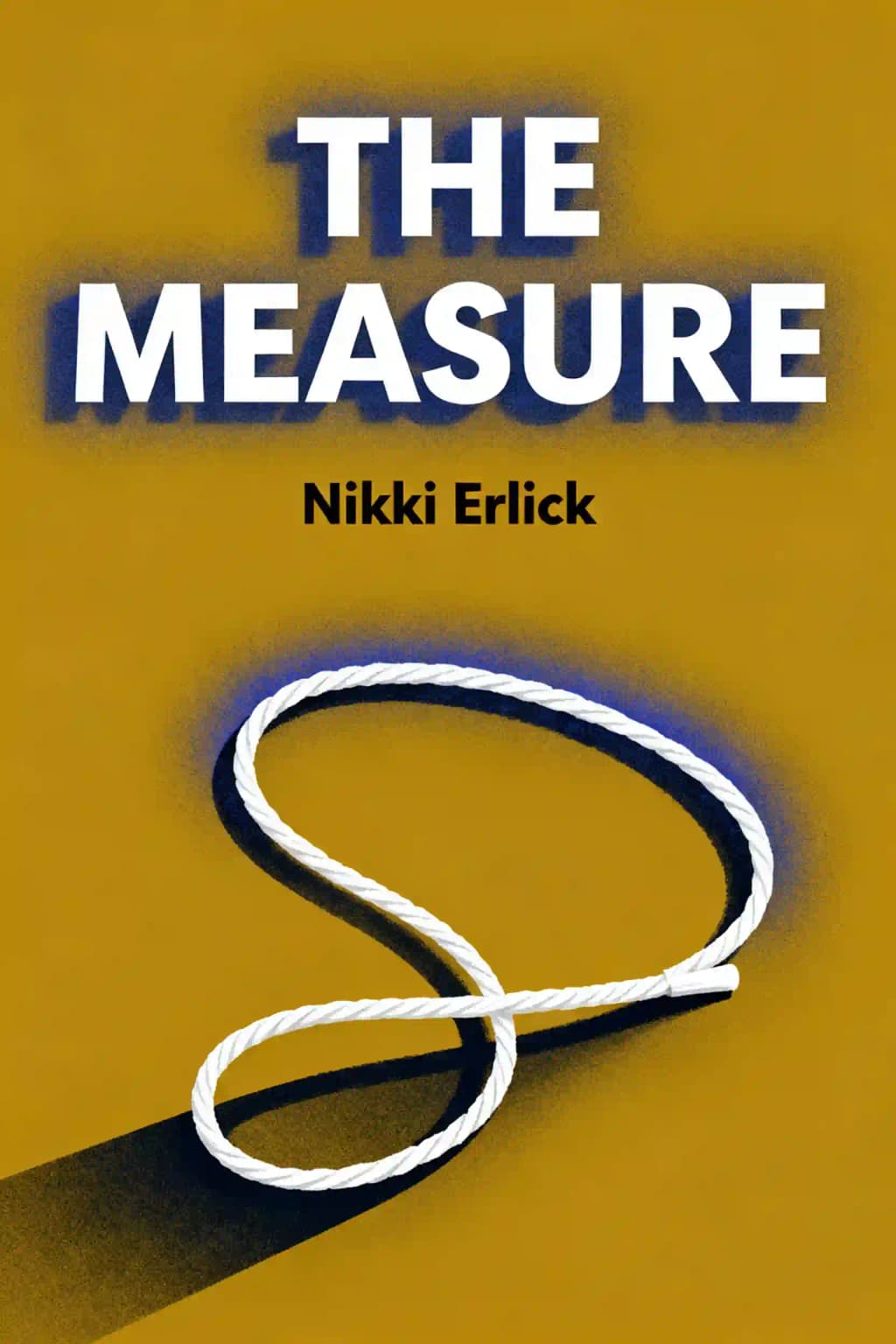
Erlick leaves us with a profound question: If we knew exactly how much time we had, would we live differently? And if so, why wait for such knowledge to live with purpose, connection, and courage? Perhaps the true gift of "The Measure" is that it prompts us to consider how we might measure our own lives-not in years, but in love given, courage shown, and meaning created in whatever time we have.