Capítulo 1
The Power Shift: How Managers Became the New Ruling Class
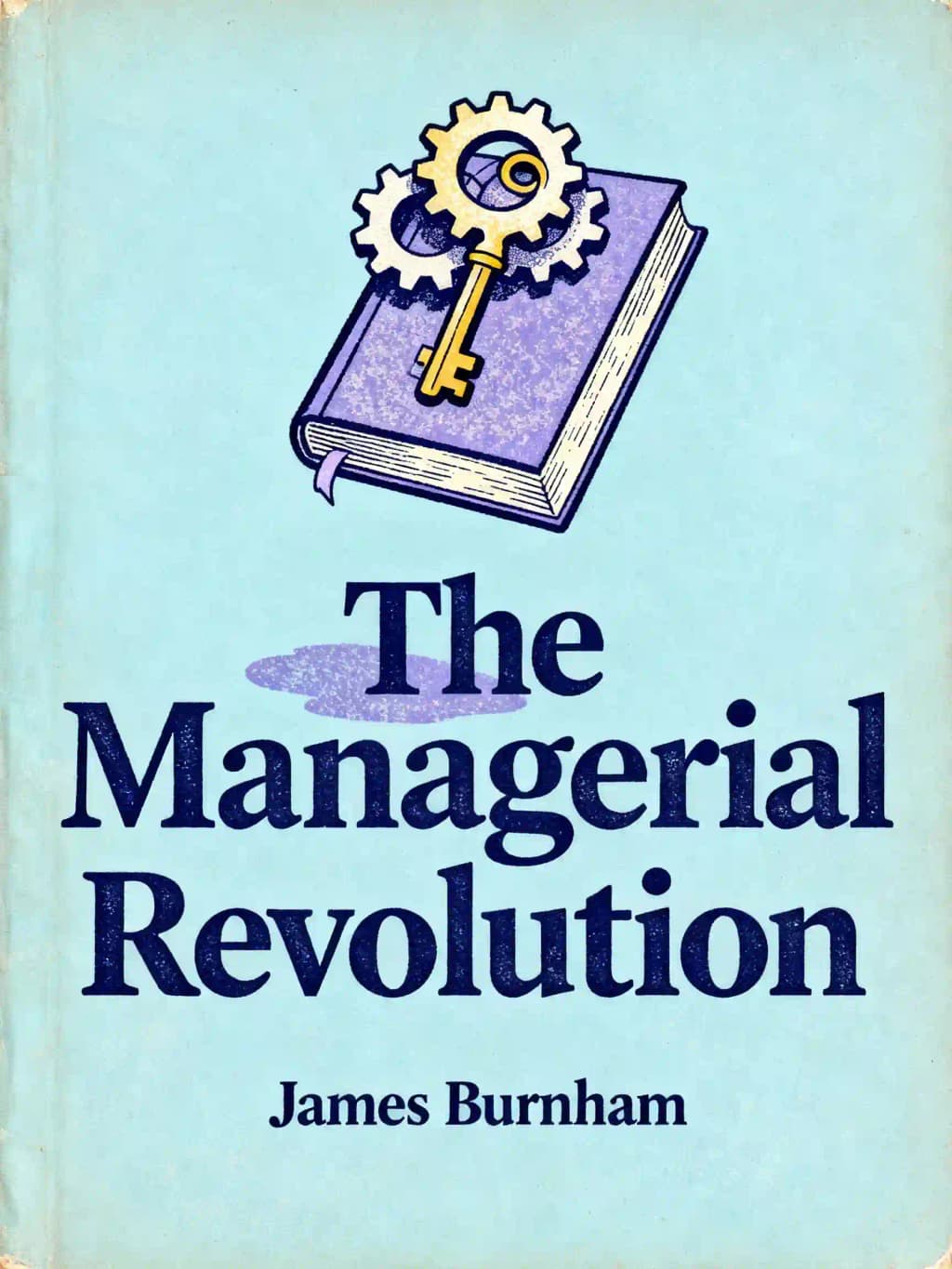
When James Burnham published "The Managerial Revolution" in 1941, it was a seismic challenge to prevailing political thought. Endorsed by George Orwell (who drew heavily from it for his dystopian masterpiece "1984"), the book predicted neither capitalism's triumph nor socialism's rise, but something altogether different-the emergence of managers as society's new ruling class. This prescient work anticipated the rise of technocratic governance decades before terms like "the administrative state" entered common discourse. Despite being out of print for years, its influence persists among political theorists across the spectrum. Interestingly, both Steve Bannon and progressive critics of corporate power have cited Burnham's analysis, recognizing how accurately he foresaw our current reality where technical expertise increasingly trumps both democratic will and capitalist ownership. As we navigate today's complex landscape of corporate-government fusion, Burnham's insights remain startlingly relevant, explaining why neither pure free markets nor traditional socialism materialized as expected.
Capítulo 2
The End of Capitalism As We Knew It
The world we inhabited from the Renaissance until roughly 1914 was unmistakably capitalist in structure. This economic system was characterized by several distinct features: production was commodity-based, with goods valued through monetary exchange; money functioned not just as a medium of exchange but crucially as capital that generated profit; production was driven by profit rather than human need; and economic activity was regulated primarily by market forces rather than conscious planning.
Politically, capitalism organized itself into national states with defined boundaries-a sharp departure from medieval feudalism's personal vassalage relationships. These states maintained limited authority, primarily enforcing property rights while avoiding extensive economic intervention. Parliament emerged as the locus of sovereignty, representing bourgeois interests against older aristocratic power centers.
The ideological foundation of capitalism rested on individualism, private initiative, natural rights (especially property rights), and the concept of progress. These beliefs weren't merely abstract principles but functional tools that justified capitalist dominance while appealing to broader populations. The bourgeoisie-those who owned the means of production-occupied the position of greatest social power and privilege.
But this system has been unraveling since World War I. The evidence is overwhelming: persistent mass unemployment, intensifying economic crises, unmanageable public and private debt, market breakdowns, permanent agricultural depression, idle investment funds, colonial management failures, technological stagnation, and ideological impotence. When millions of youth show no enthusiasm for defending "democracy" against fascism, when capitalists themselves lose faith in their system (as demonstrated at Munich), when economic recovery requires ever-greater state intervention-these are unmistakable signs of a dying social order.
The belief that capitalism will continue indefinitely rests on two false assumptions: that society has always been capitalist (when capitalism has existed for only a tiny fragment of human history), and that capitalism has some necessary correlation with human nature (when humans have adapted to dozens of social systems). The evidence points to capitalism's imminent disappearance, likely within decades or even years.
Capítulo 3
Why Socialism Never Arrived
For decades, many believed that socialism would replace capitalism. This expectation, held by socialists, communists, and even many capitalists themselves, seemed logical: as capitalism collapsed, the working class would seize power, abolish private property, and establish a classless, democratic, international society.
However, this theory has proven false. The Russian Revolution of 1917 provided the perfect test case. The Bolsheviks took power with worker support and abolished private property rights in production instruments-supposedly the crucial conditions for socialism's advance. Yet Russia developed in precisely the opposite direction. Instead of moving toward classlessness, freedom, and internationalism, it created a new class stratification with sharper income inequality than the United States, established history's most extreme autocracy, and embraced nationalism exceeding anything under the Czars.
The expected socialist revolution failed to materialize elsewhere, despite ideal conditions in the post-WWI era. Germany, the Balkans, and China all saw attempted revolutions collapse. The working class, presumed carrier of socialism, proved unable to take power even when capitalist nations lay in shambles, workers had arms in their hands, and Russia's example stood before them.
Most damning of all, the Russian experience conclusively proved that abolishing capitalist property rights does not guarantee socialism. These rights were eliminated in 1918, yet socialism never emerged. This undermines the central belief of socialist theory-that eliminating capitalist property automatically leads to classlessness and freedom.
The working class's position has deteriorated significantly. Marx predicted the "proletarianization" of most of society, but this never occurred as predicted. Agriculture resisted reduction to capitalist relations; small independent producers persisted; and a "new middle class" of salaried executives, engineers, managers, and bureaucrats grew significantly. Workers faced unemployment, deskilling, and diminished revolutionary potential as production became tied to specialized planning skills.
Meanwhile, Marxist parties collapsed worldwide-either failing socialism or abandoning it. Germany's massive Marxist movement surrendered to Hitler without resistance. Reformist Marxist parties that administered governments uniformly failed to introduce socialism. The scientific pretensions of Marxism were exposed by increased historical knowledge and clearer understanding of scientific method. Most tellingly, Marxist ideology lost its power to move the masses, especially youth who no longer responded to socialist calls.
Capítulo 4
The Struggle for Power: How Ruling Classes Rise and Fall
Throughout history, social power has been fundamentally rooted in control over the instruments of production. In all complex societies, from ancient civilizations to modern nations, a small minority has maintained control of these instruments through elaborate systems of property rights, which guarantee them preferential treatment in the distribution of society's wealth. This controlling group constitutes the ruling class - taking different forms across eras, from feudal lords who dominated medieval society to capitalists who emerged as the dominant force in modern times.
The bourgeoisie's historical rise against feudal lords presents a fascinating case study in class transformation. Rather than a coordinated campaign, it was a gradual, often unconscious process spanning centuries. Two critical factors enabled their ascent: First, the devastating European wars of the 14th-17th centuries that broke feudal lords' military power and depleted their resources. Second, the emergence of new ideologies - from Protestant theology to Enlightenment philosophy - that systematically undermined feudalism's moral and intellectual foundations. The bourgeoisie rarely engaged directly in either warfare or intellectual discourse. Instead, they strategically financed mercenary armies, supported peasant revolts, and patronized scholars, intellectuals, and legal experts who did the actual fighting and theoretical work. While these various participants fought for diverse motives - religious freedom, political rights, or personal gain - the ultimate beneficiary was the capitalist class.
The bourgeoisie's rise was particularly effective because they built their dominance gradually within the existing feudal system. They steadily expanded control over commerce, banking, and early manufacturing, even while formal feudal structures remained intact. This expansion was possible because medieval society, despite its rigid hierarchies, granted merchants and early capitalists sufficient legal rights to conduct business enterprises, even when these activities contradicted traditional feudal principles. By the time feudal lords fully recognized the threat to their power, capitalists had already secured control over society's key economic and institutional bastions.
The proletariat's attempt to replicate this success faced a fundamental structural obstacle. Unlike the bourgeoisie, who could gradually build economic power within feudalism, workers had no comparable opportunity within capitalism. They couldn't incrementally extend control over production instruments because they possessed virtually no property rights to build upon. Trade unions, despite early Marxist hopes, ultimately operated within capitalist economic relations rather than providing a foundation from which workers might advance to social dominance. Their gains, while significant for workers' welfare, didn't fundamentally alter the power structure.
A particularly revealing aspect of this transition was that many early capitalists actually emerged from the feudal ruling class itself. Forward-thinking lords adapted to changing economic conditions by investing in trade, manufacturing, and banking, effectively transforming themselves into capitalists. This demonstrates a crucial pattern: when one ruling class is displaced, individual members of the old order often appear prominently in the new ruling class, having economically and socially transformed themselves. This pattern would later repeat itself during the managerial revolution of the 20th century, as traditional capitalist families adapted to new corporate structures and professional management systems.
Capítulo 5
The Theory of the Managerial Revolution
We are witnessing a period of social transition characterized by an unusually rapid rate of change in important economic, social, political, and cultural institutions. This transition is from capitalist society to managerial society. Unlike the lengthy transition from feudalism to capitalism, which took several centuries, this period may be relatively short-perhaps fifty years from the first world war. The acceleration of this change can be attributed to technological advancement, increased global connectivity, and the complexities of modern industrial organization.
The managers-those who organize and coordinate the technical processes of production-are driving for social dominance, for power and privilege, for the position of ruling class. These individuals include corporate executives, technical specialists, bureaucratic administrators, and industrial experts who possess the specialized knowledge required to run complex organizations. This drive is worldwide, though at different stages of development in different nations. In advanced industrial economies, the process is more evident, while developing nations are experiencing the early stages of this transformation. At the conclusion of the transition period, the managers will have achieved social dominance as society's ruling class, supplanting both traditional capitalists and political elites.
The economic framework of managerial dominance will be based upon state ownership of major production instruments, including factories, transportation systems, communication networks, and financial institutions. Within this framework, there will be no direct property rights in these instruments vested in individuals, marking a fundamental shift from traditional capitalism. The managers will exercise control over production and gain preference in distribution not through individual property rights, but indirectly through their control of the state which owns the production instruments. This control manifests through their technical expertise, organizational capacity, and ability to navigate complex bureaucratic systems. The state will effectively be the "property" of the managers, placing them in the position of ruling class, with their power derived from their operational control rather than legal ownership.
The ideologies expressing the social role and interests of the managers haven't yet been fully developed, just as bourgeois ideologies weren't complete during the transition to capitalism. However, they're already approximated by several political and economic movements: Leninism-Stalinism, with its emphasis on central planning and technical expertise; fascism-nazism, which stressed state control of industry while maintaining private ownership; and at a more primitive level by New Dealism and technocracy, which advocate for increased government intervention and technical solutions to social problems. These ideologies share common elements: emphasis on planning, efficiency, and technical expertise over market forces. Most intellectuals developing these ideologies aren't aware they're contributing to managerial power-they believe they speak for truth and humanity's interests, much as early capitalist theorists believed they were promoting universal natural rights rather than class interests.
This transformation is evident in the rising importance of professional management education, the growth of regulatory bureaucracies, and the increasing complexity of organizational structures that require specialized management skills to navigate effectively.
Capítulo 6
The Rise of the Managerial Class
Managers are defined not by individual identity but by function-specifically, their relationship to production instruments. While it might seem obvious that in capitalist society the capitalists would manage production, this function has increasingly shifted away from capitalists, proving society is moving from capitalism and that capitalists are losing their status as ruling class.
Modern industry involves highly complex technical organization requiring specialized functions. Among these, management-organizing and coordinating diverse materials, tools, machines, plants, and workers-has become increasingly crucial. In early capitalism, technical management wasn't essential as production processes were simple enough that anyone reasonably acquainted with the industry could handle them. The typical early capitalist was his own manager. But technological development and large-scale public corporations have virtually eliminated this arrangement from important economic sectors.
In a typical corporation, four distinct functional groups can be identified: (1) Managers who organize the actual technical process of production; (2) Finance-executives focused on profit, sales, and costs; (3) Finance-capitalists concerned with financial aspects across multiple companies; and (4) Passive stockholders whose only right is receiving dividends. While these functions could theoretically be performed by the same individuals (as in early capitalism), they're now increasingly separated.
Crucially, only the management function is technically necessary for production-the other functions, particularly those related to profit-making and ownership, are dispensable from a purely technical standpoint. This separation creates major conflicts: each group naturally strives to improve its position, often at others' expense; each faces different pressures from the masses; and each develops different "occupational biases" in problem-solving approaches. Most critically, managers' positions depend on production processes, not capitalist property relations, while finance-capitalists' existence depends entirely on preserving capitalism.
The shift of control from capitalists to managers may seem absurd when considering the immense wealth of the "Sixty Families" and their luxurious lifestyles. Yet this mirrors how feudal lords appeared unassailable before merchants gradually took control. The process is underway but incomplete-the big bourgeoisie remains the ruling class in the United States, but a worldwide transformation is occurring.
Capítulo 7
The Managerial Revolution in Action
The rise of the bourgeoisie historically meant progressively reducing greater percentages of production to capitalist economic relations. This extension continued steadily from the Middle Ages until the first world war in 1914, when the curve of capitalist control abruptly broke downward. Russia's revolution removed one-sixth of the earth's surface from capitalist hands, while Italy and Germany moved toward eliminating capitalist control entirely. This shift represented not just a geographical reduction in capitalist influence, but a fundamental challenge to the assumption that capitalism was the inevitable endpoint of economic development.
In the United States, the big capitalist families - the Rockefellers, Morgans, and their peers - still maintain preferential treatment in distribution, living in unprecedented luxury. Their wealth manifests in vast estates, private art collections, and exclusive social circles that remain largely closed to outsiders. However, their control over production has diminished significantly. Many have withdrawn from active economic participation altogether, spending time on yachts, beaches, and in charitable activities rather than industry. This withdrawal has necessitated managers assuming more power over production processes, with professional executives increasingly making the crucial decisions that shape corporate strategy and operations.
While many managers might aspire to become the new big bourgeoisie, this is no longer possible within the modern economic framework. The conditions of contemporary capitalism no longer permit building vast aggregates of wealth like those held by the established families. Since the end of the first world war, there has been only a single change in the listing of first-rank capitalist families in America - a stark contrast to the regular emergence of new industrial fortunes in the 19th century. The inability of a ruling class to assimilate fresh blood is a recognized symptom of that class's approaching downfall, as seen in historical examples from the Roman patricians to European nobility.
The extension of government into the economy takes two distinct but interrelated forms. First, government takes over entire economic sectors, both acquiring established ones and developing new ones. This includes utilities, transportation infrastructure, and communications networks. Second, government increasingly controls more parts of the economy through commissions, bureaus, and agencies that regulate countless economic activities - from securities trading to labor relations, from environmental standards to consumer protection. These governmental controls impose restrictions on capitalist property rights, removing controlled functions from market forces and subjecting them to bureaucratic oversight. The actual direction of government-owned or controlled enterprises falls to managers - the men and women of bureaus and commissions who do the directing work. These technical experts and administrators, rather than traditional capitalists, increasingly determine how resources are allocated and how enterprises are run, marking a fundamental shift in economic power relations.
This transformation represents not just a change in personnel but a structural revolution in how economic decisions are made and implemented, with profound implications for the future of capitalism and social organization.
Capítulo 8
The Economy and Politics of Managerial Society
In a managerial economy, government enterprises are fundamentally different from capitalist ones-their products aren't subject to market laws, aren't necessarily "commodities" in the capitalist sense, and their distribution isn't determined by capitalist property relations. As government ownership and control progressively expands, the capitalist base narrows. When major production instruments come under governmental control, the transition to managerial society is complete.
Neither "state capitalism" nor "state socialism" accurately describes this emerging system. It can't be capitalism because there are no capitalists-ownership is vested in the state, not individuals, and no one can use money as capital to start profit-making businesses. Similarly, it's not socialism because the developing state-owned economy won't be classless. The managers who control the state will constitute a new ruling class with special rights to production instruments and preferential distribution of products.
The managerial economy will feature exploitation through corporate rather than individual means. Just as priest-groups in history controlled wealth and power as a functional group, managers will exploit society as a corporate body. Their rights belong to them not through individual ownership, but through their directing positions. Through privilege, power, and control of education, they'll regulate their membership, achieving continuity across generations.
State ownership provides the framework for managerial dominance-indeed, it's the only economic structure through which managers can consolidate power. Within capitalism, managers' power remains limited by owners who can fire them, by profit-dominated markets, and by inefficient industrial coordination. Only fusion of economy with state offers both a workable structure after capitalism's breakdown and the means to establish managers as the ruling class.
Politically, sovereignty is shifting from parliaments (the typical political institution of capitalism) to administrative boards, commissions, and bureaus. Russia's experience is instructive-after the 1917 revolution, the Soviet Congress initially claimed sovereignty, but within a few years had lost all attributes of power. Sovereignty shifted to key party institutions and administrative bodies, which became recognized as the lawmaking institutions of the new society.
Capítulo 9
Totalitarianism and the World Order
Totalitarianism distinguishes itself from previous dictatorships by controlling all aspects of life-not merely political actions, but business, art, science, education, religion, recreation, and morality. Such extensive control would have been impossible before modern technology, especially rapid communication and transportation.
History shows that dictatorships commonly emerge during periods of social crisis and major transition. The present era parallels the transition from feudalism to capitalism in the 16th-17th centuries, when dictators like Francis I, Charles V, and Henry VIII used methods strikingly similar to contemporary dictators-expropriation, political trials, loyalty oaths, and mass persecution.
The managers face a triple battle: against capitalists tied to the decaying order, against masses who resist class rule, and against each other for dominance. During this transition, political rule concentrates under dictatorship. But once transition is accomplished and conditions change-capitalists eliminated, new institutions consolidated, and masses controlled through both suppression and new ideologies-historical analogy suggests totalitarianism will give way to a democratic phase.
This managerial democracy, however, won't resemble capitalist democracy. The centralized economic structure creates obstacles to genuine opposition, which needs an independent institutional base to resist elimination. Democracy might function through non-parliamentary mechanisms, with political opposition localized in institutions like syndicates, cooperatives, and technical associations that would effectively become opposition parties while maintaining the fiction of a one-party system.
Globally, the capitalist system of many sovereign nations is being replaced by three super-states centered on Europe, Asia, and America. Despite American rhetoric about international law and rights of small nations, the evidence suggests a different future. Few serious persons believe Europe will again be divided into numerous sovereign nations, each with independent border guards, tariffs, currencies, armies, and bureaucracies. Even British propagandists now speak of a "United States of Europe"-a consolidation in which participating states necessarily surrender sovereignty rights.
Capítulo 10
The Future of America and the World
The United States constitutes naturally the nucleus of one of the great super-states of the future. From its continental base, it must bid for maximum world power against other super-states or face political suicide. This perspective follows three stages: consolidation of the main strategic base through internal measures; protective extension through "hemisphere defense" to eliminate independent sovereignty in neighboring nations; and bidding for world power against European and Asiatic central areas.
Capitalism cannot hold its own in these conflicts. It cannot compete economically against managerial organization, as shown in South America where "private initiative" fails against controlled managerial methods. Adequate arming is no longer profitable to capitalism, as demonstrated by France and England's failures and America's struggling armament program. The obstacles are not ill will or incompetence but capitalist institutions themselves: owners requiring adequate profit, autonomous trade unions with strike rights, market-influenced price changes, and limited governmental structure.
Despite apparent concessions to capitalists for "national defense," the United States will shift more rapidly toward managerial social structure. Modern total war is not profitable for capitalism, and consequently capitalism cannot adequately fight it. Even apparent concessions decrease capitalist owners' control while shifting power to managers in and out of government.
The American pattern of managerial development is closer to the German than Russian model, due to similar industrial advancement and existing trained managerial groups. However, unlike Germany which made its break six years before the war, the American crisis is developing during wartime itself. The United States must simultaneously address all three managerial problems: reducing capitalist power, controlling the masses, and competing with other managerial powers.
The managerial revolution is not a conspiracy but emerges naturally as private enterprise fails to maintain production, as war demands economic coordination, as investment dries up, and as unemployment grows. The state intervenes because it appears to offer the only solution to these mounting problems. Whether this constitutes "progress" is another question entirely-each social organization brings its distinctive goods and evils. What is certain is that the world is moving inexorably toward managerial society, with profound implications for how we live, work, and govern ourselves in the decades to come.