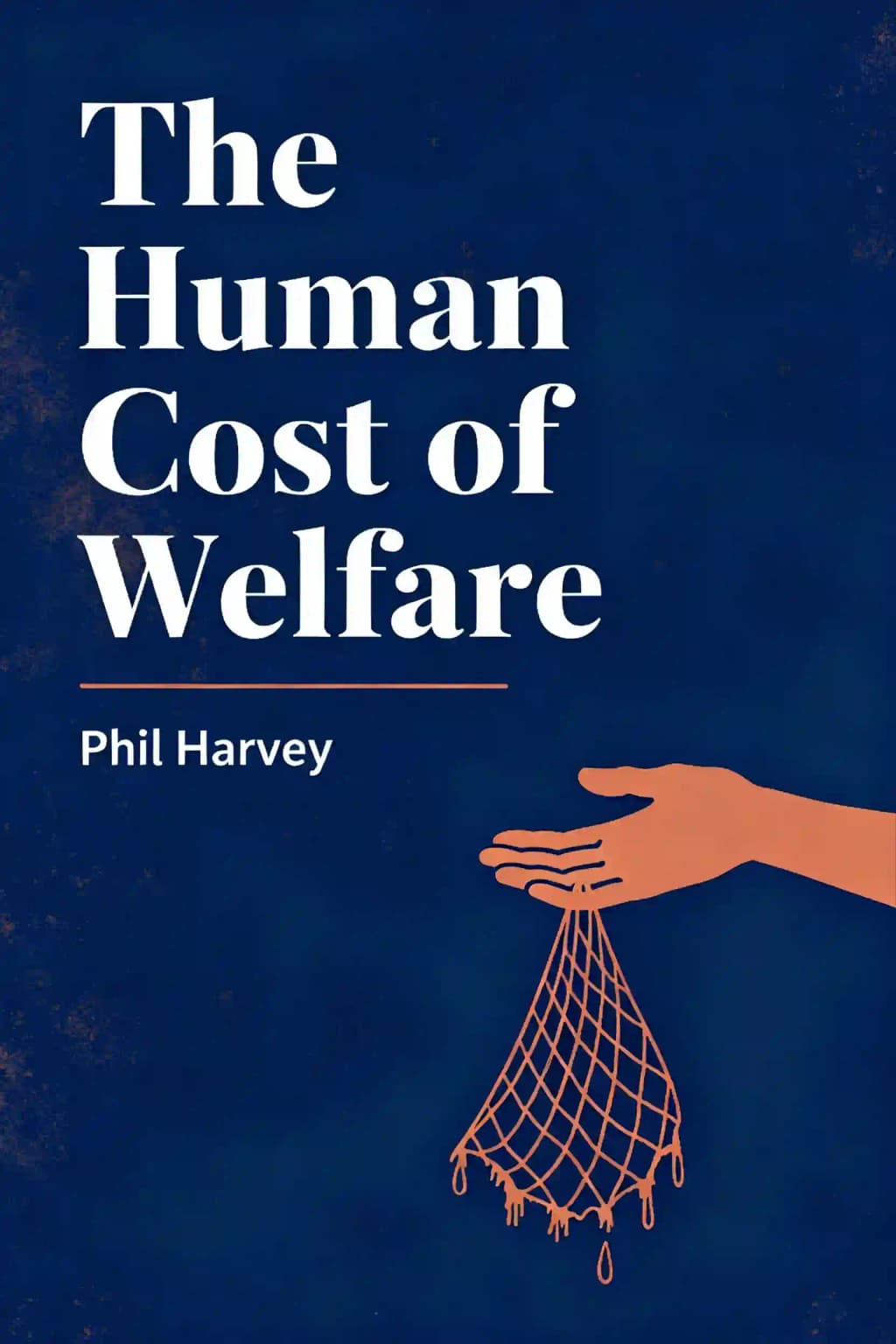
The human cost of welfare
how the system hurts the people it's supposed to help
Visão geral de The human cost of welfare
"The Human Cost of Welfare" exposes how America's welfare system traps recipients in dependency. Endorsed by former governor Gary Johnson, this eye-opening investigation features stories from 100+ welfare recipients, revealing counterintuitive truths about programs designed to help but often harm those most vulnerable.

Temas principais em The human cost of welfare
- welfare trap
- work disincentives
- government dependency
- psychology of work
- poverty cliff
Citações de The human cost of welfare
I have to work or I'd go crazy.
The money doesn't go to the kid.
Washington State has better benefits so I moved here.
I would much rather be working, at any job, than living the way I live right now.
We effectively pay people to stay poor.
Personagens de The human cost of welfare
- Phil HarveyCo-author and researcher of welfare policy
- Lisa ConyersCo-author who interviewed welfare recipients
- CoraTeacher on the Pine Ridge Reservation
- MartaHomeless woman in Brooklyn working informally
- TerryResident of a Seattle homeless encampment
Baixar resumo de The human cost of welfare
Obtenha o resumo de The human cost of welfare como PDF ou EPUB gratuito. Imprima ou leia offline a qualquer momento.
Perguntas Frequentes Sobre Este Livro
The Human Cost of Welfare critiques traditional welfare systems through a libertarian lens, arguing they often perpetuate dependency and bureaucratic inefficiency. Harvey examines unintended consequences like reduced personal agency and economic stagnation, advocating for market-driven solutions that prioritize individual empowerment over state control. The book combines empirical analysis with case studies to challenge assumptions about poverty alleviation.
Policymakers, economists, and readers interested in libertarian critiques of social systems will find this book provocative. It’s also relevant for advocates of welfare reform or those studying the intersection of government programs and individual freedom. Harvey’s accessible style makes complex socioeconomic concepts approachable for general audiences.
Yes, for its bold exploration of welfare’s unintended harms and alternatives like decentralized aid models. While controversial, Harvey’s data-driven approach and decades of philanthropic experience lend credibility. Critics argue it oversimplifies systemic inequality, but the book sparks critical dialogue about balancing compassion and self-reliance.
- Dependency Cycle: Prolonged welfare eligibility discourages workforce participation.
- Bureaucratic Waste: Administrative costs dilute aid effectiveness.
- Market Solutions: Tax incentives and private charities outperform state programs.
- Human Dignity: Top-down systems undermine personal accountability and resilience.
Harvey analyzes failed welfare expansions in 1980s India and post-2008 U.S. stimulus packages to show how poorly designed aid exacerbates poverty. He contrasts these with successful microfinance initiatives in Bangladesh and Chile, emphasizing localized, conditional support.
- Replace universal entitlements with means-tested vouchers
- Expand tax credits for low-income workers
- Deregulate nonprofit sectors to boost charitable innovation
- Implement time limits on benefits to incentivize self-sufficiency
Unlike Murray’s Losing Ground (focused on cultural factors), Harvey stresses institutional redesign. It aligns with Sowell’s Basic Economics on market efficiency but adds firsthand philanthropic insights from Harvey’s CARE and DKT International work.
Progressives argue it underestimates structural barriers like racism and wage stagnation. Others claim Harvey’s corporate philanthropy background (e.g., Adam & Eve) conflicts with his anti-statist stance. The book’s narrow focus on economic metrics also draws fire for neglecting emotional safety nets.
With AI displacing low-wage jobs and universal basic income debates intensifying, Harvey’s warnings about perverse incentives resonate. The book’s framework helps evaluate emerging policies like gig-worker protections or conditional cryptocurrency aid programs.
- “Aid should be a ladder, not a hammock”.
- “Systems that distrust human ingenuity inevitably fail humans”.
- “The state’s compassion is often just thinly veiled control”.
Harvey’s leadership at Population Services International and DKT International shaped his focus on scalable, dignity-preserving aid. His libertarian advocacy against censorship (via Adam & Eve’s legal battles) mirrors his distrust of centralized power.
- Matthew Desmond’s Poverty, By America (pro-welfare expansion counterpoint)
- Charles Murray’s By the People (libertarian governance principles)
- Esther Duflo’s Good Economics for Hard Times (empirical policy analysis)