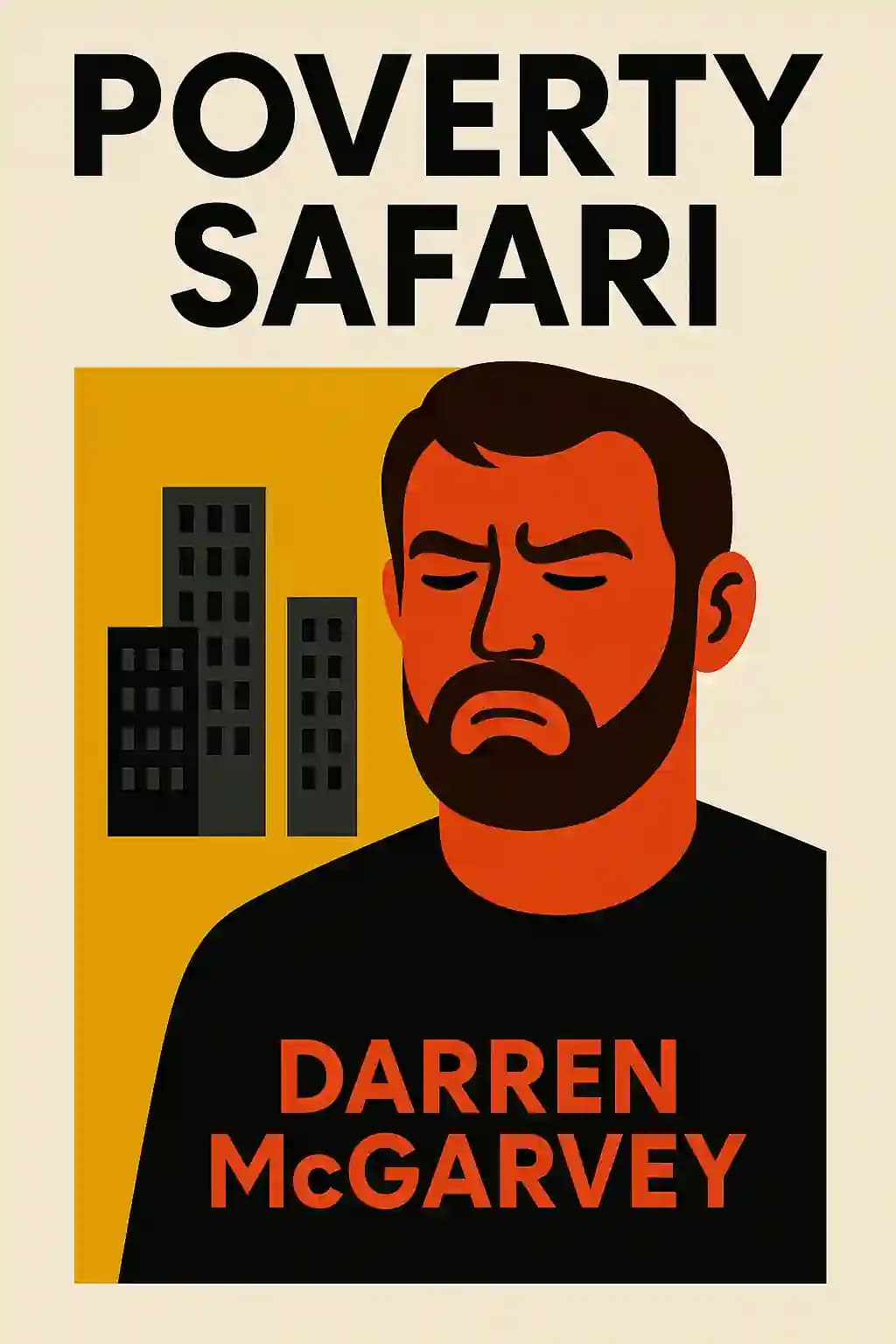
Darren McGarvey's Orwell Prize-winning memoir explores Britain's poverty crisis through lived experience. J.K. Rowling called it "savage, wise, and necessary" - a raw safari through inequality that challenges both left and right while revealing why understanding anger might be our only salvation.
Darren McGarvey, bestselling author of Poverty Safari: Understanding the Anger of Britain’s Underclass, is a Scottish social commentator and activist renowned for his incisive analysis of poverty, addiction, and social inequality. Born and raised in Pollok, Glasgow, McGarvey draws on his lived experience of growing up in an impoverished community marked by family trauma and substance abuse to craft this Orwell Prize-winning memoir. A former rapper under the stage name Loki, he blends raw personal narrative with political critique, offering a ground-level perspective on systemic deprivation.
McGarvey’s authority extends beyond literature. He created award-winning BBC documentaries like Addictions and Class Wars, earning a BAFTA Scotland Award and RTS Scotland recognition.
His follow-up book, The Social Distance Between Us (2022), further examines Britain’s class divides, while his upcoming Trauma Industrial Complex explores modern oversharing culture. As a 2023 Fellow of the Royal Society of Literature and former rapper-in-residence for Scotland’s Violence Reduction Unit, McGarvey bridges activism, media, and academia. Poverty Safari became a Sunday Times bestseller, cementing his status as a vital voice on social justice.
Poverty Safari explores poverty as a multidimensional crisis involving emotional trauma, systemic inequality, and cultural marginalization. Darren McGarvey combines memoir and social commentary to argue poverty isn’t just financial deprivation but a cycle of addiction, abuse, and exclusion. He critiques political narratives while advocating for grassroots change and personal accountability.
This book is essential for policymakers, social workers, and readers interested in social justice. McGarvey’s raw, firsthand account offers insights for those seeking to understand poverty’s psychological toll and systemic roots. It’s particularly valuable for advocates of community-led solutions and critics of oversimplified political discourse.
Key themes include:
McGarvey defines poverty as an “emotional reality” involving anger, shame, and powerlessness, not just income inequality. He emphasizes its roots in childhood trauma, addiction, and societal neglect, arguing it’s a cultural condition shaped by political and economic systems.
McGarvey advocates for:
McGarvey details his struggles with substance abuse, linking addiction to poverty’s stress and hopelessness. He argues addiction is both a coping mechanism and a societal failure, advocating for holistic support systems over punitive measures.
Some argue McGarvey overemphasizes personal responsibility, potentially absolving structural inequities. Others praise his balance but question if systemic change can occur without broader political reforms.
Unlike academic studies, McGarvey blends memoir and polemic, offering visceral storytelling over data-driven analysis. It complements Matthew Desmond’s Evicted but prioritizes emotional resonance over policy specifics.
With rising inequality and mental health crises, the book’s focus on trauma-informed policymaking resonates. Its critique of divisive political rhetoric remains pertinent in debates about welfare reform and social justice.
The book won the 2018 Orwell Prize for political writing, cementing McGarvey’s reputation as a leading social commentator. It also became a Sunday Times bestseller, broadening its impact.
Raised in Glasgow’s Pollok neighborhood amid addiction and violence, McGarvey’s lived experience informs his critiques. His work as a rapper (Loki) and BBC documentarian shapes his accessible, confrontational style.
Sinta o livro através da voz do autor
Transforme conhecimento em insights envolventes e ricos em exemplos
Capture ideias-chave em um instante para aprendizado rápido
Aproveite o livro de uma forma divertida e envolvente
Fear was a weakness.
Being angry was almost cultural where I grew up.
Not being angry was almost taboo.
Divida as ideias-chave de Poverty Safari em pontos fáceis de entender para compreender como equipes inovadoras criam, colaboram e crescem.
Destile Poverty Safari em dicas de memória rápidas que destacam os princípios-chave de franqueza, trabalho em equipe e resiliência criativa.

Experimente Poverty Safari através de narrativas vívidas que transformam lições de inovação em momentos que você lembrará e aplicará.
Pergunte qualquer coisa, escolha a voz e co-crie insights que realmente ressoem com você.

Criado por ex-alunos da Universidade de Columbia em San Francisco
"Instead of endless scrolling, I just hit play on BeFreed. It saves me so much time."
"I never knew where to start with nonfiction—BeFreed’s book lists turned into podcasts gave me a clear path."
"Perfect balance between learning and entertainment. Finished ‘Thinking, Fast and Slow’ on my commute this week."
"Crazy how much I learned while walking the dog. BeFreed = small habits → big gains."
"Reading used to feel like a chore. Now it’s just part of my lifestyle."
"Feels effortless compared to reading. I’ve finished 6 books this month already."
"BeFreed turned my guilty doomscrolling into something that feels productive and inspiring."
"BeFreed turned my commute into learning time. 20-min podcasts are perfect for finishing books I never had time for."
"BeFreed replaced my podcast queue. Imagine Spotify for books — that’s it. 🙌"
"It is great for me to learn something from the book without reading it."
"The themed book list podcasts help me connect ideas across authors—like a guided audio journey."
"Makes me feel smarter every time before going to work"
Criado por ex-alunos da Universidade de Columbia em San Francisco

Obtenha o resumo de Poverty Safari como PDF ou EPUB gratuito. Imprima ou leia offline a qualquer momento.
Growing up in Pollok, a disadvantaged suburb of Glasgow, Darren McGarvey developed the hypervigilance of a soldier in combat. Violence erupted without warning, poverty was endemic, and his alcoholic mother's unpredictable behavior taught him that retreat wasn't an option. While other children focused on learning and play, McGarvey constantly scanned for threats, calculated escape routes, and prepared defenses. This survival mechanism, though necessary in his environment, would later become a burden, making normal social interactions nearly impossible without alcohol's numbing effects. In this violent ecosystem, fear of humiliation governed behavior more powerfully than physical pain. Young men would rather suffer broken bones than appear weak. McGarvey recalls a pivotal moment when he complimented a girl's hair, saying "They're fucking beautiful!" Using "beautiful" rather than "nice" violated the neighborhood's unspoken code, immediately labeling him "gay" - not for sexual connotations, but because expressing genuine appreciation broke social rules. In places like Pollok, acknowledging beauty could be seen as a radical act, and displaying intelligence often invited violence rather than respect.
