Capítulo 1
The Conservative Revolution: Timeless Principles for Modern Challenges
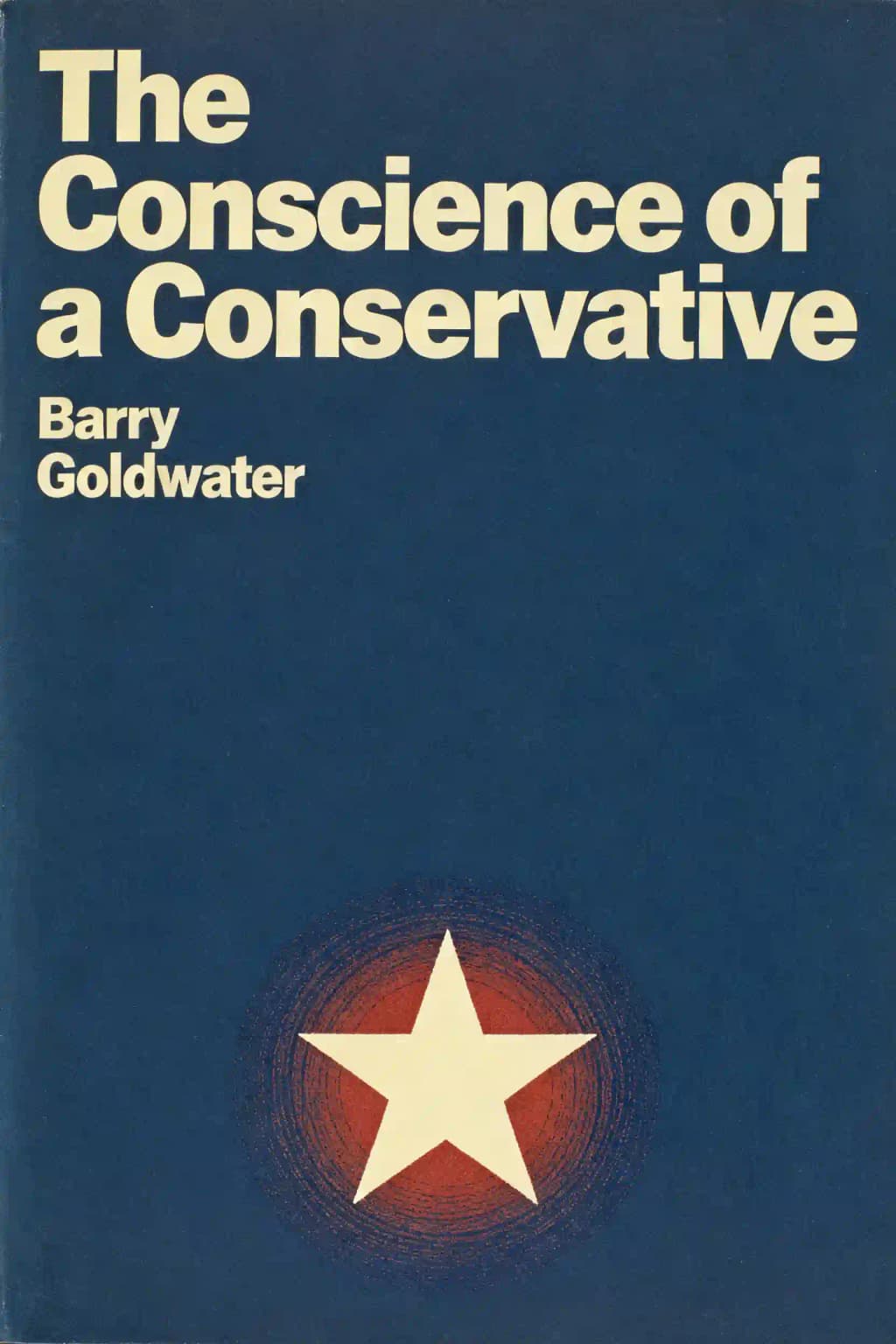
In a nation increasingly dominated by progressive policies, Barry Goldwater's "The Conscience of a Conservative" emerged as a clarion call that would forever alter American political discourse. Published in 1960, this slim volume became the intellectual cornerstone of modern American conservatism, selling over 3.5 million copies and establishing Goldwater as the philosophical father of the conservative movement. The book's influence extends far beyond its era-Ronald Reagan credited it with shaping his political worldview, while Justice Clarence Thomas called it transformative to his thinking. Even today, politicians across the spectrum acknowledge its enduring impact on American political thought. What makes this book so powerful isn't just its political arguments, but its unapologetic assertion that conservatism represents a comprehensive philosophy addressing the whole person-not merely economic theories, but a vision of human dignity, freedom, and spiritual nature that transcends political fashion.
Capítulo 2
Conservatism: A Philosophy of the Whole Person
The modern conservative often finds themselves on the defensive, qualifying their beliefs with phrases like "conservative with a heart" or "progressive conservative." This apologetic stance fundamentally misunderstands what conservatism truly represents. Conservatism isn't primarily an economic theory-that's the domain of socialism, which subordinates everything to material well-being. The essential difference is that conservatives consider the whole person, including their spiritual nature, while progressives focus primarily on material needs.
What distinguishes the conservative worldview is its recognition that each person is a unique creature with an immortal soul and different potentials. We understand that economic and political freedoms are inseparably linked-you cannot have one without the other. Individual development cannot be directed by outside forces; it must come from within, guided by one's own values and aspirations.
Throughout history, true conservatism has opposed both autocrats and collectivists who debase individual dignity. We view politics as the art of achieving maximum freedom consistent with necessary social order, always recognizing that political power constantly seeks to expand beyond its proper boundaries. The conservative understands that freedom is never more than one generation away from extinction, requiring eternal vigilance against the natural tendency of government to accumulate power.
Today, with freedom increasingly threatened by expanding government authority, the American conservative's challenge is clear: to preserve and extend freedom in the face of those who would sacrifice it for security, comfort, or the illusion of equality. This isn't merely about winning elections-it's about articulating a vision of human flourishing that honors both our material and spiritual dimensions.
Capítulo 3
The Constitutional Guardrails: Restraining Government Power
"If a job has to be done to meet the needs of the people, and no one else can do it, then it is the proper function of the federal government." This dangerous view, expressed by leaders in both political parties, completely repudiates limited government principles. It suggests government can do whatever "needs" to be done-with government itself determining those needs. This is the first principle of totalitarianism: that the State is competent to do all things and limited only by the will of those who control it.
The Constitution was designed specifically to limit government functions. The framers understood that throughout history, government has been the chief instrument for thwarting liberty. Power corrupts, and absolute power corrupts absolutely. While legitimate government functions enable freedom, the same instrument can restrict freedom once power-holders are left to their own devices.
The Constitution created a system of restraints against government's natural tendency toward absolutism through limited federal powers, reservation of other powers to states and people, separation of powers, and careful amendment procedures. These weren't academic exercises-they were practical safeguards against the human tendency to accumulate and abuse power.
We have not kept this Republic. The federal government has moved into every field, state governments are marginalized, and executive and judicial branches have exceeded constitutional boundaries without proper amendments. The result is a Leviathan national authority beyond the people's control. Government power has expanded through massive spending, extensive activities, heavy taxation, and interference in daily life.
This happened partly through broken promises but mostly through kept promises-we've repeatedly chosen leaders who expand government programs and security measures, trading freedom for comfort. As Tocqueville warned, Americans have allowed themselves to be led by "guardians" they themselves chose. Our defense against unlimited government power has weakened dangerously.
The turn will come when we elect officials committed to divesting themselves of power and restoring constitutional limits-a rare quality in politics, but essential if we are to preserve the Republic our founders established. The Constitution isn't merely a historical document but a living covenant that must be honored if freedom is to survive.
Capítulo 4
States' Rights: The Bulwark Against Federal Overreach
The cornerstone of our Republic and chief bulwark against encroachment on individual freedom by Big Government is the principle of States' Rights. Yet neither major political party now maintains a meaningful commitment to this essential concept. The Republican Party gives lip-service to States' Rights, talking about "returning rightful powers" and sponsoring conferences, but in practice, like Democrats, they summon federal power whenever they decide states aren't performing satisfactorily.
One neglected method of federal interference is through "grants-in-aid" or "matching funds" to states in areas constitutionally reserved for states. These federal programs use a mixture of blackmail and bribery-states feel compelled to accept their "fair share" of revenue collected from all states, making refusal political suicide. More directly, federal officials sometimes threaten intervention unless states take Washington-approved actions.
The fundamental error lies in treating the Constitution as merely a handbook of political theory rather than binding law. The Tenth Amendment isn't a "general assumption" but a prohibitory rule recognizing states' jurisdiction in certain areas. States' Rights means states have the right to act or not act as they see fit in areas reserved to them. The duties corresponding to these rights are owed to the people of the states, not to the federal government.
Consider the issue of education. The Constitution gives no authority over education to the federal government, yet Washington increasingly dictates educational policies through funding requirements. Or consider racial integration-while I personally believe integrated schools are wise and just, I cannot impose that judgment on Mississippi or South Carolina. Race relations, like all social problems, are best handled by the people directly concerned. Social change should come through persuasion and education, not national power, while respecting orderly legal processes.
The proper recourse for citizens unhappy with state programs is to pressure state officials or elect new ones-not federal intervention. Nothing would so advance freedom as state officials asserting their rightful claims to lost power and the federal government withdrawing from jurisdictions reserved to the states. This isn't about defending any particular policy but about defending the constitutional structure that protects all our freedoms.
Capítulo 5
Economic Liberty: The Farmer, The Worker, and The Market
Hamilton correctly foresaw that federal intervention in agriculture would prove "troublesome," though he wrongly predicted men wouldn't attempt it. This constitutional disregard has destroyed personal freedom and created economic chaos-unmanageable surpluses, immense tax burdens, high consumer prices, and vexatious controls demonstrate the folly of ignoring limited government principles.
The Constitution gives no power over agriculture to any branch of the national government. When the first Agricultural Adjustment Act was struck down by the Supreme Court, Congress simply repackaged substantially identical legislation claiming it as "regulation of interstate commerce." In Wickard v. Filburn (1942), the Court's reasoning became bizarre-ruling that wheat a farmer grew and consumed on his own farm affected interstate commerce because he might otherwise have purchased feed from someone else! This reasoning made the commerce clause limitless and nullified the Constitution's reservation of agricultural jurisdiction to states.
The tragedy is that federal intrusion hasn't solved the "farm problem" of declining incomes, but has added production controls restricting freedom, high consumer prices, huge surpluses, and a massive tax burden. Government intervention creates more problems than it solves because farm production, like any production, is best controlled by the free market. When farmers sell at prices consumers will pay, they'll produce what can be consumed, with some farmers naturally moving to other economic activities if prices are too low.
Similarly, in labor relations, the balance of power has shifted dramatically to union leaders' advantage through unwise legislation. To restore unions to their proper role, three conditions must be observed: voluntary association, confinement to collective bargaining, and negotiation with the specific employer of the workers concerned.
Compulsory unionism violates freedom of association. Right-to-work laws, which forbid making union membership a condition of employment, are essential to protect this natural right. The "free loader" argument doesn't justify compulsion-no other organization forces people to contribute. Evidence shows that in all nineteen states with right-to-work laws, union membership actually increased after passage.
Just as we outlawed corporate monopolies through antitrust laws, we should apply the same principle to labor unions. When the UAW negotiates with the entire auto industry, a single monolith faces multiple competing companies, resulting in excessive wage demands and higher consumer prices. We must make war on all monopolies-corporate or union-as the enemy of freedom is unrestrained power, regardless of who wields it.
Capítulo 6
The Moral Dimension of Taxation and Spending
The subject of taxation has been stripped of its moral principles, reducing it to a mere problem of public financing. We've been led to believe government has an unlimited claim on our wealth, when in truth, one of natural law's foremost precepts is a man's right to his property-including his earnings. The attack on property rights is actually an attack on freedom itself. How can a man be truly free if the fruits of his labor aren't his to dispose of?
Currently, taxation severely infringes on our freedom. A family man earning $4,500 annually works approximately 22 days monthly, with taxes consuming about 32% of his earnings-meaning he works seven full days each month for government. As Senator Taft noted, America is already one-third "socialized" through taxation.
While every citizen has an obligation to contribute his fair share to legitimate government functions, these functions must be constitutionally defined. Justice requires government to claim an equal percentage of each man's wealth-no more. The graduated tax is fundamentally confiscatory, aiming to bring all men to a common level. This violates both the Republic's charter and Nature's laws.
The Republican Party has failed dismally on spending control. Despite campaign promises to reduce federal spending, domestic expenditures have increased 143% in ten years-far outpacing population growth (18%), inflation (less than 20%), or GDP growth (40%).
The root problem is that government engages in activities outside its legitimate mandate. Substantial spending cuts require eliminating these unconstitutional programs. The federal government must withdraw from social welfare, education, public power, agriculture, housing, urban renewal, and other activities better performed by lower governments, private institutions, or individuals.
By reducing taxes and spending, we return to individuals the means to assert their freedom and dignity while guaranteeing the nation the economic strength that will always be its ultimate defense against foreign foes. Economic growth will be achieved not by government harnessing economic forces, but by emancipating them.
Capítulo 7
The Welfare State: Freedom's Silent Enemy
The principal domestic threat to our freedom has shifted from Marxist collectivization to the Welfare State. Collectivists have discovered that socialism can be achieved through welfarism as effectively as through nationalization. They understand that private property can be confiscated through taxation as effectively as through expropriation, and that individuals can be made dependent on the state not just by making it their employer, but by making it responsible for their personal needs from cradle to grave.
Most critically, welfarism is more compatible with democratic political processes than nationalization. While people readily oppose government takeover of industries, they merely grumble about excessive spending on "free" federal benefits. Welfarism's effects on freedom emerge only after beneficiaries become victims and dependence becomes bondage.
Consider welfarism's consequences: For donors, there's no moral virtue in voting to confiscate one person's earnings for another's benefit. For recipients, it mortgages them to the federal government and eliminates their sense of responsibility for their own welfare. The greatest evil is that welfarism transforms dignified, self-reliant spiritual beings into dependent creatures without their knowing it.
Education represents one clear example of this process. Federal aid to education is objectionable for four key reasons: First, it's unconstitutional-education is reserved to the states by the Tenth Amendment. Second, the need for federal funds hasn't been convincingly demonstrated. Third, federal aid promotes the misconception that federal money is "free money," when it's actually extracted from citizens of the very states receiving aid, minus Washington's handling costs. Fourth, federal aid inevitably means federal control of education, as demonstrated by the National Defense Education Act of 1958 with its twelve direct controls.
The trouble with American education is that we've adopted "progressive education" based on John Dewey's philosophy. We've neglected to provide an educational system that challenges our best students. In our desire to help children "adjust" to their environment, we've given insufficient opportunity to acquire knowledge that enables them to master it. We've forgotten that the proper function of school is to transmit cultural heritage and train minds to apply ancient learning to modern problems.
Charity should remain private, encouraged among individuals, families, churches, hospitals, community organizations and other institutions established for this purpose. If public intervention is necessary, it should come from local and state authorities incapable of accumulating the vast political power that threatens liberty. The welfare state isn't inevitable. We can shatter collectivists' designs on individual freedom by recognizing one truth: man's material and spiritual sides are intertwined. When the state assumes responsibility for one, it intrudes on the essential nature of the other.
Capítulo 8
The Cold War: Understanding the Soviet Threat
We can establish ideal domestic conditions for freedom yet still become slaves by losing the Cold War to the Soviet Union. American freedom has always depended partly on events beyond our shores. After WWII, we were masters of our destiny and the world, but now we face clear danger from a revolutionary world movement with the will and growing capacity to dominate the globe.
This movement possesses military power rivaling our own, superior political warfare skills, an international fifth column operating within our defenses, and an ideology that gives adherents a sense of historical mission-all controlled by a ruthless despotism. The deterioration of America's position isn't primarily due to Soviet nuclear weapons; the real cause is simple: our enemies understand the nature of the conflict and are determined to win, while we don't and aren't.
The Communists aim to conquer the world, but we haven't truly believed this obvious fact. If we had, our foreign policy would have been radically different. Our national objective has been "peace" while the Communists wage war. We've sought "settlements" while they seek victories. We've tried to pacify the world while they mean to own it. We must understand that peace should follow victory over Communism, not precede it.
Through NATO, SEATO and other alliances, we've warned the Kremlin that Communist aggression in certain areas will face American military opposition. While these alliances have likely discouraged Soviet military adventurism, their value is limited for four critical reasons.
First, the alliance system doesn't cover all areas that must be defended to prevent enemy expansion. Huge regions of the non-Communist world remain outside these alliances, particularly the "neutral" countries of the Middle East, Africa and Southern Asia-precisely where Communists are making significant advances.
Second, these alliances don't protect even their members against the most common form of Communist aggression: political penetration and internal subversion. Iraq, despite being protected by the Baghdad Pact and Eisenhower Doctrine against overt Soviet aggression, fell to a pro-Communist coup without a shot being fired.
Third, the alliance system cannot adequately protect against even overt aggression. While America's strategic air arm has kept Communists in check, as the Soviets achieve nuclear parity, our allies' weak conventional forces become a critical vulnerability.
Finally, the most serious defect is that our alliance system is completely defensive in nature. Like a boxer who refuses to throw a punch, a defense-bound nation will eventually be cut down. As long as every encounter with the enemy occurs on his initiative, grounds, and with weapons of his choosing, we shall keep losing the Cold War.
Capítulo 9
America's Foreign Policy: The Path to Victory
In fourteen years, we've committed over eighty billion dollars to Foreign Aid through grants, loans, material and technical assistance. This Gargantuan expenditure has harmed the American taxpayer and economy, fostered waste and extravagance, and created anti-Americanism among proud peoples who resent dependence on foreign charity. But has it helped win the Cold War? This is the only test by which it can be justified, as the Constitution doesn't empower our government to promote economic welfare in foreign countries.
The fundamental flaw is that increasingly our aid goes not to friends but to professed neutrals or even enemies, based on the fallacious "stomach theory" that economic prosperity prevents Communism. A man's politics stem primarily from his mind, not his stomach. Communism is a political movement led by literate, well-fed activists who won't be deterred by economic aid.
Our "exchange program" with the Soviet Union has become increasingly prominent in American foreign policy, supposedly to foster peace through mutual "understanding." The claim that conflict stems from "lack of understanding" is a great political fable. For the Soviets, the exchange program is simply another operation in political warfare. Everyone they send to America is a trained agent of Soviet policy-some are spies seeking information, all carry Communist propaganda.
The Kremlin knows our willingness to make sacrifices to halt Communist expansion varies directly with our hostility toward Communism. Their purpose is to show that Khrushchev and the Soviet system aren't so threatening after all. It would be absurd to have promoted a Nazi-American exchange program during World War II or invited Hitler for a state visit. We should be equally reluctant to treat Communist agents as welcome guests.
Our leaders proclaim support of the United Nations as a cornerstone of American foreign policy, but the United Nations is partly a Communist organization. The Communists always have at least one Security Council seat with permanent veto power, allowing them to block any substantive action contrary to their interests. Unlike America, the Communists don't respect the UN or allow it to affect their policies. If "the opinion of mankind" goes against them, they ignore it. We, however, would rather be approved than succeed.
Our strategy must be primarily offensive in nature. We cannot win by merely holding our own against Communism's dynamic challenge. Beyond parrying blows, we must strike our own. Beyond guarding frontiers, we must puncture theirs. We must engage the enemy at times and places, and with weapons, of our own choosing. We must maintain decisive military superiority, not mere parity. Our goal must be victory-not coexistence, not containment, but the defeat of an ideology that threatens everything we hold dear.
Capítulo 10
The Conservative Vision: Freedom's Last, Best Hope
The conservative vision isn't about returning to some mythical past-it's about applying timeless principles to present challenges. These principles-limited government, individual liberty, free markets, strong national defense, and respect for traditional values-aren't outdated; they're the foundation upon which American greatness was built and the only path to preserving that greatness for future generations. From the Constitutional Convention to the present day, these principles have guided America through its greatest trials and triumphs, proving their enduring relevance across centuries of technological and social change.
The choice before us is clear: continue down the path of expanding government power, diminishing individual responsibility, and defensive foreign policy, or reclaim the vision of America's founders-a nation where freedom is cherished, responsibility is honored, and enemies of liberty are confronted with unwavering resolve. History shows that societies that embrace government control over individual initiative inevitably stagnate and decline, while those that protect individual rights and economic freedom prosper. From tax policy to regulation, from education to healthcare, the conservative approach emphasizes personal choice and market solutions over bureaucratic mandates.
Conservatism offers not just a political philosophy but a way of life that honors the whole person-material and spiritual, individual and communal. It recognizes that true progress comes not from government dictates but from unleashing human potential through freedom. It understands that a nation's strength lies not in the size of its government but in the character of its citizens. This vision acknowledges the vital role of mediating institutions-families, churches, civic organizations, and local communities-in fostering the virtues necessary for self-governance and social stability.
The conservative worldview embraces both tradition and innovation, understanding that meaningful progress builds upon, rather than demolishes, the wisdom of the past. It recognizes that free markets, protected by the rule of law, drive technological advancement and economic opportunity while preserving individual liberty. This approach has consistently produced superior outcomes in human flourishing, from healthcare innovation to poverty reduction.
As we face the challenges of our time-domestic and foreign-let us remember that freedom is never more than one generation away from extinction. It must be fought for, protected, and handed on for them to do the same. Whether confronting technological disruption, geopolitical threats, or social upheaval, the conservative vision offers proven solutions rooted in eternal truths about human nature and governance. The conservative vision offers freedom's last, best hope-not just for America, but for all who cherish human dignity and liberty throughout the world, providing a blueprint for addressing contemporary challenges while preserving the fundamental rights and values that have sustained free societies.