Capítulo 1
Creativity on Demand: The Art of Brilliance Under Pressure
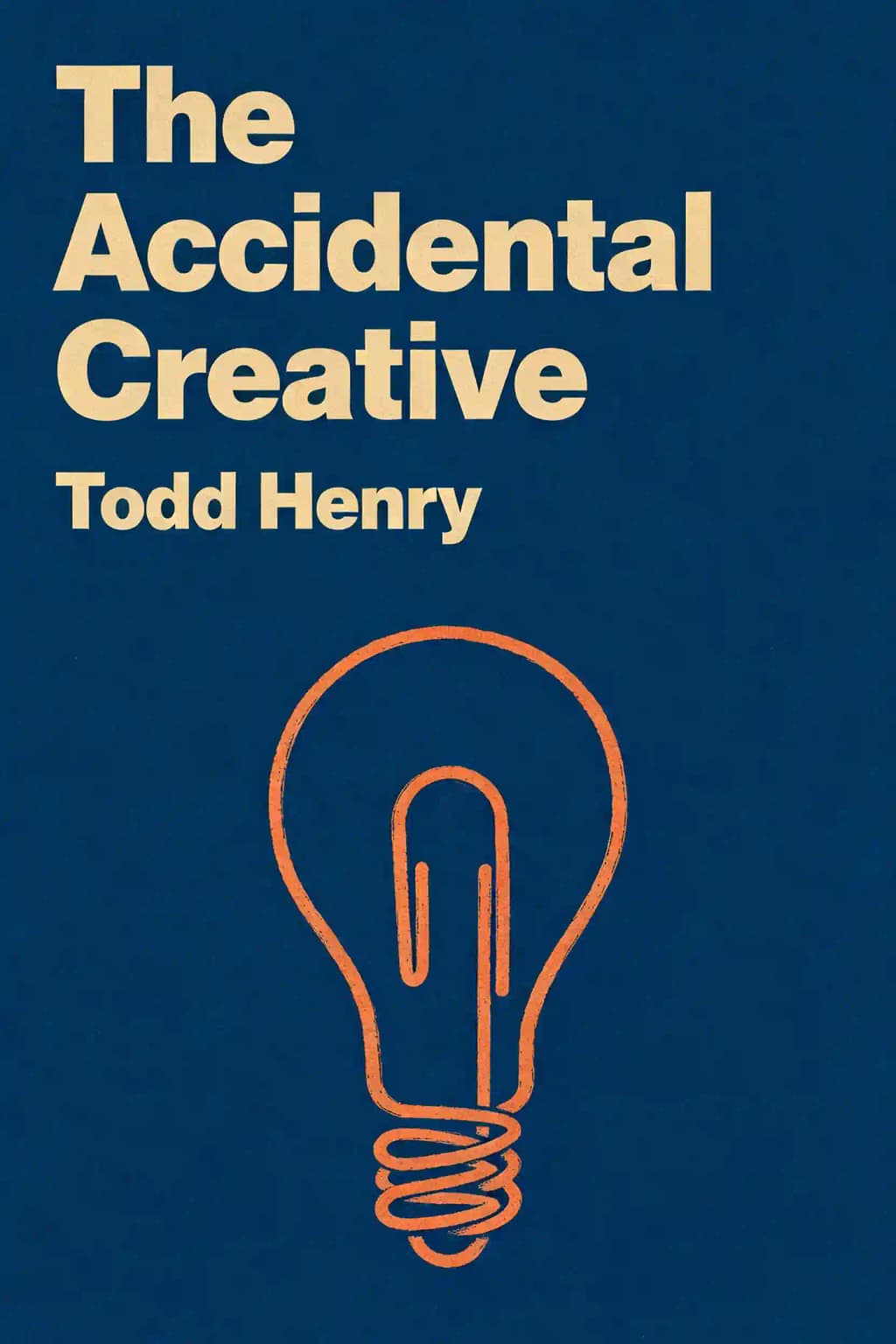
In a world that increasingly demands innovation at breakneck speed, Todd Henry's "The Accidental Creative" has emerged as a cornerstone text for professionals seeking sustainable creative output. Since its 2011 publication, this book has influenced countless creative professionals, from designers at Apple to marketing teams at Fortune 500 companies. What makes it particularly powerful is Henry's rejection of the "tortured genius" myth in favor of practical systems that enable consistent brilliance. Celebrities like Brene Brown have cited the book's influence on their work routines, and its principles have been incorporated into creative departments worldwide. The book's central premise-that creativity can be systematically cultivated through deliberate practices-challenges our cultural assumption that brilliant ideas simply arrive through mysterious inspiration or desperate last-minute pressure.
Capítulo 2
The Create-On-Demand Dilemma: Brilliant, Prolific, and Healthy
We live in a world that expects us to "create on demand"-generating brilliant solutions that meet specific objectives by defined deadlines. Whether you're developing marketing strategies, designing products, writing code, crafting presentations, or solving complex business problems, you're essentially being paid for your ideas. This pressure is relentless and often leads to an unsustainable approach to creative work, particularly in industries where innovation is the primary currency.
The fundamental challenge is that while the creative process naturally flows through peaks and valleys, most work environments demand constant output. Creative energy operates in cycles - periods of intense productivity followed by necessary recovery and incubation. Yet organizations typically structure work as if creativity were a steady-state resource, available on tap like electricity. We treat creativity as an infinite resource we can access whenever needed, ignoring its rhythmic nature. This mismatch creates a tension that ultimately damages our creative capacity and leads to diminishing returns.
To thrive in this environment, you must achieve what Henry calls the creative trifecta: being prolific, brilliant, and healthy. Most creatives excel in only two areas, creating three common but problematic patterns:
Prolific + Brilliant - Healthy = Burnout (The classic overachiever who produces great work but at personal cost)
Brilliant + Healthy - Prolific = Unreliable (The talented but inconsistent performer who can't be counted on)
Healthy + Prolific - Brilliant = Fired (The steady worker whose output lacks the necessary quality)
The marketplace demands consistency-you need both great ideas and effective execution to meet expectations. This means delivering innovative solutions reliably while maintaining high standards. But this isn't about working harder or longer hours. In fact, frenetic activity often accomplishes little of value. What looks like productivity-answering endless emails, attending back-to-back meetings, checking tasks off lists-can actually be "fake work" that prevents true creative engagement and deep thinking.
The solution isn't abandoning structure but embracing it strategically. Contrary to popular belief, creativity doesn't thrive in complete freedom-it needs boundaries to channel its energy effectively. Just as a river needs banks to direct its flow, creative work needs parameters to achieve maximum impact. Total freedom often leads to paralysis, while thoughtful structure provides the stability necessary for risk-taking and mastery over process. This might mean establishing regular creative rituals, defining clear project scope, or setting specific time blocks for different types of work.
Think of creativity like atmospheric pressure-an unseen force with powerful effects. It follows natural laws and patterns that, while invisible, profoundly impact our ability to produce meaningful work. Once you understand its governing dynamics, you can harness its power through deliberate practices that work with your natural creative rhythm rather than against it. This might include alternating between periods of intense focus and deliberate rest, scheduling challenging creative work during your peak energy hours, and building in time for idea incubation and refinement.
Capítulo 3
The Tensions That Kill Creativity
Creative professionals face unique tensions that can slowly erode their capacity for brilliant work. Understanding these tensions is the first step toward establishing practices that counteract them.
The time-versus-value tension creates constant uncertainty about when work is truly complete. Unlike traditional workers paid for time, creatives are compensated for value creation. This introduces what Henry calls "completion anxiety"-we're never certain when we've done enough. Many creatives work during off-hours, constantly tweaking projects and checking emails, driven by insecurity about proving their worth.
This manifests in teams as well, with many groups working until they simply run out of time, constantly improving until deadlines force completion. Without clear completion criteria, creatives struggle to fully engage, feeling the work is never done. Some teams become addicted to last-minute changes, discarding weeks of preparation and undermining strategic thinking.
The predictable-versus-rhythmic tension emerges as organizations crave predictability for resource allocation and planning, while creative work thrives on natural peaks and troughs of productivity. When organizations try to eliminate these natural valleys, they inadvertently cut off the peaks as well, resulting in mediocre but predictable output rather than occasional brilliance.
Many organizations judge creative workers based on arbitrary moments of observation-like taking a single photo of someone working and basing their entire evaluation on that snapshot. When a creative has a particularly productive period, that becomes the new benchmark, making normal rhythmic productivity appear as underperformance. This leads creatives to conserve energy rather than fully engage, resulting in consistent but uninspired work.
The product-versus-process tension arises because organizations focus primarily on finished products, while creative work is 99% process. Having weeks of creative work judged in mere minutes can be deeply demotivating. Decision makers often focus solely on the finished product rather than understanding the process that led to it, leaving creatives with little insight into the mindset behind criticism.
These tensions aren't just theoretical concerns-they manifest as three "assassins" that systematically destroy creative capacity: dissonance, fear, and expectation escalation.
Capítulo 4
The Assassins of Creativity
Dissonance occurs when the "why" of our work doesn't align with the "what" of our daily activities. Our minds naturally try to resolve these misalignments, hijacking creative bandwidth with environmental incongruities. This manifests in three primary ways:
Unnecessary complexity often emerges as organizations grow, with specialization creating divisions further removed from central objectives. But complexity can also be self-inflicted-a defense mechanism when we're uncertain about objectives or insecure about our abilities. Whether from insecurity or organizational growth, unnecessary complexity wastes creative energy that should be directed toward actual work.
Unclear objectives create confusion similar to children playing a game without established rules. When teams jump straight to execution before establishing project strategy (the five W's: Why, Who, What, When, Where), they handicap their ability to solve problems effectively. The more comprehensively we define our objectives, the more likely we are to experience creative insight.
Opacity in decision-making creates a vacuum that people fill with their own interpretations. When key decisions are made in a "secret chamber" and handed down without explanation, designers struggle to execute without understanding the reasoning behind requests. The clearer an organization can be about why decisions are made, the better aligned the work becomes.
Fear manifests in two primary forms. Fear of failure makes us risk-averse, settling for passable work done in risk-free ways. But brilliant creative work always requires risk-reaching beyond our present circumstances. What we're really fearing isn't typically job loss but being perceived as inadequate or ineffective.
Fear of success is more subversive, manifesting in thoughts like "Do I really want to knock this out of the park? Can I sustain that pace?" This fear plays on our paranoia that we can't maintain high expectations or handle the consequences of success. It can become epidemic within creative teams, where members rationalize subpar work to avoid stretching themselves.
Expectation escalation occurs when we allow comparisons to affect our creative engagement. When we place concrete expectations on results too early, we close off potential executions and helpful thoughts, derailing brilliant ideas before they develop. This self-limitation through comparison comes from three main sources:
Our past work often becomes a standard against which we judge infant ideas, forgetting that all our past work was once unformed. We remember completed projects more fondly than we felt during their creation, forgetting the doubt and uncertainty involved.
Unclear expectations from managers and peers can lead us to artificially escalate what's required, doing unnecessary work and wasting energy that could be better applied to actual creative problems.
Industry publications and competitors' work can paralyze us when we feel constant pressure to measure up. While learning from competition and creative heroes is valuable, we shouldn't let their influence condemn our abilities.
Capítulo 5
Focus: The Foundation of Creative Brilliance
To thrive creatively, you must develop deep focus capacity. Despite pressures for faster, better, cheaper work, you need the ability to make quick, focused dives into projects and emerge with useful ideas. Many creative people struggle with "priority ping-pong"-bouncing between unsolved problems without resolving any-which prevents the deep thinking that facilitates insight.
The solution is to stop living reactively by learning to define problems quickly, refine priorities, and cluster work to minimize distractions. Two factors particularly affect focus: unhealthy assumptions and "the Ping."
Our minds excel at solving problems and forming patterns, but this can lead to false assumptions about cause and effect. We might believe something must be done a certain way because it's always been done that way, or that a method that worked once will always work. These assumptions limit our creative process and prevent us from seeing opportunities that are obvious to others.
"The Ping" is that little sensation prompting us to check email or social media instead of focusing on work. This impulse whispers that "something out there is more important than whatever is right here." The result is what Linda Stone calls "continuous partial attention"-being kind of here, kind of somewhere else. If we check email every 5 minutes during work hours, that's potentially 67 hours annually just glancing at notifications.
To combat these focus killers, Henry introduces three practices:
Define your challenges as specific questions rather than vague objectives. When we phrase objectives as simple questions, we lead our minds directly to solving problems. For example, instead of writing "New Website" on a whiteboard, ask "How can we create a website that communicates our brand values while making information easily accessible?"
Refine your priorities with "The Big 3"-the three most important "open loops" in your life and work where you still need critical insight or creative breakthroughs. These aren't necessarily your biggest projects, but rather the areas where you need conceptual breakthroughs. By keeping these visible (on a whiteboard or index card), you create a lens through which to process the world, setting yourself up for unexpected creative connections.
Cluster similar work to reveal recurring patterns and potential overlaps between projects. By focusing for longer periods on similar tasks, you experience greater immersion, making breakthroughs more likely and work more enjoyable. This might mean setting aside dedicated time for strategic thinking, grouping meetings together to preserve large blocks of uninterrupted time, or dedicating specific times for email rather than constantly checking your inbox.
Capítulo 6
Relationships: The Hidden Engine of Creativity
Creative work often isolates us, but relationships are among our most valuable creative resources. By neglecting relationships, we limit ourselves to our own experiences, but approaching them purposefully allows us to draw on many lifetimes of insight and inspiration.
Many creatively gifted people tend toward introversion, perhaps drawn to professions that allow for isolated conceptual work. While introverts can enjoy being around people, they derive energy from solitude rather than social interaction. The danger for creative introverts is excessive isolation-seeing relationships as obligations that distract from important work rather than opportunities for growth and collaboration.
For successful relationships, Keith Ferrazzi identifies two critical elements: intimacy and generosity. Intimacy involves regularly sharing our lives with others and allowing them into our inner circle. Though relationships can be messy and push us beyond comfort zones, they help us see problems and opportunities from new perspectives.
Generosity is fundamental to the creative process itself. There are two types of people: those who live to fill others' buckets and those always looking to get their own buckets filled. The latter offer compliments only to subtly praise themselves, while the former thrive on seeing others succeed, freely giving away ideas and credit. These generous "bucket-fillers" invigorate rooms with creative energy and ultimately succeed because everyone wants to work with them.
Henry suggests three strategies to enrich relationships:
Start a Circle-a small group of creatives who meet regularly to stay focused and engaged. These circles stoke passion, maintain alignment with priorities, generate new ideas, and provide emotional nourishment. Each meeting revolves around three questions: What are you working on? What is inspiring you? What would you like prompting on?
Schedule Head-to-Heads-regular one-on-one meetings with someone you respect within your expertise area. Set consistent meeting times (monthly works well) in quiet, comfortable places and make them a calendar priority. Vary your subject matter to challenge each other with fresh insights rather than discussing the same topics repeatedly.
Establish a Core Team-trusted advisors with permission to speak candidly into your life. Choose people outside your company (for freedom of discussion), include at least one visionary who challenges your thinking, and diversify across industries for balanced perspective. Always pay for meetings to remind yourself this is an investment in your growth.
Capítulo 7
Energy: The Invisible Ally of Creativity
Like even the most perfectly designed device, our creative capacity is useless without sufficient energy to power it. Though invisible, energy powers all our mental processes, with our brain consuming 20% of available oxygen and glucose despite being only 2% of our body weight. When we're tired, we're less capable of forging connections and experiencing breakthroughs.
Many creative professionals live in an "unending Snowmageddon of work," expending tremendous effort just to keep pace. The common practice of working until exhaustion, recovering over the weekend, then repeating the cycle is deeply flawed. Creative work requires staying ahead of deadlines because tomorrow's ideas emerge from today's intentions. When relying on "just-in-time" workflows, quality suffers and motivation wanes.
The typical response-panic, late nights, caffeine-creates an unhealthy cycle that often ends only with job loss or breakdown. This energy deficit compounds over time. Creative insights require conceptual momentum, and building this momentum demands excess energy. Without it, we miss subtle stimuli and clues that might yield breakthroughs.
To manage energy effectively, Henry suggests whole-life planning across three horizons:
Weekly planning involves analyzing upcoming demands, spacing out draining activities, creating buffers between tasks, and scheduling energy-giving activities. This isn't about achieving perfect balance but strategically managing energy so ideas can emerge when needed.
Monthly planning allows you to analyze what's coming over the next several weeks and make strategic choices about new projects. If you anticipate an energy-intensive work project, scale down personal commitments. Develop templates for your month, establishing when you'll perform energy-giving activities like exercise, study, or connecting with friends.
Quarterly planning examines your life rhythm holistically, establishing priorities and accounting for significant milestones. This is when you identify neglected principles, dream projects, and new work initiatives. The focus remains on energy management-being strategic about which projects to pursue based on their demands.
Energy management also requires pruning-deliberately eliminating activities to focus on what matters most. Like vineyard keepers who prune healthy branches so nutrients reach fruit-bearing parts of the vine, we must sometimes cut away perfectly good activities to increase overall productivity. The most difficult pruning involves cutting good things from our lives-enjoyable projects, exciting ideas, and meaningful relationships that ultimately decrease effectiveness in critical areas.
Capítulo 8
Stimuli: The Raw Material of Creative Insight
We exist in an information deluge, bombarded by thousands of daily inputs. The challenge isn't just information quantity-it's discerning which inputs are relevant to our work versus mere noise. While our minds excel at assimilating information and making connections between seemingly unrelated patterns, they have limited bandwidth.
The information and experiences we absorb are "stimuli"-raw materials that generate thought. Each creative idea combines previously existing stimuli into something new. Many creatives don't monitor what enters their minds, allowing emails, reports, videos and more to flood in without filters, resulting in lack of focus and numbness to inspiration.
Like nutrition ("you are what you eat"), your mental diet affects your creative output. Because much of your daily information processing is determined by work requirements, you must purposefully include self-directed, thought-provoking stimuli that increase your creative capacity. Quality stimuli should be challenging (stretching your comprehension), relevant (connected to your work or growth), and diverse (exploring divergent topics and perspectives).
Being purposeful about stimuli allows you to direct your mind toward problems before ideas become urgently needed. By selecting stimuli that build understanding for upcoming projects-researching recommended books, following relevant blogs, studying emerging trends-you give your mind the time it needs for its best work.
Henry suggests three practices to process information usefully for creativity:
Cultivate quality stimuli through a structured study plan. Most people approach stimuli randomly, creating few connecting points between inputs, with potential insights quickly forgotten. Structure your study plan quarterly with three key questions: What will you need for upcoming work (25% of study time)? What are you curious about right now (50% of study time)? What would be good for you (25% of study time)?
Process information through effective notation. The true value of study comes not from information absorption but from processing and application. Without capturing insights, stimuli's value diminishes dramatically. Keep index cards or notebooks with you constantly, and most importantly, implement a daily ten-minute morning routine to review yesterday's notes, extract insights, and scan for ideas relevant to today's work.
Experience your world directly through sensory interaction. Regularly seek experiences that enlighten you and open new ways of thinking. Take mindful walks in parks or museums while noting observations, serve others to shift focus away from yourself, or attend uncomfortable events outside your comfort zones. The goal is stretching yourself, as "comfort is the enemy of creativity."
Capítulo 9
Hours: The Currency of Productivity
Since the invention of the clock, we've been obsessed with time. Countless time-management systems promise to help us conquer our hectic lives, all assuming time is finite and must be squeezed for every productive moment. This insecurity drives us to cram work into every crevice of our lives, perpetually thinking and problem-solving.
Most time-management advice assumes your goal is simply getting through work, regardless of quality. But as a creative, you're accountable for quality, not just quantity. What's often overlooked: one effective hour can outperform five hours of frenetic activity. Breakthroughs can happen in moments, but these sudden insights result from structuring time with an effectiveness mindset rather than an efficiency one.
We must view our time as a portfolio of investments, not a slot machine. The slot machine approach keeps us perpetually working, desperately hoping that plowing through in an always-on manner will eventually produce results. An investment mindset focuses on long-term returns. By building practices aligned with the creative process, our capacity grows over time, yielding significant returns even without immediate payoff.
Henry suggests two essential practices for effective time use:
Establish Idea Time-one hour weekly, predictably scheduled with no exceptions, as an appointment with yourself for uninterrupted idea generation. This isn't execution time; it's for exploring new possibilities, not developing existing ideas. Focus on one issue, perhaps from your Big 3. Begin each session with a clearly defined problem framed as a question (a Challenge), and use large paper or a whiteboard to record ideas from multiple perspectives: Future (what would a solution look like?), Past (what assumptions need challenging?), Conceptual (what similar problems have been solved elsewhere?), and Concrete (what are the specific attributes of the problem?).
Practice Unnecessary Creating-creating for yourself rather than others. When we constantly create on demand, we risk losing touch with the passions that fuel our best work. Creating unnecessarily lets us set our own agenda, try new things, and develop skills solely for ourselves. One benefit is experiencing "flow"-Mihaly Csikszentmihalyi's term for getting completely absorbed in challenging work that requires your full creative capacity. During flow, you lose track of time and access dormant parts of your creativity.
Capítulo 10
Finding Your Creative Voice in a World of Cover Bands
The book concludes with a powerful call to authenticity. Henry explains the Accidental Creative tagline "Cover bands don't change the world," comparing creative professionals who merely imitate others to bands that play other people's music. While imitation is a necessary phase of creative growth, those who make money solely by imitating others get trapped between earning a living and authentic self-expression.
The truly influential creators are those who stay true to their principles rather than chasing quick returns, building loyal audiences by developing original work. Though this path requires patience and often means turning down work, it leads to authentic value and "raving fans" who trust your creative voice.
How we define greatness ultimately shapes our entire life trajectory. Whether we measure it through titles, knowledge, skill mastery, family relationships, or purposeful engagement, this definition becomes our life's compass.
Understanding the distinction between occupation (our job) and vocation (what we're inherently wired for) is crucial. While occupation describes tasks we perform, vocation represents deeper themes that energize us. When we align our work with our vocation-our "resonant frequency"-even small efforts yield tremendous results.
The author shares his personal mantra to "die empty," striving each day to contribute whatever value he has to offer others. As brand expert Kristian Andersen notes: "You will be known for what you do, so you'd better get busy doing what you want to be known for."
In the end, establishing creative practices isn't about cramming more into life or hacking the creative process. There are no formulas or shortcuts to brilliance-results come only when anxiety about short-term outcomes is released in favor of activities that increase capacity for future insights. Like beavers who transform their environment simply by doing what they're wired to do every day, our daily practices performed consistently without obsessing over immediate results create significant change over time.