Capítulo 1
The Whispered Wisdom: Where Eastern Philosophy Meets Modern Life
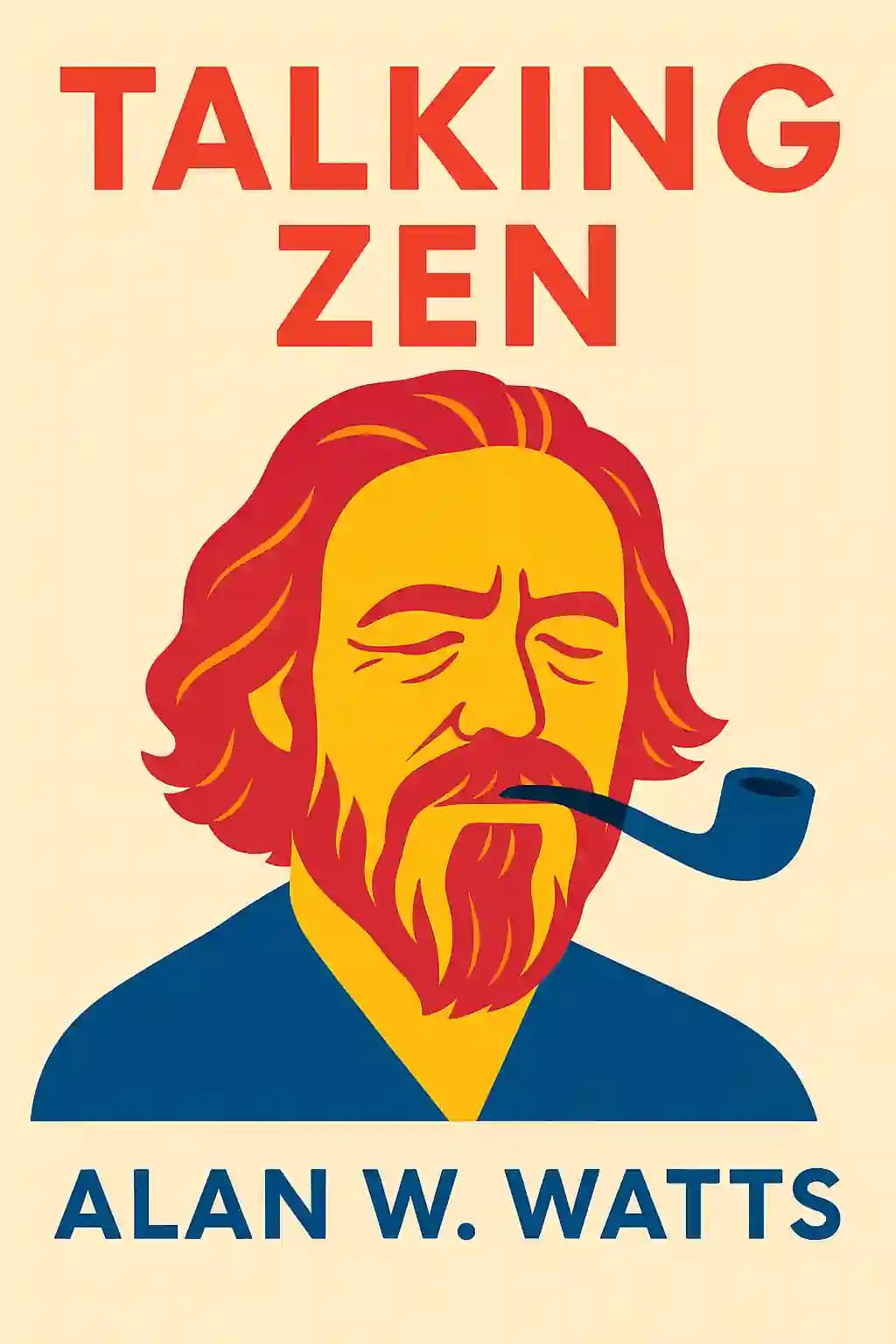
Alan Watts, often called "the foremost Western interpreter of Eastern thought," has captivated generations with his accessible approach to Zen philosophy. "Talking Zen" compiles his most illuminating spoken teachings spanning four decades, from his earliest lectures to his later seminar sessions. This collection has influenced countless spiritual seekers, including celebrities like Steve Jobs who credited Watts with profoundly shaping his worldview. The book's enduring popularity stems from Watts' unique ability to translate Eastern concepts into Western terms without losing their essence. His work bridges cultures at a time when many are seeking alternatives to conventional religious and philosophical frameworks. Let's explore the transformative insights this remarkable thinker offers.
Capítulo 2
The Frame That Isn't There: Seeing Beyond Our Mental Boundaries
We humans are compulsive framers of experience, constantly drawing invisible lines around every aspect of existence. We create boundaries around everything-birth and death, success and failure, right and wrong, pleasure and pain-to make sense of our world. These frames provide essential meaning and structure, but they also cause profound disquiet when we glimpse what lies beyond them. Consider how we frame time into past, present, and future, yet these divisions blur upon closer inspection. All knowledge depends on these distinctions between what "is" and what "is not," yet the frames themselves are merely abstractions, like drawing lines on water.
We identify ourselves through increasingly narrow frames-human, male, Caucasian, professor, parent, citizen-yet feel strangely empty when we realize we're essentially "holes tied together with string." Our very identity is built upon these arbitrary divisions: nationality, profession, relationships, beliefs. Our language, itself a complex system of frames, can only describe the boundaries, never what exists between them. Western philosophy has traditionally insisted life consists only of frames, celebrating their definiteness while overlooking their fundamentally hollow nature. Consider how we frame "self" versus "other," yet cannot precisely locate where one ends and the other begins.
This frame-based knowledge closely resembles what Indian philosophy calls maya-the grand illusion based on measurement and division. When we widen our vision beyond these artificial boundaries, we feel the futility of our carefully constructed knowledge systems, often leading to existential despair. Yet Buddhist thought transforms this apparent crisis into liberation (nirvana), seeing it as the necessary dissolution of false boundaries. The Zen tradition particularly emphasizes how our conceptual frameworks actually obscure direct experience of reality.
The central paradox is that actively seeking awakening or enlightenment inevitably pushes it further away, as desire cannot end desire. Zen masters like Rinzai advised "not seeking" and simply being ordinary, because "if a man seeks the Tao, that man loses the Tao." They understood that our very effort to grasp truth creates the illusion of separation from it. The moment we stop grasping for enlightenment and simply live in present reality, we discover what was always there, hidden in plain sight.
This understanding reveals that our perceived separation from life is an illusion created by our own mental frameworks. The Empire State Building is as much a work of nature as a bird's nest-both are expressions of the same living universe, different only in our conceptual categorization. Even our anxiety about achieving harmony with life is itself life expressing through us. What appears as disconnection is merely another pattern within the seamless whole, like waves on the ocean mistaking themselves for separate entities. Our very attempt to understand reality through frames paradoxically distances us from direct experience of it.
Capítulo 3
The Psychology of Acceptance: Finding Freedom in What Is
True acceptance brings profound psychological freedom. You are at liberty to protest suffering, feel out of harmony, seek help, relax or be tense-whatever you authentically choose. Acceptance means allowing yourself to be exactly what you are. Your nature always expresses itself regardless of your thoughts about it.
This resembles telling a potential suicide, "Go ahead, who's stopping you?"-realizing your freedom often transforms your desire to use it destructively. In religious terms, maya (illusion) is thinking we're separate from the Tao, but even this illusion is Tao. As Hsuan-chiao wrote: "You cannot take hold of it, nor can you get rid of it; While you can do neither, it goes on its own way."
The only difference between an ordinary person and an enlightened buddha is that one realizes they are buddha while the other doesn't. When asked "How does one get emancipated?" a teacher replied, "Who has ever put you in bondage?" This understanding comes when we allow ourselves to be free even in our ignorance. Our everyday experience is already a spiritual experience of the highest order.
This state beyond opposites brings astonishing inner freedom and spontaneity. While it doesn't magically solve moral, social, or political problems, it gives new zest for approaching them without private hopes or fears. It produces reverence for life rather than abuse, and makes hatred seem absurd when you realize you're free to hate.
The result is a childlike wonder for ordinary life, as a Chinese poet expressed: "How wondrously supernatural, and how miraculous this-I draw water and I carry fuel!" This ease with the world frees us to enjoy things the earnestly seeking mind considers trivial-playing with children, enjoying nature, having good meals, singing, dancing, or strolling aimlessly. The magic of life is that every little thing expresses the same power that moves stars and mountains.
Capítulo 4
Myths and Projections: How We Create Our Reality
Humans will always be myth-makers because we cannot simultaneously be subject and object, observer and observed. As a Chinese poem says, we are "Like a sword that cuts, but cannot cut itself; Like an eye that sees, but cannot see itself." This fundamental limitation shapes our entire perception of reality - we can never truly step outside ourselves to achieve pure objectivity. Our inner thought origins remain unconscious, and exploring human nature changes it unpredictably, making self-knowledge perpetually obsolete. This creates a perpetual blind spot in our understanding of ourselves and the world around us.
While Freudian and Jungian psychology established that our worldview projects our inner processes, science attempts to liberate us from myth-from constructing the world in our unconscious image-an impossible endeavor. The unconscious concept's value is showing consciousness's inescapable limitations. Our psychological projections manifest in countless ways - from seeing faces in clouds to attributing human motivations to natural events. Even our most rational scientific theories inevitably contain elements of our human perspective and cognitive biases.
An Indian tale illustrates different cultural approaches to this dilemma: A king wanted to cover the earth with leather to protect barefoot people, until a philosopher suggested binding small leather pieces to people's feet instead. This parable perfectly captures the fundamental difference between Western and Eastern philosophical approaches. Western cultures master the external world through technology and environmental control, while Eastern ones focus on controlling the mind and perception, changing oneself rather than the environment. These contrasting approaches reflect deeply different assumptions about the nature of reality and human consciousness.
Hindu and Buddhist philosophies use the concept of maya to suggest the external world is an illusion arising in our minds. This doesn't mean the world doesn't exist, but rather that our perception of it is inherently filtered through consciousness. Avidya (ignorance) means forgetting one's consciousness is not separate but part of the divine Self; failing to see pleasure and pain are correlative; and "ignore-ance"-using consciousness selectively to create the impression of distinct things rather than unity. This selective attention creates the illusion of separation where there is fundamental interconnection.
Mahayana Buddhism recognized that complete self-control is self-frustration-trying to lift oneself by one's bootstraps. The pratyeka-buddha's delusion is believing nirvana exists apart from samsara, forgetting that the controlling will is also maya. The bodhisattva's journey illustrates this profound insight: after initial withdrawal from the world seeking enlightenment, they return to discover there's no escape because there's no one separate to escape-only the trap exists. This realization transforms the meaning of nirvana from escape to embrace - it becomes freedom to fully participate in maya while recognizing its nature. The enlightened state isn't about transcending the world, but seeing it clearly for what it is and engaging with it wholeheartedly.
Capítulo 5
The Illusion of Time: Finding Eternity in the Present Moment
Our collective insanity stems from a radical error in our perception of time. While this problem seems hopelessly complex, it arises from a simple, unexamined assumption: that time is something external to us, moving uniformly forward, carrying us along with it like passengers on an unstoppable train. This mechanistic view of time has become so deeply embedded in modern consciousness that we rarely question its validity or consider alternative perspectives.
Concentration on the present moment doesn't mean staring fixedly at it, which only makes it elusive. Rather, it requires understanding there is no other moment than this one: there never was, and never will be. This moment moves faster than lightning yet is always here, changing like smoke yet ever the same. We cannot compare it with other moments because there are none-memories and anticipations are merely parts of this one moment. Consider how a musician doesn't play music by thinking about each individual note, but by flowing with the entire piece as one continuous present experience.
The correction of this basic illusion brings profound psychological changes, notably the disappearance of rush, temporal urgency and anxiety. Humans are the only creatures who rush. Plants and animals create themselves in wonderful variety but never hurry - a oak tree doesn't stress about growing faster, and a cat doesn't worry about tomorrow's schedule. Rush is the polar opposite of real time (growth and rhythm) and destroys human creativity. This artificial urgency manifests in countless ways: the constant checking of watches, the anxiety of deadlines, the perpetual feeling of being "behind schedule."
The root problem is that basic slip of mind into the optical illusion of clock-time-that silly gadget attempting to count our hours and divide life into equal units that never fit with the non-mechanical rhythms of growth and seasons. Consider how absurd it would be to measure a child's development purely by the clock, or to schedule creativity by the minute hand. For a real revolution, beyond political ideologies, we need people who won't be rushed, who realize clock-measured time is illusion. This means embracing natural rhythms: eating when hungry rather than at prescribed times, sleeping when tired rather than by the clock, and working in harmony with our body's natural energy cycles.
As the Zen saying goes, "Walk or sit just as you will, but whatever you do, don't wobble"-though if you must wobble, wobble with all your might. The universal tradition of the timeless moment insists that what we seek is right here, in this immediate instant. As Zen poetry reminds us: "In spring, flowers; in summer, breeze; in autumn, falling leaves; in winter, snow. Free your mind from idle thoughts, and every season is a good season." This wisdom appears across cultures: in the Buddhist concept of mindfulness, the Hindu understanding of eternal now, and even in modern physics' questioning of linear time. Each tradition points to the same truth: our experience of time is largely self-created, and our freedom lies in recognizing this.
Capítulo 6
The Tyranny of Convention: Finding Liberation Beyond Social Rules
Children learn arithmetic as absolute truth, with rigid rules about addition, subtraction, and multiplication presented as immutable facts of reality. However, advanced mathematicians eventually discover these "laws" are merely conventional frameworks - useful tools rather than cosmic absolutes. This parallels how education systematically makes children conform to society's conventions, but in this process of socialization, they sacrifice their natural spontaneity and develop deep inner conflicts that persist well into adulthood.
Unlike mathematics, where advanced study reveals the conventional nature of its rules, most adults never achieve this breakthrough regarding social conduct. The moral absolutes implanted in childhood become more than guidelines - they become the very architecture of thought itself. These conventional disciplines transform from tools into prison bars, constraining rather than serving the free mind.
Our fundamental challenge stems from the historical conflation of social conventions with divine will. This identification creates excessive inner turmoil, as every social rule takes on cosmic significance. The result manifests in two extreme reactions: either moral fanaticism that rigidly enforces conventions, or violent rebellion that completely rejects them. Paradoxically, when society rejects the concept of God, these conventions don't lose their power - instead, the relative simply assumes the throne left vacant by the absolute, making social rules even more tyrannical.
The profound mystery lies in understanding that society's rules are fundamentally different from nature's laws. We cannot transgress natural laws even if we desired to - we ourselves are expressions of these laws in action. As Goethe insightfully noted, "Even in resisting her laws one obeys them." This realization offers liberation from self-contradictory inner conflicts and the artificial state of constant self-consciousness.
Both religious institutions and secular relativists miss this crucial insight. The Church dismisses it as dangerous heresy, while relativists dismiss it as meaningless metaphysics. Yet both make the same fundamental error: they confuse conventional structures with ultimate reality. Traditional societies, in contrast, recognized two distinct aspects of religious life - the exoteric that maintained social order through discipline, and the esoteric that acknowledged fundamental freedom beyond conventional distinctions. Modern society lacks this essential counter-discipline, this antidote to blind conformity, leaving us deeply insecure and intolerant of difference.
The Zen master Huineng provides a powerful metaphor for understanding inner bondage - describing it as the compulsive linking of thoughts into rigid chains of association. True liberation comes not from stopping thought entirely, but from allowing thoughts to flow naturally without forcing them into predetermined patterns. This approach doesn't replace logical, connected thinking but rather complements it, transforming rational thought from a compulsive habit into a tool we can use freely and consciously when needed.
This understanding offers a middle path between rigid conformity and chaotic rejection of all convention, allowing us to use social structures while remaining inwardly free from their tyranny. It suggests that true liberation lies not in fighting against or blindly accepting conventions, but in seeing through their conventional nature while skillfully engaging with them.
Capítulo 7
Wu Wei: The Art of Not Forcing
Taoism views humanity as part of nature rather than dominating it. Chinese paintings titled "Poet Drinking by Moonlight" typically show vast landscapes with the poet tucked away in a corner, while Western paintings would make the human the central figure with nature as backdrop. Taoist and Zen-inspired painters see humans as integral to nature, not commissioned by supernatural beings to dominate it.
Following the Tao means doing things in accord with the grain-cutting wood where it's easily cut, interacting with people along genial lines. This fundamental principle is wu wei ("not forcing"). We don't force locks but jiggle them until they turn. Wu wei means acting in accord with things as they exist, not imposing extraneous force. Urban renewal projects that bulldoze slums without understanding their complex social ecology create chaos rather than solutions.
The apparent conflicts among species actually form a system of interdependence-things feeding on and cultivating each other simultaneously. Even the microorganisms competing in your body maintain your health. This "mutual arising" forms the basis of existence, allowing spontaneous, natural living without forcing.
Another important concept is li-originally meaning the markings in jade or grain in wood. Rather than "reason" or "principle," li is better understood as "organic pattern." The foam patterns of breaking waves, markings in jade, and grain in wood all exhibit li-distinct forms clearly different from randomness, yet with an order impossible to completely define.
To paint or live with this organic order, you must have an innate sense of li. This presents challenges for teachers trying to teach creativity-if creativity could be fully explained, it would lose its mystery and power. The mysterious depth from which creative things emerge is essential. As a Chinese poem says of a mountain sage: "The master has gone alone, herb gathering somewhere on the mount, cloud-hidden, whereabouts unknown."
The best teachers work without forcing. A piano teacher once showed that playing requires not hitting keys but dropping relaxed hands on the instrument-using the natural weight of the arm rather than muscular tension. This approach embodies the Taoist principle of effortless action.
Capítulo 8
Reclaiming Spontaneity: The Zen Path to Authentic Living
We all need liberation from our culture because education, while necessary, damages us in the process. Like meat that's been salted for preservation, we eventually need to soak out some of that salt. This explains why psychoanalysis has become popular not just for specific mental illness but as general maintenance for mental health-it's our attempt to find a cure for our own culture.
The primary casualty of upbringing is spontaneity. Children dance with natural joy until they notice it attracts attention, becoming self-conscious. We then send them to dancing school where they become stiff and mechanical, requiring years of practice to recapture what they once had naturally.
Self-consciousness is humanity's distinction and curse. It allows us to appreciate happiness by knowing we're experiencing it and to think about thinking itself. This rational control of behavior is civilization's glory, but it creates a dilemma: when do we stop thinking about thinking? How much evidence should we gather before acting? Most of us think until further thought becomes a nuisance, then act when it's too late to think anymore.
The principle of "headlessness" in Taoism suggests that perfect fitting things become unnoticeable-like comfortable shoes you don't feel. But this raises a paradox: if we don't know we're happy, are we truly happy? We want to know that we know, yet this self-consciousness is both blessing and curse.
Lao-tzu said, "It is easy to stand still; the difficulty is to walk without touching the ground." This weightlessness comes when we stop opposing ourselves internally. Most people constantly oppose themselves out of fear that without this internal resistance, they'll lose control. This anxiety began with human self-consciousness-our fall from grace-when we started questioning if we were aware enough or had considered enough factors.
Zen training creates a controlled environment where spontaneity can be practiced within boundaries. Unlike everyday society where complete honesty might threaten one's safety or social standing, Zen establishes a protected space for authentic expression. The critical moment comes during sanzen, the formal interview between student and master, where fundamental honesty becomes the essence of the exchange-though the more one worries about being honest, the more difficult it becomes.
Capítulo 9
The Living Buddha: Finding Enlightenment in Ordinary Life
The energy of life manifests in opposites-darkness and light, yin and yang, on and off. We create our own suffering by imagining one side will triumph over the other. Yet death is simply the other face of energy, the rest that enables something to exist. When you realize you are this one energy playing different forms, you become full of delight. This doesn't mean you won't feel pain or emotions, but deep down you're free from fundamental terror.
In Zen, a stone buddha breaks your fist when struck, while a living buddha says "Ouch" and feels pain. Buddhas are human, not gods. They're enlightened people who aren't afraid to participate in life's struggles. The difference is subtle-"it takes one to know one." A true Zen master never boasts about understanding or attainment. As Chuang-tzu said, "The perfect man employs his mind as a mirror; it grasps nothing, it refuses nothing, it receives but does not keep."
The Buddhist "void" isn't emptiness but the most real thing there is-like a radio speaker producing countless sounds without ever announcing itself as their source. You cannot make your mind an object of examination any more than you can look directly into your own eyes. This knowing isn't possessed knowledge but is best recognized when you say "I don't know it."
To understand Zen, one prerequisite is stopping thought-the constant internal chatter of symbols and words. Just as you must stop talking to hear others, you must stop thinking to discover life. When you do, you contact the "unspeakable world" where conceptual differences between self and other, pleasure and pain, simply don't exist.
Aristotle noted "the goal of action is contemplation." When you realize you're already there rather than going somewhere, you become capable of pure action. Walking meditation exemplifies this-walking not to reach a destination but because the walking itself is great. Zen monks have a distinctive cat-like walk, neither hesitant nor hurried. Creative action requires stillness, a mind capable of stopping thought.
The discipline of Zen isn't masochistic suffering but requires a delicate balance between hardness and softness. "Zen flesh" is knowing you are it already; "Zen bones" is living in the world with this knowledge without falling apart. This balance is crucial-without structure, liberation's energy would "blow the world to pieces."
The bodhisattva, unlike the pratyekabuddha who withdraws into permanent ecstasy, returns to everyday life seeing that transcendental and ordinary worlds are the same, recognizing the buddha nature in everyone. Beyond ecstasy are the hard facts of everyday life, yet the world of supreme ecstasy is no different from ordinary consciousness. The mystical experience of light-brighter than a thousand suns, transforming through colors, sounds, and textures in magnificent complexity-ultimately reveals itself as simply us, sitting here together.