Capítulo 1
The Zen of Everyday Awakening
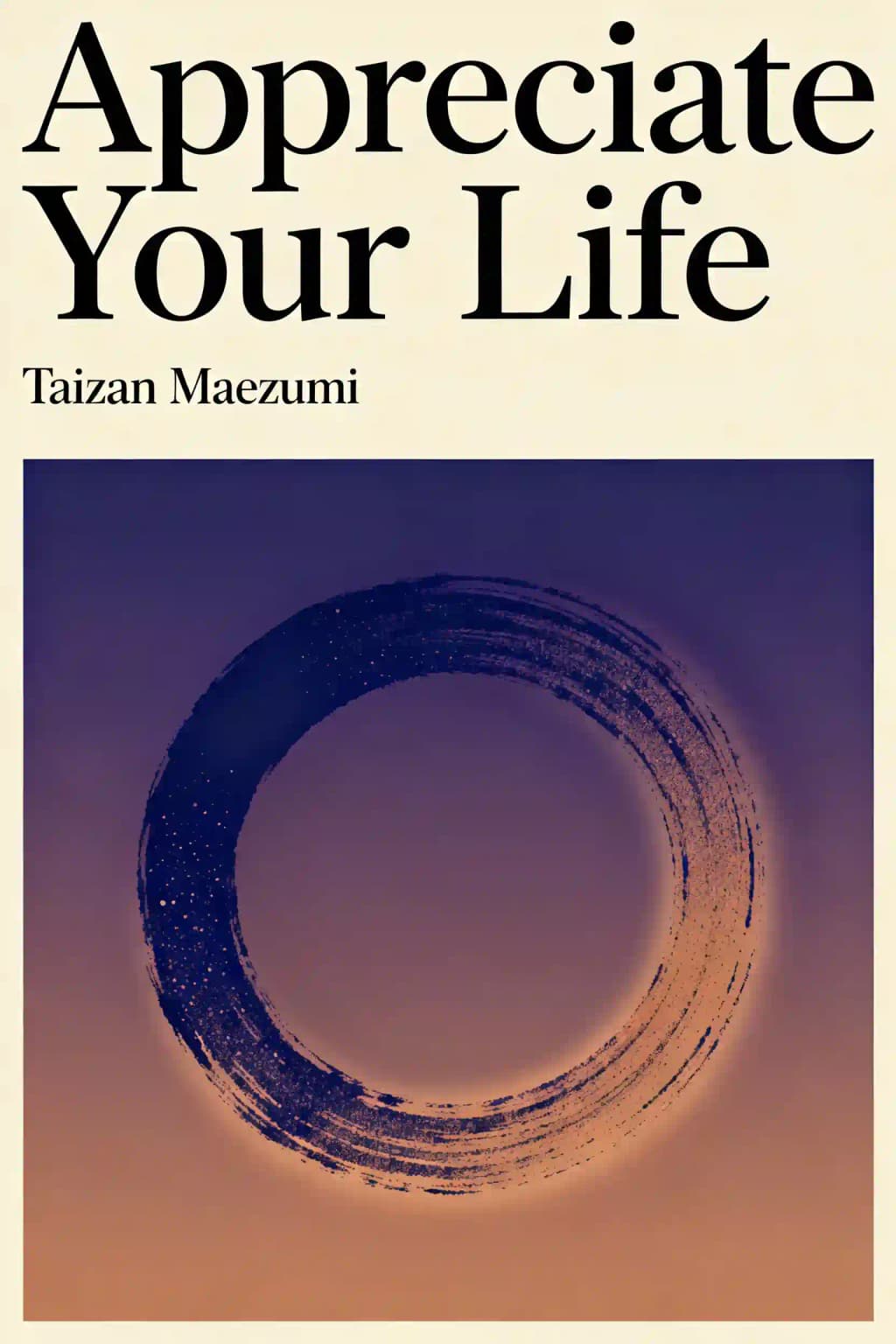
The book "Appreciate Your Life" by Taizan Maezumi Roshi stands as one of Zen Buddhism's most profound yet accessible teachings. Born into a prominent Soto Zen family in Japan, Maezumi uniquely received teaching authorization from three different lineages before establishing the Zen Center of Los Angeles. By his death in 1995, his vision had created a network of thirty-five Zen centers across nearly a dozen countries. What makes this work extraordinary is how Maezumi bridges Eastern wisdom with Western understanding, making ancient Buddhist concepts relevant to modern life. The book has influenced countless spiritual seekers, including celebrities like Leonard Cohen and Richard Gere, who credited Maezumi's teachings with transforming their approach to art and life. Beyond celebrity endorsements, "Appreciate Your Life" has become a cornerstone text in Western Zen practice, praised for its directness and practicality. Unlike many spiritual texts that promise distant enlightenment, Maezumi insists that awakening is available right here, right now, in the mundane moments of our everyday existence.
Capítulo 2
The Paradox of Your Already-Perfect Life
No one can live your life except you. Yet what exactly is this life we're living? According to Maezumi Roshi, our life is nothing less than "the treasury of the true dharma eye and subtle mind of nirvana" - the precious treasure Shakyamuni Buddha transmitted through generations. The fundamental problem is that we fail to see our life, right here and now, as nirvana itself. We imagine nirvana as something distant, beautiful, and unattainable - completely different from our actual lives with all their messiness and complications.
The essence of Zen practice is closing this imaginary gap between what we think our life is and what it truly is. Or more precisely, realizing there was never any gap to begin with. The subtlety lies not in something hidden but in something so immediate and obvious that we continually overlook it. The moment we start thinking about it conceptually, we enter duality and lose sight of what our life truly is.
This sense of "I" - this separate self we believe ourselves to be - blocks our realization through its dualistic functioning. While duality itself isn't inherently wrong (it helps us navigate daily life), remaining confined within it subjects us to opposing values like good/bad, right/wrong, gain/loss. Our life literally comes down to right now. Now! Here! What is it?
Dogen Zenji, the founder of Soto Zen in Japan, taught that our life is born and dies approximately 70,000 times each second. Such understanding transcends our usual concerns about lifespan. One day lived with clear awareness equals many years lived without it. When we see beyond duality, beyond thinking and non-thinking, everything is already the treasury of the true dharma eye!
Our practice isn't to attain some future realization - everything is already here. Just be! Just do! Be one with breathing, with sitting, with your koan! Appreciate the world of just this! There is nothing extra needed. Genuinely appreciate your life as the most precious treasure and take good care of it. This is the heart of Zen practice - not seeking something outside yourself but recognizing the perfection of what's already here.
Capítulo 3
The Three Pillars of Awakening
Maezumi Roshi teaches that Zen practice rests on three fundamental pillars: samadhi (concentration), forgetting oneself, and actualization. These three elements form the foundation of authentic practice and lead to genuine awakening.
Samadhi involves developing concentration through repeated practice. At its most basic level, this might mean counting breaths to reduce scattered thoughts. But samadhi is more than just focus - it also means cultivating evenness of mind to accept everything equally without preference or aversion. When we develop proper samadhi, we learn to perceive the external world clearly by emptying ourselves of preconceptions and projections. Rather than seeing reality through the filter of our desires and fears, we see things as they actually are.
The second pillar, forgetting oneself, naturally emerges through deepening samadhi. Our life is fundamentally ungraspable because it's limitless - not confined to the boundaries we imagine. When we truly forget the self, joy is just joy and pain is just pain - in the midst of thinking, there is no thinker; in the midst of self, there is no self. This doesn't mean becoming blank or mindless, but rather experiencing life directly without the constant narrative of "me" and "mine" coloring everything.
The third pillar is actualization - extending our realization into daily life and sharing it with others. This means living our understanding, not just contemplating it during meditation. True awakening manifests in how we wash dishes, speak to strangers, handle conflicts, and face challenges. These three pillars parallel the stages of koan study: first realizing who you truly are, then functioning freely from that realization, and finally further accomplishing the Way by trimming away unnecessary parts of oneself.
The beauty of these three pillars is their interconnectedness. As we develop concentration, we naturally begin to forget ourselves. As we forget ourselves, our true nature actualizes itself in our daily activities. And as we actualize our understanding in everyday life, our concentration deepens. It's not a linear progression but a mutually reinforcing cycle of practice and realization.
Capítulo 4
The Dance of Impermanence, No-Self, and Peace
The Buddha taught that there are three dharma seals - impermanence, no-self, and peace (nirvana). These aren't three separate concepts but one life viewed from different perspectives. Understanding any one of them deeply leads naturally to understanding the others.
Everything in our lives constantly changes thousands of times each second, beyond our conscious awareness. The life we imagine in our heads - with its fixed identity and permanent characteristics - isn't our real life at all. Our actual existence is this constant flux, this endless dance of change, which makes us fundamentally unknowable and ungraspable. This unknowable, impersonal no-self functions perfectly precisely because it's not attached to anything.
When we truly understand impermanence and no-self, we naturally discover peace (nirvana). These perspectives overlap and reinforce each other: understanding impermanence reveals the nature of suffering and no-self; understanding no-self is itself the peace of nirvana. We don't need to seek peace somewhere else - it's already here as our life when we stop resisting what is.
Maezumi Roshi emphasizes that practice involves four essential steps: listening to dharma teachings, reflecting deeply on those teachings, practicing them diligently, and verifying them through direct experience. This process isn't intellectual - it's experiential. We must embody these understandings in our daily lives.
The practice of zazen (seated meditation) is particularly powerful for realizing these dharma seals. In zazen, we directly experience impermanence as thoughts, sensations, and emotions arise and pass away. We encounter no-self as we observe that there's no fixed entity controlling or experiencing these phenomena. And we taste nirvana in moments when we completely let go of resistance and rest in things as they are.
Rather than seeing impermanence as something to fear or overcome, Zen practice invites us to recognize it as the very texture of reality - not a flaw but the essential nature of existence itself. When we embrace impermanence fully, we discover a profound freedom and peace that transcends our usual anxieties about change and loss.
Capítulo 5
Zazen: The Heart of Zen Practice
Why practice zazen? Dogen Zenji explains that zazen is "the front gate for the Buddha dharma" - the direct entry point to Buddhist teachings. Through zazen, we actualize jijuyu zanmai (self-fulfilling samadhi), where we receive and use ourselves freely. This samadhi isn't something we create or achieve - it's Oneself, completely autonomous and the supreme wisdom transmitted directly from Buddha to buddhas.
The remarkable truth is that we are already in this state of attainment, like Daitsu Chisho Buddha who sat for ten kalpas. The Buddha dharma never appeared to him because it was already there! Those with "right trust" and "great capacity" can realize this truth immediately, while those with "small capacity" doubt themselves, thinking "I am no good" or "I'm not ready."
When we merge completely with zazen, we reveal our life as the self-fulfilling samadhi of all buddhas. This doesn't require special talent or extraordinary effort - it simply requires showing up on our cushion and being fully present with whatever arises. We must appreciate our transient life as the self-contained, self-fulfilled life of all buddhas.
The physical aspects of zazen matter. Our posture should be comfortable yet dignified, manifesting our body as bodhi (enlightenment) itself. The mudra (hand position) symbolizes unity of opposites - left hand resting on right palm with thumbs lightly touching horizontally like the surface of still water. Our feet, positioned in half or full lotus (or simply flat on the floor if sitting in a chair), help the body settle and become grounded.
Begin by swaying side to side, gradually decreasing the arc until settling upright. Tuck in your chin slightly, keep your eyes half-open with your gaze resting at a forty-five degree angle. Take several deep breaths - first exhaling completely through your mouth, then inhaling deeply. As Koryu Roshi taught, "When you breathe in, swallow the whole universe. When you breathe out, breathe out the whole universe."
Mental concentration centers in the hara, about two inches below the navel. Following Dogen's instruction, "Think of not-thinking. How? Non-thinking," we penetrate into the nondual state beyond thinking and not-thinking. Just-sitting requires forgetting the self - no thoughts because there's no thinker. We become the sounds, the raindrops, the thunder. In zazen, we expect nothing, for everything is already here.
Capítulo 6
Closing the Gap Between Who You Are and Who You Are
The paramitas (perfections) in Buddhism are often described as means "to reach the other shore." But Dogen radically reinterprets this, teaching that "the other shore is already reached." The purpose of practice isn't to get somewhere else but to realize that this shore and the other shore are the same - to close the gap between our ordinary life and the buddhas' life.
We're simultaneously at the starting line and the goal line, already living the buddhas' life whether we realize it or not. The challenge isn't to become something different but to recognize what's already true. The difficulty lies in not getting stuck in intellectual understanding, which creates separation between ourselves and reality. Instead, we must become one with our practice - become the breath counting, become zazen, become the koan.
To close the gap between Yourself and yourself means becoming responsible for your life as the dharma, not as what you think you are. This awareness can happen at any moment under any circumstances - while washing dishes, during an argument, sitting in traffic. When we close this gap, our life becomes delightful not just for ourselves but for those around us. We become more tolerant and generous, taking any situation as Buddha's life and managing it well.
The answer to life's great questions is simple: Be yourself! Become zazen yourself. Be your true life and death. Be the Buddha! Yet this simple matter is somehow the most difficult to do. The obstacle to awakening is always the self-centered "me, my, I" that creates a partial, relative view of reality. Nirvana isn't some future state but our life and death right here, right now.
When we sit zazen, we must do it wholeheartedly, putting all our energy into resolving the great matter. Even though we're in the midst of awakened life, we often fail to realize it - this obvious, simple truth remains elusive until we face ourselves completely. The gap we're trying to close isn't between where we are and some distant enlightenment, but between our conceptual understanding of ourselves and the direct experience of who we truly are.
Capítulo 7
The Koan of Your Life
Koan practice is often misunderstood as solving ancient puzzles or riddles. But Maezumi Roshi teaches that your life itself is the koan - the fundamental question that must be resolved. The word koan (ko-an) has deep meaning: ko means "public" or "universal" as opposed to personal ideas, while an means "maintaining one's intrinsic position." Each of us, regardless of our differences, has equal intrinsic value - the value of emptiness.
When we truly embody a koan, it enters realization. Consider the Sixth Patriarch Hui-neng's famous question to his disciple Nangaku Ejo: "What comes thus?" After eight years of struggle, Ejo answered, "When anything is said about it, you miss the mark." When he finally gave up trying to conceptualize, he realized the answer. This is seeing our original face as the unity of absolute and relative.
To "come thus" means to be thus, as this! When there's even the tiniest discrepancy between who I am and who I am, it's off. You are Avalokiteshvara Bodhisattva - that's the koan. When you practice this realization, your life becomes marvelous, giving no-fear to all beings. This is true compassion.
Shikantaza (just sitting) and koan practice seem different yet are fundamentally the same. Both embody our life as the Buddha Way, as the manifestation of the Three Treasures. Shikantaza is doing zazen as the manifestation of your life as Buddha dharma itself. Koan practice is embodying this life as the koan. Whether practicing shikantaza or koan, the point isn't about results or superiority but realizing the absolute and relative in your life.
Our life itself is the genjo koan, the embodiment of reality. The trap is thinking true self exists somewhere beyond your life as it is. In fact, our conditioned self is our true self, our life as it is exists in perfect realization. When you embody this understanding, your treasure house opens by itself.
Capítulo 8
Navigating Life's Challenges with Zen Wisdom
How do we handle life's negative extremes - pain, fear, frustration, loss? In the Four Noble Truths, Buddha speaks of suffering, but Dogen Zenji tells us there is buddha within sickness, old age, and death. "Birth and death is the life of the Buddha," and "When the Buddha is within birth and death, there is neither birth nor death." Each moment we are born anew.
The Eightfold Path begins with right understanding, which addresses ninety percent of life's pain. When making decisions, consider four aspects: time, place, people involved, and amount. The Buddha's Eight Awarenesses begin with wanting little and knowing how to be satisfied - wisdom that can sustain our lives well. Want little of what you don't have and be satisfied with what you already possess. You already have everything you need! The less we have, the more abundance we experience.
When we don't expect anything, we realize everything is already here. Your practice isn't just for yourself - when you forget yourself, your life becomes Buddha's life. When facing pain and frustration, appreciate your life as Buddha's life.
Intimacy is a central theme in Master Sekito Kisen's poem "Identity of Relative and Absolute." The mind of the Great Sage isn't merely conveyed but is intimate - vividly present. The relative fits the absolute like a box and lid; the absolute meets the relative like two arrows meeting midair. Our ordinary life is the relative part while our essential Buddha nature is the absolute. These aren't separate but function as one.
Like the legendary archery masters whose arrows met in midair, our true nature and apparent self are intimately connected. We must live so that our life and all externals are together as one. This isn't achieved through intellectual effort but by realizing you are already as you are. Taking refuge in the Three Treasures is intimacy - being one with Buddha, Dharma, and Sangha. Accept yourself as you are and your life as it is. Trust yourself as the Buddha Way itself. Inside and outside your robe are one - there is no division.
Capítulo 9
Living as Boundless Compassion
The Four Bodhisattva Vows begin with saving all sentient beings, which means saving oneself in both limited and unlimited senses. Buddha's teaching shows one is all, all is one - there's no separate "other life." The bodhisattva realizes the Way and lives that life, knowing that in helping others, they help themselves.
We say bodhisattvas "sell water by the river" - seemingly unnecessary since we are already the water itself, true nature itself! The bodhisattva uses everything, including intellectual ideas, to save beings from attachment to those very ideas. Each moment of our life includes all sentient beings, as Shakyamuni Buddha declared upon enlightenment: "I and the great earth, all beings, have simultaneously attained the Way." Our vow is to realize what this "I" truly is.
The Four Bodhisattva Vows address our fundamental practice: (1) Saving all sentient beings by seeing one life as all life; (2) Putting an end to inexhaustible desires by eliminating the deluded separation that creates problems; (3) Mastering boundless dharmas by truly seeing what this one life is; and (4) Attaining the unsurpassable Buddha Way. Our life is already the Way - the best bodhisattva practice is living this seemingly small individual life as one whole life in relationship to all surroundings.
Like Master Zuigan who called to himself, "Is the master in?" we must recognize that the "others" who deceive us are not outside ourselves. Everything happens now, and this precious life is the water by the river - no need to buy what we already possess.
During a Zen and Christian worship service, Maezumi was struck by the Beatitude: "Blessed are the pure in heart for they shall see God." He explores this as a koan, examining what "heart" truly means - not our physical heart, but something synonymous with mind or spirit. To be pure in heart means to be genuine enough to be in God's heart. Seeing God parallels Buddhist teachings about seeing the Tathagata - not through forms or perceptions.
When you're pure in heart, you see the dharma, but thinking "I am pure" creates stains through comparison. True purity comes when you drop all ideas of pure versus defiled. Similarly, "Blessed are the poor in spirit" connects to Buddhist teachings - to be poor in spirit means to have nothing, to embody no-mind, which reveals the boundless kingdom of heaven.
Capítulo 10
The Eternal Dance of Life and Death
Dogen Zenji teaches that life does not become death, and death does not become life - each exists in its own state with its own before and after. Like firewood and ash, or winter and spring, they are distinct periods. This is the confirmed teaching of buddha-dharma: life is "non-born" and death is "non-extinguished." We can understand life and death in three ways: as division (birth to death), as change (moments of transformation), and most realistically, as instances (being born and dying countless times each day).
The practice of Buddha Way transcends this duality. When the "ten thousand dharmas are without self," there is no life and death - whose death could it be without self? Our original self is always here; we've never gone anywhere. The koan of Master Dogo and Zengen illustrates this profound inquiry - when Zengen asked if a corpse was alive or dead, Dogo refused to answer, forcing Zengen to discover for himself that life manifests completely in each moment. As Dogen says in Zenki, "Life is manifestation" - the total realization of both life and death simultaneously.
Death is inevitable, yet unpredictable. When someone dies, perhaps five hundred people suffer. What happens after death? A doctor who died of cancer concluded life ends at death, but others maintain it's simply unknown - beyond logical speculation.
Before birth presents similar questions. Without our ancestors, we wouldn't exist. If we came from somewhere before birth, are we going somewhere after death? The Buddha identified birth, illness, aging and death as suffering, teaching there is no substantial self while simultaneously instructing us to make this "I" a torch illuminating our path.
Maezumi believes life continues after death - "I will die and not die simultaneously." The unborn, undying life that has been continuing is crucial, though we don't know exactly how it continues. When we're not aware of this undying life, we're "killing the life of buddhas and ancestors." Our actions always have causes and effects, so we should be kind to each other and ourselves.
Impermanence is one of the thirty-seven conditions favorable to enlightenment taught by Dogen Zenji. Rather than seeing impermanence as merely the transient nature of life and death, Dogen presents a profound perspective: "Impermanence is the Buddha nature." This isn't just about contemplating the deterioration of the body, but understanding that impermanence itself is our true nature. When we truly see that our lives arise through constantly changing causations, we find freedom in no-self.
Capítulo 11
Shakyamuni Buddha and I Are Practicing Together
When we understand Master Gensha's statement, "Shakyamuni Buddha and I are practicing together," all questions about practice resolve themselves. We must have trust in our life as the Way itself, and in ourselves as Shakyamuni Buddha himself. This isn't sophisticated teaching - our life truly is the Buddha's life.
When we breathe in, we breathe in the whole universe; when we breathe out, we breathe out the whole universe. Eventually, we forget who is breathing what. There is no inside or outside, no this or that. Everything disappears together, leaving both nothing and everything.
The essence of thusness is enlightenment itself. Dogen Zenji teaches that to think of attaining thusness is already to be a person of thusness - we are already thusness, the as-it-is-ness that is supreme enlightenment. This very body and mind is thusness. The entire universe in ten directions is merely a small portion of supreme enlightenment, yet our bodies and minds manifest as the entire universe because they are selfless.
Those who suddenly arouse the mind to seek verification of what they haven't yet verified are already persons of thusness - their effort isn't personal effort but the effort of thusness itself. Even our anxiety about attaining thusness is itself the essence of thusness. Our lives cannot be measured by any restricted ruler; we ourselves are the mark, the bow, and the arrow. The wisdom Buddha manifests is innate in all of us.
When becoming a Buddhist, one receives the blood lineage chart that connects directly to Shakyamuni Buddha - not just the historical figure but the eternal Buddha representing all buddhas past, present, and future. This lineage represents awakening to one's Buddha nature. The most precious aspect of this lineage is the realization that "this very mind is Buddha." Upon awakening to this truth, one's life becomes identified with Shakyamuni's and with the entire universe.
This is what Shakyamuni discovered when he declared, "I and the great earth, all beings, simultaneously attain the Way." The jukai ceremony confirms this connection - the red bloodline forms one continuous circle from your name back to Buddha. Buddhism transcends religious labels; it's about awakening to one's true nature regardless of background. The Buddha Way is universal - it's about living this life in the best way possible as a fully realized human being.