Capítulo 1
When AI Meets Human Potential: The Dawn of a New Era
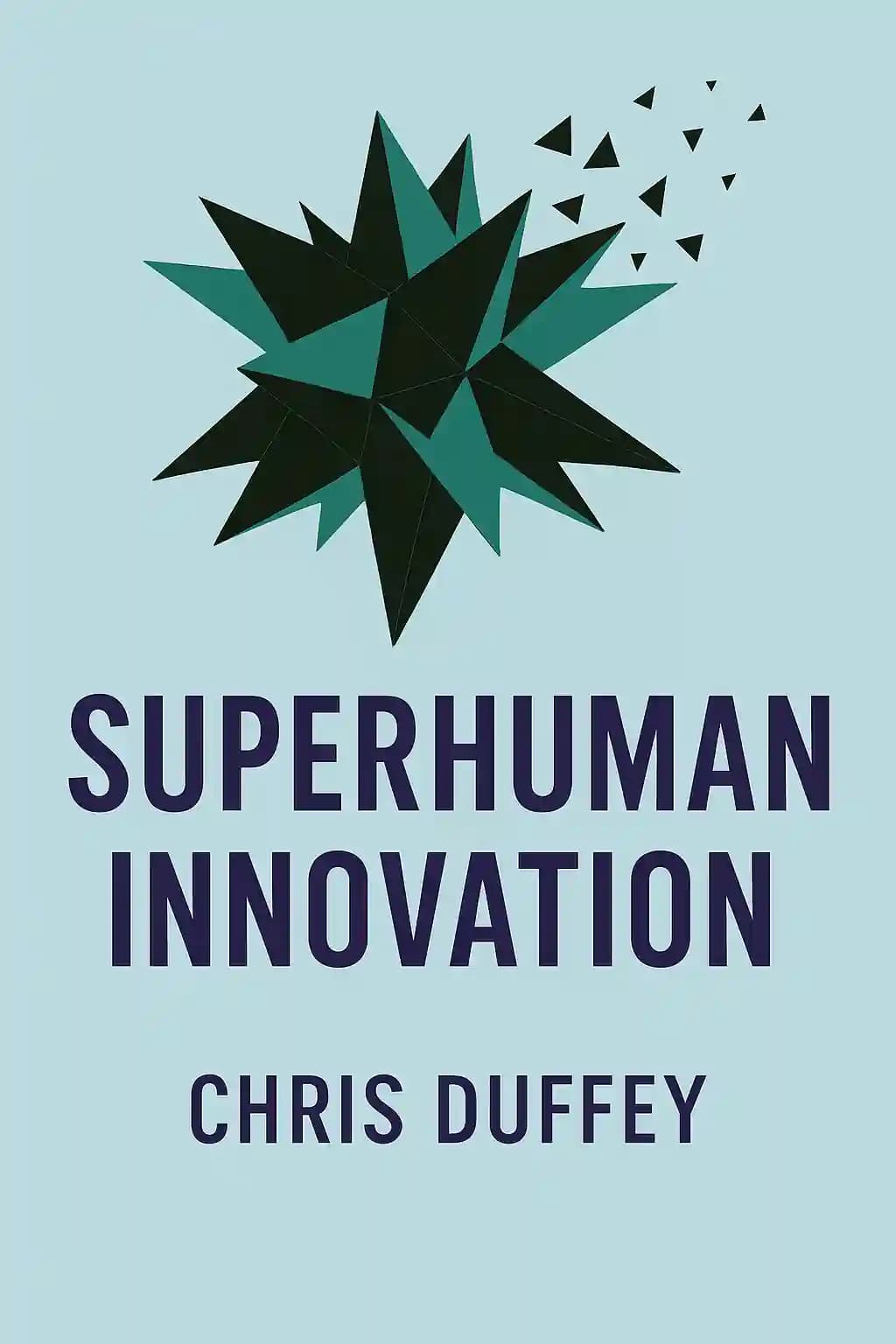
What if I told you that the most transformative technology of our time isn't replacing humans, but making us superhuman? This is the provocative premise behind Chris Duffey's groundbreaking work "Superhuman Innovation." As a creative director at Adobe who leads strategic development partnerships, Duffey doesn't just theorize about AI-he lives it. In fact, he used AI as a co-author for this very book, demonstrating its practical applications while writing about them. The book has garnered attention from industry leaders at Google, Microsoft, and IBM, who recognize it as essential reading for understanding how AI will reshape business. Unlike many technical AI books that focus on algorithms and code, Duffey's approach centers on practical business applications that can transform organizations today. In a world where companies are desperately seeking AI guidance, this book offers a clear framework for implementation that has already influenced countless innovation strategies across Fortune 500 companies.
Capítulo 2
The Second Mind: How AI Extends Human Capabilities
When a child develops the understanding that others have their own thoughts and feelings-the theory of the second mind-it marks a significant developmental milestone. This cognitive leap, typically occurring around age four, enables empathy, collaboration, and complex social interaction. Humanity is experiencing a similar awakening with artificial intelligence as our collective "second mind," expanding our abilities beyond what we previously imagined possible. This parallel development represents not just a technological advancement, but a fundamental shift in how we process and interact with the world around us.
This concept of AI as a complementary intelligence isn't new. Throughout history, humans have used other intelligences to enhance their abilities-from ancient Greeks using pigeons to deliver Olympic results to medieval scholars employing astronomical calculation devices, and our modern use of computers. What's different now is the scale and sophistication of this complementary intelligence. Modern AI systems can process millions of data points simultaneously, recognize complex patterns, and generate insights at speeds that would take humans centuries to match.
The relationship between humans and AI resembles that of Leonardo da Vinci's approach to art and science-a beautiful convergence of creativity and logic. Just as da Vinci didn't see art and science as separate disciplines but as complementary ways of understanding the world, AI and human intelligence aren't competing forces but collaborative powers that together create something greater than either could alone. For instance, in medical diagnosis, while AI can analyze thousands of medical images with remarkable accuracy, human doctors provide the crucial emotional intelligence and contextual understanding needed for holistic patient care.
Every 10-15 years, a game-changing technology platform emerges. From desktop computing in the 1980s to the internet in the 1990s to mobile devices in the 2000s to cloud storage in the 2010s, each innovation has built upon the previous. AI emerged largely from our need to make sense of the vast data created by these technologies. Its transformative potential rivals that of electricity-not just changing how we innovate, but what we create. Consider how AI is revolutionizing drug discovery, reducing research time from years to months, or how it's enabling real-time language translation, breaking down global communication barriers.
Einstein reportedly said the true sign of intelligence is imagination. With AI, we now have "intelligent imagination" informed by data insights. This combination unlocks what Duffey calls "superhuman innovation"-the amplification of human ability through artificial intelligence to create previously impossible solutions. For example, AI-assisted design tools can generate thousands of potential solutions to engineering problems, while humans select and refine the most promising options based on real-world constraints and aesthetic considerations.
The fundamental premise is simple yet profound: AI will not replace humans but will work alongside us, freeing us to use our natural creative abilities while handling mundane, repetitive tasks. This collaborative approach represents the true mission of artificial intelligence-not to become human, but to make humans more capable than ever before. From personalized education that adapts to individual learning styles to AI-enhanced scientific research that accelerates discovery, we're witnessing the emergence of a new era of human-AI synergy that promises to unlock unprecedented potential for human achievement and creativity.
Capítulo 3
The Digital Transformation: Creating Experiences That Matter
The modern consumer lives in a world of constant connectivity, where experiences matter more than products. This shift from product-centric to experience-centric thinking represents the heart of digital transformation. But what exactly constitutes an "experience"?
Brian Solis defines experience as the sum of all customer interactions with a brand at every touchpoint throughout the customer lifecycle. This concept applies not just to consumer relationships but to employee-employer dynamics, patient-doctor interactions, and business-to-business engagements as well.
Amazon exemplifies customer experience leadership through their entire operation. From their website to fulfillment centers optimized with robots and intelligent product placement, their customer-first philosophy permeates everything they do. Even their brick-and-mortar stores reflect this commitment to seamless experiences.
Voice technology has created entirely new customer touchpoints through assistants like Alexa, Google Home, and Apple HomePod. These interfaces enable frictionless interactions for everyday tasks from checking weather to ordering products. In business settings, physicians query medication side effects, truck drivers plan routes, and managers book meetings-all through voice commands that eliminate traditional friction points.
These friction points-moments in the customer journey that cause frustration or purchase abandonment-must be identified and eliminated. Netflix successfully does this by predicting and suggesting content based on viewing history. Banks have implemented voice authentication to replace cumbersome security questions. Credit card companies maintain customer profiles tracking typing speed and navigation habits to prevent fraud while maintaining convenience.
In healthcare, telemedicine applications eliminate the friction of office visits by enabling remote consultations via smartphones. Apple's HealthKit takes personalization further by gathering medical data and providing tailored reminders for medication, exercise, and other health activities.
The customer journey must be seamless across all touchpoints-one frustrating interaction can ruin the entire brand impression. Consider a hypothetical car-buying scenario: a perfectly designed digital experience can be undermined by disconnected systems at the dealership level, resulting in lost sales and negative social media impact. Conversely, Amazon's approach to error handling-connecting customers directly with local shipping supervisors who can resolve delivery problems-turns potential negative experiences into brand advocacy opportunities.
Creating great experiences extends beyond customers to employees. Building a sense of community and shared purpose increases employee loyalty, innovation, and productivity. Companies like Knowbe4 foster this through daily status meetings where team members gather informally on bean-bag chairs to discuss goals and company performance, while sharing in financial success through bonus plans.
In an experience culture, the entire organizational ecosystem must work together seamlessly. This requires businesses to gather and analyze comprehensive data about customer and employee needs, habits, and preferences. Without this data foundation, delivering optimum experiences becomes impossible.
Capítulo 4
Data: The Essential Fuel for AI Innovation
Data serves as the essential fuel for AI, powering every intelligent decision and prediction. From your current location and phone number to your car's engine health metrics and driving patterns, data points build comprehensive profiles that enable personalized experiences. Marketers collect customer demographics, online behaviors, and purchasing patterns, while electronic health records (EHRs) centralize medical information from various providers to enable better-informed healthcare decisions.
The power of data comes with significant challenges-it's labor intensive to gather, complex to manage, and requires massive resources for storage, communication, and security. Consider Amazon's seemingly simple transaction: each product has a unique barcode with associated information about dimensions and warehouse location; orders must be tracked through multiple touch-points including warehouses, shipping companies, and merchants; and all this information must be captured, organized and indexed while maintaining high performance.
Cloud computing has revolutionized data storage, moving services from local computers to internet-hosted platforms like Amazon Web Services, Google Cloud Platform, and Microsoft Azure. Many companies create private clouds for internal use or adopt hybrid models mixing external cloud services with internal resources. This accessibility has sparked the rise of Software as a Service (SaaS) applications like Adobe Creative Cloud and Microsoft 365.
The true power lies in leveraging data to identify broad populations, use cases, and trends through pattern recognition. Smart devices transmit consumer habits that can be correlated with social media activity and other information to determine trends. The challenge involves breaking down silos between different departments and organizing both structured data (easily classified information like names and dates) and unstructured data (videos, social media posts, GPS location data) to gain comprehensive insights.
Organizations need both defensive data strategies (meeting regulatory requirements, reducing expenses, mitigating risks) and offensive strategies (improving revenue, creating new products, generating ROI). Companies like PayPal gain competitive advantage through data strategies that support customer-first policies, using machine learning to continuously improve fraud detection.
However, the process is complex-80% of the work involves acquiring and preparing data, which must be captured, formatted, filtered, structured, indexed, and manipulated before becoming useful. With the Internet of Things projected to generate over 500 zettabytes of traffic annually, infrastructure for storage and processing presents significant challenges.
Walmart exemplifies effective data strategy, using information from their distribution system for demand planning, forecasting, and inventory management to optimize their supply chain. During the 2008 recession, they employed both offensive and defensive strategies, removing thousands of marginal SKUs to reduce clutter and improve efficiencies.
Even small businesses have data strategies, whether formally defined or not. Ultimately, data should be driven by business strategy, not the other way around, as businesses often restrict growth based on infrastructure limitations.
Capítulo 5
Building the Foundation: Infrastructure for AI Success
Infrastructure serves as the foundation upon which applications, both AI and non-AI, reside. It encompasses decisions about where systems will be hosted-locally in company-owned computer rooms, in the cloud, or a hybrid approach-and includes communications networks, hardware, and virtualized machines.
The primary infrastructure challenge for most companies is maintaining vital legacy systems while simultaneously expanding and building new systems. Organizations must continue operating as they enhance infrastructure, whether by adding components like disc cabinets or constructing entirely new computer rooms. In many cases, legacy applications cannot be moved to newer equipment, necessitating hybrid approaches where old infrastructure continues operating alongside new systems.
While startups enjoy the advantage of beginning with a clean slate, established companies must make difficult decisions about their legacy systems. Options include maintaining aging applications with specially trained technicians or building entirely new infrastructure and migrating data. Each approach carries risks that must be thoroughly understood to prevent business disruption.
When transitioning to new systems, companies must determine whether to maintain applications in-house, outsource to vendors, or adopt Software as a Service (SaaS) solutions, while considering hardware requirements, staffing needs, and disaster recovery plans. One retailer's experience highlights the importance of proper testing environments-after spending millions on development and faster hardware, their new merchandising system initially performed worse than the legacy system due to bugs and inefficiencies that weren't caught during testing.
Infrastructure architecture can be conceptualized in layers, beginning with networks, followed by hardware such as servers and disc drives (or cloud equivalents), and then operating systems and virtualization. Many businesses now leverage cloud-based resources, which offer advantages in cost, performance, availability, and disaster recovery, though this requires greater investment in network infrastructure.
When designing infrastructure, scalability is paramount-systems must accommodate business growth without requiring redesign or reimplementation. High availability and disaster recovery are also critical considerations, ideally implemented at the hardware or virtualization layer rather than within individual applications.
Technology changes become exponentially more difficult to correct as implementation progresses-errors are easiest to fix in preliminary design, harder during coding, more difficult after database population, and extremely challenging in production. This principle highlights the advantage of agile and scrum methodologies over traditional waterfall approaches.
For infrastructure stability, it's advisable to avoid bleeding-edge technology unless absolutely necessary, allowing time for bugs and performance issues to be resolved. Security and privacy considerations should be designed into systems from the beginning rather than added later.
Capítulo 6
The SUPER Framework: A Strategic Approach to AI Implementation
The SUPER framework provides a strategic model for harnessing AI as a catalyst for innovation. This five-pronged approach-Speed, Understanding, Performance, Experimentation, and Results-serves as the foundation for successful AI implementation. All five elements must be addressed for an AI project to succeed, though strategies may emphasize certain aspects depending on specific requirements.
Speed ensures solutions produce quick results-like telemedicine that can't afford delays for sick patients. Understanding means AI-enabled solutions must enhance comprehension of problems-like smart home alarms that learn which visitors to admit. Performance focuses on accomplishing designed tasks effectively-such as autonomous ships navigating adverse conditions. Experimentation addresses both AI's internal curiosity and its ability to spark human inspiration-MIT research shows algorithms with artificial curiosity solve complex problems more effectively. Finally, Results must impact the business bottom line through measurable outcomes.
The SUPER framework provides superhuman capabilities based on the premise that humans and machines working together outperform individuals working alone. This approach enhances human roles rather than replacing them. The 2014 "centaur" concept in chess exemplifies this-combining human intuition, creativity, and empathy with a computer's calculation abilities. This human/AI system works best when roles are clearly defined, letting each contribute their strengths: AI excels at data storage and complex calculations, while humans master social interactions and nuanced tasks.
AI can function as an assistant, peer, or manager. KLM's Customer Service Rep Tool helps agents handle overwhelming social media messages by pulling information from historical customer data and various sources. Facebook uses AI algorithms with human reviewers to analyze thousands of posts and determine newsfeed content relevance. As a peer, AI can predict football plays-two NC State students built a system that predicted NFL plays with 91.6% accuracy. As a manager, AI can control traffic lights, as demonstrated in Pittsburgh where travel time was reduced by 25%.
The relationship between humans and AI is symbiotic-they learn from each other. AI health systems can assist physicians by analyzing thousands of patient records to identify rare diseases doctors might miss. Similarly, Malwarebytes uses machine learning to detect new malware by analyzing behavioral deviations from normal patterns.
AI strategy must support business strategy, which according to Michael Porter falls into three categories: cost strategy (exemplified by Walmart using AI to improve logistics), differentiation strategy (like Tesla creating an entirely new electric car ecosystem), and focus strategy (such as Starbucks with customizable coffee). AI can enhance each approach through predictive analysis, identifying market gaps, and creating logistical efficiencies.
Capítulo 7
Speed: Accelerating Business Through AI
Speed is critical to business success, as demonstrated by Thomas Burke's Olympic victory using a new four-point stance-showing how small changes can yield significant results. One key limitation on business growth is production capacity; companies can only sell what they can produce.
Throughout history, manufacturing innovations have driven growth, from Henry Ford's assembly line (reducing car production from 12 hours to 2.5 hours) to Japanese automakers' just-in-time delivery systems. While emergencies can accelerate production (like US aircraft manufacturing during WWII), sustainable change often works better through incremental improvements using the Kaizen philosophy.
Technological advancements following Moore's Law (computing power doubling every two years) now make organizational acceleration more achievable through AI. Adobe Sensei exemplifies this by using AI to address content velocity challenges, helping marketers meet demands for personalized experiences by speeding up content creation, distribution, and optimization. Its auto-tagging feature accelerates image searches in large collections.
AI also streamlines operations by automating paperwork for support calls, allowing customer service representatives to focus on customers rather than forms. Taking this further, AI chatbots can fully automate common customer service issues, providing 24/7 support with fewer errors while enabling proactive customer interactions.
Manufacturing processes face challenges with performance, efficiency, and production errors that limit scalability. Companies like Nintex Workflow Cloud examine entire manufacturing workflows to identify patterns and bottlenecks, suggesting comprehensive improvements rather than creating robots for individual tasks. FANUC partnered with NVIDIA to use AI chips enabling industrial robots to train themselves, cutting down training time and improving assembly line performance.
In healthcare, AI is transforming early diagnosis and treatment. IBM Research's Center for Computational Health developed a system that mines electronic health records to predict conditions like heart failure before patients reach critical stages. IBM's Watson for Genomics and Watson for Oncology assist doctors, while DeepMind Health supports healthcare systems like NHS.
AI is revolutionizing retail by addressing checkout lines and personalizing shopping experiences. Technologies like AI-powered body scanners speed up airport security, while startups like IMAGR and Mashgin develop systems that automatically tally shopping cart items, potentially eliminating checkout lines altogether. Personal shopping assistants create highly customized experiences-45% of retailers plan to implement AI to improve customer interactions.
Capítulo 8
Understanding: Gaining Deeper Insights Through AI
AI's ability to improve understanding of customers, employees, and markets is as crucial as its speed benefits. Machine learning enables computers to learn without specific programming, solving problems in object recognition, speech, language translation, and more-though each requires systems tailored for specific tasks since general AI doesn't yet exist.
Human communication involves countless variables-sight, tonality, sentence structure, voice inflection, body language, eye position, historical context, speaker affinity, pronunciation, emotional state, intent, education, and interpersonal dynamics. This complexity explains why emails and texts are often misunderstood, as they lack body language and tone that convey sarcasm and humor.
AI expands understanding by enabling meaningful connections across distance and time. For businesses, this means identifying interested customers while avoiding the disinterested. AI can determine when consumers are receptive to messages and products, displaying ads only when appropriate. According to research, ad spend for real-time bidding networks will reach $42 billion globally by 2021, with 80% of senior marketers believing consumers are ready for AI.
AI enhances understanding through technologies like body language analysis, facial recognition, gait analysis, and eye tracking. Companies like Modiface use AR and AI for beauty product marketing, with technology that tracks 68 facial parameters including iris size, lips, eyes, and head position. This technology previews future smart homes where mirrors in bathrooms and dressing rooms will let consumers virtually try different clothes and makeup, then order products they like for quick delivery.
In healthcare, AI enhances understanding through applications like Ada, a health tech startup's "personal health companion" that assesses patient symptoms and recommends follow-up with medical professionals when needed. Samsung's Know You Again AI glasses help people with dementia by displaying information about approaching people, creating meaningful experiences through augmented reality and artificial intelligence.
Understanding customers has evolved from ancient marketplace vendors adapting their offerings to modern AI systems that adaptively learn customer behaviors. Today's systems can de-silo data across physical and digital touchpoints to create deeply personalized experiences. Supermarkets strategically place fresh products near entrances based on psychological insights, while services like Adobe Experience Cloud integrate geofencing and behavioral data to maintain customer loyalty through precisely delivered experiences.
Capítulo 9
The AI-Infused Future: Transforming Humanity
We truly live in magical times, yet we're barely cognizant of the technological power we're gaining. The smartphone exemplifies this transformation-replacing phone booths with devices that connect anyone on the planet, send messages instantly, play sophisticated games, and stream high-definition content. These pocket-sized computers already monitor health with AI-driven recommendations, pinpoint our location with GPS, and enable augmented reality experiences.
The promise of AI combined with other technologies is vast. Smart cities could use AI to manage traffic flow, dim streetlights when unnecessary, and plan maintenance. Crime reduction, emergency services, and utilities could all be managed more efficiently. Smart homes could learn who should have access, control lighting based on behavior, and refrigerators could automatically order food based on consumption patterns.
Today's children have unprecedented capabilities thanks to smartphones and AI. Unlike previous generations who relied on physical encyclopedias, card catalogs, and handwritten assignments, modern children can access millions of resources instantly, attend lectures remotely, and use AI to help understand information. This technology blend is creating "superchildren" who can research and create from anywhere, transforming childhood itself.
The evolution of visual design illustrates AI's transformative power. From the days when graphic artists used physical tools like pens and plaster letters, to digital tools like Photoshop, and now to AI-powered tools like Adobe Sensei that can automate precise image changes and predict modifications across millions of photos. These technologies are creating "superartists" freed from physical constraints, allowing completely unfettered creative expression.
Working on a farm has historically been one of the most dangerous occupations. Today, large air-conditioned machines handle ploughing, while AI has revolutionized farming forever. Machine learning precisely delivers water to individual plants, determines exact pesticide mixtures, and fine-tunes the entire growing cycle. These "superfarmers" have the potential to eliminate starvation by growing higher quality food in greater quantities with less environmental impact.
In healthcare, non-invasive surgeries allow operations that once required extended hospital stays to be done on an outpatient basis. The internet of medical things enables holistic patient monitoring, while robotic surgeons perform delicate operations with humans primarily supervising. These "superdoctors" and "superhospitals" are improving lives, extending lifespans, and addressing medical problems quickly and easily.
In the past, human interactions were limited by distance and communication ability. The internet changed that dynamic forever, allowing individuals to communicate with anyone globally from a handheld device, retrieve information from libraries worldwide, and have food delivered directly by drones. AI promises even greater changes at the individual level. Virtual and augmented reality guided by AI enable new vistas of understanding, while IoT devices like smart refrigerators automatically order food. Education and entertainment are available at anyone's beck and call. AI has created the "superyou" with powers beyond belief at your fingertips-the ultimate magic of AI that will ultimately result in "superhumanity."
As Salvador Dali said, "Intelligence without ambition is a bird without wings." The combination of human ambition with artificial intelligence creates something truly superhuman-a future limited only by our imagination and our willingness to embrace these new capabilities.