Capítulo 1
The Culinary Revolution That Transforms Home Cooking
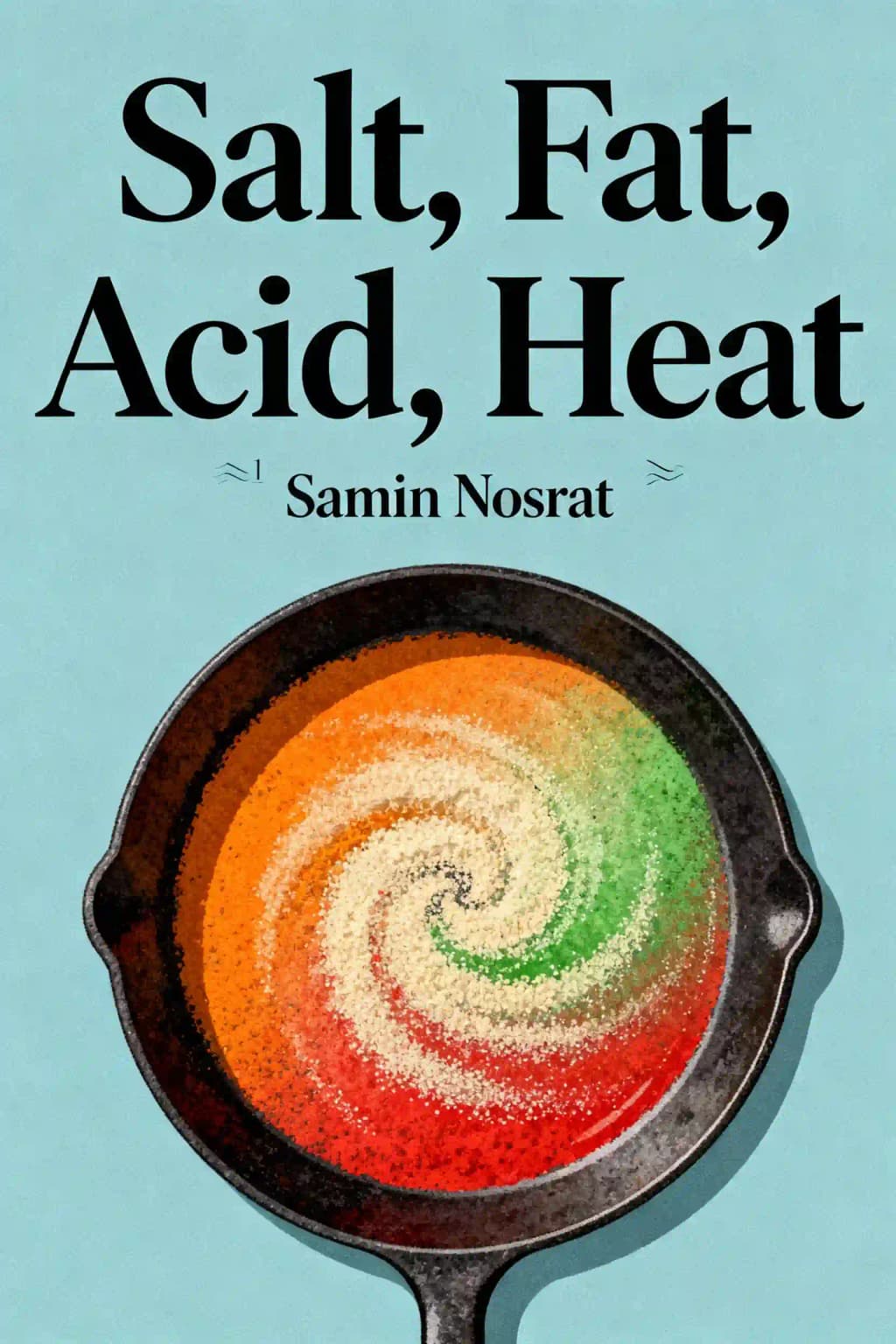
In 2017, a relatively unknown chef named Samin Nosrat published a cookbook that would forever change how we think about cooking. "Salt, Fat, Acid, Heat" quickly became a sensation, landing on The New York Times bestseller list and earning praise from culinary icons like Alice Waters and Yotam Ottolenghi. The Netflix adaptation further cemented its cultural impact, with Time magazine naming Nosrat one of the 100 most influential people of 2019. What makes this book revolutionary isn't fancy recipes or exotic ingredients, but rather its elegant distillation of cooking into four fundamental elements that anyone can master.
Capítulo 2
The Four Elements That Govern All Good Cooking
Imagine standing in your kitchen, overwhelmed by a complex recipe with unfamiliar techniques. Now imagine instead understanding the simple principles that make food delicious-principles that work whether you're making pasta in Italy, curry in India, or tacos in Mexico.
This is Samin Nosrat's revelation: good cooking across all cuisines is governed by just four elements-Salt, Fat, Acid, and Heat. Master these, and you can cook anything well, with or without recipes.
Nosrat's culinary journey began unexpectedly when, as a college student at UC Berkeley, she dined at Alice Waters' legendary Chez Panisse restaurant. The meal so moved her that she wrote to Waters asking for a job. Starting as a busser, she eventually worked her way into the kitchen, where she was initially intimidated by the chefs' seemingly innate knowledge. They discussed dishes from around the world without cookbooks, preparing whatever the chef imagined based on available ingredients.
As she improved through questioning, reading, cooking, and tasting, Nosrat began detecting patterns in the seemingly impenetrable maze of daily-changing menus. Salt, Fat, Acid, and Heat were the four elements guiding basic decision-making in every dish. This revelation transformed cooking from an inscrutable mystery into a systematic approach that anyone could learn.
Capítulo 3
Salt: The Mineral That Transforms Food
Growing up, Nosrat thought salt belonged only in a shaker at the table. Her culinary awakening came while making polenta at Chez Panisse, when Chef Cal Peternell shocked her by adding three enormous palmfuls of salt to her pot. The transformation was revelatory-the corn tasted sweeter, the butter richer, all flavors more pronounced. It wasn't salty; it simply had a satisfying zing!
Salt is an essential nutrient our bodies need to survive. Our hardwired craving for it explains why it appears in cuisines worldwide. But salt's primary role in cooking isn't just adding saltiness-it's amplifying flavor. It enhances other tastes by minimizing bitterness, balancing sweetness, and heightening aromas. Think of a rich espresso brownie with flaky sea salt-the salt reduces bitterness, intensifies chocolate flavor, and offers savory contrast to sweetness.
The type of salt matters less than familiarity with your chosen salt's characteristics. Salt crystals form differently based on evaporation methods: rapid evaporation creates small, dense cubes (table salt), while slow solar methods produce light, hollow flakes (like Maldon). These varying shapes significantly impact cooking, as a tablespoon of fine salt can be two to three times "saltier" than coarser salt.
Kosher salt, particularly Diamond Crystal, has become the professional kitchen standard because its light, hollow flakes adhere well to food, dissolve quickly, and are harder to oversalt with. For everyday cooking, use kosher or refined sea salt to season from within-in pasta water, on roasts, with vegetables, and in doughs. Reserve expensive flaky sea salts for finishing, where their texture and flavor can shine.
Proper seasoning means food shouldn't taste salty; it should be salted. This requires constant awareness of how a dish tastes throughout cooking-sometimes just seven grains of salt make the difference between satisfactory and sublime. When food tastes flat, underseasoning is the likely culprit. Your palate will become more discerning with practice.
Capítulo 4
The Science of Salt: Transforming Food from Within
Salt distribution in food follows basic chemistry principles-osmosis and diffusion. When you salt chicken, the grains dissolve and move inward while water moves outward to the surface, both seeking chemical balance. This is why properly salted meat tastes seasoned throughout, not just on the surface.
Seasoning meat in advance allows salt time to diffuse evenly, seasoning from within. Time matters more than quantity-a small amount applied early works better than more applied just before cooking. Though salt initially draws water out through osmosis, with time it dissolves protein strands into a gel that better absorbs and retains moisture during cooking.
Different foods respond differently to salt. For meat, season large cuts 1-2 days ahead; chicken a day ahead; turkey 2-3 days ahead. Fish and shellfish proteins degrade when salted too early-flaky fish need only fifteen minutes, while meatier fish steaks can handle thirty minutes. Vegetables with pectin (most produce) soften when salted, making them cook faster with less nutrient loss. For legumes and grains, salt helps soften them by weakening pectin in their cell walls.
Properly seasoned cooking water encourages food to retain nutrients. When cooking in unsalted water, vegetables lose minerals and sugars as they try to establish equilibrium with their environment. But in well-salted water, vegetables absorb salt, seasoning themselves from within while retaining their nutrients and vibrant color. Season cooking water "as salty as the sea" (about 2 tablespoons kosher salt per quart).
The three most valuable tools for encouraging salt diffusion are time, temperature, and water. Time allows salt to travel slowly to the center of foods. Heat stimulates diffusion-salt penetrates more quickly at room temperature than when refrigerated. Water promotes salt diffusion, making watery cooking methods ideal for dense ingredients when time is limited.
Capítulo 5
Fat: The Essential Flavor Carrier
Unlike salt, fat takes many forms from various sources and plays three distinct roles in cooking: as a main ingredient affecting flavor and texture, as a cooking medium enabling high-temperature browning and crisping, and as seasoning to adjust flavor or enrich texture before serving.
Fat not only has its own distinct flavors but carries and enhances other aromas, coating the tongue to prolong our experience of various flavors. This is easily demonstrated by comparing garlic sizzled in water versus olive oil-the oil version delivers a much more powerful flavor impression. Fat also enables surface browning at temperatures above 230F, introducing entirely new flavors like nuttiness, sweetness, and umami that water-based cooking cannot achieve.
Different fats have distinct flavors that define various cuisines. Olive oil defines Mediterranean cooking from Italian to Middle Eastern cuisines. Butter is versatile and common in cooler climates across North America, Europe, and parts of Asia. Neutral-tasting seed oils like canola and grapeseed are valued precisely because they don't impart flavor and have high smoke points for browning foods. Animal fats carry concentrated flavor molecules that make them taste distinctly of their source-beef fat tastes beefier than steak, pork fat porkier than pork.
Using culturally appropriate fats is essential for authentic flavor-olive oil for Mediterranean cooking, ghee for Indian dishes, or sesame oil for East Asian preparations. Most dishes benefit from using multiple fats-what Nosrat calls layering fats. Consider both cultural appropriateness and harmony with other ingredients: finish fish cooked in clarified butter with butter sauce; pair blood oranges with creamy avocado drizzled with agrumato olive oil; brush waffle irons with bacon fat before pouring in butter-enriched batter.
Capítulo 6
How Fat Creates Texture
Fat affects both flavor and texture in cooking. By transforming foods from soft to crisp or creamy, fat introduces varied textures that excite our palates. Depending on how we use fats, we can achieve five distinct textures: Crisp, Creamy, Flaky, Tender, and Light.
For food to become crisp, water must evaporate from its surface, requiring temperatures beyond 212F. Fat serves as the perfect medium, creating even contact between food and pan while heating to 350F or higher. The key is using enough fat to prevent sticking without leaving food greasy. Let your senses guide you-ensure the pan bottom is coated when sauteing, preheat properly, and drain fried foods before serving.
Emulsions are kitchen alchemy-temporary peace treaties between normally incompatible liquids like oil and water. When whisked together, tiny droplets of one liquid disperse in another, creating a creamy mixture that's neither one nor the other. Butter, ice cream, mayonnaise and chocolate are all emulsions. A simple vinaigrette demonstrates this principle, though without an emulsifier like mustard, it quickly breaks back into separate components.
Wheat flour contains proteins that form gluten when combined with liquid. As dough is kneaded, these proteins create long chains that make dough chewy and elastic-desirable for bread but not for tender pastries. Fat inhibits gluten development by coating individual strands, preventing them from linking together-this is where the term "shortening" comes from. The texture of baked goods depends on four main variables: fat, water, yeast, and how much the dough is worked.
For rich flavor and velvety crumb in butter cakes, proper creaming is essential-whipping room-temperature butter with sugar for 4-7 minutes until light and fluffy. The key is working air in slowly to form millions of tiny, consistent bubbles without generating heat through friction. Even with chemical leaveners, proper aeration is crucial since baking soda and powder only expand existing air bubbles.
Capítulo 7
Acid: The Bright Note That Balances Flavors
Technically, acid is any substance below 7 on the pH scale. While you probably don't have a working pH meter in your kitchen, we all have a handy acid sensor: our tongues. Anything sour contains acid, which in cooking typically comes from lemon juice, vinegar, or wine. But acid has many sources, including fermented foods like cheese, sourdough bread, coffee, and chocolate, as well as most fruits and even tomatoes.
"Mouthwatering" has long been synonymous with "delicious" because enjoyable foods make our mouths produce saliva. Of all five basic tastes, acid triggers this response most powerfully-our mouths flood with saliva to balance acidity and protect our teeth. Yet acid alone isn't particularly gratifying; it's how acid contrasts with other tastes that heightens pleasure in food.
Unlike salt, which has an absolute threshold beyond which food becomes inedible, acid balance is relative. Think of lemonade: lemon juice and water alone taste unpalatably sour, but add sugar and it becomes delicious, though no less acidic. The pH remains constant-the acidity is simply balanced by sweetness. Salt, fat, bitterness, and starch similarly benefit from acid's contrast.
Pure acid tastes simply sour-nothing more. The distinctive flavors we associate with acidic ingredients come from how they're produced-the type of wine used for vinegar, the milk or bacteria for cheese. Even the same cheese tastes more acidic and complex when aged longer, which is why young cheddar is mild and aged cheddar sharp.
Many iconic dishes are defined by their particular acids: peanut butter needs jelly's tang, fish and chips demand malt vinegar, carnitas tacos require salsa, and xiao long bao must have Chinese black vinegar. Like cooking fats, acid can change a dish's direction, so let geography and tradition guide your choice.
Capítulo 8
How Acid Transforms Texture and Color
Though acid primarily affects flavor, it also triggers chemical reactions that change food's color and texture. Acid dulls vibrant greens, so wait until the last moment to dress salads, mix vinegar into herb salsas, or squeeze lemon over cooked green vegetables. Conversely, acid keeps reds and purples vivid-cabbage, red chard stems, or beets retain their color best when cooked with slightly acidic ingredients like apples, lemon, or vinegar.
Acid keeps vegetables and legumes tougher longer. Foods containing cellulose or pectin cook much more slowly with acid present. While carrots soften to baby food after 15 minutes in water, they'll remain firm after an hour in red wine. This explains why onions in tomato sauce stay crunchy-cook them until tender before adding acidic ingredients. For beans and legumes, a pinch of baking soda nudges the water toward alkalinity, ensuring tenderness. Cook legumes completely before adding acid, which "uncooks" them by tightening their skins.
In meat and fish, acid first denatures proteins by unfolding them, creating a tender texture that traps moisture. But with prolonged exposure, these proteins coagulate and squeeze out water, resulting in tough, dry food. This explains why sashimi becomes tender tartare with acid, then transforms into chewy ceviche over time. Acid also helps break down collagen in tough cuts of meat, so adding wine or tomatoes early in braises creates juicy, succulent results.
While salt and fat are added as distinct ingredients, acid can actually be produced during cooking through two methods. The fast method is browning foods. When sugars caramelize or when the Maillard reaction occurs in proteins and carbohydrates, acidic compounds form among hundreds of new flavor molecules. The slower method is fermentation, where carbohydrates transform into carbon dioxide and acids through the action of yeasts and bacteria.
Capítulo 9
Using Acid Strategically Throughout Cooking
As with all good cooking, the best way to use acid is to taste repeatedly. If something is noticeably sour, it probably has too much acid. When the food tastes bright and clean, the acid balance is perfect.
Consider both which acids to use and when to add them. Just as with salt and fat, a single dish often benefits from several forms of acid layered throughout cooking. Some acids should be worked into dishes from the start-these "cooking acids" include tomatoes in pasta sauce, wine in ragu, beer in chili, and mirin in glazed chicken. They tend to be mellow, transforming foods slowly over time.
Give acid time to work when macerating shallots and onions-just 15-20 minutes in vinegar or citrus juice softens their harshness before building a dressing. There's no replacement for incorporating acid early into braises and stews; the alchemy of time and heat softens sharp edges.
Garnishing acids finish a dish with brightness. While undersalting can't be fixed at the table, a hit of acid at the last second often improves food. Freshly squeezed citrus juice is best, as its volatile aromatics disperse over time. Heat changes both citrus juice and vinegar-dulling the former and mellowing the latter-so add them just before serving for maximum impact.
The perfect peach demonstrates nature's ideal balance: sweet and juicy, but also acidic. Without that pucker, it would be all sugar and no complexity. Pastry chefs know to mimic this natural balance. The best apples for pie aren't the sweetest varieties but tarter ones like Fuji and Honeycrisp. Chocolate and coffee make perfect dessert bases because they're bitter, sour, and rich in umami-once sweetened, they trigger multiple taste receptors.
A good meal requires balance beyond individual dishes. Pair caramelized onion tart with garden lettuces and sharp mustard vinaigrette. Serve long-cooked pork shoulder with bright, acidic slaw. Balance rich Thai curry with crunchy, light cucumber salad. Each dish should be balanced in Salt, Fat, and Acid, but the meal as a whole needs balance too.
Capítulo 10
Heat: The Element of Transformation
Heat is the element of transformation. It triggers the changes that take food from raw to cooked, runny to set, flabby to firm, flat to risen, and pale to golden brown. Unlike Salt, Fat, and Acid, Heat is flavorless and intangible, but its effects are quantifiable.
Heat's sensory cues-sizzles, spatters, crackles, steam, bubbles, aromas, and browning-matter more than thermometer readings. All your senses-including common sense-help gauge heat's effects on food. Heat changes foods in predictable ways. Understanding these patterns helps you make better choices at the market, plan menus, and cook every dish.
The goal is always the same: apply heat at the right level and rate so that the surface and interior finish cooking simultaneously. Think of a grilled cheese sandwich: you need the right heat level so the bread browns at the same rate the cheese melts. Too hot, and you'll burn the bread before the cheese melts; too cool, and everything dries out before browning.
Heat is energy that transforms food through chemical reactions. Food's four basic molecules-water, fat, carbohydrates, and protein-each react differently when heated. Water content determines if food becomes crisp or moist, while controlling steam helps determine browning.
Water is essential to nearly all foods, determining texture and flavor concentration. Remove water to create crispness; retain it for tenderness. Steam is a crucial temperature indicator-its presence means surface temperatures aren't hot enough for browning. Learning to manage steam determines cooking outcomes: release it for browning or contain it for gentle cooking.
Fat's flexibility across temperatures creates diverse textures from crisp to creamy. Unlike water, fats can withstand temperatures far beyond 212F before smoking, allowing food surfaces to reach temperatures that create crispness.
Capítulo 11
Gentle vs. Intense Heat: Choosing the Right Approach
Good cooking hinges on deciding whether to cook food slowly over gentle heat or quickly over intense heat. This choice depends primarily on tenderness-whether you need to create it or preserve it. Already-tender foods (eggs, delicate vegetables, some meats) require minimal cooking to maintain their tenderness. Tough or dry foods (grains, dense vegetables, tough meats) benefit from longer, gentler cooking.
Browning, regardless of food type, typically requires intense heat, sometimes necessitating combined cooking methods-brown then simmer for stews, or simmer then brown for hash-to achieve both browning and tenderness.
The gentle cooking methods include simmering/coddling/poaching, steaming, stewing/braising, confit, sweating, bain-marie, low-heat baking/dehydrating, and slow-roasting/grilling/smoking. The intense cooking methods include blanching/boiling/reducing, sauteing/pan-frying/shallow-and deep-frying, searing, grilling/broiling, high-heat baking, toasting, and roasting.
Simmering-cooking food in gently bubbling water-is the cornerstone of cooking in liquid. While boiling is appropriate only for vegetables, grains, pasta, sauce reduction, and hard-cooking eggs, nearly everything else should be brought to a boil then reduced to a simmer. This gentler approach prevents delicate foods from falling apart and keeps tougher foods from overcooking on the surface before cooking through.
For sauces-whether tomato sauce, curry, gravy, or mole-bring to a boil then reduce to a simmer. Fresh milk sauces should remain at a simmer to prevent protein coagulation above 180F, which causes curdling.
Simmering transforms tough cuts with abundant connective tissue into tender, moist meat. At Florence's Nerbone, the secret to their renowned brisket sandwiches is simple: "I get here every morning at six and simmer it. The water must never boil."
Capítulo 12
Mastering Heat Through Multiple Cooking Methods
Sometimes you'll need to use more than one type of heat to achieve desired results-this is called layering heat. Toasted bread exemplifies this concept: wheat is first combined with water to make dough and baked until cooked through, then toasted a second time.
Breaking down the cooking process into stages allows you to finish delicate items at serving time, preventing overcooking from reheating. Restaurant cooks use this approach to balance quality with efficiency-cooking long-cooking foods (tough meats, dense vegetables, hearty grains) partially or entirely in advance, while preparing delicate items (fried foods, tender meats, fish, baby vegetables) to order.
You can braise pork shoulder overnight then grill it for tacos the next day, roast or blanch tough vegetables before sauteing them, or simmer chicken thighs until tender before shredding for pot pie. Combining different cooking methods creates pleasing texture contrasts like crisp crusts and tender insides.
Since you can't taste heat's effects until cooking is complete, other senses become crucial. The best cooks are careful observers who use all their senses to determine when foods are properly cooked:
Sight: Cakes develop golden-brown color and pull away from pan sides; fish changes from translucent to opaque; shellfish open up; quinoa's germ "tail" sticks out; pasta lightens in color; deep-fried foods emit fewer bubbles as they finish cooking; chicken turns from pink to opaque; custards jiggle only at the center.
Smell: Learn to recognize the aromas of cooking onions at different stages of browning and caramelizing sugars; notice when spices release their fragrance during toasting; always investigate burning smells.
Sound: Food should sizzle when added to a hot pan; sputtering indicates excessive hot fat; listen for boiling sounds, even through foil.
Feel: Tender meats firm up when cooked; tough meats firm up then relax again when done; cakes spring back when touched; starches sticking to pot bottoms signal potential burning; properly cooked beans and grains are tender throughout; pasta should be chewy with slight resistance; vegetables are done when tender at their thickest points.
Capítulo 13
From Theory to Practice: Applying the Four Elements
To compose great dishes, answer basic questions for each element: How much Salt, Fat, and Acid, when, and in what forms? Will ingredients benefit most from gentle or intense Heat? The answers will reveal a theme for improvisation.
Chef Judy Rodgers said "Recipes do not make food taste good; people do." While recipes can provide inspiration or instruction, cooking is circular, not linear-like touching one part of a spiderweb makes the entire thing quiver. Think of recipes as snapshots of dishes, not replacements for your senses. No recipe is infallible; you must remain present, using your judgment about which pan to use, how high to heat it, and how to judge doneness.
When deciding what to cook, choose one element as the foundation for your meal-this is anchoring. Your anchor might be an ingredient (like pre-salted chicken), a cooking method (like grilling on the first day of summer), a specific recipe, or even just what's available in your kitchen.
Balance your meal by contrasting textures, flavors, and ingredients. Pair rich meats with bright acidic sauces, mouth-drying starches with mouthwatering sauces, and incorporate seasonal companions that naturally complement each other. Layer flavors by using single ingredients multiple ways-lemon zest and juice, coriander seeds and cilantro leaves.
Any dish you love to eat-tortilla soup, Caesar salad, banh mi sandwich, margherita pizza-likely has an ideal balance of Salt, Fat, and Acid. Since our bodies can't produce certain essential forms of these elements, our palates naturally seek foods with this balance, regardless of cuisine.
Salt, Fat, and Acid can give shape to a dish or meal on their own. When deciding what to make, first determine which form of each element to use, and how and when to apply them. This creates a natural recipe structure. Use each element strategically: Salt to enhance, Fat to carry, and Acid to balance flavor. Add salt early to beans but acid late; season meat for a braise in advance, start with cooking acid, and finish with garnishing acid. Let these three elements work together to improve anything you eat, whether homemade or from a restaurant.
Capítulo 14
The Transformative Power of Understanding
What makes "Salt, Fat, Acid, Heat" revolutionary is how it transforms cooking from a mysterious art into an accessible science without losing its soul. By understanding these four elements, you gain the confidence to cook intuitively, adapt recipes, rescue kitchen disasters, and create delicious meals from whatever ingredients you have on hand.
This approach liberates home cooks from the tyranny of recipes while honoring culinary traditions from around the world. It explains why your grandmother's cooking tastes so good even though she never measures anything, why restaurant food seems more flavorful than home cooking, and why some recipes work while others fail.
Nosrat's gift is making complex culinary science accessible through clear explanations, vivid examples, and practical applications. Her warm, conversational style invites readers into the kitchen rather than intimidating them with cheffy jargon. The book's illustrations by Wendy MacNaughton deliberately avoid the food-porn photography of typical cookbooks, instead using charming drawings that emphasize techniques and principles over perfection.
By mastering Salt, Fat, Acid, and Heat, you'll develop what professional chefs call "kitchen confidence"-the ability to cook by feel, taste, and intuition rather than slavishly following instructions. You'll understand not just how to cook, but why cooking works the way it does. And in doing so, you'll join a culinary revolution that's changing how a generation of home cooks approaches food, one element at a time.