Capítulo 1
The Shadow Empire: How the KGB Reclaimed Russia and Challenged the West
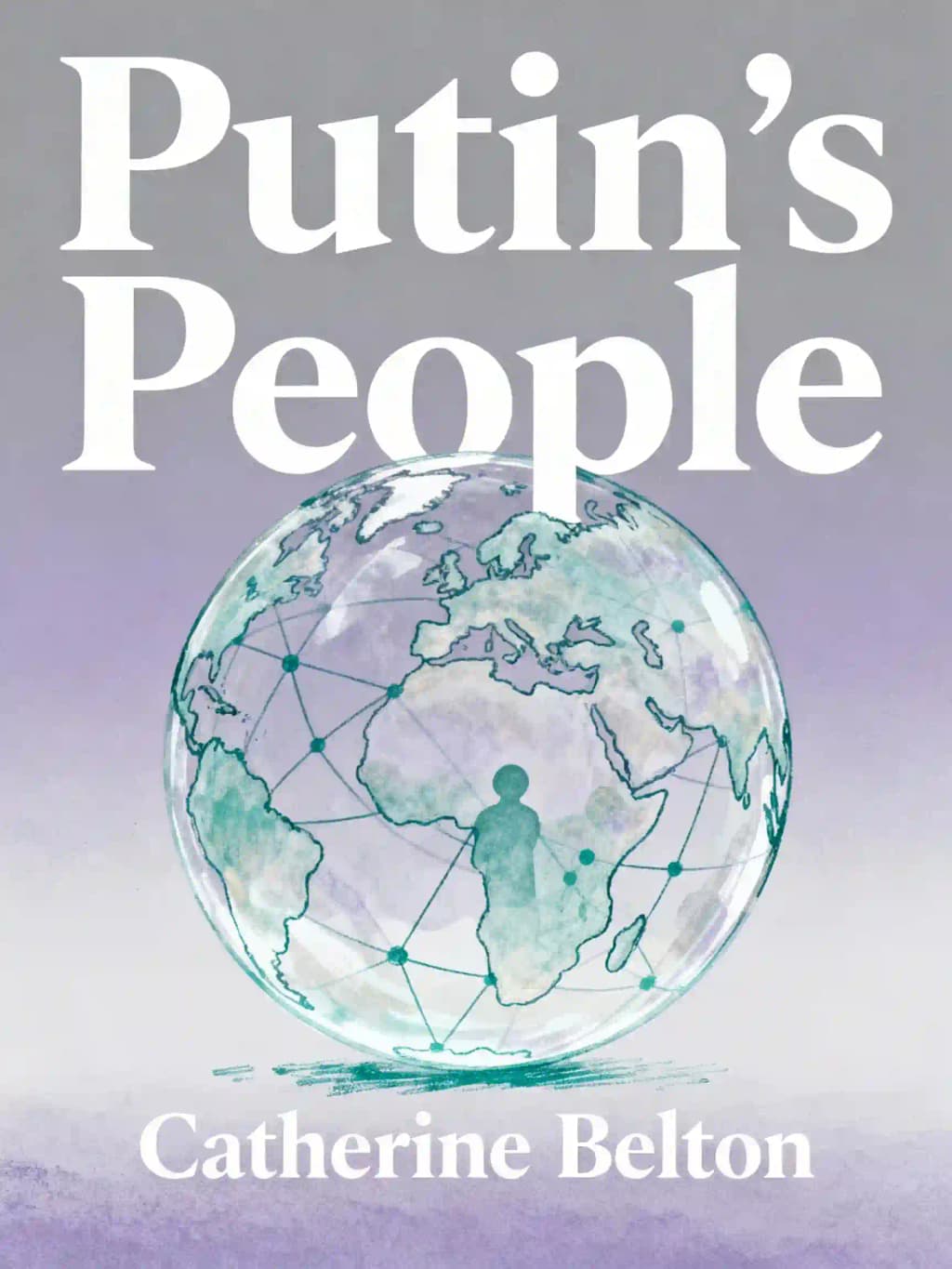
In February 1992, a documentary aired featuring Vladimir Putin as St. Petersburg's deputy mayor, projecting competence amid post-Soviet chaos. Though he claimed to have resigned from the KGB, evidence suggests he continued receiving paychecks afterward. This unassuming bureaucrat would eventually become Russia's longest-serving leader since Stalin, transforming a fledgling democracy into what critics call a "mafia state." Catherine Belton's explosive investigation draws on unprecedented access to Putin insiders, revealing how KGB networks meticulously prepared for the Soviet collapse, stashed billions abroad, and eventually recaptured the state. The book has become required reading in intelligence agencies worldwide, with The Washington Post calling it "the most important book on Russia in years." Even Bill Browder, whose Magnitsky Act sanctions battle made him Putin's nemesis, admitted: "If you want to understand Putin's Russia, read this book."
Capítulo 2
The KGB's Secret Contingency Plan
When the Berlin Wall fell in November 1989, Vladimir Putin and his KGB colleagues in Dresden were caught partially unprepared. They frantically burned documents day and night, destroying communications, contact lists and agent networks until their furnace burst. Despite the chaos, the KGB managed to secure most sensitive Stasi files before protesters reached headquarters. A Stasi officer handed over files to Putin who ensured "nothing remained of them apart from ashes." Twelve truckloads of documents were transported to Moscow, while others were burned with petrol at a nearby Soviet army base.
This desperate document destruction masked a deeper reality: parts of the KGB had been preparing for regime collapse for years. By the early 1980s, progressive KGB members at Moscow's Institute for World Economy had begun developing market-based reforms that could maintain overall control while introducing competition. When Mikhail Gorbachev became General Secretary in 1985, these ideas gained momentum through glasnost and perestroika reforms.
The KGB launched "Operation Luch" (Sunbeam) to prepare for regime change, sending Boris Laptev to East Berlin in 1988. Initially tasked with penetrating opposition groups, the operation evolved to establish agent networks that could survive German reunification by recruiting untainted second and third-tier political figures. Putin likely participated in this operation while serving as Party secretary in Dresden, putting him in contact with local SED chief Hans Modrow, whom the KGB hoped to cultivate as Honecker's successor.
Simultaneously, the Stasi began securing their future by moving billions of marks into Western front companies. Dresden served as a central hub, with Herbert Kohler creating "operative firms" to hide Stasi connections and store "black cash" for post-collapse operations. As the KGB's main liaison with Dresden's Stasi, Putin worked directly with Kohler during this period. Years later, figures from these networks would reemerge in companies central to Putin regime influence operations.
The Soviet security services had long deployed terrorism as a key weapon after nuclear arms made military force obsolete. In West Germany, the Stasi provided safe haven, false identities, and training to Red Army Faction terrorists who conducted bombings, assassinations and kidnappings. According to a former Red Army Faction member, Dresden became a meeting place for terrorists specifically because it was away from Western intelligence presence in Berlin. The terrorists would travel by train into East Germany, be met by Stasi agents, and taken to safe houses where Putin and KGB colleagues would meet them.
Capítulo 3
The Birth of KGB Capitalism
When Putin returned to Russia in February 1990, the Soviet Union was unraveling. Rather than taking a traditional post at KGB headquarters, Putin was directed to return to Leningrad. There, instead of defending the old guard against the democratic movement, Putin attempted to attach himself to it, even approaching human rights activist Galina Starovoitova to offer his services as her driver, which she rejected. He initially took a position at Leningrad State University overseeing foreign relations, but within weeks became right-hand man to Anatoly Sobchak, the charismatic law professor who had become a democratic movement leader and city council chairman.
During the August 1991 coup attempt against Gorbachev, Putin proved instrumental in Sobchak's defiant stance against the putsch. While Sobchak made powerful televised speeches denouncing the coup leaders, Putin and Communist rear admiral Vyacheslav Shcherbakov handled the dangerous negotiations with the KGB and military commanders to prevent hard-line troops from entering the city. Throughout these events, Putin demonstrated his KGB training by reflecting everyone's views back to them: "He would change his colours so fast you could never tell who he really was," observed Franz Sedelmayer, a German security consultant.
The coup's failure accelerated the Soviet collapse, but prosecutors soon discovered that the Communist Party had been systematically hiding its wealth. Just as the East German Stasi had transferred funds to front companies, the KGB was creating private companies for the Communist Party. Former Politburo members claimed there hadn't been time to implement these "invisible economy" plans, but evidence suggested the project was well underway under KGB foreign intelligence leadership.
One key example was KGB colonel Leonid Veselovsky, who resigned two weeks before the August 1991 coup attempt and moved to Switzerland to work at Seabeco, a KGB-backed "friendly firm" headed by Soviet emigre Boris Birshtein. Though former KGB chief Kryuchkov claimed these plans were never implemented, leaked conversations revealed Seabeco's continued KGB association.
Much of the Soviet wealth had been transferred through raw materials trades via firms like Seabeco and Marc Rich's Glencore. When the Soviet Union collapsed, KGB foreign intelligence operatives "were the men who knew where the money was," and some "continued to manage money for the KGB" behind the scenes. These smuggling schemes, friendly firms, and trusted custodians became the model for Putin's future regime and its influence operations.
Capítulo 4
St. Petersburg: The Dark Laboratory
St. Petersburg's sea port, where Russia's tumultuous history has always run deep, became ground zero for an alliance between the KGB and organized crime in post-Soviet Russia. This port became the starting point for the business alliances of deputy mayor Vladimir Putin, who worked closely with both organized crime leaders and oil traders who gained export monopolies.
St. Petersburg in the early 1990s faced empty coffers, food shortages, and an explosion of crime as organized groups moved in to fill the power vacuum. Putin, however, maintained a network of connections with the city's KGB, particularly his former mentor Viktor Cherkesov, who headed St. Petersburg's FSB. Putin became the point man for dealing with law enforcement, someone who could call generals with special forces connections when needed.
Marina Salye's investigation into Putin's foreign-relations committee uncovered a scandal of growing proportions. When Putin finally addressed the city council, he arrived with just two pages of notes, claiming everything else was a "commercial secret." Salye's investigation revealed Putin had handed out over $95 million in export licenses to obscure front companies, with virtually no food imports arriving in return. A further $900 million in export quotas had been granted by the federal government, including $717 million for aluminum.
The companies involved received extraordinary commissions of 25-50% instead of the standard 3-4%. One firm was allowed to acquire rare-earth metals for two thousand times less than market price. Many recipients had suspicious connections: Dzhikop was co-run by the brother of Putin's university classmate; Interkommerts was led by a convicted criminal with ties to East Germans Putin knew in Dresden; and several deals went to Gennady Timchenko and his partners, who had KGB connections.
In 2013, Felipe Turover revealed Putin's oil-for-food scheme was designed to create hard-currency slush funds for paying "friendly firms" that had supplied crucial equipment to the Soviet Union. He insisted Putin didn't steal from these funds but "spent money, of course" for travel and expenses. What emerged was essentially an "obschak" - a criminal gang's common cash pot where the lines between strategic operations and personal use remained deliberately blurred.
After the oil-for-food scheme, Putin's allies targeted the Leningrad Baltic Sea Fleet (BMP) - a strategic asset controlling hundreds of ships, the sea port, oil terminal, and neighboring ports. When the liberal-minded Viktor Kharchenko became too independent, the KGB men orchestrated his downfall. In February 1993, Kharchenko was arrested on embezzlement charges, removed from his position, and the KGB installed their own director. They systematically sold off ships to offshore companies, essentially looting the fleet while a BMP director was shot dead during this takeover.
Capítulo 5
The Ozero Dacha Cooperative and Putin's Rise
As Putin and his KGB associates consolidated control of St. Petersburg's economy, they began pursuing bourgeois dreams of their own. They established an exclusive dacha community called the Ozero cooperative on the shores of Lake Komsomolskoye near the Finnish border. The former villagers who'd lived there for generations were systematically relocated inland, their lakeshore access cut off by high fences, while the newcomers built imposing Finnish-style chalets on vast tracts of land.
The Ozero members - primarily Bank Rossiya shareholders including Vladimir Yakunin, Andrei Fursenko and Yury Kovalchuk - represented "the blue blood" of Putin's KGB connections. These weren't associates who'd earned their positions through merit, but rather "old friends" who'd known Putin "from before." This principle of personal loyalty would later expand nationwide when Putin became president, as the Ozero dacha group members captured strategic economic sectors, with Bank Rossiya forming the core financial empire behind their network.
When Putin was suddenly appointed to a senior Kremlin position in summer 1996, KGB General Gennady Belik pronounced himself satisfied with Putin's development, noting that while he'd made mistakes in St. Petersburg, "by the end of his activities, Vladimir Vladimirovich had grown a great deal."
Putin's promotion came at an unexpected moment - just after his boss Anatoly Sobchak lost his re-election bid for St. Petersburg mayor, with Putin serving as campaign manager. Though official narratives emphasize Putin's loyalty in resigning after Sobchak's defeat, he was unemployed less than a month before being invited to Moscow as deputy head of the Kremlin administration.
His rise thereafter was meteoric. Though initially blocked by Western-leaning Anatoly Chubais, Putin instead received the prestigious position heading the Kremlin's foreign property department. Within seven months, he was promoted to head the Control Department, then became first deputy chief of staff, and finally FSB director - an unprecedented appointment for a mere lieutenant colonel.
Once installed as FSB chief, Putin quickly eliminated threats from his St. Petersburg past. Yury Shutov, a former Sobchak deputy who'd collected compromising material on Putin's connections to the Tambov crime group, was arrested at gunpoint and eventually died in Russia's toughest penal colony. Even more disturbing, Galina Starovoitova - the human rights activist Putin had once approached for work - was murdered four months after his FSB appointment.
Capítulo 6
Operation Successor: The KGB Takes the Kremlin
By summer 1999, the Kremlin had fallen eerily quiet, with once-bustling corridors now nearly empty as Yeltsin's regime crumbled. "It was like being in a cemetery," recalled Kremlin banker Sergei Pugachev. The financial crash of August 1998 had destroyed Russia's economy and Yeltsin's authority, forcing him to appoint KGB spymaster Yevgeny Primakov as prime minister. With Yeltsin repeatedly hospitalized, Communist officials were taking control of the government, launching corruption investigations against the Yeltsin "Family" - the president's inner circle including his daughter Tatyana and various oligarchs.
The situation worsened when the New York Times revealed another scandal-US law enforcement was investigating billions in suspected Russian money laundering through the Bank of New York. Reports soon emerged linking $2.7 million in transfers to accounts held by Tatyana's husband Leonid Dyachenko in the Cayman Islands.
The Yeltsin Family, desperate for protection against mounting investigations, convinced themselves Putin was their savior. His daring operation to help Sobchak escape arrest had demonstrated his willingness to break laws to protect allies. Pugachev still viewed Putin as obedient, someone who "followed him like a dog," and associated him with Sobchak's liberal democratic values.
What Pugachev didn't know was that Putin had worked closely with Felipe Turover-the very KGB officer behind the Mabetex leaks-on the St. Petersburg oil-for-food scheme. Turover later revealed that when his name was leaked to the Italian newspaper, Putin had warned him about an alleged elimination order from Yeltsin's chief bodyguard and helped him leave the country. "He never worked for the Family against Primakov," Turover explained. "And he only worked formally against Skuratov."
Putin had masterfully played all sides, deceiving the Family while maintaining his connections to the security services. As Turover put it: "Warfare is based on deception. This is the strategy of Sun Tzu... Putin learned his judo lessons well."
Rather than falling to what they perceived as a Communist coup, the Yeltsin Family had actually succumbed to a creeping takeover by security men. Under siege from all sides, they'd been forced to reach an accommodation with the KGB.
In agreeing to step down early, Yeltsin made Putin's election almost a fait accompli. As acting president, Putin had the entire administrative apparatus behind him and could spend the budget at will. On the election's eve, he signed a decree boosting wages for teachers, doctors and other state workers by 20 percent.
Capítulo 7
The Siloviki Consolidate Power
Putin's inauguration on May 7, 2000, marked a stark departure from Yeltsin's democratic emphasis. While Yeltsin spoke emotionally about Russia's hard-won freedom and peaceful transition of power, Putin's speech emphasized restoring the Russian state and honoring all of its history. He spoke of uniting Russians around "one Motherland, one people" with "one common future" - signaling a departure from Yeltsin's focus on democratic freedoms.
Hidden among officials at the inauguration were Putin's KGB men from St. Petersburg - the siloviki who would soon flex their muscles. These included businessmen like Kovalchuk of Bank Rossiya and Timchenko who controlled oil exports, both hardened in St. Petersburg's vicious economic struggles and hungry for Moscow's riches. Also present were Putin's former Leningrad KGB colleagues who would become his power base.
For Putin's first presidential years, the Leningrad KGB men shared uneasy power with Yeltsin-era holdovers. Voloshin, the wily Kremlin chief of staff representing the Family, helped ensure Putin inherited "a well-oiled machine." Despite being a liberal economist, Voloshin had KGB connections, having graduated from the Academy of Foreign Trade associated with KGB foreign intelligence. Prime Minister Mikhail Kasyanov, nicknamed "Misha 2 Per Cent" for allegedly greasing wheels behind scenes, represented the Yeltsin years but was kept for his expertise in foreign debt management.
Putin initially won global plaudits with liberal economic reforms: a flat 13% income tax that eliminated non-payment problems, land reforms allowing private property transactions, and debt repayment to the IMF. He hired liberal economist Andrei Illarionov as presidential economic adviser while rising oil prices boosted the Russian budget. Simultaneously, he sought rapprochement with the West, closing the Lourdes listening station in Cuba, building relations with George W. Bush, and allowing U.S. access to Central Asian military bases after 9/11. But this liberal facade masked different intentions.
When Putin became president, the Yeltsin-era oligarchs still wielded enormous power. These Moscow businessmen, initially propelled through perestroika with KGB support, had broken free from their former masters. Through the loans-for-shares auctions, seven businessmen had consolidated nearly 50% of Russia's wealth, leaving Yeltsin dependent on their financial support for his 1996 re-election.
Putin's security men viewed the oligarchs' capital flight as a threat to national security - and to their own power. Vladimir Yakunin, a former KGB officer who'd taken over Bank Rossiya, prepared a study showing that by 1998-99, almost 50% of Russia's GDP was produced by companies owned by just eight families. "All the profits were going into private pockets. No taxes were paid. It was looting," Yakunin later said.
Capítulo 8
Operation Energy: Reclaiming Russia's Oil Wealth
In the vast west Siberian oil basin, Soviet engineers had created an economic powerhouse that by the late 1980s made the USSR the world's largest oil and gas producer. This region held two-thirds of Soviet oil output and was the strategic foundation of Soviet imperial might. While most production subsidized domestic military manufacturing through fixed low prices, oil exports-controlled by the KGB-generated hard currency that funded Soviet global operations from Eastern Europe to Africa and the Middle East.
When the Soviet Union collapsed, the oil industry initially fractured into four vertically-integrated companies (Lukoil, Yukos, Surgutneftegaz and Rosneft), nominally state-controlled but increasingly run by former Soviet directors. Despite this apparent privatization, KGB foreign-intelligence operatives maintained control over most oil exports through the 1990s.
The loans-for-shares auctions of the mid-1990s transferred these KGB revenue streams to private hands, with Khodorkovsky acquiring Yukos for $300 million and the Berezovsky-Abramovich partnership getting Sibneft for just $100 million. The young bankers' access to government treasury accounts gave them capital advantages over KGB operatives. This transfer of power was transformative-oil export revenues now flowed to private offshore accounts beyond state reach while tax payments were minimized.
Unlike the Communists, Putin's siloviki wouldn't announce renationalization campaigns - they'd declared themselves market supporters. Instead, they aimed to distort the market as a weapon, establishing quasi-state capitalism to further their own power. They started with Gazprom, Russia's strategic gas monopoly, purging Yeltsin-era managers who'd siphoned assets and replacing them with St. Petersburg allies including Alexei Miller.
By 2002, Mikhail Khodorkovsky had transformed himself from wild-east robber baron into a beacon of transparency, unveiling his $7.6 billion fortune and staking Yukos's future on Western integration. He hired Western executives, improved production techniques, and boosted output to exceed Kuwait's. His company's stock soared as he courted Washington elites, launched the philanthropic Open Russia with Henry Kissinger on its board, and shipped the first-ever direct Russian oil tanker to Texas.
But these Western ambitions, especially his lobbying for privately-owned oil pipelines that would bypass state control, directly challenged Putin's KGB men. By February 2003, Khodorkovsky privately acknowledged that "a group of people in the Kremlin" wanted to take his company, though he still believed "Putin keeps his word" about not reversing privatizations.
The final breaking point came during Putin's September 2003 visit to America. At the New York Stock Exchange, Putin met privately with ExxonMobil CEO Lee Raymond, who bluntly stated his intention to eventually buy control of YukosSibneft. Putin was shocked - he'd only expected discussions about minority stakes and reciprocal share exchanges that would create an "energy bridge" between Russia and the US. For Putin and his KGB allies, selling control of Russia's strategic reserves to Americans was unthinkable and contradicted their vision of restoring Russian imperial might.
Capítulo 9
The Obschak: Putin's Shadow Financial Empire
While Moscow focused on the Yukos attack in summer 2004, a series of unremarkable transactions occurred on the city's stock exchange. Shares of Sogaz, a little-known Gazprom insurance company, were quietly sold in three tranches to obscure companies connected to Bank Rossiya - the St. Petersburg bank once used for Communist Party funds and later controlled by Putin's allies. This unheralded sale marked the beginning of a massive wealth transfer that would siphon billions in assets from Gazprom to Bank Rossiya, transforming the regional banking minnow into a financial powerhouse whose assets grew forty-fold within eight years.
These transfers initiated the formation of a grand-scale obschak (collective fund) for Putin's strategic and personal needs, while elevating a new caste of oligarchs - Putin's KGB-connected associates from St. Petersburg. The asset transfers would never have happened without Putin's men taking over Gazprom and the departure of Yeltsin-era liberals from government.
Sergei Kolesnikov, a financier deeply involved with Bank Rossiya's operations, eventually exposed how the system worked. Initially supportive of Putin, he grew concerned as the regime dismantled checks and balances after the 2004 election. Horrified by the escalating asset-siphoning from Gazprom and the creation of a near-feudal economy where Putin ruled like a tsar, Kolesnikov finally fled Russia in autumn 2010, carrying USB sticks with transaction documents that amounted to a roadmap of the presidential obschak's creation.
Through an intricate web of offshore companies stretching from Liechtenstein to Panama, Kolesnikov and his partners funneled Petromed "donations" into Putin's network. One notable transaction involved $203 million from Roman Abramovich in 2001, with 35% transferred to offshore entities that funded Bank Rossiya's expansion and financed Gorelov and Shamalov's acquisition of 12.6% stakes each in the bank.
This initial funding enabled a remarkable series of asset acquisitions. First came Gazprom's insurance company Sogaz, whose profits tripled by 2006 as state companies rushed to become clients. Sogaz then acquired a 75% stake in Leader Asset Management, which controlled Gazfond, Gazprom's $6 billion pension fund. Through this nested structure, Bank Rossiya gained control of Gazprombank, Russia's third-largest bank, in an under-the-radar asset swap valued at just $1.8 billion, though Gazprom later valued the bank at $8 billion.
What disturbed Kolesnikov most was how funds increasingly went toward Putin's personal comfort, particularly a Black Sea palace that ballooned from a modest thousand-square-meter house into a $1 billion Italian-style mansion with helipads, amphitheater, marina and teahouses. When Putin ordered all remaining funds diverted to this palace after the 2008 financial crisis, Kolesnikov decided to flee: "It turned out that I'd been working every day for fifteen years for ten hours a day to build a palace for the tsar."
Capítulo 10
Londongrad: Russia's Western Infiltration
While Putin's regime consolidated power at home, it simultaneously expanded influence operations abroad. Dmitry Firtash, a Ukrainian gas trader secretly holding 50% of the company Rosukrenergo with Kremlin backing, worked closely with Viktor Yanukovych in Ukraine. Firtash's billions began flooding into Europe through Vienna, a historic spy capital where he joined forces with Andrei Akimov, one of Putin's top KGB-linked financiers. Together they oversaw Rosukrenergo, one of many Gazprom-connected trading intermediaries emerging across Europe that served as fronts for Russian intelligence and influence operations.
In Vienna, these networks intersected with Martin Schlaff, a former Stasi agent from Putin's Dresden past who'd become a powerful businessman with deep political connections across Europe and the Middle East. The Gazprom trading schemes like Centrex operated through Byzantine ownership structures that experts warned indicated money laundering and kickbacks.
Meanwhile in Russia, the economy increasingly resembled a feudal system with Putin as the modern tsar. Roman Abramovich performed the first major act of fealty by accepting Putin's order to govern remote Chukotka, where he spent billions of his own fortune while Sibneft received tax breaks through the region. The constant threat of prosecution turned Yeltsin-era oligarchs into loyal vassals serving at the Kremlin's pleasure.
Western policymakers clung to the belief that Russia's rising middle class would eventually demand political rights. Russian companies rushed to list on Western stock exchanges, particularly London, raising over $4 billion in 2005 alone. The West believed these listings would force Russian businesses to adopt Western standards of transparency and governance.
London's "light-touch regulation" made it particularly attractive compared to stricter US markets. Russian companies could list global depositary receipts in London with lower due diligence requirements, leaving investors responsible for verifying information. Even when prospectuses revealed troubling details about insider dealing and opaque transactions, investors eagerly participated.
Roman Abramovich's purchase of Chelsea Football Club was a calculated PR coup that smoothed the path for Russian influence in Britain. According to Sergei Pugachev, "Putin personally told me of his plan to acquire the Chelsea Football Club in order to increase his influence and raise Russia's profile, not only with the elite but with ordinary British people."
The purchase also aimed to increase Russia's clout with FIFA, helping secure Russia's bid to host the 2018 World Cup. "Through Chelsea, he got an entry ticket into the football world," said one Russian tycoon. "He was able to use it to lobby for the World Cup, which meant a lot for Moscow."
Though Abramovich was seen as the acceptable face of Russian business with ties to the Yeltsin era, this perception merely served Putin's purposes. As Alexander Temerko noted, "Putin likes people like Abramovich and Yumashev to travel the world and tell people he's not such a crocodile."
Capítulo 11
From Soft Power to Active Measures
Russian influence operations began subtly in Ukraine, long before pro-Kremlin separatists easily took over regional administrations with help from Russian agents. Ukrainian politicians had warned about Russian black cash undermining successive presidents through shadowy gas-trading schemes. Russia increasingly invested in the Russian Orthodox Church, whose historical roots in Ukraine ran deep, with priests praying for Moscow to save "Holy Rus" - the ancient imperial cradle uniting Russia, Ukraine and Belarus. Russian Orthodoxy was promoted as a counterpoint to Western liberal values, funded by wealthy Russian Orthodox oligarchs first in Ukraine then expanding westward.
Among these Orthodox oligarchs were Vladimir Yakunin, former KGB Russian Railways chief, and Konstantin Malofeyev, a cherub-faced associate of Geneva-based White Russians close to Putin. Malofeyev first met Serge de Pahlen in 1991 as a seventeen-year-old monarchist in St. Petersburg's St. Peter and Paul Cathedral during the Soviet Union's final days. This relationship, like Putin's before him, became enduring, with Malofeyev later calling de Pahlen "unique" and saying "the whole of Russian history flows through him."
By age thirty-one in 2005, Malofeyev founded Marshall Capital, an investment fund quickly growing to over $1 billion in assets across telecoms, food manufacturing, hotels and real estate. While never disclosing his investors, he simultaneously established the Foundation of Saint Vasily the Great with de Pahlen to promote Orthodox values across Ukraine, Europe and the US.
Unlike the public-facing George Soros, Malofeyev operated in shadows, never disclosing budgets or activities. Rather than promoting liberal openness, Putin's men advanced Russian Orthodox ideology preaching the opposite of Western liberal values - tradition over individual rights, homosexuality as sin, and subordination to the state. The Kremlin embraced once-marginalized philosophers like Alexander Dugin, whose theories positioned Russia as a Eurasian empire destined to become the world's true power - the Third Rome.
The Kremlin's influence operations extended to paramilitary proxies like Russian Cossack groups running youth camps and the Night Wolves motorcycle gang, who served as both propaganda and paramilitary force. Four years before "little green men" appeared in Crimea, Putin had symbolically ridden with the leather-jacketed Night Wolves into Crimea on a three-wheeled Harley Davidson. While officially receiving 18 million rubles in 2014 for "patriotic youth education," such groups had access to untraceable funds from businessmen and FSB slush funds.
Malofeyev was central to the Ukraine operation. His Moscow office employed the men who became leaders of Russia's covert Ukrainian invasion: his former security chief Igor Strelkov (a military intelligence officer who had fought in Chechnya and Bosnia) led Russian forces arriving in east Ukraine, while his PR adviser became the new leader of the Donetsk People's Republic. In November 2013, before the fighting began, Malofeyev conveniently sold his Rostelecom stake for $700 million to focus on "humanitarian projects."
Capítulo 12
The Network and Donald Trump
When Shalva Tchigirinsky first met Donald Trump at Atlantic City's Taj Mahal casino in 1990, he represented the vanguard of Soviet intelligence operations in the West. Though claiming to have fled Soviet persecution, Tchigirinsky admitted close relationships with Soviet spymaster Yevgeny Primakov and former military intelligence chief Mikhail Milshtein. His supposed marriage to a Spanish citizen was merely cover for his operations smuggling antiques and establishing joint ventures as part of the KGB's strategy to funnel Communist Party assets westward before the Soviet collapse.
Trump's 1990 meeting with Tchigirinsky came at a critical moment when the real estate mogul faced potential bankruptcy, being $5 billion in debt with $980 million in personal guarantees. The Taj Mahal casino had required over $1 billion in investment. Yet by 1992, Trump achieved a remarkable financial turnaround, with restructured debts and the Taj Mahal suddenly booming with Russian clientele. The casino became notorious for lax money-laundering controls and attracted Russian mobsters like Vyacheslav "Yaponchik" Ivankov, a Solntsevskaya crime group associate who was tracked by the FBI to Trump Tower and made nineteen visits to the Taj Mahal in 1993, gambling $250,000 there.
Felix Sater, who approached Trump around 2001, had by his own admission been working with senior Russian intelligence figures. Growing up in Brooklyn's tough environment, Sater had a criminal history including a 15-month jail term for stabbing a broker with a broken cocktail glass and escaping charges for a $41 million stock fraud scheme connected to Italian crime families. His Russian intelligence contacts began when he fled to Moscow after the 1996 collapse of the Bank of New York money-laundering scheme.
By 2001, Sater had partnered with former Soviet trade official Tevfik Arif to form Bayrock Group, establishing offices one floor below Trump's in Trump Tower. They offered Trump lucrative licensing deals requiring no investment from him, including developments in Fort Lauderdale, Phoenix, and the $450 million Trump SoHo project where Trump received an 18% stake without contributing capital. These deals came when Trump's casino business was filing for bankruptcy protection.
When Trump announced his presidential run in 2015, Shalva Tchigirinsky was nearby with Trump's close ally Steve Wynn, who initially predicted the campaign would last only two months. Yet as Trump's popularity grew, the Russian network intensified its courtship. Felix Sater reappeared, working with Trump's lawyer Michael Cohen on a grandiose Moscow tower project-a hundred-story glass obelisk that would be Europe's tallest building, potentially bringing Trump $100 million. In an October 2015 letter, Sater boasted, "I will get Putin on this program and we will get Donald elected," promising to leverage his Kremlin connections.
When Trump won in 2016, Putin's security men celebrated their victory as revenge for the Soviet collapse. Yakunin eventually admitted Russia strategically deployed its intelligence services, stating matter-of-factly: "All intelligence services carry out active measures... The Russians do this." He compared these efforts to Soviet funding of Western peace movements, suggesting Russia was merely trying to "raise itself from its knees" by building "a circle of friends."
Capítulo 13
The Mafia State: Putin's Russia Today
Putin's system of KGB capitalism has calcified internally even as it threatens Western liberal democracy. After Khodorkovsky's takedown, security men's power expanded to the point where the FSB has leverage over virtually every businessman and politician in Russia, creating a system of warring clans fighting over national wealth.
The case of Alexander Shestun, a district head south of Moscow, perfectly illustrates how Putin's mafia state functions. Once a successful businessman who demonstrated loyalty by joining the pro-Kremlin party and working as an FSB informant (a "torpedo"), Shestun recorded compromising conversations when powerful interests targeted his land. The recordings revealed FSB General Ivan Tkachev, head of Department K, threatening him while bragging about jailing other regional leaders who resisted removal.
Tkachev, who oversaw many black-cash transfer schemes with Felix Sater's associate Yevgeny Dvoskin, candidly explained the system's brutal logic: "It would be better for you if you were tangling with bandits" rather than Putin's state. He even acknowledged Putin's direct communication with organized crime boss Sergei "Luchok" Lalakin: "The president speaks with him. He received a medal."
Putin's January 2020 constitutional changes represent a calculated move to maintain his grip on power amid growing vulnerabilities. The amendments boost parliament's oversight while simultaneously expanding presidential authority to fire judges and ministers at will. Most crucially, they create a path for Putin to remain president for life by allowing him to run for two more terms.
Russia has devolved into a KGB simulation of a market economy-courts, parliament, elections and oligarchs all function as Kremlin fronts in a phantom system where property rights depend entirely on loyalty. Everyone tapes everyone else, ministers and oligarchs can be jailed at any moment, and even former power brokers like Alexander Voloshin remain hostage to the system. Putin reportedly told departing officials he knew where their money was.
Sergei Pugachev, once "the Kremlin's banker" who helped install Putin, now lives with profound regret, saying "power is sacred" and "we all thought the people weren't ready." Despite fleeing Russia, he acknowledges "my fate is attached to Putin's." He laments ignoring warnings from Boris Berezovsky that appointing someone from the KGB meant entering "a vicious circle" and from Putin's mentor Anatoly Sobchak, who responded to news of Putin's appointment with "Don't frighten me!" The revolution remains incomplete, with Russia's security services having laid the groundwork for revanche from the beginning-only to repeat the mistakes of the past.