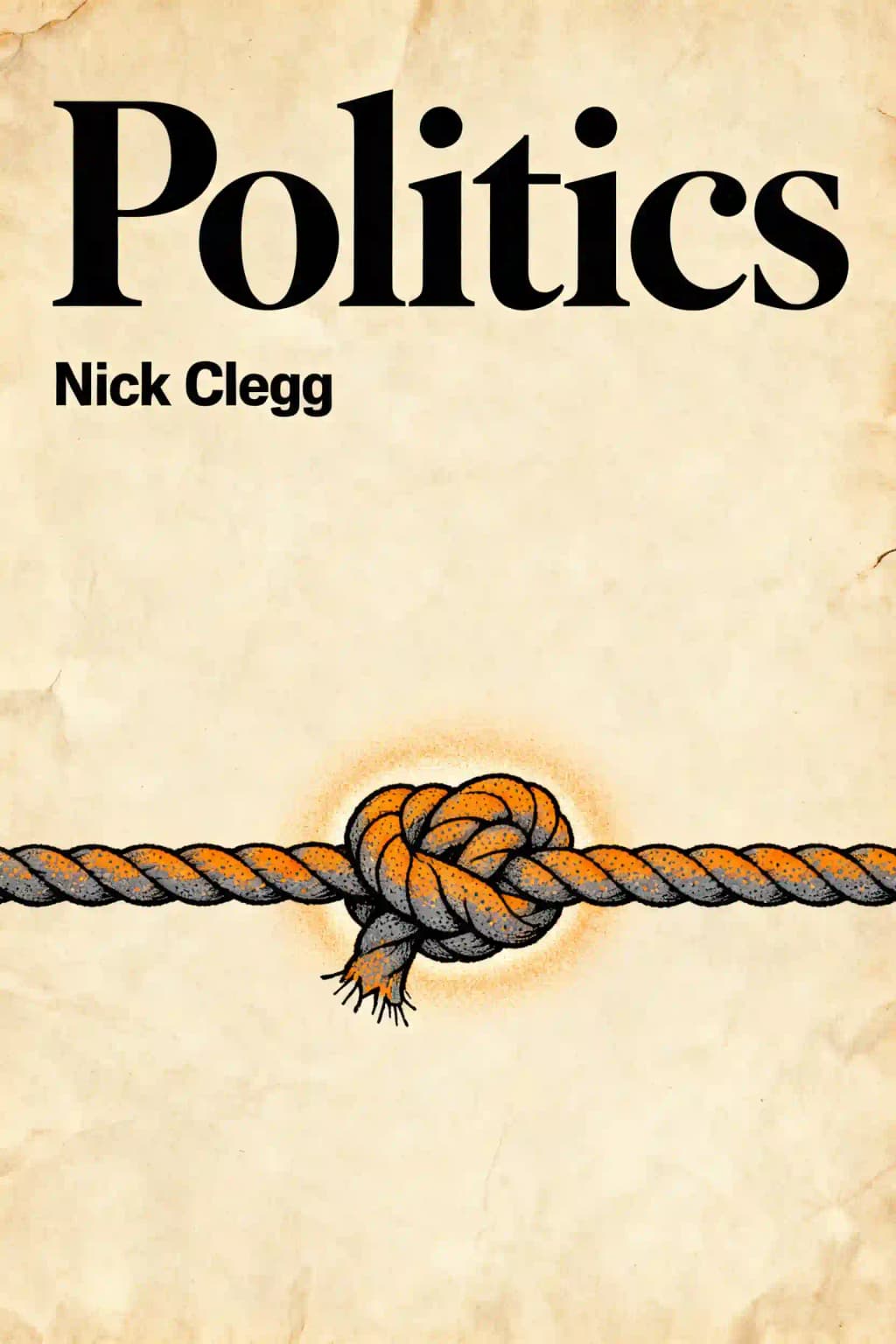
Nick Clegg's candid memoir unveils the turbulent realities of coalition leadership. Praised for its humane, honest examination of centrism amid extremism, this political insider's account offers crucial lessons for navigating our increasingly polarized world. What price does compromise demand in modern democracy?
Nick Clegg, author of Politics: Between the Extremes, is a British political leader and former Deputy Prime Minister known for his advocacy of liberal centrism and coalition governance.
Drawing from his decade-long career in the European Parliament and five years as leader of the Liberal Democrats, the memoir explores themes of political polarization, pragmatic policymaking, and the challenges of multiparty governance. Clegg’s insights are shaped by his pivotal role in forming the UK’s first postwar coalition government in 2010, where he negotiated key reforms like the Fixed-term Parliaments Act.
His follow-up work, How To Stop Brexit (and Make Britain Great Again), expands on his pro-European Union stance and policy-driven approach to national issues. A frequent commentator for The Financial Times and BBC, Clegg holds degrees from Cambridge University and the College of Europe.
Since 2018, he has served as Meta’s president of global affairs, bridging tech and policymaking. Knighted in 2018 for public service, Clegg’s book has been praised by The Guardian as “a vital primer on coalition politics.”
Politics: Between the Extremes is Nick Clegg’s candid memoir reflecting on his tenure as UK Deputy Prime Minister (2010–2015) and leader of the Liberal Democrats. It defends centrist, evidence-driven governance while critiquing populism, detailing coalition negotiations with the Conservatives, policy wins like the Pupil Premium, and controversies like tuition fee reforms. The book also analyzes Brexit and advocates for liberal internationalism.
This book appeals to readers interested in UK political history, coalition governance, or post-Brexit liberalism. Policymakers, students of political science, and voters seeking insider perspectives on the 2010–2015 Conservative–Lib Dem alliance will find Clegg’s rationale for compromise and reform particularly insightful.
Yes, for its unflinching account of coalition trade-offs and Clegg’s defense of pragmatic centrism. The book balances self-critical honesty (e.g., admitting missteps on tuition fees) with pride in achievements like tax reforms and same-sex marriage legalization. Its analysis of populism’s rise remains relevant to current political debates.
Key themes include:
Clegg argues the 2010 coalition stabilized the UK economy post-recession and enabled Lib Dem policy wins like raising the income tax threshold. He acknowledges strategic failures in communicating compromises but insists governing was preferable to ideological purity in opposition.
The book confronts accusations of betrayal over tuition fees, electoral collapse in 2015, and perceptions of Liberal Democrat weakness in coalition. Clegg attributes these outcomes to structural challenges of shared power and media narratives favoring “black-and-white” politics over nuance.
He admits misjudging public reaction to abandoning his 2010 pledge to oppose fee hikes, calling it a “disastrous error” that eroded trust. However, he argues the policy redirected funds to poorer students through higher repayment thresholds.
Clegg vehemently opposes Brexit, framing it as a symptom of populist distrust in institutions. He advocates for renewed international cooperation and warns against isolationist policies, drawing on his EU negotiation experience.
Unlike polemical accounts, Clegg’s book emphasizes systemic challenges over personal blame. It shares similarities with memoirs by Rory Stewart and David Cameron but uniquely focuses on smaller-party dynamics in coalition governments.
Its warnings about polarization, media-driven simplification, and institutional decay resonate in an era of global populist movements. The book offers a blueprint for centrist reformers navigating fractured political landscapes.
Key ideas include:
Sinta o livro através da voz do autor
Transforme conhecimento em insights envolventes e ricos em exemplos
Capture ideias-chave em um instante para aprendizado rápido
Aproveite o livro de uma forma divertida e envolvente
Politics itself is inherently abnormal.
Public perceptions often invert reality.
Westminster's elitism threatens authentic politics.
Partisan coverage is now the norm.
The reality of power often remains obscure.
Divida as ideias-chave de Politics em pontos fáceis de entender para compreender como equipes inovadoras criam, colaboram e crescem.
Destile Politics em dicas de memória rápidas que destacam os princípios-chave de franqueza, trabalho em equipe e resiliência criativa.

Experimente Politics através de narrativas vívidas que transformam lições de inovação em momentos que você lembrará e aplicará.
Pergunte qualquer coisa, escolha a voz e co-crie insights que realmente ressoem com você.

Criado por ex-alunos da Universidade de Columbia em San Francisco
"Instead of endless scrolling, I just hit play on BeFreed. It saves me so much time."
"I never knew where to start with nonfiction—BeFreed’s book lists turned into podcasts gave me a clear path."
"Perfect balance between learning and entertainment. Finished ‘Thinking, Fast and Slow’ on my commute this week."
"Crazy how much I learned while walking the dog. BeFreed = small habits → big gains."
"Reading used to feel like a chore. Now it’s just part of my lifestyle."
"Feels effortless compared to reading. I’ve finished 6 books this month already."
"BeFreed turned my guilty doomscrolling into something that feels productive and inspiring."
"BeFreed turned my commute into learning time. 20-min podcasts are perfect for finishing books I never had time for."
"BeFreed replaced my podcast queue. Imagine Spotify for books — that’s it. 🙌"
"It is great for me to learn something from the book without reading it."
"The themed book list podcasts help me connect ideas across authors—like a guided audio journey."
"Makes me feel smarter every time before going to work"
Criado por ex-alunos da Universidade de Columbia em San Francisco

Obtenha o resumo de Politics como PDF ou EPUB gratuito. Imprima ou leia offline a qualquer momento.
Picture the Rose Garden in May 2010: two young leaders, sleeves rolled up, promising a new kind of politics. Fast-forward five years, and one of them stands at the Cenotaph watching his party collapse from 57 seats to just 8. What happens in between? Not the sanitized version you see on the news, but the real machinery of power-the late-night cigarettes on the terrace, the budget vetoes days before announcement, the fights over banker bonuses that never make headlines. This is the story of what governing actually costs, told by someone who paid the price. It's about discovering that influence without symbols looks like weakness, that compromise reads as betrayal, and that the gap between wielding power and appearing powerful can destroy a political party. Through one politician's journey from hero to scapegoat, we glimpse something larger: how democracies are fracturing along new fault lines, and why the center cannot hold when voters crave certainty over nuance.