Capítulo 1
The Transformative Power of Starting Over
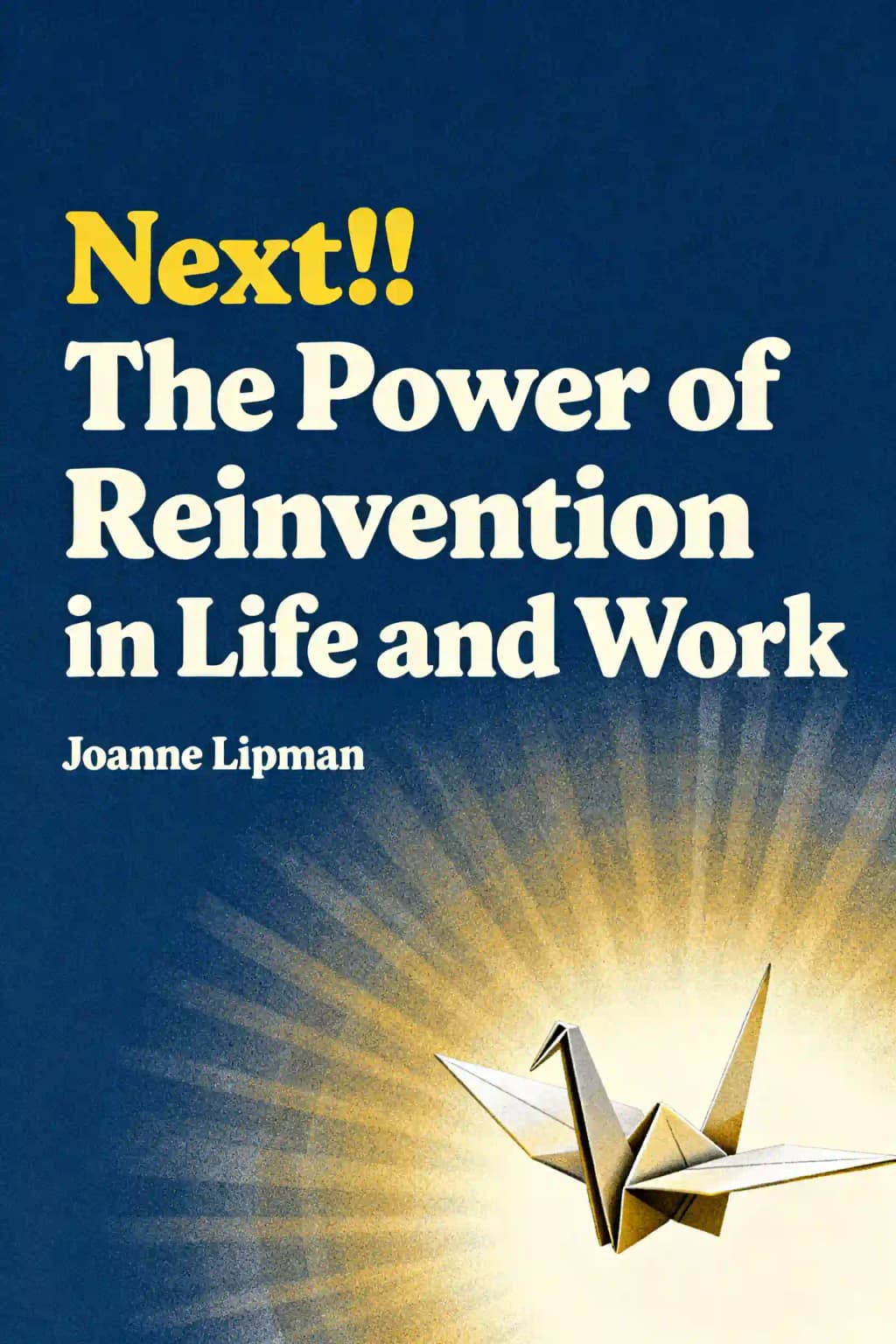
James Patterson was already a successful advertising executive, the creative mind behind "I'm a Toys 'R' Us kid" when he secretly harbored dreams of becoming a novelist. Rising before dawn each day to write, he eventually published his first thriller-which critics promptly panned. Yet Patterson persisted through rejection, gradually developing his distinctive style. Fast forward years later, and the former ad man has transformed into America's most commercially successful author with over 400 million books sold worldwide. His reinvention journey wasn't an overnight success but rather a methodical evolution that combined his advertising expertise with his passion for storytelling. Patterson's remarkable transformation exemplifies what millions discovered during the pandemic: the possibility of reinvention exists for everyone, though the path is rarely straightforward. This phenomenon has made Joanne Lipman's "NEXT" a cultural touchstone, praised by psychologists and business leaders alike for demystifying how successful transitions actually work, rather than offering simplistic "follow your passion" advice that ignores the messy reality of transformation.
Capítulo 2
The Reinvention Road Map: Search, Struggle, Stop, Solution
Most successful transformations follow a predictable pattern-whether you're changing careers, bouncing back from failure, or recovering from trauma. The journey begins with searching for new information and possibilities, followed by an inevitable period of struggle that most self-help books conveniently ignore. This difficult middle phase is actually where the most critical development happens. Eventually, you must stop pushing and allow your unconscious mind to process what you've learned. Only then does the solution emerge, often as a sudden insight that feels absolutely right.
This pattern appears across diverse fields-from Joseph Campbell's "hero's journey" to religious narratives of wandering in the desert to Katherine May's contemporary work on "wintering." The Covid-19 pandemic forced millions into this uncomfortable middle space simultaneously, creating what researchers call a "liminal period" between what was and what will be.
Chris Donovan exemplifies this journey perfectly. A telephone repairman for 25 years, he secretly sketched women's shoe designs in his spare time, never imagining this could become his career. After a prostate cancer diagnosis at 50, he realized life was too short not to pursue his passion. At 54, he became the oldest student at Florence's prestigious Polimoda fashion school, eventually launching his distinctive footwear line despite pandemic challenges. His designs cleverly reference his telephone repairman past, incorporating industrial parts that honor his previous career rather than abandoning it.
Similarly, Jim Patterson followed this transformation trajectory while working overnight shifts at McLean psychiatric hospital, reading serious literature and attempting writing despite discouragement. Though he published his first book years earlier, Patterson didn't leave his advertising job until nearly 50, after writing multiple books including some failures before finding his marketable style.
Most successful pivots aren't about radical reinvention but rather seeking fuller expressions of who you already are. They involve taking incremental steps over years while incorporating previous experiences into new endeavors. Stacey Abrams uses storytelling skills from her romance writing in politics, while Vera Wang applied discipline from figure skating to fashion design, noting skating "teaches you discipline... when you fall down, you pick yourself up and try again. It's a good metaphor for life."
Capítulo 3
Trusting Your Gut: When Intuition Outperforms Analysis
When contemplating major life changes, conventional wisdom suggests careful analysis of all available information. Yet research shows many transformative decisions ultimately come from gut feelings rather than exhaustive data collection. A Duke University study found nearly half of CEOs allocate spending based on "gut feel" rather than purely financial metrics.
Management expert Shabnam Mousavi explains this phenomenon simply: "Because it works. Deliberate ignorance of information has led to successful outcomes." While we like to believe we make rational decisions weighing every factor, life is too complex for that approach. Simple rules of thumb often outperform complex algorithms because it's impossible to account for every variable.
This is illustrated by the dog catching a Frisbee analogy-the dog instinctively follows the disc without calculating trajectory, spin, and wind speed. Similarly, executives may ask subordinates to rationalize decisions they've already made intuitively or hire consultants to recommend paths they already plan to take.
Clea Shearer and Joanna Teplin exemplify this approach. Meeting as Nashville transplants needing to reinvent themselves, they formed The Home Edit organizing business after just four hours together, purely on "gut instinct." Within five years, they built a nationwide business with celebrity clients and millions of Instagram followers. "We don't mess around with analyzing things until we're blue in the face. We just go for it," they explained.
What appears as extraordinary intuition is actually pattern recognition built on deep expertise. Chess masters can instantly recognize the right move because they've stored 50,000-100,000 patterns. Japanese shogi players' brains showed increased activity in areas associated with automatic behavior as they gained expertise. Experts can spot fakes or assess situations without conscious analysis, like a fire commander who once saved his crew by sensing danger in an unusually hot, quiet house fire-his expertise allowed him to recognize the abnormal pattern before consciously understanding the basement fire.
However, gut feelings unsupported by experience can be disastrous, as with Jeffrey Katzenberg's failed Quibi streaming service. Despite raising $1.75 billion based on founders' reputations, Quibi collapsed within six months due to fundamental misunderstandings of social media dynamics.
Capítulo 4
The Breakthrough Moment: Understanding Eureka Insights
Those transformative "aha moments" that redirect our lives aren't random strokes of luck but follow a predictable pattern. Participants in Erik Dane's study on career epiphanies reported experiencing sudden clarity that felt almost physical-one woman described seeing colors better, while others felt their insights were "bestowed as gifts" rather than something they consciously created.
Despite conventional wisdom suggesting careful analysis for major life decisions, these participants found their epiphanies came without deliberate effort. Their brains seemed to work "behind their back," knitting together disparate information until everything suddenly "came together" in a moment of clarity.
This process mirrors the classic stages of creativity described by advertising executive James Webb Young in 1939: Search->Struggle->Stop->Solution. First, collect information (search), attempt to connect pieces (struggle), then abandon the effort (stop), allowing your unconscious mind to work until the idea suddenly appears (solution).
Neuroscientists John Kounios and Mark Beeman have actually observed this process using brain scans. When people experience "aha" moments while solving word puzzles, a burst of activity occurs in the right temporal lobe, specifically the anterior superior temporal gyrus-an area that integrates different types of information. Just before insights appear, participants experience a "brain blink" where visual processing temporarily shuts down, blocking distractions.
Three key factors create favorable conditions for these transformative insights:
First, distraction is essential. Taking your mind off a problem allows your subconscious to connect unrelated ideas into novel thoughts. Research by Jonathan Schooler demonstrates that productive mind wandering can boost creativity by 40%, explaining why Aaron Sorkin takes multiple showers during writer's block.
Second, relaxation removes mental guardrails. Insights emerge most readily when our brains are relaxed and the prefrontal cortex-our inner control freak-is offline. Financial executive Sallie Krawcheck discovered this pattern, noting her best ideas came during breaks or "relaxed, more tired states" when thinking isn't constrained.
Third, positive mood significantly increases breakthrough likelihood. Research shows participants in better moods were more likely to solve problems through insight rather than analysis. Anxiety narrows thinking, while positive moods expand thought, making us more receptive to remote associations and alternative possibilities.
These eureka moments feel right because they often are right. Research by Carola Salvi found solutions derived from "aha" moments were significantly more accurate than analytical solutions-94% correct for insight-solved word problems versus 78% for analytically-solved ones.
Capítulo 5
Finding Strength in Brokenness: Post-Traumatic Growth
Kay Wilson's story exemplifies trauma's devastating impact and the possibility of transformation. While hiking near Jerusalem, she and her friend Kristine were brutally attacked by machete-wielding men. Kristine was killed, and Kay suffered thirteen stab wounds, barely surviving after her aorta was missed by just four millimeters. For years afterward, Kay endured debilitating PTSD symptoms-flashbacks, insomnia, hypervigilance-and spent three years in self-imposed desert isolation.
Yet remarkably, despite her ongoing trauma and rage, Kay channeled her energy into helping Palestinian children, founding the Yellow Brick Road Project. She returned to painting colorful, joyful pictures and playing piano again, including the song "Somewhere over the Rainbow" that had kept her conscious during her desperate escape. "I think I've had enough darkness," she explains. "Behind all this darkness and the messy society we live in, there is a lot of beauty there. We just have to look for it."
Trauma's devastating effects have been documented since ancient times. Mesopotamian cuneiform tablets from 3200 BC describe warriors suffering from horrific visions and nightmares after battle. Throughout history, the condition has had many names: "soldier's heart" during the Civil War, "shell shock" after WWI, and "battle fatigue" in WWII. Only in 1980, following the Vietnam War, was the syndrome formally named post-traumatic stress disorder (PTSD).
While PTSD describes trauma's devastating effects, it fails to account for the remarkable transformations many survivors experience. Richard Tedeschi and Lawrence Calhoun discovered this phenomenon while researching wisdom in the 1980s. Though their initial study failed to uncover wisdom's origins, they stumbled upon something unexpected: many trauma survivors reported positive life changes. These people didn't merely "bounce back"-they bounced forward into more fulfilling lives.
Their research identified five domains of growth: appreciation for life, improved relationships, spiritual changes, personal strength, and notably, new possibilities in life. Studies across diverse trauma survivors-from earthquake victims to combat veterans-show nearly half eventually experience this growth.
Post-traumatic growth requires survivors to develop a new narrative connecting their past, present, and future. The key ingredient is often an "expert companion"-not necessarily a professional, but someone who helps make sense of their new reality and illuminates possible paths forward. Michael Murphy exemplifies this journey; after severing his spine in a fall, he initially struggled for three years but eventually came to see his accident as "one of the best things to ever happen to me," opening new opportunities.
Capítulo 6
When Necessity Drives Innovation: The Outsider Advantage
Working mothers face pervasive systemic discrimination in the workplace, being consistently viewed as less competent and more dispensable than their male counterparts. Despite women comprising nearly half the workforce and earning 57% of college degrees, they encounter significant promotion barriers at every career stage. This imbalance compounds dramatically at each leadership level, resulting in women holding just 8.8% of Fortune 500 CEO positions. Research shows that when women do lead, they deliver 25% higher financial returns on average, yet face disproportionately harsh judgment for any missteps.
These persistent barriers have paradoxically transformed women into masters of reinvention and adaptation. Unlike men's typically linear career trajectories, women's careers often follow a distinctive three-stage pattern: idealistic beginnings filled with ambition, mid-career struggles against discrimination and family responsibilities, and ultimately creative reinvention. When facing job loss or career setbacks, women demonstrate greater resilience than men, maintaining stronger personal identities beyond their professional roles and benefiting from more robust social support networks that aid in transitions.
This grit and adaptability proves especially crucial for those facing multiple layers of marginalization. Kathryn Finney's journey exemplifies this resilience - transforming from a Yale-trained epidemiologist to a TV personality showcasing bargain fashion finds on NBC's Today Show, before ultimately becoming one of the most influential Black technology investors in America. Her venture, Genius Guild, backed by $20 million in funding, actively supports Black founders in the overwhelmingly white, male-dominated technology sector. Though repeatedly facing rejection from venture capitalists who explicitly stated they "don't do Black women," Finney persisted through multiple strategic pivots, leveraging each experience to build her next opportunity.
The landscape is gradually shifting, driven by pioneering women who refuse to accept traditional limitations. Jane Veron's evolution from PTA mom to nonprofit CEO and mayor of Scarsdale, New York, demonstrates how women are creating new leadership pathways. Younger generations may face fewer explicit obstacles - Gen Z is notably more diverse and tolerant, with almost half being non-white and showing greater acceptance of non-traditional career paths. Among these new pioneers is Ruzwana Bashir, who overcame her conservative Pakistani immigrant background to attend Oxford, become the second female president of the prestigious Oxford Union in 190 years, and secure positions at Goldman Sachs and Blackstone.
Though initially following the expected elite finance path, Ruzwana found the work ultimately unsatisfying despite its prestige and security. Her diverse experiences - straddling Eastern and Western cultures, insatiable thirst for learning, deep understanding of the hotel industry, and passion for authentic travel experiences - uniquely positioned her to identify a significant market gap. The frustration of spending twenty hours meticulously planning a birthday trip to Istanbul sparked her entrepreneurial vision for Peek, an innovative online marketplace for booking curated travel experiences. This venture combined her insider knowledge of finance with her outsider perspective on travel industry inefficiencies, exemplifying how diverse experiences can fuel breakthrough innovation.
Capítulo 7
The Power of Preparation: Moving Before You Move
Major transformations rarely happen instantly-they unfold gradually through what I call "moving before you move." Most successful reinventions involve early, often unconscious steps during the search phase, rather than unprepared giant leaps that typically fail. This pattern of gradual transition allows individuals to test waters, build competencies, and develop confidence before making definitive changes.
Will Brown's transformation from Harvard graduate and J.P. Morgan banker to farmer illustrates how unexpected paths emerge through incremental steps. After purchasing a weekend property-an old dairy farm in rural Connecticut-he began absorbing farming knowledge almost unconsciously. Initially viewing the property as merely a retreat from city life, Will started helping a neighboring farmer with her beef cows, learning essential animal husbandry skills and farming practices during weekends. These early experiences, though casual, laid crucial groundwork for his future career change.
The learning process accelerated when the elderly cow owner passed away, presenting Will and his wife Barbara with an unexpected opportunity to purchase her sixteen cows. This decision point revealed different perspectives within their partnership - while Will initially underestimated the commitment required, Barbara clearly established boundaries, firmly telling him not to expect her help with runaway cows. This reality check forced Will to seriously consider the implications of farm ownership.
As farm life increasingly captivated Will's interest and time, he made strategic career adjustments. Rather than abruptly leaving banking, he transitioned to consulting work, which offered greater flexibility to spend time on the farm. This intermediate step provided both financial security and the ability to gradually increase his farming involvement. The herd expanded naturally as cows had calves, and the operation grew organically. Eventually, Barbara also underwent her own transition, leaving her nonprofit job in 2008 to join the farming operation full-time, demonstrating how one person's reinvention can influence others' paths.
Though his shift from Wall Street to farming might appear radical, Will recognizes profound continuity in his career evolution. His economist's mindset proved surprisingly valuable in agriculture, as he applied sophisticated problem-solving skills to farm management. He discovered that running a farm operation demanded similar analytical abilities to banking, but offered the satisfaction of overseeing an entire enterprise rather than being "one cog in a giant organization." The farm provided opportunities to apply financial modeling, risk management, and strategic planning in a more tangible context.
Will's successful reinvention exemplifies the power of "moving before you move." By taking incremental steps - purchasing the property, helping neighbors, transitioning to consulting work - he began moving toward his new life before consciously realizing he was leaving the old one. This gradual approach allowed him to build both practical skills and emotional readiness for his eventual career change, while maintaining financial stability throughout the transition.
Capítulo 8
The Revolutionary Act of Rest: Why Stopping Powers Success
Our culture venerates constant work and busyness, but this approach actually undermines creativity and problem-solving. When facing challenges or contemplating major life changes, most of us double down like Sisyphus rolling his rock uphill or Boxer from Animal Farm repeating "I will work harder!" The modern workplace celebrates this always-on mentality, with phrases like "hustle culture" and "grinding" becoming badges of honor. However, research consistently shows this approach is precisely wrong and potentially harmful to both productivity and innovation.
Taking breaks is essential to the search->struggle->stop->solution paradigm of reinvention. Our unconscious mind does tremendous work when we're not actively focused on problems, engaging in what neuroscientists call "diffuse mode thinking." Studies confirm that consecutive Zoom meetings crush creativity by up to 96%, and working without pause makes us less innovative. Most breakthrough ideas don't emerge while sitting at desks or in meetings-they come during showers, walks, or sleep. This phenomenon, known as "incubation," allows our brains to form novel connections and insights that conscious, focused thinking often misses.
Despite overwhelming evidence, modern society actively resists relaxation. Americans leave one-third of vacation days unused, with 55% of workers reporting feelings of guilt when taking time off. Remote workers log an average of 2.5 more hours per day than their office-based counterparts, and executives frequently boast about minimal sleep requirements as if it's a competitive advantage. An entire productivity industry, worth over $10 billion annually, sells us on working "harder, faster, and better" despite research showing no correlation between busyness and actual productivity.
The science behind creative rest is compelling. Research confirms we're most creative when daydreaming, accessing what psychologists call the "default mode network." In a comprehensive study of writers and physicists, 20% of their best ideas came during non-work activities like showering or exercising. Walking increases creativity by up to 60%, which explains why innovative thinkers like Steve Jobs, Beethoven, and Nietzsche all took regular walks. Time in nature boosts problem-solving abilities by 50%, with even a 15-minute forest walk showing measurable cognitive benefits. Brief meditation sessions of just 10-15 minutes improve learning and memory retention by 10-20%.
Sleep emerges as particularly powerful for problem-solving and creativity. University of Minnesota research shows thinking about important life goals like job possibilities is "highest during relaxed periods when the brain's default-mode network dominates, or during sleep." During sleep, our brains actively process complex information and form new neural connections. Harvard researchers found students who napped for 90 minutes performed far better navigating a complex maze than those who stayed awake, with dreamers about the maze performing ten times better. This demonstrates sleep's crucial role in memory consolidation and problem-solving.
History's most prolific creators understood this power of strategic rest: Winston Churchill maintained his leadership through WWII while taking daily two-hour naps, Nintendo designer Shigeru Miyamoto conceived Donkey Kong while relaxing in the bath, director Ingmar Bergman finished work by 3:30 PM daily to preserve creative energy, and Stephen King typically works just four focused hours a day with afternoon naps. Ernest Hemingway wrote in the morning and spent afternoons fishing, while Maya Angelou never worked past 2:00 PM, understanding that creativity requires renewal through rest.
Capítulo 9
The Art of Transformation: Embracing What Comes Next
We're experiencing a period of seismic cultural change similar to when Play-Doh transformed from soot cleaner to children's toy. In today's post-pandemic world of political unrest and economic uncertainty, many feel unmoored as they navigate what comes next. The stories in this book offer reassurance by showing how others have successfully reinvented themselves through common stages: searching for new information, struggling through transitions, stopping when necessary, and finding solutions.
Even when feeling stuck, we're constantly moving forward in ways not immediately visible-the seeds of our future are already present in our current activities. We must embrace the struggle rather than expect fairy-tale transformations. Taking breaks isn't weakness but strength-whether it's Keith Reinhard inventing the Hamburglar in his sleep or the pandemic giving space to reorient lives around what truly matters.
During the search phase, try on "possible selves"-imagining your future identity like James Patterson did as a novelist while working in advertising. Take small, iterative steps rather than expecting overnight transformation-like Ina Garten hosting dinner parties long before becoming the Barefoot Contessa. Trust your gut instinct, which often reflects your expertise and pattern recognition before your conscious mind catches up.
During the struggle phase, lean into this difficult middle period that stories often minimize. Create a "CV of failure" to assess whether to persist or redirect efforts, while finding an "expert companion" for crucial outside perspective-as when Danny Meyer's uncle pointed out his lifelong food obsession, setting him on a path to becoming a successful restaurateur. Reach out to "weak ties"-casual acquaintances or dormant connections-who research shows provide more novel job opportunities and creative insights than close connections.
Nothing is wasted in our life journeys-every experience contributes to what comes next. Kathryn Finney used her Yale epidemiology studies and "Budget Fashionista" experience to become a tech investor in Black-owned businesses. Len Elmore combined childhood dreams, civil rights interests, basketball career, and legal skills to teach at Columbia. The most extraordinary pivots often come through unexpected paths-like Khe Hy abandoning his financial career goal for meaningful work with family time, or Chris Handy discovering flight attending through community theater.
Change is iterative and continuing, as demonstrated by those reinventing themselves well into their later years, like Paul Tasner running a startup at 75 and Spencer Silver becoming a painter at 80. While stepping into the unknown can be frightening, concrete strategies from the Reinvention Road Map can guide us forward-helping us discover not just what comes next, but who we might become in the process.