Capítulo 1
From Auschwitz to America's Most Famous Tailor
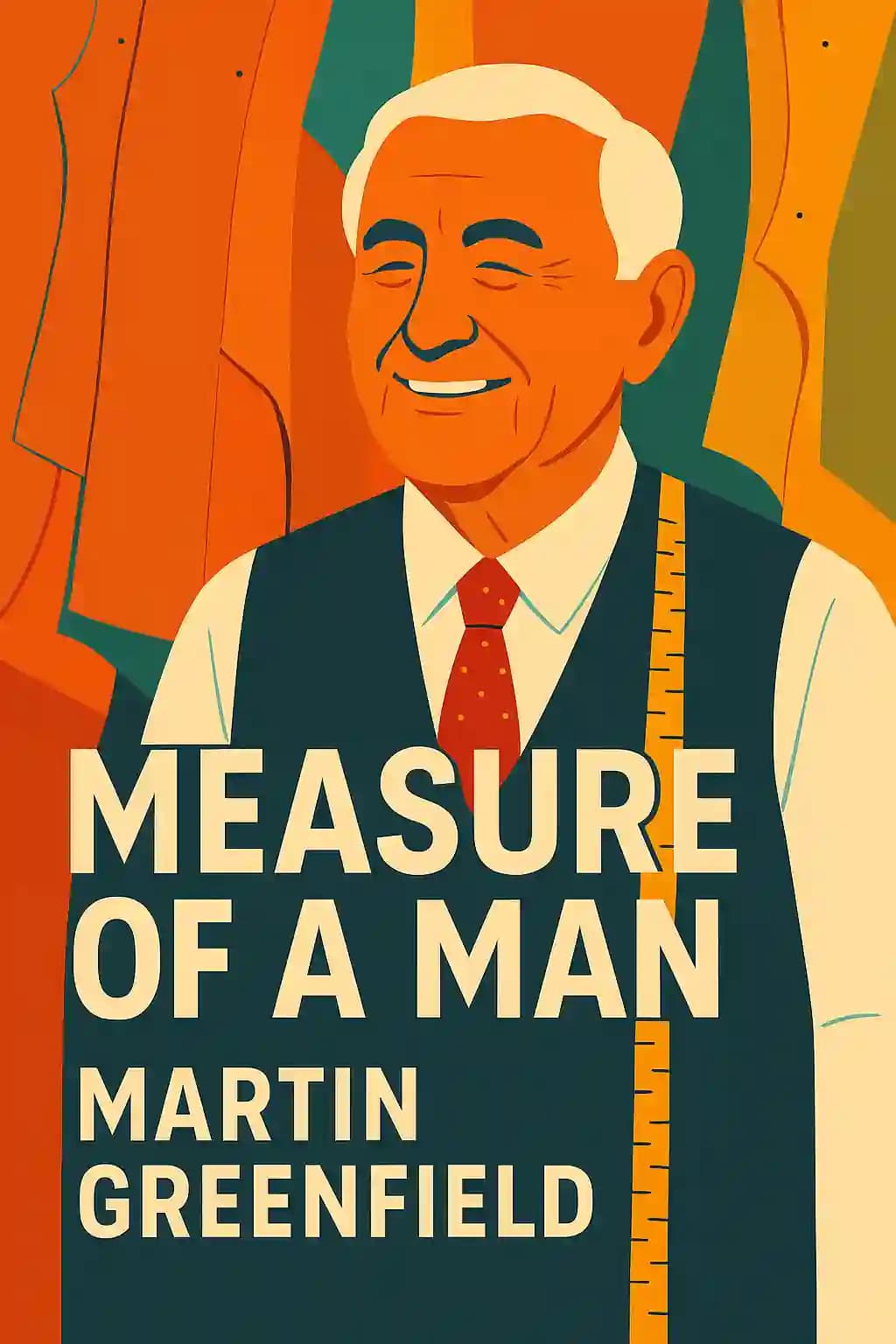
The elegant man with the monocle stood before us, his dark leather boots shining like mirrors. I was just fifteen-year-old Maximilian Grunfeld, far from my Czechoslovakian home, standing in line at Auschwitz with my family. I didn't yet know this was Josef Mengele, the "Angel of Death." Two torn Nazi shirts saved from that nightmare would eventually help me build America's most prestigious custom suit company. My journey from concentration camp prisoner to dressing presidents and Hollywood stars has been chronicled in publications from GQ to The New York Times. Even today, celebrities and politicians alike seek out Martin Greenfield Clothiers in Brooklyn, where handcrafted techniques from a century ago are still practiced. My story is one of survival, reinvention, and the American dream-a testament to how a Holocaust survivor became the man who dresses America's most powerful men.
Capítulo 2
The Nightmare Begins: Auschwitz and the Loss of Family
Paradise ended for me in April 1944, on Passover's second day, when Germans and Hungarians surrounded Jewish homes in our village of Pavlovo, Czechoslovakia. Given just an hour to pack, we were marched six miles, packed into cattle cars, and transported to the Mukacevo ghetto. After a month, our family was placed on the very last transport to Auschwitz.
When we arrived, Mengele stood before us, calm and quiet. When he motioned for my mother to put my five-year-old brother down and she refused, he sent her, my brother Sruel Baer, my sister Rivka, and my grandparents to the left. "See you later," my mother said. I never saw them again. My father, my sister Simcha, and I were sent right. Then Simcha was separated from us. We men were stripped, shaved, disinfected, and tattooed-my father became A4405, I became A4406.
Hours after our arrival, my father pulled me close. "Together, we will never survive, because working together we will suffer double. We must separate," he insisted. I protested fiercely, but his mind was made up. "You are young and strong, and I know you will survive. If you survive by yourself, you must honor us by living, by not feeling sorry for us."
The next morning, when Germans asked about our trades, Dad grabbed my wrist and thrust it into the air. "A4406," he said. "He is a mechanic. Very skilled." When the Germans came to take me away, I foolishly ran, only to be attacked by a German shepherd that tore into my leg. That day was the last time I ever saw my father.
My first job in Auschwitz was washing Nazi uniforms. When I accidentally tore an SS officer's shirt collar, he beat me until I bled. A fellow prisoner taught me to sew, and I mended the shirt-then secretly wore it under my striped uniform. Strangely, both prisoners and guards treated me better when I wore it. I even deliberately tore another shirt to have two. That moment marked the beginning of my life's work-two ripped Nazi shirts helped this Jew build America's most famous custom-suit company.
Capítulo 3
Surviving Hell: Daily Life in the Camps
Many days inside Auschwitz I was afraid I would die-and then afraid I wouldn't. We were surrounded by death and darkness, madness and murder, all executed with vicious precision that made the moral insanity more bizarre and cruel.
Each morning at 4:30 we endured roll call, where any sign of weakness meant selection for the crematorium. The ovens burned day and night, spewing smoke and flames. I forced myself to eat whatever was given-rancid coffee, soup with hair and insects, sawdust-filled bread-knowing that to be sick meant death.
Killings were frequent and without provocation. What appeared random was actually systematic psychological torture, breaking our belief in the rewards of goodness. Soon I became numb to death, a survival mechanism that allowed me to carry scores of corpses. At fifteen, I had become an undertaker.
I was once forced to beat another prisoner while being interrogated about whether my father was a partisan. For five straight days, we were made to whip each other, neither of us betraying our fathers despite our bloodied backs. A doctor later saved my life by transferring me to Buna.
Five miles from Auschwitz lay Buna, where IG Farben used slave labor in their factories producing synthetic rubber and Zyklon B gas. Though work was grueling with 11-13 hour shifts, the Nazis were less inclined to kill inmates randomly since the company paid for prisoners. After arriving with my wounded back, I fell ill and was assigned to the hospital where I helped other patients by standing in for them during roll calls and sneaking extra food.
American bombing raids in December 1944 brought hope as we watched our captors scurry and hide like cockroaches. Seeing them cower in fear felt damn good. But as winter 1945 battered Buna, the cold became unbearable. By mid-January, Russian cannons could be heard approaching the camp, and our block leader confirmed we would evacuate the next night.
Capítulo 4
The Death March and Liberation
The Germans planned to empty dozens of subcamps and march tens of thousands of prisoners to Gleiwitz in what became known as the Death March. What one wore determined survival. I raced to the hospital and grabbed socks, a shirt, and a jacket. Foot care was essential-prisoners had no socks, only wooden clogs with weak linen straps that caused blisters and infections.
The march began with pistol shots-anyone who faltered was executed on the spot. Soon after, a German soldier forced me to carry his heavy pack. Working with two boys marching behind me, I secretly lightened the load by discarding a heavy ammunition box and sharing the soldier's bread and wurst with them.
As conditions worsened, prisoners collapsed and were shot. Fearing the soldier would discover his pilfered pack, I devised a desperate plan during our brief rest. With the boys' help, I buried myself in snow, creating a breathing space between my knees. When I emerged later, the column was gone, leaving only frozen corpses across the landscape.
Though briefly free, I decided to continue toward Gleiwitz, having nowhere else to go. Upon arrival, I was surprised to feast on the Germans' abandoned dinner. I distributed food to other skeletal prisoners, even giving double portions to some. The brief respite at Gleiwitz ended when we were packed into roofless coal cars for a brutal four-day journey. When prisoners died, we immediately threw their bodies from the train to make more room.
Our train stopped on February 5, 1945, at a railway station in central Germany. We trudged up the hill to Buchenwald, one of Germany's largest concentration camps, where iron gates displayed the slogan "To each what he deserves." I was assigned to Block 58 in the infamous "Little Camp," a shoddy quarantine facility where I continued searching for my father among 45,000 fellow inmates from thirty countries.
By March and early April, rumors spread that liberation was near. When the Americans arrived, they found emaciated prisoners, including a three-year-old boy. The next day, April 12, General Eisenhower visited with Generals Bradley and Patton. Ike ordered every soldier not on the front lines to tour the camp, saying "Now, at least, he will know what he is fighting against."
Rabbi Herschel Schacter conducted the first Jewish service at Buchenwald on April 20. When I asked him, "Where was God?" he could only reply, "There are no answers to certain questions." Despite liberation, a thousand prisoners died within five days. Today, the Buchenwald clock tower's hands remain set to 3:15, the time of our liberation.
Capítulo 5
A Time for Vengeance, A Time for Mercy
Though physically free, I remained emotionally chained. With the SS surrendered but the German army still active, we could leave camp but weren't completely safe. I was consumed by rage and a desire for revenge against the Weimar mayor's wife who had me beaten for eating rabbit food when I was starving. I found two Jewish boys willing to join me, and we armed ourselves with machine guns from the piles of seized German weapons.
We walked to Weimar and found the mayor's house. Inside, we confronted the blonde woman, who was holding her baby. Despite my companions urging me to shoot, I couldn't pull the trigger-I would have become like Mengele, who had sentenced my mother and baby brother to death. My moral upbringing prevented me from becoming an honorary member of the SS. Instead, I demanded the keys to their Mercedes, which she had hidden in the barn under hay.
We drove back to Buchenwald in the mayor's car, even picking up German girls along the way. At camp, I traded the Mercedes for a motorbike with sidecar, which I used to give rides in and out of camp for weeks.
Hitler committed suicide on April 30, 1945, and the German army surrendered a week later. Though grateful to be alive, I was anxious about my future. Going "home" wasn't an option for most survivors-hatred of Jews remained high, our possessions had been stolen, and millions of our relatives murdered. My only obsession was living free and finding my family.
Capítulo 6
Rebuilding a Life: From Refugee to Entrepreneur
After liberation, I began rebuilding my life with determination. The bus ride from Buchenwald to Prague felt surreal as I watched German countryside disappear behind me. At sixteen, I had witnessed more death than a hundred civilian men combined. Remembering my father's words to live life fully if I survived, I enlisted in the Czechoslovakian army, lying about my age.
Following my brief military service, I developed entrepreneurial ambitions. With a group of fellow survivors my age, I started an import-export business selling cigarettes. We'd buy them cheaply, then travel by train (often riding on top to avoid paying fares) to cities where we could sell them at a premium. This business taught me about supply and demand while allowing us to travel and search for surviving family members.
My quest to find my father ended in Budapest in summer 1946. At a HIAS gathering, I met Mendel, a man from near my hometown. When I mentioned my search, he delivered devastating news: "You can stop looking. I was there the day the Germans shot him." My father had been directing a bridge construction project at Buchenwald that missed its deadline. The Nazis executed him just one week before liberation.
I mustered the courage to visit my hometown of Pavlovo. When I arrived, Russians had taken over our family home. Unable to bring myself to knock, wanting to preserve my memories intact, I simply walked past to visit our family cemetery. I prayed briefly and left, vowing never to return.
Our group of young survivors became a makeshift family. We met four Jewish girls who, like us, had survived the camps and lost their parents. Their presence gave me hope that perhaps my sisters had somehow survived. We protected these girls from Russian soldiers known for assaulting female travelers. Together, we shared what little we had-even celebrating with a feast when one boy secured a calf from a farm.
Business was thriving with our cigarette trade, but when Russian Communists began infiltrating the Czech government, I knew I had to leave. I'd witnessed tyranny once before and wouldn't wait for another round of oppression. In fall 1946, I planned my exodus just in time, as Czechoslovakia would fall to forty years of Communist rule by 1948.
Capítulo 7
America: The Land of Second Chances
At Gabersee displaced persons camp, I maintained vehicles in the United Nations Relief and Rehabilitation Administration motor pool. I also helped with the Aliyah Bet-a covert operation smuggling Holocaust survivors into Palestine despite British opposition. Despite initial skepticism about my youth, my mechanical skills convinced Officer Taub to let me help drive trucks loaded with refugees toward Italy.
Everything changed when I received a letter from Baltimore, Maryland-my first correspondence from a family member since the camps. It was from Uncle Irving Berger, my mother's brother, written in Yiddish with a dollar bill enclosed. He explained my mother had never met her siblings because they'd moved away before she was born. I had an Aunt Elka in the Bronx and another uncle in Mexico. The miracle that they'd found me amid such chaos brought tears and smiles. Uncle Irving invited me to America, offering to send a ticket for the voyage.
I sought Officer Taub's counsel about whether to pursue Palestine or America. "Don't even think of it," he advised about Palestine. "If your Uncle Irving sends you a ticket, go! There's no place like America." My application was approved, and my cousin Mark purchased my ticket for $142 on the SS Ernie Pyle, departing September 11, 1947.
Standing dockside at Bremerhaven, I stared at the massive 522-foot Ernie Pyle, impressed and anxious. As we sailed away, I remained at the railing long after others had dispersed, watching Germany fade-the keeper of my family's blood and ashes. I silently promised my father I would honor his final words: "Honor us by living, by not feeling sorry for us."
On September 18, we spotted the glittering New York skyline, a string of perfect diamonds across the dark horizon. The Statue of Liberty glowed beautifully against the wet black sky. I felt my life born anew, certain this magnificent land could help someone so small.
The next morning, an immigration official issued me a green card, declaring: "You are an American, but not a citizen." Those words-"You're an American"-felt enormous. I couldn't believe my fortune. When my Aunt Elka, my mother's oldest sister, greeted me with wild hugs and kisses, I was overwhelmed. That evening, the city's thousand sounds lulled me into the deepest sleep I'd had in years.
Capítulo 8
From Floor Boy to Master Tailor: The Birth of a Legacy
New York in 1947 was magical, humming with people and possibility. I arrived just before the legendary all-New York World Series between the Yankees and Dodgers. After a few days with Aunt Elka, I moved to Baltimore to live with my cousin Frances Berman and her family. They treated me like royalty, buying me my first GGG suit for job interviews-named after the three Goldman brothers who manufactured premier hand-tailored men's suits in New York.
My inability to communicate in English frustrated me deeply. One evening after dinner, I discussed changing my name with my cousin's husband Moe. "I want a good, strong American name," I explained. Frances suggested "Martin Greenfield" instead of Maximilian Grunfeld. "I love that!" I exclaimed, smacking the table. Just like that, I became Martin Greenfield-a name with dignity and heft that was easy to say and spell.
My friend Kalvin kept urging me to join him in Brooklyn, where I could work at GGG and take English classes at night. I started work at GGG making thirty-five dollars a week as a floor boy, confused by the complex assembly-line operation that was so different from the single tailors I'd known in Europe.
The GGG factory's assembly-line approach to tailoring completely bewildered me. After my first week, I nearly quit, telling manager Adolph Rosenberg I couldn't understand how my work fit into making suits. Rosenberg took me through all 108 operations that created a GGG suit. This revelation changed everything. I resolved to master every single task-hand basting, darting, piping, blind stitching, pressing-determined to become indispensable.
After work and English classes, Kalvin and I embraced New York nightlife-clubs, Danny's Hideaway, Thursday dinners at the Doral Hotel, movies, and double dates. At Ebbets Field, I fell in love with baseball. My English teacher accompanied me to explain the rules, turning the stadium into my American classroom. Sitting there in the eighth inning, I was overwhelmed with gratitude-the crack of a baseball bat had replaced the sting of a flogging stick.
Mr. William P. Goldman was from the old school, treating workers with respect and keeping his word. At lunchtime, he'd select workers to dine with him, with one rule: no work talk, only family and personal interests. After six months at GGG, I'd advanced from floor boy to fitter to blind stitcher. Mr. Goldman offered to make me an assistant supervisor rather than pursue my childhood dream of becoming a doctor: "I'll make you a suit doctor!" He shared his secret to success: "Produce quality with intrinsic value"-meaning superior materials and craftsmanship justify higher prices because the products last longer.
Capítulo 9
Building a Family and a Business
By 1956, I had worked my way up at GGG to head quality inspector, earning $110 weekly-enough to support the family I desperately wanted. That April, a coworker set me up with Arlene Bergen, a gorgeous executive secretary at Fuller Fabrics. When we met for our blind date, time stopped as the stunning blue-eyed brunette walked into the room. After dancing all night at Brooklyn's Town and Country club, I quickly fell for her directness when she refused to "go steady," saying I should either be serious enough to marry her or move on.
We married on December 23, 1956, during GGG's Christmas shutdown, with Mr. Goldman himself blessing the challah at our wedding. Even amid my newfound happiness, the Holocaust still haunted me through nightmares. When Arlene confronted me about my disturbed sleep-speaking Hungarian or Yiddish with contorted face and clenched fists-I initially resisted discussing it. Finally, I revealed my recurring nightmare: running through woods with her and our baby while Nazis hunted us, trying to protect them by splitting up as my father had done with me.
Our sons Jay and Tod were born in 1958 and 1960, fulfilling my greatest dream of having a family to cherish and protect. While building a family was one thing, building a career in men's fashion required cultivating celebrity connections. Eddie Cantor became my gateway to Hollywood's elite. His kindness extended beyond our initial meeting-he arranged introductions to stars at the Hillcrest Country Club and even had Bob Hope and Lana Turner welcome us on their movie set.
By the late 1960s, I felt underappreciated at GGG. Mr. Goldman had promised my pockets would be full when we reached 100,000 units annually. After closing a deal that pushed us to 110,000, my paycheck remained unchanged. When confronted, Mr. Goldman apologized, gave me a substantial annual bonus, and bought me a new Cadillac with GGG plates to be replaced every three years.
In 1977, exactly thirty years after arriving in America as a floor boy, I bought the GGG factory in Brooklyn for $100,000. While the facility and equipment were mine, the GGG brand was not. I started Martin Greenfield Clothiers with just six people, envisioning a boutique operation producing 100 suits weekly. That vision quickly expanded as Diamonds in Philadelphia and then Neiman Marcus called, wanting my hand-tailored suits.
Capítulo 10
The Measure of Power: Dressing Presidents and Politicians
In politics, perceptions become reality, and a leader's appearance symbolizes America herself. Since my early days at GGG, I've worked to ensure America's political power brokers look their best, with military men understanding this importance better than most.
One of my first political clients was my liberator and hero, General Dwight D. Eisenhower. In 1949, Mr. Goldman assigned me to oversee production of suits for Eisenhower, then president of Columbia University. I was ecstatic to serve the man who saved my life. When Eisenhower became President, I continued making his suits. Unable to communicate directly with him, I began slipping anonymous foreign policy advice notes into his jacket pockets-even his golf pants-offering my strategic wisdom on matters like the Suez Crisis.
I was working late when two serious-looking men escorted me to a storage room. They identified themselves as Secret Service agents and showed me two large bulletproof plates. They needed me to construct two special vests for President Gerald Ford-one that could hold the protective plates with quick-release Velcro, and another identical-looking vest without protection that he could change into discreetly.
When the Clintons entered the White House, I was invited to measure President Clinton, and discovered his closet contained only a couple of short leather jackets, numerous jogging suits, a ratty overcoat, and a few average off-the-rack suits-possibly the most pathetic presidential wardrobe in American history. Within two weeks, we had created four beautiful Donna Karan ventless jackets, pants, and traditional tuxedos.
In October 2010, Ikram Goldman, a style advisor to Michelle Obama, recommended us to make suits for President Obama. Meeting President Obama in his private office, I was struck by his height and smile. Built like a fitting mannequin-a 40 long with an impressive 3312-inch waist-he showed me a fine Italian-made suit jacket he liked. I promised to make something "much, much better." We developed special red, white, and blue hand stitching exclusively for the interior linings of his jackets.
My dear friend Colin Powell and I met around the time of the First Gulf War. At our first meeting at the Waldorf Astoria, he said, "My cousin tells me you're the best tailor in America. When I retire, I'll be wearing civilian clothes. I'd be honored if you'd put me in my next uniform." His first visit to my Brooklyn factory was deeply emotional. When he saw the seamstresses doing handwork, tears filled his eyes as he recalled his mother working as a seamstress in the garment district after immigrating from Jamaica.
Capítulo 11
Hollywood and High Fashion: Crafting the Perfect Image
In the early years, I was too poor to own a television, but I could afford movies. I learned about America through cinema, captivated by Hollywood's magic and the intersection between film and fashion. Today's high-definition films put tremendous pressure on costume designers for period-perfect accuracy, and they love our team because we still practice handcrafted techniques from a hundred years ago, all done right here in Brooklyn.
We worked with costume designer Catherine Martin on the 2013 film The Great Gatsby, crafting all suits and formal wear for Leonardo DiCaprio, Tobey Maguire, and Joel Edgerton. My son Jay handled the measuring and fitting, engaging in lengthy discussions about the precise shade for Gatsby's famous pink suit. Catherine wanted modern suits with 1920s details rather than historically accurate clothing, which proved perfect for Baz Luhrmann's fusion of old-school extravagance and new-school edge.
One of our longest-running period collaborations has been with HBO's Boardwalk Empire. Working with creator Terence Winter and costume designer John Dunn, we dressed 173 characters and made over 600 suits across five seasons. John came with extensive research-mug shots of gangsters, old clothing catalogs, colored drawings with fabric swatches attached. The jackets of that period were longer, higher waisted, fitted in the shoulder with a natural rounded shape.
Unlike the old days, celebrities, directors, costume designers, and athletes now come directly to our factory for fittings. Rising stars in men's fashion vie for apprenticeships with us, and I try to give my talented tailors the chance to interact with celebrities as part of their training. I made tuxedos for Frank Sinatra and Sammy Davis Jr., who often requested jackets with no pockets, just dummy flaps, making them "costumes" and therefore tax write-offs.
In May 2009, fashion designer Zaldy Goco asked us to create special costumes for Michael Jackson's This Is It tour. The designs were elaborate-silk and wool fabrics with metallic buttonholes, dangling gold chains, red lining featuring pictures of Michael moonwalking. Michael wore them at a rehearsal just two days before he died. The final suit shipped out hours after his passing.
The challenge in making suits for movie characters is balancing directors' visions with actors' preferences. For Russell Brand in Arthur, we created elegant clothes with aristocratic flair while incorporating his preference for low-rise, tight pants and modern details like working sleeve buttonholes that allowed him to roll up his sleeves irreverently. We've also dressed numerous professional athletes, from LeBron James to Shaquille O'Neal (who wears a size 58 suit and size 22 shoes).
Capítulo 12
The Full Circle: Finding Faith and Purpose
My life has been filled with far more light than darkness, flooded with more blessings than I could ever deserve. One of those blessings came on August 9, 2008, when at eighty years old, I finally celebrated my Bar Mitzvah at our Hampton Synagogue in Westhampton Beach. Rabbi Marc Schneier, whose Bar Mitzvah suit I had made when he was thirteen, officiated my ceremony.
I wore my three-piece lavender seersucker suit and was surrounded by my family and five hundred friends. Throughout the ceremony, I imagined my lost family looking down on me with joy rather than sadness. When Rabbi Schneier placed the prayer shawl around me, I felt God's presence and peace. I told the congregation this was a day for celebration, not because I'm a hero, but because against all odds, I survived to reach this moment.
Only one explanation for my improbable life makes sense: God allowed America to make me possible. Despite all the ways I might have died-in the camps, on the Death March, or from countless other dangers-I survived to find family, marry my dream girl, have wonderful sons, and build my only-in-America dream in beloved Brooklyn.
Years after my confrontation with the Weimar mayor's wife, I discovered an article in a 1945 issue of Life magazine reporting that the mayor of Weimar and his wife had committed suicide after seeing the Buchenwald atrocities. The very woman I had nearly killed had taken her own life. God had spared me the guilt of murder-she had done it herself. Divine justice had prevailed without requiring my intervention.
Today, my sons Jay and Tod work alongside me in the factory, bringing business leadership and transforming tailoring from art to science. Watching them work brings me special joy, knowing they'll never experience the separation I endured during the Holocaust. My newfound family extended with Arlene's wonderful cousins, and my grandchildren Amy, David, Rachel, and Sofia represent our family's future.
I'm left with nothing but gratitude and joy for my life. Some things, it turns out, are beyond measure.