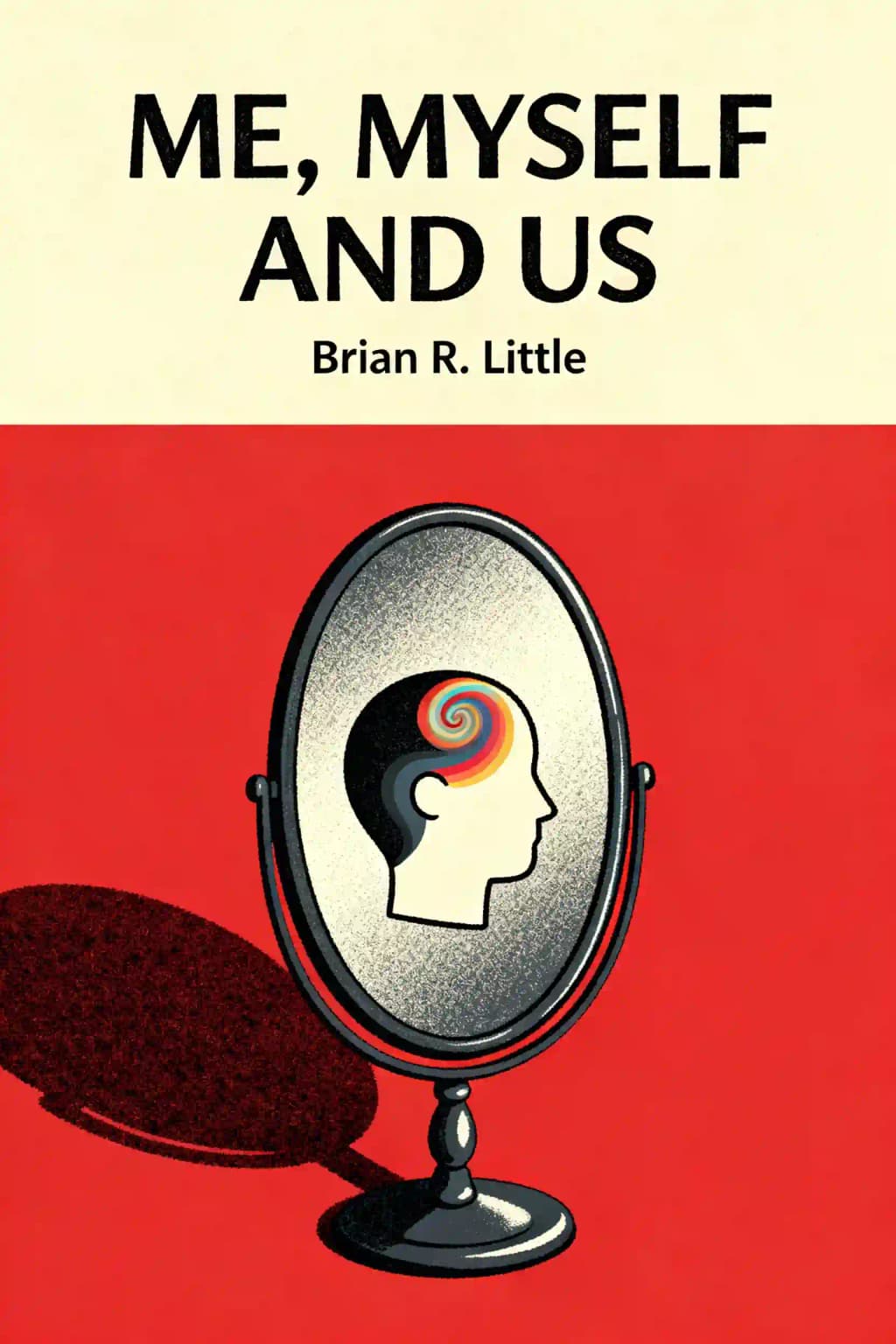
Me
lessons in the new science of personality
Visão geral de Me
Discover why Harvard students claim Brian Little's personality psychology masterpiece "changed their lives." Beyond simplistic Myers-Briggs labels, learn how "free traits" can transform your well-being through the revolutionary biopsychosocial approach that's reshaping how we understand ourselves and others.

Temas principais em Me
- personal project analysis
- free trait theory
- personal construct systems
- big five dimensions
- biogenic vs sociogenic identity
Citações de Me
We should avoid slotting people away as mere stereotypes.
The more diverse our constructs, the more adaptively we can navigate life's complexities.
We have the freedom to reconstrue others and ourselves.
Introverts are more sensitive to stimulation, while extraverts seek more stimulation.
Openness to experience reflects receptivity to new ideas, interactions, and environments.
Personagens de Me
- Brian R. LittleAuthor and psychologist specializing in personality
- GeraldMilitary cadet used as a case study on identity
- DerekJob candidate evaluated in a case study
- George KellyPsychologist who developed personal constructs
Baixar resumo de Me
Obtenha o resumo de Me como PDF ou EPUB gratuito. Imprima ou leia offline a qualquer momento.
Perguntas Frequentes Sobre Este Livro
Me, Myself, and Us examines the science of personality through the lens of modern psychology, challenging traditional typologies like Myers-Briggs. Brian Little explores the Big Five personality traits, "free traits" (behaviors contradicting innate tendencies), and how personal projects shape identity. The book blends research with actionable insights to improve relationships, careers, and well-being.
This book is ideal for psychology enthusiasts, self-improvement seekers, and professionals in coaching or HR. Students and general readers will appreciate its accessible yet research-driven approach to understanding personality flexibility and the balance between biological predispositions and personal agency.
Yes. Critics praise its engaging mix of scientific rigor and wit, offering fresh perspectives on personality beyond simplistic categorizations. Little’s concept of “free traits” and interactive self-assessments provide practical tools for personal growth, making it valuable for readers seeking evidence-based strategies for thriving.
Key ideas include:
- The Big Five traits: Openness, conscientiousness, extraversion, agreeableness, neuroticism.
- Free traits: Acting “out of character” to pursue meaningful goals, despite potential health trade-offs.
- Personal constructs: How subjective perceptions shape behavior.
- Contextual influences: How environments interact with innate tendencies.
Unlike self-help guides, Little’s work emphasizes scientific rigor over prescriptive advice. It contrasts with Myers-Briggs by advocating for trait flexibility, aligning more with contemporary research like the Big Five. Its focus on “personal projects” distinguishes it from purely biological or social models of personality.
A free trait involves temporarily adopting behaviors mismatched with one’s core personality (e.g., an introvert acting extroverted to lead a team). Little argues this adaptivity helps achieve meaningful goals but warns chronic use may cause stress, advocating balance.
Well-being stems from aligning personal projects with core values, not just innate traits. Little emphasizes intentionality: thriving requires understanding when to leverage free traits and when to recharge in environments matching innate dispositions.
Some readers may find its academic depth less actionable than typical self-help books. While it offers frameworks (e.g., personal projects), it avoids step-by-step guides, prioritizing conceptual understanding over quick fixes.
By identifying “core” traits, readers can choose roles aligning with innate strengths while strategically using free traits for advancement. For example, an introverted leader might schedule recovery time after extroverted tasks like presentations.
While direct quotes are sparse, central ideas include:
- “Personality is not destiny—it’s a dynamic interplay of traits and context.”
- “Free traits let us transcend biology but demand self-awareness to avoid burnout.”
Its focus on adaptability resonates in fast-evolving work and social landscapes. As remote work and AI reshape roles, understanding trait flexibility helps navigate change while maintaining well-being—a critical skill in modern life.
Little’s roles at Harvard, Cambridge, and McGill inform its academic foundation. His research on personal projects and free traits, honed through decades of teaching and speaking, ensures a blend of scholarly depth and relatable storytelling.


