Capítulo 4
The Revolutionary Nature of True Leisure
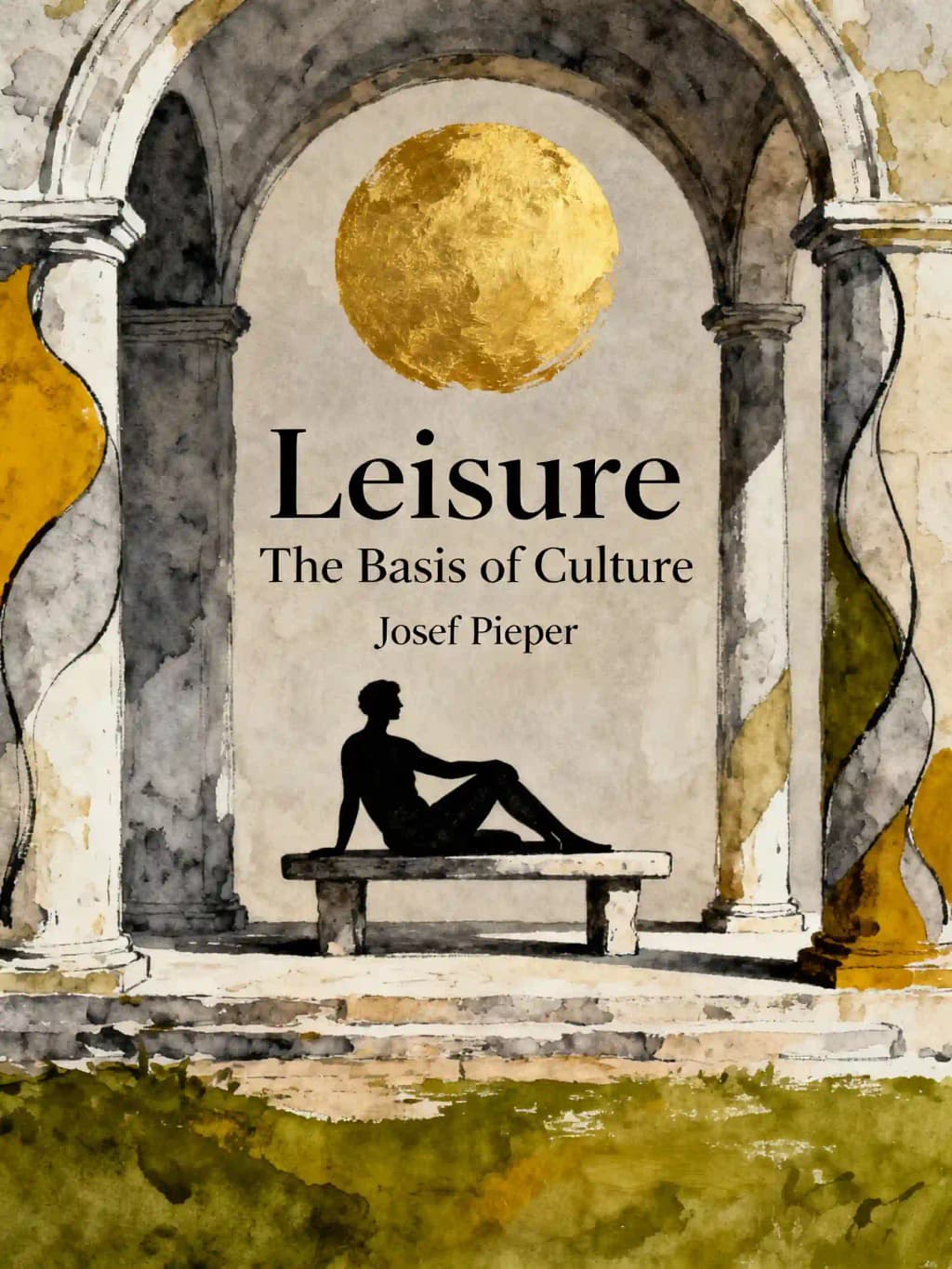
Leisure stands in complete opposition to the "worker" ideal in three fundamental ways. First, leisure implies non-activity and inward calm-not being "busy" but letting things happen. It requires silence, not mere noiselessness, but the soul's receptive power to answer reality undisturbed. This contemplative attitude allows one to steep oneself in the whole of creation with serenity, embracing the mysterious nature of the universe with deep confidence.
Unlike the restless activity that characterizes the modern mind, leisure allows things to unfold naturally. As Konrad Weiss noted, there is "confidence in the fragmentariness of life and history," contrasting with Ernst Junger's cold dissection of mystery through tidy formulas. True leisure means being open rather than intervening, loosening the reins rather than grabbing hold-similar to falling asleep, which requires "letting oneself go."
Second, leisure is an attitude of contemplative celebration. It draws vitality from affirmation-consenting to one's true nature and abiding in concord with the universe's meaning. Like lovers' tranquil silence drawing strength from concord, leisure celebrates the basic meaningfulness of existence. Just as God beheld creation and saw "it was very good," in leisure we affirm: it is good. The festival represents leisure's essence-uniting tranquility, contemplation, and intensity of life.
Third, leisure stands perpendicular to work as social function. Unlike breaks taken for work's sake, leisure exists on a different plane entirely. It cuts across work vertically, as intellectus (intuition) relates to eternity while ratio relates to time. Leisure doesn't exist to restore working powers-though it does renew strength-but to ensure the functionary remains fully human, capable of grasping the world as a whole.
Through leisure, we access "superhuman, life-giving existential forces" that open a "gate to freedom" from the latent anxiety marking the world of work. As Aristotle observed, in leisure man lives "not to the extent that he is a man, but to the extent that a divine principle dwells within him."
Capítulo 5
The Modern Proletarian Condition
The practical challenge becomes whether we can defend or reconquer leisure against the invading claims of "total labor." This isn't merely about preserving Sunday afternoon idleness, but protecting the preserve of freedom, education, culture, and undiminished humanity that views the world as a whole. In our hyperconnected age, where work emails follow us home and "side hustles" are normalized, this challenge has become increasingly urgent and complex.
A proletarian is not simply a poor person-medieval beggars weren't proletarians. Nor is a proletarian necessarily poor-specialists in a "totalitarian work state" are proletarians despite their income. Rather, the proletarian is one who is "fettered to the process of work"-the vast utilitarian process serving public need, where the worker's life is wholly consumed. This definition encompasses both factory workers and high-powered executives who cannot separate their identity from their professional role.
This fettering occurs through three distinct but interrelated causes: lack of property (the propertyless wage-earner who must sell his capacity to work), state coercion (in totalitarian systems where everyone becomes subject to economic forces), and inner impoverishment (where life contracts until one can neither act nor conceive of anything beyond work). These forms mutually reinforce each other-the "total work" state needs spiritually impoverished functionaries who find illusory fulfillment in service. Modern examples include the gig economy worker dependent on platforms, the corporate employee bound by golden handcuffs, and the entrepreneur who sacrifices all personal life for business success.
This proletarian mindset extends beyond the working class to all levels of society. Even highly paid professionals can be proletarians if their entire existence is consumed by their function. Doctors working 80-hour weeks, lawyers billing endless hours, and tech workers living at their offices all exemplify this condition. The distinction between liberal and servile arts becomes crucial-servile arts being directed "to the satisfaction of a need through activity." Liberal arts, by contrast, cultivate the whole person and serve no immediate practical purpose.
Deproletarianization requires expanding life beyond merely useful work by combining property ownership opportunities, limiting state power, and overcoming inner impoverishment. This might involve promoting employee ownership programs, protecting time for contemplation and creativity, and fostering communities that value non-productive activities. The challenge is particularly acute in an era where technology enables constant productivity monitoring and work increasingly colonizes private life.
We must not deny work's "servility" by pretending it doesn't primarily serve external purposes. Such fiction establishes the inhuman state of labor under totalitarianism-ultimately tying workers to production as life's supposed meaning. True deproletarianization requires recognizing the distinction between useful activity whose purpose lies outside itself and liberal arts that cannot be reduced to utility. This means acknowledging that our worth as humans extends far beyond our economic output and creating spaces-both physical and temporal-where non-instrumental activities can flourish.
Capítulo 6
The Sacred Foundation of Leisure
What ultimately makes leisure both possible and justifiable? The soul of leisure lies in "celebration"-the point where relaxation, effortlessness, and the superiority of "active leisure" to all functions converge. But if celebration forms leisure's core, then leisure can only be justified on the same basis as a festival. That basis is divine worship.
Divine worship means the same thing where time is concerned as the temple where space is concerned. "Temple" means a particular piece of ground specially reserved and marked off from land used for agriculture or habitation. This plot is transferred to the gods' estate-neither lived on nor cultivated. Similarly, divine worship sets aside a certain space of time from working hours-a limited time, specially marked off and withdrawn from utilitarian ends. Every seventh day represents such a period-"festival time" arising in this way and no other.
There can be no such thing in the world of "total labor" as space not used on principle; no plot of ground or period of time withdrawn from use. The "worker's" world rests solely on rational utilization. A "feast day" in that world is either a pause for the sake of work or, like "Labor Day," a celebration of work itself. There might be games and circuses-but who would describe mass entertainment as festal?
The world of "work" is impoverished, regardless of material goods, because on a utilitarian basis, genuine wealth-which implies overflowing into superfluities-becomes impossible. Divine worship, however, creates real wealth through sacrifice, its living heart. Sacrifice means voluntary offering freely given, antithetical to utility. It creates wealth that cannot be consumed by the workaday world, establishing an area where calculation is abandoned and goods deliberately squandered.
Separated from divine worship, leisure becomes laziness and work inhuman. The vacancy left by absence of worship fills with mere killing of time and boredom. As Baudelaire cynically noted in his Journal: "One must work, if not from taste then at least from despair. For, to reduce everything to a single truth: work is less boring than pleasure."
Capítulo 7
The Philosophical Act as Liberation
The philosophical act represents a fundamental shift in human orientation-a stepping beyond the confines of the workaday world. Unlike scientific inquiry, which begins with preliminary questions before experimentation, asking "What does philosophizing mean?" is itself already philosophy. This question occurs not before or after the philosophical enterprise but in its very midst, for one cannot speak about philosophy without simultaneously addressing man's nature and his relationship to knowledge, truth, and reality itself.
Like all philosophical questions, this one cannot be answered with finality. Philosophical answers are not what Parmenides called "neatly rounded truths" that can be picked like apples. They are more like horizons that continuously expand as we approach them. Philosophy's entire structure differs-it is conditioned by hope and driven by an endless quest for understanding rather than definitive conclusions.
To philosophize means stepping out of the workaday world-the utilitarian realm of useful functions, demand and supply, hunger and satiety. This world is dominated by a single end: satisfying the "common need" through work. In this realm, actions are valued primarily for their practical outcomes: building shelter, producing food, creating tools. But "common need" differs fundamentally from "common good." While the former represents essential needs for survival and comfort, the "common good" encompasses much more, including what Aquinas called the "useless" life of contemplation. It includes art, music, literature, and philosophical inquiry-activities that may not contribute directly to material well-being but enrich human existence in profound ways. The common good requires that some people philosophize, though philosophy doesn't satisfy common needs.
Philosophy's freedom lies in its "uselessness." It is what Newman called "the knowledge of a gentleman"-not functional knowledge but free knowledge, pursued for its own sake rather than for practical application. This knowledge isn't legitimized by usefulness or social function but by its intrinsic value in expanding human understanding and consciousness. This is the meaning of "liberal" in "liberal arts"-those not ordered to satisfy practical needs through activity but aimed at cultivating the mind and spirit.
Unlike sciences, philosophy cannot be put at the disposal of external ends. While governments might reasonably say "We need physicists trained in particular branches" or "We need medical researchers to cure the flu," they cannot say "We need philosophers to elaborate this ideology" without strangling philosophy itself. The same applies to poetry and other creative pursuits. Philosophy and poetry contain their own ends and cannot serve as means to other purposes without losing their essential nature. They represent the highest form of intellectual freedom-the pursuit of truth and beauty for their own sake, unrestricted by practical demands or utilitarian considerations.
This liberation from immediate utility allows philosophy to examine fundamental questions about existence, knowledge, ethics, and the nature of reality itself-questions that might seem impractical but are essential to human understanding and development. Through this "useless" pursuit, philosophy helps us understand not just how to live, but why we live, contributing to human wisdom in ways that transcend mere practical utility.
Capítulo 8
Wonder and the Transcendent Human Spirit
Unlike animals perfectly adapted to their sharply defined environments but simultaneously imprisoned within them, humans possess spirit-the capacity to establish relationships with the totality of being. Spirit by its very nature breaks the bounds of any "environment," abolishing both adaptation and imprisonment. As Aristotle wrote, "The soul is, fundamentally, everything that is." The spiritual soul is meant to fit in with all being. Spirit exists not in "a" world or "its" world, but in "the" world-the whole of reality.
Yet humans are not pure spirit but finite spirit. The world coordinated to spirit is indeed man's world, but the essence of things is not given to him fully and completely. Man is essentially corporeal-spiritual, a fusion of plant, animal, and spiritual life. Therefore, he cannot live exclusively face-to-face with the totality of reality; he needs both world and environment. He cannot permanently dwell "beneath the stars" but requires the familiar roof, everyday surroundings, and habits.
The truly human condition is to see the stars above the roof-to preserve our apprehension of universality amid daily habits. Philosophizing means experiencing how our immediate surroundings can and must be broken in upon by the call of "the world." This philosophical act is, as Aquinas said of contemplation, "not properly human, but superhuman."
Wonder-that profound, receptive astonishment at the very fact that things are-constitutes the true beginning of philosophy. This wonder is not merely a starting point but the lasting source of all genuine philosophizing. It combines both negative and positive aspects: negatively, it acknowledges our incomplete knowledge; positively, it actively seeks understanding through a desire for knowledge. Unlike God who knows perfectly and animals who lack the capacity to seek causes, humans alone can truly wonder.
This gives wonder the same structure as hope-we are travelers not yet possessing full understanding but actively seeking it. The sciences may cease wondering when they reach conclusions, but the philosopher never stops wondering, for philosophical questions about essences can never be fully answered.
Capítulo 9
The Contrapuntal Relationship Between Philosophy and Faith
Philosophy cannot form a closed system that claims to have captured ultimate reality. Any philosophy that presents itself as a completed system contradicts the very nature of philosophizing as an ongoing quest. The philosopher must remain open to the inexhaustible mystery of being, maintaining the tension between knowledge and wonder, between what can be grasped and what remains beyond our full comprehension. This dynamic tension is exemplified in the Socratic paradox of knowing that one does not know, which becomes not a resignation but a catalyst for continued inquiry.
Philosophy has always been preceded by traditional interpretations of the world, emerging from the rich soil of cultural and religious understanding. The great founders of Western philosophy-Plato and Aristotle-not only recognized these pre-existing traditions but accepted them as their starting points. Plato considered these ancient traditions as divine in origin, "handed down by our forefathers," as evidenced in his dialogues like Timaeus and Phaedrus. Philosophy stands in a contrapuntal relationship with theology, receiving its impulse from a prior interpretation of reality while maintaining its independence through questioning concrete experience. This relationship can be seen in how medieval philosophers engaged with religious texts while developing their own systematic inquiries.
In the Western world since classical times, Christian theology has become the primary pre-philosophical tradition concerning the world as a whole. The vitality of philosophy depends on maintaining its contrapuntal relationship with theology, where it draws existential salt. When philosophy becomes a shriveled intellectual discipline for specialists, disconnected from these deeper wellsprings, it loses its power to illuminate human experience and address fundamental questions of existence. This can be observed in the contrast between the vibrant philosophical traditions of Augustine and Aquinas versus the more sterile academic philosophies that sometimes emerge in purely secular contexts.
Contrary to popular belief, Christian philosophy isn't distinguished by having ready answers. Rather, it more fully grasps the sense of wonder rooted in ignorance, exemplified in Augustine's assertion that if you comprehend it, it is not God. Its distinguishing mark is being inspired by mystery-even revealed truths of Christianity remain partly hidden, creating a productive tension between faith and reason. The advantage of Christian philosophy lies in seeing the world in its real character as unfathomable mystery, while simultaneously providing a framework for meaningful engagement with that mystery.
Christianity isn't merely doctrine but reality-a Christian philosopher must be deeply rooted in Christian reality, not just harmonizing natural and supernatural knowledge theoretically. As Aquinas distinguished, beyond conceptual knowledge lies knowledge through existential affinity-knowing divine things as one's own is only possible for one who has not just learned Christianity but suffered and experienced its reality. This experiential dimension transforms philosophical inquiry from an abstract intellectual exercise into a lived engagement with truth, combining theoretical rigor with spiritual insight. The Christian philosopher thus operates in a unique space where reason and faith, experience and reflection, mystery and understanding converge in a dynamic interplay.