Capítulo 1
The Enigmatic Genius Who Reinvented Physics
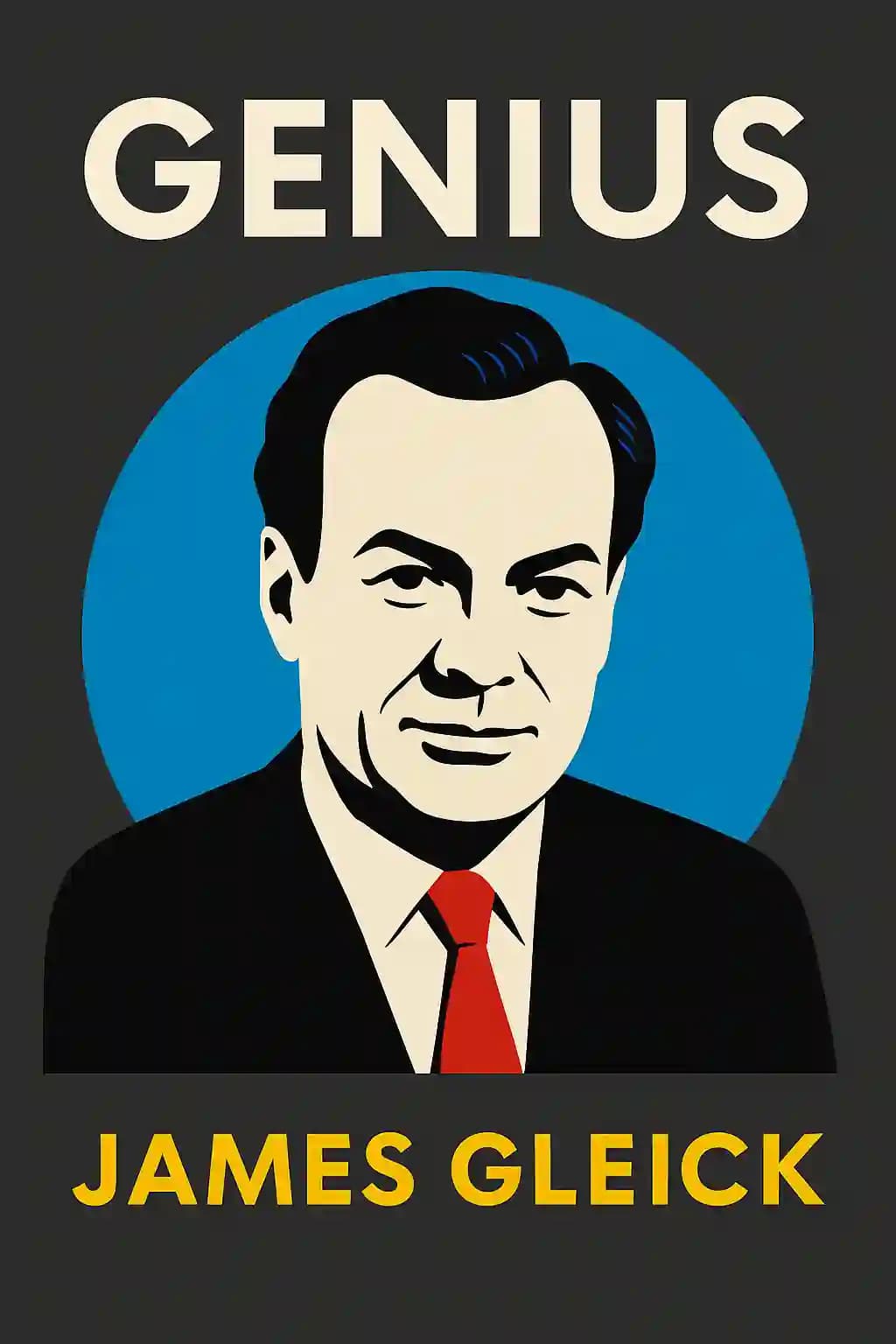
Richard Feynman has become the patron saint of physics, a figure whose name is whispered with reverence in scientific circles worldwide. His revolutionary approach to quantum electrodynamics earned him a Nobel Prize, but his legacy extends far beyond this achievement. Bill Gates named Feynman's lectures as the book that influenced him most, while physicist Freeman Dyson described him as "half genius and half buffoon." Unlike Einstein's otherworldly persona, Feynman embodied an accessible brilliance-playing bongos, cracking safes, and explaining complex physics with disarming clarity. His life story reads like scientific mythology: the boy from Far Rockaway who helped build the atomic bomb, revolutionized quantum physics, and ultimately transformed how we understand reality itself.
Capítulo 2
From Beach Dreams to Quantum Schemes
Growing up in Far Rockaway during the 1920s, Richard Feynman inhabited a world that was neither fully urban nor rural. This liminal community on a spit of beach off Long Island's south shore provided the perfect environment for a budding scientist-freedom to explore combined with moral rigor. The neighborhood produced a disproportionate number of Nobel laureates and successful scientists, children of immigrants embedded in a culture that prized learning and meritocracy.
Young Richard transformed his bedroom into a laboratory, wiring circuits throughout the house and employing his younger sister Joan as a four-cents-a-week assistant (whose duties included enduring mild electrical shocks for his friends' entertainment). His father Melville, though unable to pursue scientific education himself, nurtured Richard's curiosity in profound ways. Rather than simply providing facts, he taught his son to value understanding over mere knowledge.
Two paternal lessons proved particularly formative. When another boy criticized Richard for not knowing a bird's name, Melville explained that knowing a bird's name in every language tells you nothing about the bird itself-only what humans call it. This distinction between labels and understanding would become central to Feynman's approach to physics. In another pivotal moment, while explaining inertia through the example of a ball rolling backward in a wagon, Melville added, "that, nobody knows why it's true"-demonstrating a deep understanding of the limits of scientific explanation that would later resonate with Richard's work in quantum mechanics.
Feynman's mother Lucille brought humor and storytelling to balance Melville's seriousness. When bridge partners questioned how she could tolerate Richard's noisy experiments, chemical smoke, and ruined hand towels, she calmly replied, "it was worth it." This unconditional support for intellectual exploration created the foundation for Feynman's fearless approach to science.
At Far Rockaway High School, Richard found his competitive outlet in the Interscholastic Algebra League. While other students worked furiously with pencil and paper, "Ritty" often saw solutions instantly through mental shortcuts and creative reframing. Beyond school mathematics, he discovered "recreational mathematics"-puzzles and open problems where he felt like a researcher rather than just a student. By fifteen, he had mastered trigonometry and calculus, often teaching his own teachers. His classmates dubbed him not "Most Intellectual" but "Mad Genius."
The summer of 1933 brought the Feynman family to Chicago's World's Fair, "A Century of Progress," where science was gloriously celebrated. This golden age of scientific heroes would profoundly shape Richard's aspirations, even as he developed his own distinct approach to physics-one that would eventually transform the field in ways even Einstein couldn't have imagined.
Capítulo 3
The Quantum Revolutionary at MIT
At MIT's Spring Open House in 1936, freshman Theodore "T.A." Welton was startled to find another first-year student confidently demonstrating a complex harmonic analyzer and explaining Fourier transforms to visitors. This was Dick Feynman, already displaying his remarkable ability to make complex concepts accessible-a talent that would later make him a legendary educator.
Feynman began at MIT questioning his path, exploring mathematics and electrical engineering before settling on physics. The department was led by John Slater, who distrusted the philosophical implications of quantum mechanics flowing from European schools. Unlike his European counterparts who reveled in questions about causality and observation, Slater maintained that theories should simply make good experimental predictions. "I do not like mystiques; I like to be definite," Slater said, speaking for most American physicists who valued Edison's practical spirit over Einstein's theoretical one.
Though only a sophomore, Feynman boldly enrolled in the advanced "Introduction to Theoretical Physics" course alongside Welton. Both stood out immediately, with Feynman occasionally being called to the blackboard when Professor Stratton lost track of equations. In this course, Feynman encountered the principle of least action-the strange law that moving objects always take the path that minimizes a quantity called "action." Though useful as a computational shortcut, Feynman stubbornly refused to employ it, insisting on calculating all forces explicitly to understand the "real physics."
MIT worried about its students' social development, prescribing compulsory Tea for freshmen and organizing countless dances to refine their social skills. Fraternities strictly segregated students by religion; Feynman joined Phi Beta Delta, one of just two Jewish houses. Despite his social awkwardness, Feynman found confidence through Arline Greenbaum, the beautiful, talented girl who gave piano lessons to his sister Joan. They became engaged during his junior year.
Unlike many mathematically gifted people, Feynman actively rejected culture. Music made him uncomfortable despite his sense of rhythm. He abandoned Sunday school after discovering it mixed fiction with fact. He barely passed freshman English, considering grammar rules arbitrary and useless. Even philosophy disappointed him; he found Descartes's proofs less than rigorous and delighted in contradicting established thinkers.
The focus of physics was narrowing to the theories of the fast and the small-relativity and quantum mechanics-where classical physics no longer applied. In spring 1936, Feynman and fellow student T.A. Welton launched their own version of quantum theory through collaborative study. They exchanged notebooks by mail over summer break, essentially recapitulating the 1925-27 quantum revolution. They attempted ambitious projects: Welton wondered if electromagnetism could be tied to space-time geometry like gravity; Feynman tried developing an operator calculus for non-commuting quantities. "I oscillate between right and wrong," Feynman wrote, capturing their exhilarating journey through uncharted mathematical territory.
For his senior thesis, Feynman tackled what initially seemed a modest problem: why does quartz expand so little when heated? This question about a common mineral led him into fundamental discoveries about molecular forces. Unlike typical senior projects cataloging spectra or building laboratory instruments, Feynman's investigation probed deeper questions about how atoms behave within crystalline structures. He developed a computational technique that calculated forces directly rather than deriving them from energy calculations, saving considerable labor. His thesis demonstrated that the force on an atom's nucleus equals the electrostatic force from the surrounding electron field-once electron distribution is calculated quantum mechanically, the problem becomes classical. This elegant result became known as "Feynman's theorem."
Capítulo 4
Princeton's Quantum Crucible
Princeton University in 1939 was becoming a powerhouse in nuclear physics, deliberately investing in the field while other institutions like MIT remained more conservative. The intellectual atmosphere was charged with excitement about atomic nuclei and the newly discovered phenomenon of nuclear fission.
John Archibald Wheeler, a twenty-eight-year-old assistant professor who combined a businessman's appearance with a mind that produced profound insights, became Feynman's mentor. Wheeler had collaborated with Niels Bohr on the "liquid drop" model of nuclear fission, predicting that only the rarer uranium isotope would fission explosively and that neutron bombardment would create a yet-undiscovered element (plutonium).
Princeton's gentility was famous-the eating clubs, arboreal lanes, ersatz-Georgian architecture, academic gowns at dinner, and punctilious courtesies at tea. Einstein called it "a quaint ceremonious village of puny demigods on stilts." Feynman found the formality frightening, especially at Dean Eisenhart's Sunday tea where he committed his famous gaffe asking for both cream and lemon, prompting Mrs. Eisenhart's "Surely you're joking, Mr. Feynman!"
Physics had exploded beyond classical topics into strange new realms. The field was "inward bound," probing ever deeper into the atom's core with expensive equipment and esoteric theories. Quantum electrodynamics remained incomplete, with a fundamental problem at its heart: the electron.
The electron posed a paradox. Was it a finite pellet or an infinitesimal point? If finite, what kept it from bursting apart from its own charge? If pointlike, the equations produced troubling infinities when calculating an electron's effect on itself-its "self-energy." Dirac had acknowledged this fatal flaw, concluding that "some essentially new physical ideas are here needed."
Feynman quietly nursed a radical solution: eliminate self-action entirely. If electrons couldn't act on themselves, the troublesome infinities would vanish. This meant eliminating the field concept itself-the totality of charges that enabled self-action-and replacing it with direct particle interactions across space and time. "Shake this one, that one shakes later," as Feynman explained, with light merely the manifestation of this direct interaction.
The lawn sprinkler problem captivated Princeton's physicists: would an underwater sprinkler spin in reverse when sucking water rather than spraying it? The question revealed how shallow our understanding of Newton's laws could be. Every physicist had an immediate intuition, yet these intuitions contradicted each other. Wheeler joked that Feynman had convinced him of opposite answers on consecutive days.
Frustrated with thought experiments, Feynman built a physical apparatus using an S-shaped tube, rubber hose, and compressed air borrowed from Princeton's cyclotron laboratory. His experiment ended spectacularly when the glass bottle exploded, earning him banishment from the lab.
The correct answer? The inverse sprinkler doesn't turn at all. Unlike the organized jets of a normal sprinkler creating measurable momentum, water enters a sucking nozzle from all directions, applying no net force.
This problem illuminated a deeper question about time's arrow. The equations of physics run equally well forward and backward, yet real-world processes seem irreversible. In the relativistic universe, simultaneity had been demolished, challenging sequentiality and causality. Physicists now contemplated temporal possibilities that earlier generations would have dismissed.
Meanwhile, Arline developed worrying health symptoms-a neck lump and unexplained fevers. After being initially diagnosed with Hodgkin's disease, doctors later determined she had tuberculosis-still serious but not immediately fatal. Despite Princeton threatening to revoke his fellowship if he married a woman with tuberculosis, Feynman resolved to marry Arline, writing to his disapproving mother: "I've found myself singing while planning our life together."
Capítulo 5
Los Alamos: Science in the Shadow of War
Feynman joined other scientists at Trinity, the first atomic bomb test. As the youngest group leader, he struggled with a radio, finally catching a signal announcing "Minus thirty minutes." At 5:29:45 A.M. on July 16, 1945, the flash transformed the New Mexican desert-first blinding white, then shifting through silver, yellow, and orange. The scientists experienced the blast differently: Feynman noticed cloud formation, Frisch saw silent sunshine, Rabi felt it "bore into you." After 100 seconds came the sound-a rifle-crack followed by rolling thunder that Feynman felt physically, registering the physics acoustically.
Before this moment, Feynman had been recruited by Robert Wilson for a secret uranium isotope separation project that would contribute to the nuclear bomb effort. The Manhattan Project began modestly before expanding into the largest single-purpose industrial enterprise ever assembled. At Princeton, Wilson's isotope separation project operated on a few thousand dollars, with a theoretical division consisting solely of Feynman and Paul Olum sharing a small office. Despite their youth, they bore the pressure of working on the nation's most critical secret research.
At Los Alamos, Hans Bethe and Richard Feynman formed an unlikely but powerful partnership-the "Battleship" and the "Mosquito Boat." Bethe, the solid German professor who headed the theoretical division, plowed methodically through problems while Feynman buzzed around him, challenging every assumption with his brash New York accent: "You're crazy" and "That's nuts." Their colleagues developed a rule of thumb: "If Feynman says it three times, it's right."
Feynman's diffusion calculations became central to determining critical mass-when neutron creation would exactly balance neutron loss through absorption or escape. This wasn't simple arithmetic but understanding how neutrons spread through radioactive material. Throughout his Los Alamos work, Feynman embraced uncertainty, filling his papers with frank acknowledgments of what wasn't known. He manipulated approximation itself as a tool, developing theorems valued not for mathematical beauty but practical utility.
At Los Alamos, computation was ubiquitous. Walking through the wooden barracks, one would find dozens of scientists calculating everything from explosion shapes to cocktail potencies. Mental arithmetic masters like Bethe, Fermi, and von Neumann worked together in small rooms, producing rapid-fire calculations of pressure waves. Feynman developed unique computational methods, sometimes using unconscious estimation-colleagues noted how he would make whooping sounds to indicate exponential or arithmetic growth.
The atomic and computer eras were born simultaneously at Los Alamos, where computational demands exceeded anywhere else on earth. The hybrid machines-part mechanical, part human-prefigured true computers, with people carrying cards between desks functioning as memory and logic units. When the Marchants calculators broke down, Feynman and Nicholas Metropolis taught themselves repair work, disassembling machines and diagnosing problems.
Richard and Arline built their own private fence against the outside world. Their coded letters caught the eye of military censors, who cited regulation 4(e) prohibiting secret writing. When told Arline could include a key for the censors, she responded with delightful subversion-sending letters with holes cut in them or ink blotches covering words. She even mailed a do-it-yourself jigsaw puzzle letter.
Friday afternoons, Feynman would leave Los Alamos, traveling down the gravel switchbacks of the mesa toward Albuquerque to visit Arline in the hospital. The journey took him through desert spotted with pale green bristles, with the Sangre de Cristo Mountains rising like luminous cutouts thirty miles to the east. He felt like a spy traveling between two secret worlds, uncertain when he was truly himself.
As Arline's health continued to deteriorate, the couple clung desperately to any sign of hope. Richard frantically researched medical possibilities, writing to doctors about experimental treatments. He heard rumors of a new substance made from mold growths-"streptomicin"-that seemed effective against tuberculosis in guinea pigs. Unknown to them, the first clinical trial of streptomycin was indeed underway at the Mayo Clinic, with promising results in tuberculosis patients. But the drug wouldn't be released to the public until 1947-too late for Arline, who died in June 1945, just weeks before the Trinity test.
Capítulo 6
Cornell: Reinventing Quantum Mechanics
Feynman arrived at Cornell in fall 1945, finding himself a professor in a housing-scarce college town experiencing postwar enrollment explosion. After spending his first night sleeping in a campus building lobby, he struggled to adjust to the slower pace after the urgency of Los Alamos. Though outwardly functional, Bethe later noted that "Feynman depressed is just a little more cheerful than any other person when he is exuberant."
If Feynman was struggling to find his footing, Julian Schwinger was not. Their styles contrasted sharply-Schwinger with his elegance, expensive clothes, and Cadillac; Feynman deliberately rough-hewn. Schwinger worked nocturnally, delivered seamless lectures without notes, and spoke in "carefully architected sentences." Already published extensively with collaborators in the Physical Review, Schwinger had avoided Los Alamos for radar work at the Radiation Laboratory, maintaining his academic momentum while Feynman's career was interrupted by the war.
Feynman's final letter to Arline revealed his continued grief and isolation: "You, dead, are so much better than anyone else alive." Though he wanted to move forward, meeting "many girls & very nice ones," they all seemed like ashes compared to his deceased wife. The letter, sealed away and unread until after his death, concluded with poignant simplicity: "I love my wife. My wife is dead."
Feynman's struggles mirrored a growing sense of defeat among theoretical physicists, despite their public glory. The core problem was mathematical: calculations produced infinities rather than finite values for quantities like electron mass. As Feynman later explained, it was like measuring a diagonal and getting infinity instead of seven feet-useless for understanding real things.
This crisis brought together about two dozen physicists at the Ram's Head inn on Shelter Island for an intimate conference on "Fundamental Problems of Quantum Mechanics." The gathering was dominated by experimental news, particularly Willis Lamb's discovery of what would become known as the Lamb shift-a gap between energy levels in hydrogen that contradicted Dirac's theory. This precise experimental contradiction gave theorists a concrete target: a finite, measurable discrepancy that needed explanation.
Freeman Dyson arrived at Cornell that fall, a 23-year-old British mathematical prodigy whose seemingly idle habits mystified other graduate students. At Cornell, Bethe assigned him to work on the Lamb shift problem. Dyson soon became fascinated with Feynman, whom he initially described to his parents as "half genius and half buffoon"-a characterization he later regretted.
Beyond the mathematical challenges of quantum electrodynamics lay a deeper problem: visualization. While many physicists retreated into philosophical discussions about reality and measurement, Feynman sought physical intuition-a way of seeing and feeling quantum phenomena. Unlike Einstein, who "stopped thinking in concrete physical images and became a manipulator of equations," Feynman's thinking remained intensely physical. Those who watched him work noticed his whole body engaged-rolling on floors, murmuring rhythmically, drumming fingertips. He described his own process as "a half-assedly thought-out pictorial semi-vision thing" where he would "see the jiggle-jiggle-jiggle or the wiggle of the path."
Feynman's path integrals remained a loose collection of ideas and methods-his private physics that he struggled to communicate even to sympathetic listeners like Bethe and Dyson. When Bethe lectured on the Lamb shift in fall 1947, Feynman realized he could compute the necessary correction but couldn't translate his technique into standard physics language. Meanwhile, Schwinger's progress on quantum electrodynamics was generating excitement.
At the Pocono conference, Feynman struggled to present his mathematical approach, unable to formally justify methods he'd developed through trial and error. Despite his confidence speaking about physics, facing giants like Bohr, Dirac, Fermi, Wheeler, Bethe, Oppenheimer and Teller proved overwhelming. When Feynman sketched particle trajectories on the blackboard, Bohr objected that such paths violated the uncertainty principle and lectured at length. Feynman knew he had failed: "I had too much stuff. My machines came from too far away."
Capítulo 7
Caltech: From Quantum Fields to Feynman Diagrams
The California Institute of Technology evolved from modest beginnings in the 1920s to become a scientific powerhouse by midcentury. Located in wealthy Pasadena, "ten miles from Los Angeles as the Rolls-Royces fly," Caltech's campus featured Spanish-style architecture amid orange groves. By the early 1950s, Caltech had developed the Jet Propulsion Laboratory and was polishing the giant lens for Palomar Mountain's telescope, cementing its reputation as a premier American scientific institution.
After four years at Cornell, Feynman grew restless. His romantic entanglements were becoming increasingly public and frustrating, and he never settled into permanent housing. Though Cornell had an excellent physics department, Bethe would always be its dominant figure. When Robert Bacher recruited him for Caltech's rebuilding physics program, Feynman seriously considered it. He was also drawn to South America, studying Spanish and later Portuguese when invited to visit Brazil's Centro Brasiliero de Pesquisas Fisicas in summer 1949.
In Brazil, Feynman maintained scientific connections through ham radio, sending cryptic nuclear physics predictions to Lauritsen at Caltech and corresponding with Fermi about meson theory. While teaching at the University of Brazil, he grew frustrated with the rote learning style he encountered, lamenting that students could recite formulas but couldn't apply knowledge to real-world observations. He passionately advocated for hands-on experimentation over memorization, believing true science meant understanding "how to handle doubt and uncertainty" and "how to distinguish truth from fraud."
Feynman's divorce from Mary Louise Bell concluded with him agreeing to limited alimony payments and a division of possessions that briefly amused the national press with its unusual "extreme cruelty" grounds: playing bongo drums and doing calculus in bed. "He begins working calculus problems in his head as soon as he awakens... He did calculus while driving his car, while sitting in the living room and while lying in bed at night," she had testified.
After solving quantum electrodynamics, theoretical physicists no longer shared a single compelling problem. Most turned toward exploring smaller atomic distances and timescales where new particles appeared, driven by physics' historical pattern of finding deeper simplification with each inward step. Military funding flooded physics research after the Manhattan Project convinced generals that scientists left to their own devices produced miraculous results.
For his first major work since quantum electrodynamics, Feynman turned away from particle physics toward superfluidity-the frictionless flow of liquid helium cooled near absolute zero. This phenomenon, where liquid defies gravity by climbing container walls and passing through microscopic cracks impassable even to gases, fascinated him as a return to the childlike wonder of fluid dynamics. Feynman approached superfluidity with pure visualization rather than formal mathematics. After struggling with various mental models, he had a breakthrough while lying in bed, imagining quantum vortex lines-essentially atomic-width "quantum smoke rings" around which atoms circulated.
Murray Gell-Mann entered physics as a prodigy who started Yale at fourteen. After a year at the Institute for Advanced Study and time with Fermi at Chicago, Gell-Mann tackled the particle classification problem. He developed a powerful framework introducing a new quantum number he called "strangeness." This property was conserved in strong and electromagnetic interactions but violated in weak interactions, elegantly explaining why certain particles appeared easily but decayed slowly.
In late 1954, Gell-Mann wrote to Feynman, whom he considered genuinely free of phoniness and formalism. After visiting Caltech and discussing extensions to Feynman's quantum electrodynamics, Gell-Mann accepted a position there, placing the two leading minds of their generation in the same building. Their subsequent collaborations and rivalries gained an epic quality, showcasing strikingly different expressions of intellectual brilliance within theoretical physics.
Capítulo 8
The Legacy of Genius
In spring 1955, Albert Einstein died at Princeton Hospital-the man most universally identified with "genius." While most of his body was cremated, pathologist Dr. Thomas Harvey preserved his brain in formaldehyde. Despite decades of study and the brain being reduced to small gray shreds, researchers found nothing conclusive about what made Einstein's mind exceptional. This futile search exemplified the conundrum of genius: Is it truly special, or merely a statistical extreme? Is it innate or developed?
Those who knew Feynman consistently cited his originality. "He was the most original mind of his generation," declared Dyson. Sidney Coleman noted Feynman's tendency to disregard standard methods: "There are lots of people who are too original for their own good, and had Feynman not been as smart as he was, I think he would have been too original for his own good." Feynman refused to read current literature and discouraged students from beginning with what was already known.
Yet when Feynman described his own methods, he emphasized constraints rather than freedom. Scientific imagination, he insisted, operates in a straitjacket-"whatever we are allowed to imagine in science must be consistent with everything else we know." Innovation comes not through unlimited freedom but through disciplined creativity within bounds. This conservative principle implies that science's existing framework is fundamentally sound.
While particle physicists explored the unimaginably small, Feynman recognized that engineers had barely begun to exploit miniaturization possibilities. In his landmark 1959 American Physical Society talk at Caltech, he declared that writing the Lord's Prayer on a pinhead was "nothing" compared to what was possible. The entire Encyclopaedia Britannica could fit on that same pinhead with a 25,000-fold reduction in each dimension-achievable with existing technology by reversing electron microscope lenses and focusing ion beams. Though Feynman never returned to this subject, his talk essentially founded nanotechnology.
Despite his contributions to high-energy physics, Feynman remained fascinated by everyday phenomena. Standing before nearly two hundred freshmen in 1961, he opened with what he considered the most information-dense scientific statement possible: "all things are made of atoms-little particles that move around in perpetual motion, attracting each other when they are a little distance apart, but repelling upon being squeezed into one another." Rather than beginning with historical development and mechanics as traditional courses did, Feynman started with atoms because that's where his understanding of the world began.
In January 1986, the space shuttle Challenger exploded 73 seconds after liftoff, killing all seven crew members. The disaster seemed to confirm a growing public sense that technology had broken free of human control. Feynman served on the Rogers Commission investigating the disaster, where he performed a simple demonstration: he took a piece of O-ring rubber, placed it in ice water (matching the 32-degree launch temperature), compressed it with a C-clamp, and showed it had lost its resilience. This demonstration dominated media coverage and forced NASA to acknowledge cold diminished seal effectiveness-something they had known but never properly tested.
In October 1987, another tumor appeared. When the Los Angeles Times sent him an advance obituary, he quipped: "I have decided it is not a very good idea for a man to read it ahead of time: it takes the element of surprise out of it." By January, he was suffering night sweats and chills. On his office blackboard he had written: "What I cannot create I do not understand" and "Know how to solve every problem that has been solved."
On February 3, 1988, he entered UCLA Medical Center with a ruptured ulcer and kidney failure. Refusing dialysis that might extend his life briefly, he told his daughter Michelle, "I'm going to die." Watched over by Gweneth, Joan, and his cousin Frances, he faced death with the same clarity he had brought to physics: "I don't have to know an answer. I don't feel frightened by not knowing things, by being lost in a mysterious universe without any purpose, which is the way it really is as far as I can tell."
His last words captured his essence: "I'd hate to die twice. It's so boring." Shortly before midnight on February 15, 1988, he died, leaving behind not just what he knew, but how he knew it-a legacy that continues to inspire scientists and thinkers across disciplines to this day.