Capítulo 1
Unleashing Your Potential Through Action and Experimentation
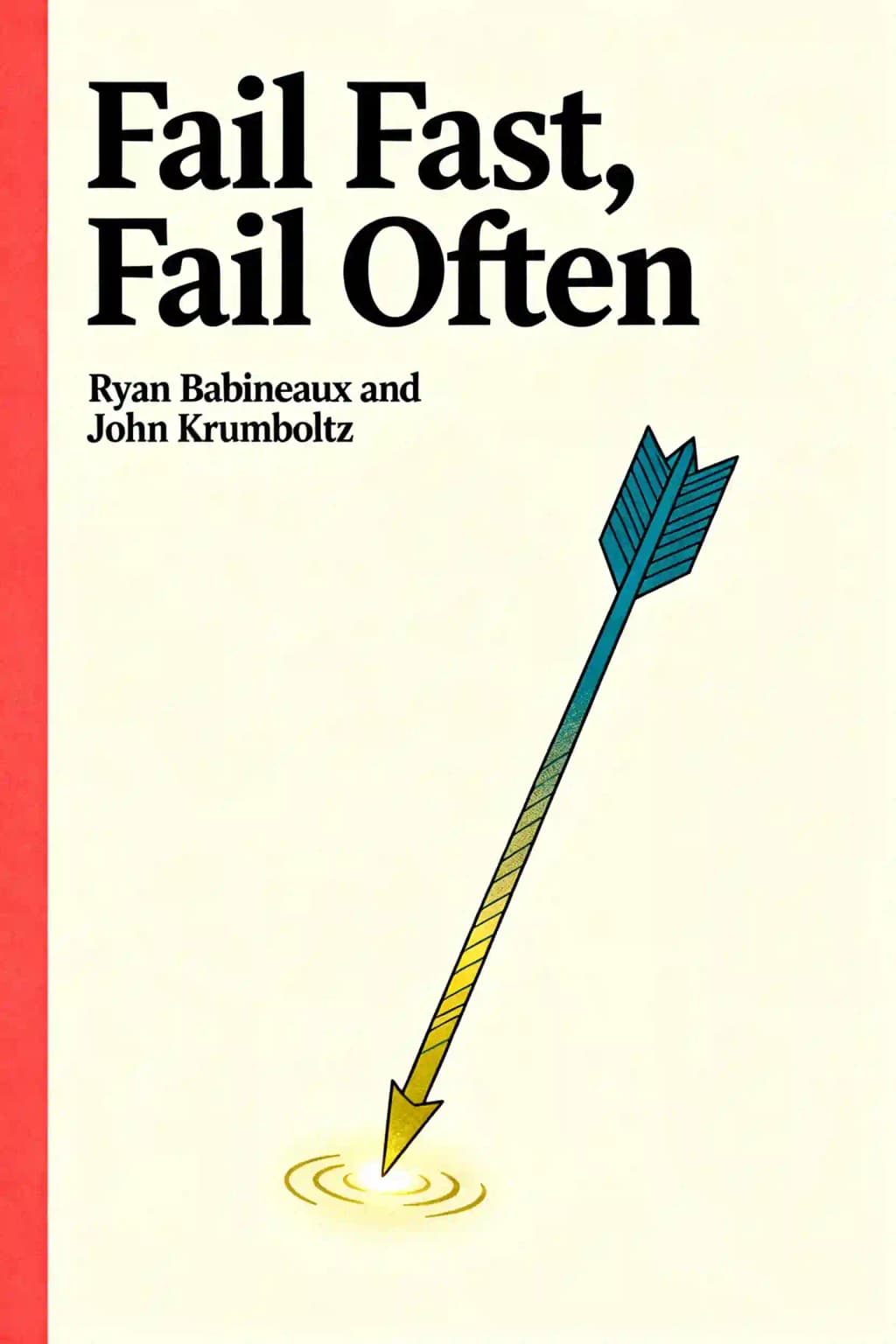
Have you ever found yourself stuck in a cycle of planning but never doing? You're not alone. In their groundbreaking book "Fail Fast, Fail Often," Stanford instructors Ryan Babineaux and John Krumboltz reveal a counterintuitive truth: happy, successful people spend less time planning and more time acting. This isn't just motivational fluff-it's backed by extensive research and real-world examples. The book has become required reading in Silicon Valley, where "failing forward" is practically a religion, and has influenced entrepreneurs, artists, and career-changers worldwide. Even celebrities like Tim Ferriss and Brene Brown have embraced its principles of rapid experimentation and learning through failure. What makes this approach so powerful is that it doesn't require dramatic personal transformation-just small changes in behavior that create momentum toward a more fulfilling life.
Capítulo 2
The Happiness Tipping Point: Joy as Your Secret Weapon
When we're unhappy, we often adopt a "not yet" mindset-believing we can't enjoy life until we've solved our current problems. This perspective is fundamentally flawed. Focusing exclusively on fixing what's wrong blinds us to opportunities and prevents us from taking actions that could transform our circumstances.
The most effective approach is counterintuitive: pursue what you enjoy first, rather than waiting until your problems are resolved. This isn't self-indulgence-it's strategic. Research consistently shows that positive emotions enhance our cognitive abilities, creativity, and problem-solving skills. When we're in good spirits, we think more adaptively and process complex information more effectively.
Psychologist Alice Isen's groundbreaking studies demonstrate this convincingly. Her research showed that physicians in positive moods diagnosed cases more quickly and accurately, while negotiators found more flexible, mutually beneficial solutions. Teresa Amabile's work with creative writers revealed that those focused on intrinsic enjoyment produced significantly better poems than those motivated by external rewards.
This effect extends to the workplace as well. In a fascinating study of 12,000 employee diary entries, people reported 50% more valuable creative ideas on days when they felt positive, with benefits carrying over to subsequent days. Barbara Fredrickson's "Broaden-and-Build" theory explains why: positive emotions expand our thinking patterns and encourage exploratory actions, while negative emotions narrow our focus.
Gary Erickson's founding of Clif Bar perfectly illustrates this principle in action. During a long bike ride in 1990, Erickson couldn't stomach his sixth PowerBar and had an epiphany: he could create a better-tasting energy bar. This insight didn't come while he was sitting at a desk strategizing-it emerged while he was pursuing his passion for cycling. Working with his mother in their bakery, they experimented for months until creating a nutritious bar with cookie-like taste and texture. By 2002, the company was so successful that Erickson declined a $120 million buyout offer.
Just as sleep and nutrition are essential for functioning, joy is equally vital. Without enough positive experiences, your entire life suffers. Successful people regulate enjoyment as carefully as they do sleep and food, organizing daily opportunities for rewarding activities. Fredrickson's research suggests we need a minimum three-to-one ratio of positive to negative experiences to flourish. Below this ratio, people spiral downward into rigid, predictable behavior; above it, they become more creative and energized.
The key isn't experiencing extraordinary moments-simple pleasures like walking or sharing tea with friends suffice. What matters is frequency: regular moments of accomplishment sustain engagement and performance far better than occasional major achievements.
Capítulo 3
Fail Fast to Learn Fast: Embracing Imperfection
Most significant accomplishments arise from hundreds of mistakes and failures. Jerry Seinfeld tries thousands of joke ideas before perfecting his national shows. Howard Schultz's original Starbucks concept featured bow-tied baristas, Italian menus, opera music, no chairs, and no nonfat milk-evolving through countless experiments to today's successful model.
Silicon Valley entrepreneurs call this "failing forward"-pushing ahead quickly to gather feedback. Pixar Animation Studios exemplifies this approach, with president Ed Catmull describing their creative process as going from "suck to non-suck." Director Andrew Stanton advocates being "wrong as fast as we can" to reach solutions quickly.
For creative work especially, writer Anne Lamott recommends producing a "really shitty first draft" as an essential starting point. This embodies the central principle: you can't know what something is like until you're actually doing it.
The approach requires reframing failure as learning: if you want to succeed at something, you must first be bad at it. This applies to everything from music to business to language learning. By developing a "fail first" attitude, you strategically make mistakes quickly to accelerate your learning process and discover unexpected opportunities along the way.
Fear of failure often disguises itself as laziness, jealousy, or caution. When worried about your competence, you tend to only do things you're already good at. But approaching activities as a beginner rather than an expert opens more possibilities-you learn new things, make friends, and discover unexpected interests.
Carol Dweck's research demonstrates this powerfully: students praised for effort rather than intelligence were more willing to tackle difficult problems, performed better, and maintained higher self-esteem when facing challenges. When approaching new activities, adopt a beginner's mindset-be playful and curious, focus on learning rather than performance, and expect to make mistakes.
Helen, a clinical psychology graduate student, exemplifies the power of failing forward. Her first teaching experience was disastrous-jumbled lectures, technical failures, and students walking out in frustration. She received the lowest evaluation score at the university, with one student calling her "the worst lecturer in the universe." Rather than quitting, Helen saw her shortcomings as opportunities to improve. She taught another class, adding engaging stories, flexible discussions, and group activities. Ten years later, Helen's classes have waiting lists, and she's consistently ranked as the university's best professor.
While failure is never fun-whether it's rejection from an elite school or discovering you're not as talented as hoped-this short-lived pain pales compared to the paralysis of fear. The alternative is a stuck-in-a-rut life where you never experience freshness, discover hidden talents, or enjoy the process of learning.
Capítulo 4
Curiosity: Your Gateway to Opportunity
Children naturally explore their world through tinkering and experimentation, acting on curiosity without evaluating potential outcomes. As we age, we lose this instinct, becoming preoccupied with doing what we "should" do rather than what intrigues us. We hesitate to try new things unless we can predict success, like Marie who kept a guitar untouched for a year because she couldn't decide if she wanted to commit to learning it.
This cost-benefit approach to life's possibilities squashes enthusiasm and experimentation. A Tibetan lama visiting America was most surprised by how readily Americans "cheat themselves out of the enjoyment of their lives" by talking themselves out of following their interests. The most successful innovators, by contrast, remain voraciously curious, connecting diverse experiences into novel insights.
When we subject potential activities to rigid cost-rewards analysis, we kill our enthusiasm and make trying new things feel too burdensome. Many people mistakenly believe that trying something requires long-term commitment, when in reality, our complex world makes outcomes unpredictable. The surest path to fulfillment is exploring what genuinely intrigues you, even if time constraints mean you can't pursue everything.
Successful innovators think differently because they constantly learn from diverse experiences and connect them in novel ways. As Steve Jobs noted, creativity is simply connecting things based on a rich variety of experiences. While most children stop asking questions around age six-perhaps due to educational systems that value correct answers over inquiry-innovative thinkers often grow up in environments that encourage pursuing interests without concern for conventional achievement.
Bill Strickland's life transformed when, as a frustrated sixteen-year-old in blighted Manchester, Pennsylvania, he followed his curiosity into an art classroom. Drawn by sunlight, coffee aroma, and jazz music, he discovered a teacher working with clay on a potter's wheel. Though his first attempt collapsed, the experience sparked something profound.
After graduation, despite being a C-student, Strickland began tutoring at a community center where he met an Episcopalian minister who mentioned funding for community projects. Strickland proposed an art center where kids could learn pottery and escape violence. With $25K from the church and a donated house, he renovated the space and launched the Manchester Craftsmen's Guild.
Though slow to start, the program gained traction as students improved academically. By 1972, he was asked to lead Manchester Bidwell, a trade school he expanded to include various vocational programs. His success led to a new 62,000-foot facility in 1986, national recognition including a MacArthur genius grant, and programs that now help 450 teenagers annually with an 86% college continuation rate.
For those who've lost touch with their natural curiosity, five essential principles can help reconnect: First, curiosity functions as a form of awareness that helps you recognize opportunities-the more you exercise it, the stronger it becomes. Second, curiosity has an expiration date-it arises in specific moments with immediate opportunities that may vanish if you delay action. Third, curiosity provides energy, propelling you into action when you might otherwise remain stagnant. Fourth, curiosity accelerates learning by naturally directing you toward relevant information and skills without requiring elaborate planning. Finally, curiosity gets things moving-like freeing a ship stuck in mud, acting on curiosity creates momentum that opens new possibilities.
Capítulo 5
Don't Marry a Job Before Your First Date
We're conditioned from childhood to choose and commit to a career path before we've experienced it-essentially marrying a job before the first date. Despite this absurdity, countless professionals claim they can match you to your perfect occupation through tests, personality assessments, or even astrological signs. This pressure to define our future prematurely often limits our potential happiness and success.
The matching model of career selection, dating back to Frank Parsons in the early 1900s, assumes people have stable traits that can be matched to specific careers. This approach fails for three key reasons: First, our interests constantly evolve-what fascinates us one year may change completely the next. Second, occupations aren't limited to specific personality types-any profession contains diverse individuals with varying approaches. Third, the world itself is rapidly changing, creating jobs that didn't exist a decade ago. Career tests can't predict opportunities that haven't been invented yet.
Successful companies like Google release minimal viable products quickly rather than waiting for perfection, gathering real-world feedback to guide development. Steve Blank and Eric Ries have studied this approach, finding that exhaustive five-year plans rarely match reality. The "lean start-up" methodology prioritizes small, interactive experiments that accelerate learning over comprehensive planning.
The lean approach originated in Toyota's manufacturing revolution through the Japanese concept of genchi gembutsu-"go and see for yourself." This principle is essential for career exploration because no amount of research can substitute for firsthand experience. Sara's story illustrates this perfectly-despite loving crime shows and planning to become a forensic scientist, when she finally visited an actual crime lab, she discovered she hated the environment. The harsh lighting, disinterested employees, and antiseptic smell immediately told her this wasn't right for her. Instead of wasting years pursuing the wrong path, she pivoted to interior design, where her personality thrived.
The lean approach emphasizes "validated learning"-testing assumptions before acting on them. Many people limit their careers with false assumptions like "chemistry is too hard," "I'm too old," or "I don't have the right degree." Jill's story demonstrates how damaging these assumptions can be. Despite loving animals since childhood, she abandoned her veterinary dreams because she struggled with science classes and feared blood. After years in unfulfilling finance work, a company buyout gave her freedom to explore. When she finally volunteered at a vet clinic, she discovered blood didn't bother her when working with animals. At 36, she returned to school, excelled in science courses, and became a successful veterinarian.
Lean start-ups create minimal viable products with the fewest features and least up-front cost, getting them to customers quickly to gather feedback and adjust course. This approach minimizes wasted resources while maximizing learning opportunities. This concept applies directly to career preparation-invest as little time and resources as possible before trying the actual work. Too many people (especially lawyers) spend years studying only to discover they hate the profession.
Capítulo 6
Think Big, Act Small: The Power of Incremental Progress
The authors challenge the cultural emphasis on big wins, using the example of Allan, a software engineer who, shocked by his weight gain, set ambitious fitness goals. Despite joining an expensive gym and creating an intense workout schedule, Allan quickly became overwhelmed, sore, and discouraged when he gained two pounds in the first week. He soon abandoned his program entirely.
This illustrates how lofty goals often paralyze people rather than inspire action. The authors challenge the "no pain, no gain" mentality and the business world's obsession with stretch goals and BHAGs (big, hairy, audacious goals). Stanford professor Bob Sutton argues such goals are often counterproductive, as people freeze when facing overwhelming challenges. Harvard research by Teresa Amabile shows people are least creative when struggling with difficult objectives, and that motivation requires frequent task completion to build momentum.
Psychologist Karl Weick's influential 1984 paper introduced the concept of "small wins"-breaking complex problems into bite-sized tasks with achievable goals. This approach clarifies actions, reduces uncertainty, and builds momentum. Alcoholics Anonymous exemplifies this by focusing on sobriety one day at a time rather than for life. Small wins create "visible results" that set forces in motion favoring additional progress. Each small win reveals new allies, resources and opportunities in an unpredictable but productive path.
Tom Fatjo's garbage business journey exemplifies small wins leading to major success. After his initial truck compactor broke, Fatjo found himself stomping garbage down manually, sometimes sinking to his armpits in muck. Surprisingly, he enjoyed the physical work and industry learning opportunities, prompting him to quit accounting for full-time waste management. He expanded methodically-first adding commercial accounts, then buying a landfill when regulations changed. When Houston's mayor asked him to handle city garbage in just twelve days, Fatjo seized the opportunity, suddenly managing 1,000 additional trucks.
A three-week research trip revealed the industry lacked national companies while new regulations required capital investments beyond small operators' means. Recognizing this opportunity, Fatjo acquired independent operators weekly, building BFI into a $256 million company with 2,800 trucks in 131 cities by 1976. His success came not from grand initial plans but from starting small with one truck and $500, discovering opportunities incrementally through direct experience.
When facing paralysis with big projects like career changes or lifestyle improvements, focus on finding just one small thing to do. No matter how chaotic life seems, you can always take one positive step to get things moving. The smaller and easier your action step, the better! The beauty of small wins is that you often don't know where they'll lead, so enjoy taking little steps that might bring unexpected opportunities.
Research by Professor Saras Sarasvathy reveals that successful entrepreneurs aren't reckless risk-takers but rather pragmatic individuals who capitalize on existing resources-their skills, knowledge, and social connections. They minimize risk by asking questions like "Am I willing to work three days on a prototype?" rather than committing life savings to long-term ventures.
Emma, a lifelong photography enthusiast who had worked as a programmer for decades, found herself jobless in her mid-forties. Rather than pursuing another programming position, she decided to follow her dream of becoming a professional photographer. Initially, Emma planned an elaborate six-month process to create a portfolio and website before launching her business. With guidance, she instead created a simple website in just two weeks and began volunteering her photography services.
Though hesitant at first about commercial work, Emma discovered creative possibilities in even simple assignments. She joined an artists' guild, leveraging her web design expertise to head a committee and connect with established photographers. Instead of spending months researching stock photography companies, Emma quickly submitted three photos to a site and made her first sale-26 cents-within a week. This small win allowed her to call herself a "professional photographer." Emma gradually expanded into various paid work while still pursuing her fine-art photography goals, learning to focus on daily progress rather than projecting a perfect artistic image.
Capítulo 7
Be an Innovator: Seeing the World with Fresh Eyes
Innovation-creating new ways to contribute value to your life and world-is essential to personal success regardless of profession. Each day offers opportunities to solve problems, strategize, develop new practices, and work more effectively. Creativity and insight are equally vital to enriching your personal life, from being a supportive friend to creating meaningful family rituals. Research shows that innovation doesn't require exceptional intelligence or education-just inquisitiveness and active pursuit of new experiences.
Successful innovators observe the world with fresh, curious eyes-like alien anthropologists seeing Earth for the first time. This "beginner's mind" approach (what innovation scholars call "vuja de") helps you see familiar things in powerful new ways. Many transformative business ideas come from such observations: Ratan Tata created the world's cheapest car after seeing a rain-soaked family of four crowded onto a scooter, and Scott Cook founded Intuit after watching his wife struggle with household finances.
To develop your observational powers, pay attention to your environment, people, technology, your own mind and body, nature, and aesthetic qualities around you. The "30-Second Snapshot" exercise-spending half a minute fully absorbing every sensory detail of your surroundings-can strengthen this skill.
Innovators constantly ask questions: Why are things this way? What's really happening here? What could be done differently? Often the simplest questions lead to breakthrough innovations, like when Edwin Land's three-year-old daughter asked why she couldn't see a photograph immediately-leading to the invention of the Polaroid camera. Innovation frequently comes from reframing questions about existing problems, as when Dr. William Hunter created drug-eluting stents by asking "What does the body do to these stents?" rather than "How can we make a better stent?"
The quality of your creative output depends entirely on your inputs. As Todd Henry notes in The Accidental Creative, "Garbage in, garbage out." Great innovators deliberately seek inspiration from diverse sources-Steve Jobs found the perfect plastic finish for the original Mac by examining a Cuisinart food processor, and improved the metal case design by studying Mercedes-Benz trim in the company parking lot.
The most transformative knowledge often comes from unexpected sources outside formal education. Johannes Gutenberg applied wine press technology to create the printing press, Charles Eames used shipyard plywood-molding techniques for furniture design, and Steve Jobs incorporated calligraphy principles into Mac typography a decade after taking the course "for fun." Learning opportunities exist everywhere-in mundane moments, personal hardships, and everyday interactions.
Innovation requires breaking out of routine patterns. The "Mapping Your Luck" exercise helps identify areas of repetition in your life and replace them with fresh experiences. First, reflect on where you spend time-lunch spots, weekend activities, shopping routines, reading habits, TV shows, and neighborhoods you visit. Create a simple map showing these locations, then rate each area from 1-10 based on how much "newness" and unexpected opportunities you encounter there. Finally, identify the low-scoring "stale" areas and replace them with novel activities.
Capítulo 8
Overcome Analysis Paralysis: Taking Action Despite Uncertainty
When we overthink decisions, we often paralyze ourselves into inaction. Jason, who meticulously researched a trip to Prague for months, ultimately abandoned his travel plans, overwhelmed by details. Many of us excel at planning but struggle with actually doing-we have "Ph.D.s in planning and kindergarten educations in doing."
Research shows excessive information inhibits action. In one study, a grocery store table with six jam varieties generated ten times more sales than one with twenty-four options. When faced with too many choices, we become confused and either stick with familiar options or avoid deciding altogether. Studies with physicians and university admissions officers demonstrate that additional choices make decisions harder, not easier.
Worse still, decision-making depletes mental energy needed for action-participants who made choices before attempting challenging tasks showed less persistence and poorer performance. Ultimately, overthinking leads to confusion, status quo bias, distraction by trivial factors, and energy depletion-all enemies of meaningful action.
When facing complex choices like career changes or relocations, we often make decisions unnecessarily complicated by considering every possible long-term implication. The solution is to "shrink the decision" by identifying small, exploratory steps instead of committing to major changes. For example, rather than agonizing over whether to switch careers, simply decide if you're willing to talk with someone who made a similar change.
When John received an unexpected interview invitation from Stanford while happily employed at Michigan State, he avoided overthinking the implications of potentially moving his family. Instead, he asked himself a much simpler question: "Do I want to take a free vacation in sunny California?" This approach transforms paralyzing decisions into manageable actions that provide valuable information without requiring major commitments.
We're hardwired with a negativity bias that makes us better at spotting risks than opportunities. To counter this, apply the "One Yes Trumps Three No's" rule-give each positive reason three times the weight of each negative one. When considering actions, we often neglect to evaluate the default outcome of doing nothing, which can be the riskiest choice of all. Staying in an unfulfilling job, remaining socially isolated, or never developing expertise might be the true cost of inaction.
When weighing options, we often overlook the default outcome-what happens if we do nothing. Sometimes the biggest risk is the future we'll have if we're unwilling to change: continued isolation if we skip social events, remaining in unfulfilling work if we don't apply for new jobs, never becoming an expert if we don't start as a beginner, or endless nights of TV instead of trying new activities.
When faced with complex decisions, find a key action that simplifies everything and creates momentum. For Jason, who once talked himself out of visiting Prague, buying an airline ticket to Beijing years later became his springboard action that made everything else fall into place. The best springboard actions involve external commitments to others-scheduling meetings, making reservations, or signing up for courses.
Capítulo 9
Stop Resisting and Start Living: Overcoming Internal Barriers
Our happiest moments come when we're engaged in exciting projects, taking on challenges, or nurturing relationships-not when we're passive. Yet resistance, our biological hardwiring to seek familiarity and avoid risks, often stops us. This internal voice is strongest when we face significant life changes like career shifts, creative projects, or forming new habits. Resistance exaggerates dangers, downplays possibilities, and claims the timing is never right.
Steven Pressfield describes resistance as a diabolical force that prevents us from pursuing meaningful work-whether writing, painting, or entrepreneurship. While this caution made sense when saber-toothed tigers roamed, modern life requires taking action despite our warning signals.
Laney, a bored financial analyst with creative aspirations, once discovered a perfect university job matching her philosophy background. Initially excited, her enthusiasm mysteriously waned when application time came. She rationalized not applying by questioning the job's value. This pattern repeats in many lives-skipping workouts when tired, abandoning promising relationships over vague doubts, or declining travel opportunities when feeling overwhelmed.
While trusting your gut seems wise, psychologist Tanya Chartrand's research reveals these "mystery moods" often result from disrupted unconscious patterns rather than genuine intuition. When faced with unfamiliar situations, our neural systems produce negative emotions that masquerade as intuition. Like the Wizard of Oz, these seemingly powerful moods are revealed as harmless when we take action despite them.
The best way to get in the mood for something is simply by doing it. When changing routines, like swapping evening web surfing for walks, initial resistance is normal. But once you start walking, enjoyment follows. Taking action is not only the fastest way to develop positive attitudes toward new activities-it's often the only way. Public speaking, new social settings, creative projects-waiting until anxiety disappears means never starting.
Every significant project has what we call the "malodorous middle"-when progress slows, enthusiasm wanes, and success feels distant. Tim Brown of design company IDEO notes that design rarely proceeds smoothly from "height to height." Projects typically begin with optimism before entering a difficult middle phase where conflicting objectives must be integrated into fresh designs. IDEO designers visualize this as a U-shaped curve: starting with "hope," dipping into a valley of "insight" where progress seems minimal, before rising to "confidence" when solutions emerge.
Success requires "grit"-what psychologist Angela Duckworth defines as "perseverance and passion for long-term goals." Her research shows that leaders across fields share this essential quality: the stamina to maintain effort despite failure, adversity, and plateaus. While others change course when bored or disappointed, gritty individuals persist. Educational psychologist Benjamin Bloom's study of world-class performers found that mastery requires three characteristics beyond raw talent: passion for their field, desire for high achievement, and willingness to invest substantial time and effort.
Procrastination-resistance's trickiest form-doesn't directly discourage action but suggests postponement: "Don't worry, you'll write that novel tomorrow-let's walk while the sun's out." The solution is simple yet powerful: spend time every day working on your most important projects. Psychologist Neil Fiore recommends the "unschedule"-aiming for just thirty minutes of quality, focused work rather than completing entire projects. This breaks inertia and shifts your identity from procrastinator to producer.
Most of us maintain a mental list of tasks we want to accomplish someday-home improvements, fitness goals, creative work, business development-but haven't found time or motivation to begin. The key is transforming abstract "someday" goals into concrete "today" actions. Instead of saying "I will lose weight," commit to "I will eat a light lunch." Rather than "I will write a children's book," decide "I will write a few sentences on the bus ride home." By breaking down ambitious goals into small, immediate actions-saving a dollar toward debt reduction, taking a walk after work, calling a friend-you make progress possible.
Capítulo 10
It Takes a Community: Building Your Support Network
Success rarely comes from solitary effort-virtually every achievement story involves the support of friends, mentors, advisors, and family. Rather than traditional "networking" focused on extracting resources from others, true community building means sharing your full humanity through meaningful conversations and relationships. There is no more powerful way to enrich your life and encounter new possibilities than through diverse, meaningful connections with others.
The people around you profoundly shape your actions and perceptions. Solomon Asch's famous conformity experiments demonstrated how individuals will doubt their own judgment when surrounded by others making incorrect choices-but having just one ally significantly reduces this conformity pressure. More recent research by Dr. Nicholas Christakis shows that behaviors are literally contagious: obesity, study habits, lawn care practices, and even emotional states like happiness or depression flow through social networks. The implications are clear: if you want to be dynamic and enthusiastic, surround yourself with people who embody those qualities. Your social circle doesn't just influence what you do-it shapes what you believe is possible.
While traditional networking focuses on connecting with similar people to gain resources, innovative thinkers practice "idea networking"-deliberately seeking relationships with people from different backgrounds to expand their knowledge. Research shows that breakthrough ideas often emerge from interactions outside one's usual social circle. As University of Chicago sociologist Ron Burt notes, creativity functions more as an "import-export business" than individual genius-an idea common in one group can be revolutionary in another.
Sheila, a talented architect trapped in a stressful corporate environment, dreamed of starting her own firm where she could bring her dog to work and focus on interesting design problems rather than just profit. After struggling to find a viable niche in the competitive architecture industry, she began expanding her social connections on the advice of a career coach. When a chance meeting with an old college friend led to helping a medical clinic buyer solve a space problem, Sheila discovered an unexpected specialty. Three years later, she runs a thriving practice designing medical clinics, complete with three dogs roaming the office.
As we age, we tend to narrow our social circles to people similar to ourselves. To counter this natural tendency, we should examine the diversity of our relationships across age groups, professions, cultural backgrounds, living environments, economic classes, and life orientations. Expanding your social community to include people different from yourself dramatically opens up new possibilities in your life.
A simple way to expand your social relationships is talking to someone new weekly. Whether striking up conversations with strangers, getting to know coworkers, or having coffee with neighbors, these interactions don't need to become long-term friendships. The goal is appreciating the experience of meeting someone new and learning about their life, like pausing to admire a flower's beauty.
Despite forming many friendships throughout life, we often neglect maintaining these relationships amid daily busyness. Reconnect with old friends by calling someone weekly, meeting for a meal, or contacting past colleagues. This habit takes less effort than expected and significantly enriches your life, even if changing established patterns feels uncomfortable.
Create a Mastermind Group of 3-6 people with diverse backgrounds who meet regularly to brainstorm and support each other. Benjamin Franklin formed such a group for self-improvement, as did Henry Ford with Thomas Edison and Harvey Firestone, and Richard Branson when founding Virgin Music. These groups provide diverse perspectives and accountability, with each member sharing their work and receiving feedback during meetings.