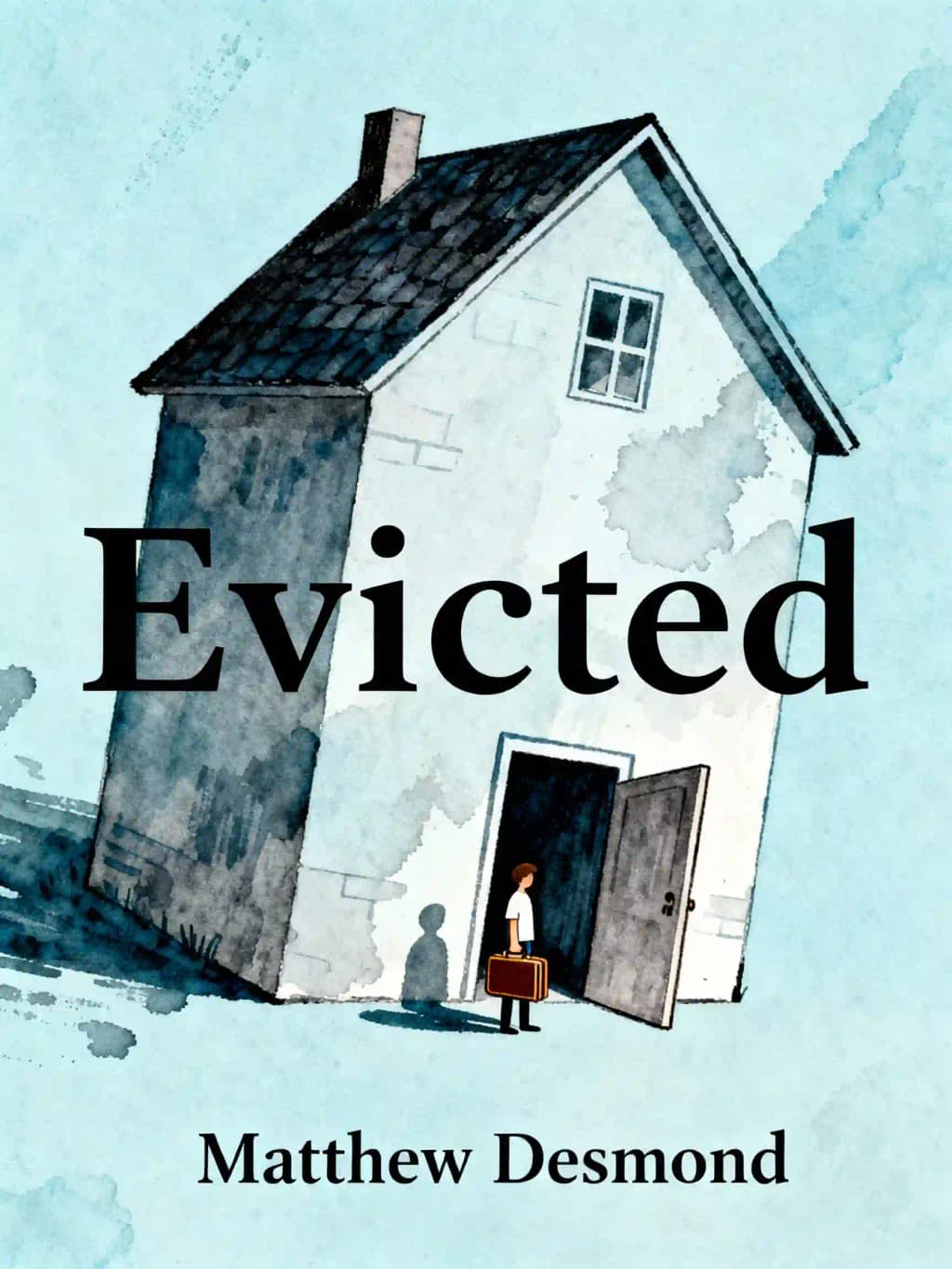
Pulitzer Prize-winning "Evicted" exposes America's hidden housing crisis, where poverty and profit collide. Bill Gates praised Desmond's transformation of data into unforgettable stories that changed housing policy nationwide and inspired Princeton's groundbreaking Eviction Lab, revealing the shocking truth - eviction causes poverty, not just results from it.
Matthew Desmond, Pulitzer Prize-winning author of Evicted: Poverty and Profit in the American City, is a sociologist and Princeton University professor renowned for his groundbreaking research on urban poverty, housing insecurity, and systemic inequality.
A MacArthur “Genius” Fellow and recipient of the National Book Critics Circle Award, Desmond combines academic rigor with ethnographic storytelling to expose how eviction perpetuates cycles of poverty. His work draws from years of fieldwork in low-income communities and his role as principal investigator of Princeton’s Eviction Lab, the first national database tracking housing displacement.
Desmond’s other works, including Poverty, by America (2023) and The Racial Order, further explore themes of economic justice and structural discrimination. A contributing writer for the New York Times Magazine and named to the Politico 50 list of influential thinkers, he bridges scholarly insight with public discourse.
Evicted has sold over a million copies, been translated into 12 languages, and remains a pivotal text in sociology and public policy courses worldwide.
Evicted examines America’s housing crisis through the lives of eight Milwaukee families struggling with poverty and displacement. Desmond, a Princeton sociologist, exposes how eviction perpetuates cycles of poverty, detailing exploitative landlord practices and systemic failures. The book combines ethnographic storytelling with data to argue that stable housing is foundational to dignity and opportunity. It highlights personal stories, like single mother Arleen Bell’s eviction, to humanize structural inequality.
This book is essential for policymakers, social justice advocates, and students of sociology or urban studies. It offers critical insights for anyone interested in poverty, housing policy, or economic inequality. Readers seeking a deeply researched, narrative-driven analysis of systemic injustice will find it compelling. Landlords, activists, and educators also benefit from its unflinching portrayal of housing insecurity.
Yes. Hailed as “wrenching and revelatory” (The Nation), Evicted won the Pulitzer Prize for its groundbreaking exploration of eviction’s societal impact. Desmond’s blend of personal narratives and rigorous data provides a transformative perspective on poverty. It’s widely praised for making complex systemic issues accessible and urgent.
Key themes include poverty (how housing instability entrenches disadvantage), profit (landlords exploiting marginalized tenants), and home (housing as essential for stability and identity). Desmond argues eviction isn’t just a symptom but a cause of poverty, trapping families in cycles of dislocation and debt.
Desmond asserts that eviction fuels poverty by destabilizing families, reducing job prospects, and worsening health. He challenges the notion that housing is a market commodity, advocating for universal vouchers and tenant protections to ensure housing as a basic right.
The book depicts landlords like Sherrena Tarver, who profit from renting substandard homes to desperate tenants. While some show fleeting empathy, their business models often prioritize profit over human dignity, exploiting legal loopholes to maximize evictions and rents.
Desmond advocates for expanding housing vouchers, strengthening tenant rights, and capping rent increases. He emphasizes that housing policy must address systemic inequities, not individual failings, to break poverty cycles.
Following characters like Arleen (a single mother evicted repeatedly) and Scott (a nurse battling addiction), Desmond humanizes statistics. These narratives reveal how eviction devastates mental health, employment, and family stability, making systemic issues relatable.
Some housing experts argue the book focuses narrowly on extreme poverty, overlooking broader low-income struggles. Critics also note it emphasizes tenant exploitation without fully analyzing landlord financial risks or market complexities.
Unlike statistical analyses like The Poverty Industry, Evicted uses immersive storytelling akin to Nickel and Dimed. It uniquely links housing instability to systemic economic failure, offering actionable policy solutions alongside personal narratives.
With housing costs soaring globally, Desmond’s insights remain critical. The book informs debates on eviction moratoriums, rent control, and homelessness prevention, underscoring the urgent need for policy reform in post-pandemic economies.
“Eviction is a cause, not just a condition of poverty” encapsulates its central argument. Another—“Home is the wellspring of personhood”—highlights housing’s role in dignity and opportunity.
Living alongside tenants and landlords, Desmond conducted ethnographic fieldwork for nearly a year, paired with quantitative data. This mixed approach lends academic rigor while amplifying marginalized voices often excluded from policy discussions.
The epilogue shifts from analysis to advocacy, outlining policy reforms like universal housing assistance. Desmond urges readers to view stable housing as a moral imperative, not a market commodity, challenging America’s values of fairness and opportunity.
Sinta o livro através da voz do autor
Transforme conhecimento em insights envolventes e ricos em exemplos
Capture ideias-chave em um instante para aprendizado rápido
Aproveite o livro de uma forma divertida e envolvente
"The 'hood is good,' she often says. 'There's a lot of money there.'
This moment right now, it's going to create a lot of millionaires.
This is America! This is America!
Eviction functions not just as a consequence of poverty, but as one of its primary causes.
Divida as ideias-chave de Evicted em pontos fáceis de entender para compreender como equipes inovadoras criam, colaboram e crescem.
Destile Evicted em dicas de memória rápidas que destacam os princípios-chave de franqueza, trabalho em equipe e resiliência criativa.

Experimente Evicted através de narrativas vívidas que transformam lições de inovação em momentos que você lembrará e aplicará.
Pergunte qualquer coisa, escolha a voz e co-crie insights que realmente ressoem com você.

Criado por ex-alunos da Universidade de Columbia em San Francisco
"Instead of endless scrolling, I just hit play on BeFreed. It saves me so much time."
"I never knew where to start with nonfiction—BeFreed’s book lists turned into podcasts gave me a clear path."
"Perfect balance between learning and entertainment. Finished ‘Thinking, Fast and Slow’ on my commute this week."
"Crazy how much I learned while walking the dog. BeFreed = small habits → big gains."
"Reading used to feel like a chore. Now it’s just part of my lifestyle."
"Feels effortless compared to reading. I’ve finished 6 books this month already."
"BeFreed turned my guilty doomscrolling into something that feels productive and inspiring."
"BeFreed turned my commute into learning time. 20-min podcasts are perfect for finishing books I never had time for."
"BeFreed replaced my podcast queue. Imagine Spotify for books — that’s it. 🙌"
"It is great for me to learn something from the book without reading it."
"The themed book list podcasts help me connect ideas across authors—like a guided audio journey."
"Makes me feel smarter every time before going to work"
Criado por ex-alunos da Universidade de Columbia em San Francisco

Obtenha o resumo de Evicted como PDF ou EPUB gratuito. Imprima ou leia offline a qualquer momento.
A sheriff's deputy knocks at 1:00 PM. By 1:30, your children's toys, your grandmother's photos, your winter coats-everything you own-sits in a heap on the curb. Neighbors glance over, then quickly look away. This isn't a scene from a disaster movie. It's Tuesday afternoon in Milwaukee, where sixteen families lose their homes every single day through formal eviction proceedings. Thousands more are forced out through informal pressure that leaves no paper trail. What was once shocking enough to draw crowds of angry protesters now barely registers as newsworthy. Eviction has become so routine in America's poorest neighborhoods that it's practically invisible-yet it's quietly destroying lives, shattering families, and perpetuating cycles of poverty that trap generations. This is the hidden crisis that Matthew Desmond spent years documenting, living alongside both landlords and tenants to understand how losing your home has transformed from a rare catastrophe into an ordinary fact of life for millions of Americans.