Capítulo 1
From Corporate Comfort to Entrepreneurial Freedom
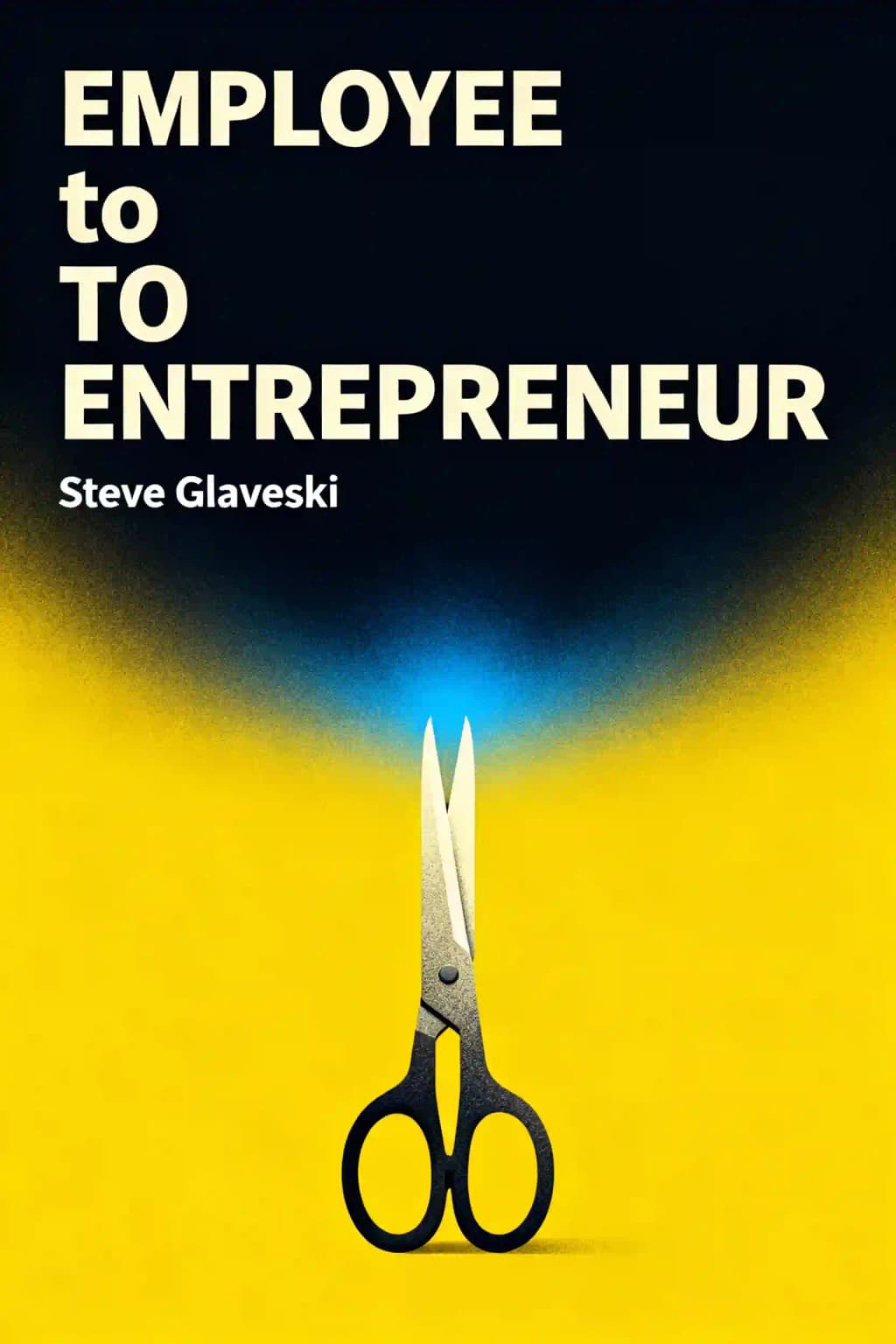
The journey from employee to entrepreneur isn't just about changing careers-it's about fundamentally transforming how you view work and life. Steve Glaveski's path exemplifies this transformation. As a first-generation Australian raised in Melbourne's challenging western suburbs by Eastern European factory workers, he worked his way into prestigious firms like EY and Macquarie Bank before building his own seven-figure business, Collective Campus. His story gained attention when he was summoned to Human Resources after being featured in The Australian newspaper for his side project, Hotdesk-an "Airbnb for office space" that he'd conceived while noticing vacant offices at client sites. What began as a $2,500 minimum viable product evolved into a successful business working with major brands like Microsoft and BNP Paribas. This book has become a favorite among corporate professionals seeking more meaningful work, with readers particularly drawn to its practical framework for testing ideas without risking financial security. In our rapidly changing economy where job security increasingly feels like a relic of the past, Glaveski's approach offers a roadmap for those looking to create impact and find fulfillment beyond the traditional career path.
Capítulo 2
The Future is Already Here: Why Traditional Employment is Changing
If you took one step today and doubled the distance daily for 30 days, you'd walk far enough to circle Earth 26 times. This exponential growth explains why technologies once considered science fiction-virtual reality, artificial intelligence, autonomous vehicles-are rapidly becoming reality. As William Gibson noted, "The future is already here-it's just not evenly distributed."
Twenty-five years ago, search engines would have seemed magical. Ten years ago, summoning a private car with a button press would have appeared exclusive to secret societies. Today we take these technologies for granted. Moore's law has enabled platforms like Google and Amazon while disrupting traditional industries. Manufacturing jobs have plummeted since the 1970s while productivity increases, as technology becomes increasingly "intelligent." Computers now perform tasks once thought uniquely human-playing chess, writing poetry, diagnosing diseases, reading emotions.
Companies achieve more with fewer employees: Netflix generates 357 times more value per employee than Blockbuster did at its peak. This explains the growing gap between productivity and household income-corporations need less human capital to achieve more.
The transition from employee to entrepreneur requires shifting from risk mitigation through analysis to risk mitigation through building and testing. First-time entrepreneurs, especially those from corporate backgrounds, often fall into traps like jumping to conclusions, confusing family support with market validation, wasting seed funding before establishing value propositions, overpaying for subpar software development, and overestimating their "unique advantage."
Entrepreneurship isn't just a job title but a state of mind requiring breaking from the traditional "school, taxes, death" narrative. It's about managing your own psychology and breaking free from social conditioning that pushes us toward education, career, and comfort. The freelance economy is growing three times faster than traditional employment as people seek fulfillment beyond profit.
There will never be a "right time" to start-at every life stage, there will be excuses. As Jon Acuff notes, "You don't need to go back in time to be awesome; you just have to start right now." Examples like Conrad Hilton (who started Hilton Hotels in his fifties) and quadruple amputee Kyle Maynard (who scaled Mount Kilimanjaro unassisted) show that age and physical limitations are no barrier.
To begin your entrepreneurial journey: Write down why you picked up this book and keep that reason visible; objectively assess which aspects of your job could be performed by algorithms; identify what's stopping you from taking the leap; and find ways to create time by eliminating unnecessary activities or taking small steps toward entrepreneurship alongside your current responsibilities.
Capítulo 3
Connecting the Dots: Building Your Entrepreneurial Foundation
Many people struggle to identify their passion or purpose not because they don't have one, but because they haven't found it or been trained to see it. Finding purpose requires first collecting dots (experiences) before connecting them.
In his famous Stanford speech, Steve Jobs explained that "you can't connect the dots looking forward; you can only connect them looking backwards." His diverse interests-Zen Buddhism influenced Apple's minimalism, calligraphy classes shaped Apple's typography, and his Xerox PARC visit revealed the graphical user interface he later "borrowed." Successful entrepreneurs like Uber's founders (who couldn't find a cab), Airbnb's creators (who rented air mattresses during a conference), and Dropbox's founder (frustrated with thumb drives) all solved problems they personally experienced by connecting their collected dots.
Harvard professor Clayton Christensen defines connecting dots as "associational thinking"-synthesizing unrelated fields or ideas. First principles thinking-used by entrepreneurs like Elon Musk, Jeff Bezos, and Richard Feynman-involves boiling things down to fundamental truths and reasoning up from there. This approach helps move beyond incremental improvements to create transformative ideas.
With today's technology, there's no excuse not to learn something new daily. Podcasts have revolutionized learning by enabling brain-expanding conversations around philosophy, psychology, politics and more. A quarter of Americans listen monthly-five times more than go to movies. Many successful entrepreneurs listen at 2-3x speed to maximize learning.
In our rapidly changing world, we can't afford to stop learning after graduation. As "eternal newbies" (Kevin Kelly's term), our most crucial skill is learning how to learn. Books like Tim Ferriss's The 4-Hour Work Week, Eric Ries's The Lean Startup and Marcus Aurelius's Meditations can fundamentally change how we respond to situations.
Developing a learning mindset requires self-awareness, resilience, tolerance of ambiguity, willingness to embrace failure, and disidentification with ego. With finite time, evaluate whether learning something is worthwhile by asking: Could someone else do this for a reasonable price? Are there DIY solutions? Do I need to understand all technical elements? What's the opportunity cost?
Experiencing different cultures provides invaluable perspective and inspiration. Budget airlines have made travel more accessible than ever. Solo travel forces you out of your comfort zone and into meaningful interactions with strangers. When with friends, we tend to stay insulated. Breaking out of your comfort zone increases your tolerance for ambiguity and discomfort while developing greater empathy through engaging with strangers.
Don't passively wait for learning to happen-deliberately carve out distraction-free time for consuming useful content. Track your progress weekly using tools like Rescue Time to measure how you're spending your learning hours. The positive feedback loops from better conversations, identifying opportunities, and closing deals will motivate continued learning.
Capítulo 4
Finding Your Why: The Power of Purpose
Standing on a railway platform after another unfulfilling day of consulting work, I found myself wondering what I'd actually achieved. In my late twenties, despite a decade since making career decisions in high school, I still hadn't connected enough dots to know what I truly wanted. Like many others, I lived for weekends and numbed my dissatisfaction through various distractions. Looking around, I saw other smart, ambitious people wasting their potential on office politics and meaningless PowerPoint presentations.
When tackling your "why," first examine what your why is right now. What triggered you to seek change? Was it a single spark or a series of events? Many people get sucked into the matrix of daily work, looking at similarly immersed colleagues and concluding "this must be how it's supposed to be." As Mark Twain said, "Whenever you find yourself on the side of the majority, stop and reflect."
Every few months I perform a sanity check using the "5 Fs" as a helpful guide to assess whether I need to make changes to my work:
1. Freedom: Having autonomy to choose projects, explore interests, express yourself, work wherever you want, and collaborate with people who inspire you.
2. Financial independence: Earning enough to live comfortably without being enslaved to someone else.
3. Fulfillment: Doing meaningful work that gets you out of bed excited, where the struggle feels worthwhile.
4. Fitness: Maintaining physical and mental health as a foundation for achieving the other Fs.
5. Family and friends: Ensuring you have time for relationships despite work commitments.
The five whys technique helps get to the root cause of decisions by repeatedly asking "why" to drill deeper. We only have one life, so spending it solving the wrong problems is tragic. When making life decisions, try to operate from a place of voluntary reason rather than involuntary reaction.
Marcus Aurelius noted in 160 AD, "Without purpose, nothing should be done." Nearly two millennia later, Brad Stulberg defined purpose as "the world's greatest performance enhancer." Consider Tom Boyle, who lifted the front end of a 1500kg Camaro to free a trapped cyclist-a feat of lifting five times his body weight, far beyond what Olympic powerlifters typically achieve. Purpose dramatically enhances performance.
Holocaust survivor Viktor Frankl wrote that success and happiness cannot be pursued directly but emerge as side effects of dedicating oneself to something greater. Material possessions provide fleeting pleasure but not lasting happiness. Only by pursuing things that give us true esteem and opportunities to reach our potential do we find fulfillment.
The world has dramatically improved: absolute poverty has fallen from 53% to under 17% in just 30 years, global homicide rates have plummeted, and literacy has increased from 12% to almost 90% since 1800. Finding work that feeds your sense of self-worth creates a positive feedback loop-it nourishes you, and you continue to nourish it.
When Shay Namdarian left his corporate job to join Collective Campus, he was triggered by a colleague counting down to the weekend on a Tuesday morning. To overcome self-doubt and fear, he asked himself five key questions: What is the worst possible outcome? What is stopping you? What is the best possible outcome? Are you seeking permission? Would you regret not taking action? As George Costanza from Seinfeld demonstrated, sometimes doing the opposite of your instinct is the right move. Rejection and failure are always better than cowardice and regret.
Capítulo 5
Embracing Your What: Aligning Purpose With Action
The author emphasizes that to succeed, your "why" and "what" must align. Without this alignment, you won't persist through challenges-like James N. Watkins observed, "A river cuts through rock, not because of its power, but because of its persistence." Despite shutting down Hotdesk, the author gained valuable experience-a "two-year personal MBA in entrepreneurship"-that helped identify a purpose he truly connected with.
When considering entrepreneurship, first determine if your current dissatisfaction stems from lacking purpose, autonomy, or mastery in your existing role. Small decisions made consistently have compound effects-like checking email every 10 minutes prevents deep work and ultimately hinders significant progress.
The dramatic reduction in startup costs creates unprecedented entrepreneurial opportunities. Setting up an e-commerce site that once cost tens of thousands now requires just $29/month with Shopify. Cloud platforms like AWS let businesses start free and scale as needed. The author's podcast, which reaches thousands monthly, required minimal equipment compared to the substantial recording studio, production, and distribution costs of twenty years ago.
Just as using a 1500s map to sail to Australia would lead to failure, outdated mental models prevent us from seeing new opportunities. To pursue opportunities, we must redraw our mental maps of the world, especially regarding what constitutes success. The author took an 80% pay cut to launch his startup, prioritizing meaningful work, freedom and fulfillment over immediate financial gain.
Despite the glamorization of entrepreneurial success stories like Elon Musk's, the reality is far more challenging. As Shark Tank's Lori Greiner noted, "Entrepreneurs are the only people who will work 80 hours a week to avoid working 40 hours a week." If making money is your primary goal, conventional career paths offer better short-term prospects.
The author presents eleven alternatives to entrepreneurship for those seeking fulfillment: joining value-aligned companies, changing roles internally, switching industries, pursuing creative side projects, changing careers, building side hustles, reframing contentment sources, nurturing relationships, reducing work hours, becoming an intrapreneur, or freelancing.
Before making radical career changes, consider that what you seek might be available within your current organization. As Seneca wrote, "If you really want to escape the things that harass you, what you're needing is not to be in a different place but to be a different person."
Ray Dalio proposes that "meaningful work + meaningful relationships = happiness." Perhaps meaningful relationships, not work, is what you're lacking. Humans have six fundamental needs: social, physical, emotional, intellectual, sexual and love. Many can be satisfied at work, but if you're missing deep intellectual conversations or emotional connections, expanding these areas might be your solution rather than changing jobs.
One critical flaw in human thinking is our tendency to jump to conclusions when things aren't going well. We convince ourselves the grass is greener elsewhere and make irrational decisions. We favor action because it feels like progress, when we might just be digging a deeper hole. As Ray Dalio explains in "Principles," think through not just the first but second and third-order consequences of your decisions.
Capítulo 6
Developing an Entrepreneurial Mindset
Mindset is the most critical factor differentiating success from failure, creating conditions for both professional and personal fulfillment. It's about how you respond to adversity daily. When Steve started Collective Campus with his co-founder Sean, they had no brand, content, marketing channels or track record, yet positioned themselves to sell to large enterprises. They set up hundreds of meetings in the first few months by reaching out on LinkedIn, guessing email addresses, and requesting introductions.
Entrepreneurs inevitably face the "trough of despair" or "trough of disillusionment." Like Rocky Balboa said, life "is about how hard you can get hit and keep moving forward." Being driven by greater purpose helps you stay the course through darkness. Anita Campbell, founder of Small Business Trends, recommends exercise, a good night's sleep, and remembering that "the worst day of the year and the best day of the year happen in the same month."
Success in entrepreneurship requires an operating system of tools and philosophies that help navigate life's unexpected twists. This mindset isn't just for business but for life itself, helping you respond effectively when reality doesn't align with expectations.
Carol Dweck's research shows people have either fixed or growth mindsets. A fixed mindset sees intelligence and ability as static, while a growth mindset embraces challenges and views failure as valuable feedback. With a growth mindset, happiness becomes abundant rather than limited. Adam Grant advocates for "front-stabbing"-direct, constructive feedback from people who care about your development-over surrounding yourself with yes-people who make you feel good temporarily but hold you back long-term.
Through his podcast Future Squared, the author has interviewed nearly a hundred thought leaders who, despite their expertise, often hold contradictory views. Our perspectives are shaped by our social circles, the information we consume, past experiences, belief systems, and cognitive biases. To make informed decisions, seek evidence both supporting and refuting your assumptions.
Stoicism, a Hellenistic philosophy influenced by Socrates, centers on logic and the idea that virtue is the highest good. It teaches responding rather than reacting to external events. Marcus Aurelius captured its essence: "Remove the judgement and you have removed the thought 'I am hurt'; remove the thought 'I am hurt' and the hurt itself is removed." Stoicism focuses on controlling what you can and accepting what you can't.
Former Navy Seal Jocko Willink exemplifies extreme ownership by posting a photo of his watch at 4:30 each morning, proving he's up early to seize the day. Taking ownership empowers you to act, while making excuses disempowers you and surrenders control to random external forces.
Human beings are prone to over a hundred cognitive biases that shape behavior and inform decisions. Seven key biases that stifle entrepreneurship include: ambiguity effect, anchoring, backfire effect, confirmation bias, congruence bias, courtesy bias, and fundamental attribution error.
Meditation has moved from "new age mumbo jumbo" to mainstream practice. Its benefits include reduced aging and stress, increased attention span and immunity, improved metabolism and brain function, better relationships, greater life appreciation, improved sleep, and increased happiness. Many influential figures meditate, including Rick Rubin, Tim Ferriss, Ray Dalio, Jerry Seinfeld, The Beatles, Oprah Winfrey, and Steve Jobs.
Capítulo 7
Taking Action: From Ideas to Execution
Taking action is the key to success, yet many people with great ideas never execute them. Some fear failure, others hide in "stealth mode" developing products for too long, and many wait for the "right time" that never comes. Today, testing ideas doesn't need to be expensive or difficult. The author's children's entrepreneurship program, Lemonade Stand, started with just $100 in Facebook ads and a simple Eventbrite listing, which sold 12 tickets at nearly $500 each.
Entrepreneurial boot camps and self-help seminars often create cycles of inspiration without action. People get excited, do nothing, return later for another dose of motivation, and repeat the pattern. This happens because they lack an effective roadmap or don't know where to begin, making the process overwhelming despite initial excitement.
Nearly half of people make New Year's resolutions, yet 92% fail by year's end, with a third collapsing within two weeks. We fail because we don't address underlying behaviors and blockers. Common excuses include not having time (translation: not prioritizing), travel schedules disrupting habits, saying yes to too many projects, poor sleep and diet affecting performance, or bad attitudes.
Leaving a six-figure salary for entrepreneurship doesn't have to jeopardize financial security. Before leaving Macquarie Bank, the author secured pre-approval for a property investment loan, purchasing a $420,000 property (using equity from a previous investment for most of the $42,000 deposit). In four years, it gained $180,000 in value-far exceeding what he could have saved from salary. With positive gearing, tenant rent covers interest and some expenses.
To overcome procrastination, just start with the bare minimum. For writing, aim for "just a crappy 200 words a day"-the act of starting makes continuing much easier. Doing the minimum delivers a sense of achievement and serotonin hit. Whether it's going to the gym, taking an online course, or writing a book, the hardest part is beginning. Remember, it's okay to fail small and learn, but avoid catastrophic $50,000 failures.
Capítulo 8
Testing Your Ideas: The Lean Startup Way
In our rapidly changing business landscape, where S&P500 companies face 50% turnover within a decade and company lifespans are shrinking dramatically, relying on intuition alone is dangerous. Even venture capitalists with their extensive due diligence only hit one "home run" for every seven failures. Market failure remains the primary reason startups collapse.
Being slightly cheaper or marginally better isn't enough to overcome customers' present habits, anxiety about change, switching costs, and budget constraints. Richard Koch advises being "at least half as cheap or one order of magnitude better." Understanding customers' "jobs to be done" is crucial-the underlying tasks they're trying to accomplish.
Design thinking is a human-centered process developing solutions for human problems, starting with the people you're designing for and ending with solutions tailored to them. The five stages are collect insights, define the problem, ideate solutions, prototype and test.
The highest quality solutions come from valuable insights into human behavior. First, engage using open-ended questions and always ask "why?" to uncover deeper meaning. Second, observe what people do in their natural habitat for clues about thoughts, feelings and needs that conversations alone don't reveal. Finally, immerse yourself in the customer journey firsthand to understand their experience.
In our rapidly changing world of evolving technologies, business models and customer habits, elaborate business plans based on flawed assumptions waste time. Instead of 50-page documents with financial prophecies, start with Ash Maurya's lean canvas-a single-page adaptation of Alex Osterwalder's business model canvas. This forces you to identify key building blocks by answering fundamental questions about your problem, solution, target customers, channels, promotion, costs, and revenue model.
After identifying key assumptions, create prototypes to separate fact from fiction quickly, cheaply and effectively. Three prototype categories include: hypothetical (observing behavior rather than asking yes/no questions), Wizard of Oz (creating an illusion of a complete product that looks real from outside but has minimal functionality behind the scenes), and Minimum Viable Product (MVP)-a functional version focusing only on key features required to solve the customer's problem and compel payment.
Not everyone will be your customer from day one. Early adopters, comprising about 15% of the eventual market, become your initial fans, providing cash flow and runway to develop your product for wider audiences later. According to Geoffrey Moore's technology adoption lifecycle, innovations start with "tech geeks" (2.5%), move to early adopters (13.5%), then to early majority, late majority, and finally laggards.
Prototyping doesn't require months of development and thousands of dollars. You can build effective prototypes in under an hour for little cost to validate problems, solutions and business models. Options include: targeted ads on platforms like Facebook to test offer appeal; landing pages to measure engagement; mobile app prototypes using tools like POP or Proto.io; concierge prototypes; email marketing with A/B testing; explainer videos; paper prototypes; 3D printouts; cardboard models; LinkedIn outreach; crowdfunding campaigns; and hacked-together solutions.
Capítulo 9
Maximizing Your Productivity and Wellbeing
In just three years, I built a seven-figure business working with corporate heavyweights across multiple continents. I've self-published two Amazon bestsellers, secured a traditional book deal, written hundreds of blog posts, launched an award-winning podcast with over 300 episodes, delivered keynotes to large audiences, and mentored dozens of startups.
Flow-a mental state of energized focus first identified by psychologist Mihaly Csikszentmihalyi-is actually a physiological state that dramatically boosts productivity. A 10-year McKinsey study found executives are 500% more productive when in flow. This state occurs when alpha and theta brain waves merge at the border between conscious and subconscious mind.
Flow can be activated through psychological, environmental, and social triggers. Psychological triggers include intense focus on a single task without distractions, clear goals, immediate feedback, and tasks that are about 4% more challenging than your current skill level-the sweet spot between boredom and anxiety. The biggest flow killers include push notifications, lack of passion or purpose, absence of tangible outcomes, email distractions, smartphone notifications, and workplace interruptions.
Since Steve Jobs introduced the iPhone in 2007, smartphones have fundamentally changed how we interact with the world. This convenience has created widespread psychological dependence, now recognized as "nomophobia" (no-mobile-phone phobia). The average person touches their phone 2,617 times daily, with extreme users exceeding 5,400 touches.
Apps are deliberately designed to be addictive through Nir Eyal's "Hooked" model: triggers (notifications), variable rewards (like slot machines), investment (building profiles/following), and dopamine hits from notifications. Smartphone addiction leads to damaged relationships, diminished life experiences as we focus on capturing rather than living moments, depression, and severely compromised productivity.
Virtual assistants allow entrepreneurs to focus on high-value tasks rather than routine, process-oriented administrative work. The principle is simple: if you can generate at least $20/hour doing what you love and excel at, you should have no qualms paying a VA $10/hour to handle tasks you dislike or aren't good at.
The Pareto Principle states that 80% of effects come from 20% of causes. What's often overlooked is the deeper breakdown: 64% of revenue comes from just 4% of customers, and 51% from less than 1% of customers. This means 4% of customers are willing to spend 16 times more than the rest.
Physical fitness directly impacts productivity. Exercise produces serotonin, improving your mood, making work stresses more manageable, and strengthening your immune system. Morning workouts boost metabolism through EPOC (excess post-exercise oxygen consumption), burning more calories throughout the day. Research shows wealthy individuals often exercise for at least 30 minutes before starting their workday.
Our minds constantly chatter with involuntary thoughts that keep us trapped in the past or anxiously anticipating the future. Becoming aware of this mental chatter is the first step toward gaining control over it. Psychologist Robert Emmons' research shows expressing gratitude improves mental, physical and relational wellbeing with long-lasting effects on happiness. Keeping a gratitude journal-writing down three things you're grateful for daily-boosts enthusiasm, determination and energy.
Capítulo 10
The Journey Forward: Your Next Steps
At life's end, what will you wish you had done differently? Will you regret not challenging the status quo more? Not breaking out of your comfort zone? Not spending more time with loved ones? Not exploring the world more adventurously?
Entrepreneurship isn't about working harder-it's about living life on your terms, doing work that matters and makes a difference. The author doubts you'll regret not watching more Netflix, shopping more, spending more time on social media, or accumulating more wealth. Yet many spend their time on these easy, comfortable activities that ultimately leave them unfulfilled.
Life's most rewarding experiences push us beyond comfort zones, drive us to answer difficult questions, force us to learn something new, and help us emerge better versions of ourselves. Even without knowing your "why," starting on any "what" can reveal new opportunities. As in Coelho's "The Alchemist," sometimes you need a journey to see what was at your feet all along.
The author challenges readers to stop procrastinating and build momentum-register a domain, declare your intentions, attend an entrepreneurship meetup, or complete a lean canvas. Do something today, and every day thereafter, forming a habit that will be hard to break. There are two kinds of readers: those who apply what they read and those who don't. Take that first step-the world needs you.