Capítulo 4
Isolation and Injustice: The Compounding Effects of Systemic Barriers
Jeremy Woody's harrowing account of being deaf in prison illuminates how institutional settings can create devastating isolation for disabled people. His experience serves as a stark illustration of the compounding effects of systemic barriers-when disability intersects with an already oppressive environment, the results can be catastrophically dehumanizing. The prison system, designed without consideration for disabled individuals, creates multiple layers of exclusion that go far beyond physical confinement.
"The prison provided no American Sign Language interpreters," Woody explains. "None of the staff-not doctors, nurses, mental health professionals, chaplains, or administrators-knew sign language." This fundamental communication barrier affected every aspect of prison life, from missing meals because he couldn't hear announcements to being unable to access educational programs or medical care. When he developed cancer, he only received proper communication through an interpreter at the hospital, not in prison. The contrast between these two settings highlighted how the prison system actively chose to deny basic accessibility accommodations.
The injustice reached its peak during disciplinary proceedings, revealing how the denial of communication access directly undermines legal rights. Brought to court in shackles, Woody had no way to communicate his defense. Though one sympathetic guard attempted to help by writing notes, others refused to uncuff him so he could respond. "Unable to write 'not guilty' or request an interpreter, I was automatically declared guilty," he recalls. "My only response was to scream in frustration." This experience landed him in solitary confinement, where he spent days crying "endlessly from fury and helplessness." The progression from communication barrier to punishment exemplifies how disability discrimination compounds existing power imbalances.
Woody's story represents an extreme but not isolated example of what happens when accessibility is treated as optional rather than essential. The denial of communication access didn't just inconvenience him-it effectively erased his personhood, denying him the most basic rights to medical care, education, and legal defense. Similar patterns of exclusion appear throughout the criminal justice system, where disabled individuals face disproportionate rates of arrest, conviction, and harsh treatment.
This systemic exclusion extends far beyond institutional settings. Throughout the anthology, contributors describe persistent barriers in education, healthcare, employment, and social spaces. These barriers manifest in multiple forms: physical inaccessibility, lack of accommodations, discriminatory policies, and perhaps most pervasively, attitudinal obstacles like prejudice and stereotyping that can be equally limiting. What makes these accounts so powerful is that they move beyond individual experiences to identify the structural nature of disability discrimination, showing how ableism operates as a system of oppression that intersects with racism, sexism, class inequality, and other forms of marginalization.
The anthology doesn't just document injustice, however. It also highlights resistance and advocacy, demonstrating how disabled individuals and their allies work to challenge and transform oppressive systems. Woody's story concludes with his release and subsequent lawsuit against Georgia corrections officials with help from the ACLU-a reminder that disabled people aren't passive victims but active agents fighting for change. His case, along with other legal and grassroots advocacy efforts, shows how collective action can challenge institutional discrimination and push for meaningful reforms in policy and practice.
Capítulo 5
The Revolutionary Power of Disabled Joy
"Society assumes joy is impossible for disabled people, associating disability only with sadness and shame," writes Keah Brown, creator of the viral hashtag #DisabledAndCute. Her essay "Nurturing Black Disabled Joy" challenges the persistent narrative that disability and happiness are mutually exclusive.
Brown describes her journey from self-deprecation and anger to embracing joy as a revolutionary act. "For most of my life, hope seemed impossible in a body like mine," she admits. The turning point came on a snowy day in 2016 when she "vowed to nurture joy, even skeptically." Her process involved actively rerouting negative thoughts and speaking aloud what she liked about herself-a practice that eventually led to creating #DisabledAndCute, which went viral globally within two weeks.
This celebration of joy appears throughout the anthology in various forms. When Selma Blair stepped onto the 2019 Vanity Fair Oscars red carpet with her diamond-adorned cane, she challenged the embarrassment many disabled people feel about mobility aids. As one contributor notes, "Blair rejected this stigma, letting her mobility device shine." Her Vanity Fair feature proudly displayed her stylish horse-head cane with its designer named like any other part of her outfit. This public confidence inspired many disabled people to finally embrace the mobility aids they needed but had been avoiding due to stigma.
Joy also emerges in unexpected places-like the intimate relationship described by Jamison Hill, who has a severe condition that prevents him from speaking. He and his partner Shannon, who has the same condition but can still speak, communicate via text messages while cuddling in bed. "Despite Shannon never having heard Hill's voice, they've built a profound connection," the essay reveals. In a poignant moment, Hill attempted to whisper "I love you" through clenched teeth, but Shannon couldn't understand his words. Her perfect response: "You don't have to say anything. I love you!"
These accounts of joy serve as powerful counternarratives to the tragedy model of disability. They demonstrate that disabled lives aren't defined by suffering but contain the full spectrum of human emotion and experience. The revolutionary aspect of disabled joy lies in its defiance-it refuses the expectation that disabled people should be objects of pity or inspiration. Instead, it asserts their right to pleasure, connection, and fulfillment on their own terms.
Capítulo 6
Communication as Power: Finding Voice Through Technology and Art
"Augmentative and alternative communication (AAC) is nonverbal communication for people with speech disabilities using symbols, letters, and words on low-tech and high-tech devices," explains Lateef McLeod, who began using AAC at age six. His essay highlights how access to appropriate communication tools fundamentally changes the power dynamics for disabled people.
Before his first AAC device, McLeod communicated through picture boards his mother made, simple vocalizations, and rudimentary sign language. The evolution of technology has dramatically expanded possibilities for communication, with modern mass-produced devices like iPads being significantly more affordable than specialized AAC devices that cost thousands of dollars. Yet McLeod emphasizes that technology alone isn't enough-societal changes are also necessary, as "people who use AAC often face seclusion and isolation."
Communication access extends beyond speech disabilities. For deaf people like Jeremy Woody, lack of sign language interpretation effectively silenced him in prison. For those with intellectual disabilities like Ricardo T. Thornton Sr., communication barriers often take the form of people speaking about them rather than to them or dismissing their capacity to understand and express complex thoughts.
The anthology also explores how art becomes a vital form of communication for disabled people. Jamison Hill describes writing as "burning"-that feeling of immersion when "words flow until my knuckles hurt, and I can't stop until it's done." For Hill, who has bipolar II disorder, finding the right balance of medication allowed him to "create deliberately rather than through controlled falling." His realization that "mental illness didn't make me creative-it made me ill" challenges romanticized notions about the relationship between creativity and mental health conditions.
Dance emerges as another powerful communication medium. S.E. Smith describes attending a performance by wheelchair dancers that created "the rare feeling of being in a space truly created for disabled people." The performance flipped typical power dynamics, making non-disabled attendees experience "how unsettling it can be... to be on 'the other side of the access divide.'"
These varied accounts demonstrate that communication isn't just about conveying information-it's about agency, connection, and self-determination. When disabled people gain access to appropriate communication tools and spaces, they gain power to shape their own narratives and participate fully in community life.
Capítulo 7
Creating Crip Space: The Beauty of Disability-Centered Environments
"As long as claiming our own ground is treated as an act of hostility, we need our ground," writes s.e. smith, describing the importance of spaces created specifically by and for disabled people. Their essay recounts attending a dance performance where the environment was designed with disabled people in mind-a rare experience that highlights how profoundly inaccessible most spaces remain.
Smith compares crip space to "a fragile natural place requiring protection while remaining open to change." These spaces provide vital community but also present challenges, as "not all disabled people feel welcome" due to the diverse and sometimes conflicting needs within disability communities. The essay concludes with the jarring transition back to the outside world, where barriers immediately reappear, including broken elevators at the BART station-a stark reminder of why protected spaces remain necessary.
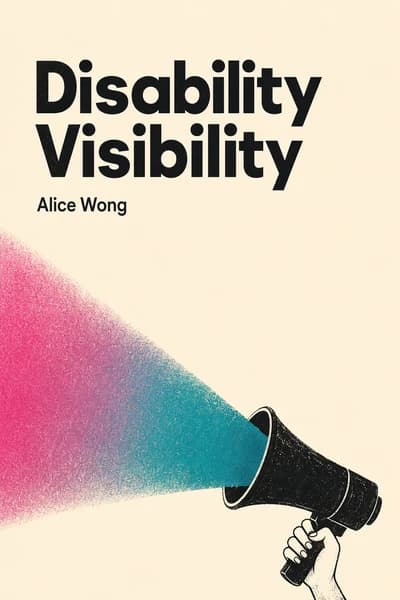
Throughout the anthology, contributors describe the relief and joy of finding environments where their needs are centered rather than treated as inconvenient accommodations. These spaces range from physical locations to virtual communities that provide connection across geographic distances. The Disability Visibility Project itself, which Wong created in 2014 to record oral histories with StoryCorps, represents such a space-one that has expanded from a one-year project into a movement with approximately 140 oral histories and an online community sharing disability media and culture.
The concept of crip space extends beyond accessibility to include cultural elements that celebrate disability identity. Eugene Grant's essay about Benjamin Lay, a dwarf person born in 1682 who became one of the first white radical abolitionists, highlights the importance of disability history and role models. Grant, who has dwarfism himself, didn't learn about Lay until age 31, highlighting "the shameful absence of historical figures with dwarfism in literature." His discovery of this historical figure provided "a rare dwarf role model to share with future generations."
Similarly, Stacey Milbern's reflection on "crip ancestorship" through special boot socks passed down from disability rights leaders expands the concept of space to include temporal connections. Milbern describes how disabled ancestors continue learning alongside the living, participating in movements for change. These ancestral connections create a sense of belonging that transcends immediate physical environments.
The creation of disability-centered spaces represents a radical reimagining of what environments could be if disabled needs and perspectives were prioritized rather than marginalized. These spaces offer glimpses of a more inclusive future while providing essential refuge in a present that remains largely inaccessible.
Capítulo 8
Intersectionality: Disability at the Crossroads of Identity
The anthology powerfully illustrates how disability intersects with other aspects of identity-race, gender, sexuality, religion, and nationality-creating unique experiences that can't be reduced to any single category. These intersections highlight both compounded oppressions and distinctive perspectives that enrich disability culture, while revealing the complex layers of discrimination and resilience that shape disabled lives.
Sandy Ho's experience as a disabled Asian American woman reveals how cultural stigma shapes disability experience across generations and cultures. The Chinese language itself reflected changing attitudes-from canfei (useless) to canji (sickness) and now can zhang (disabled and obstructed), demonstrating how linguistic evolution mirrors societal shifts in disability perception. Her navigation of "Asian spaces or American spaces" as "a disabled Asian American woman" demonstrates the complexity of holding multiple marginalized identities simultaneously. Ho describes specific instances of being excluded from both disability spaces that center white experiences and Asian American spaces that aren't accessible, forcing her to constantly negotiate her multiple identities.
Maysoon Zayid's essay explores the nuanced intersection of disability with religious identity and cultural practices. As a Muslim woman with cerebral palsy, her experience of Ramadan differs from both non-disabled Muslims and non-Muslim disabled people. When teachers tried to slip her candy during fasting, fearing her parents were forcing her to fast, they misunderstood the complex negotiation between religious practice and disability accommodation that Zayid and her family had already thoughtfully navigated. She details how her family modified traditional practices while maintaining religious significance, creating innovative solutions that honored both her faith and her disability needs.
Keah Brown explicitly addresses intersectionality in "Nurturing Black Disabled Joy," noting that "as a Black woman with cerebral palsy," her joy represents resistance against multiple systems of oppression. She describes specific moments of celebration and self-love that challenge both ableist and racist expectations, highlighting how finding joy becomes a revolutionary act. Similarly, June Eric-Udorie describes how "claiming disability felt like adding an unnecessary burden to my already complex identity as Black, female, Nigerian, and British." Her narrative explores the pressure to minimize disability within communities already fighting multiple forms of discrimination.
These intersectional perspectives challenge single-issue approaches to both disability rights and other social justice movements. They remind us that disabled people aren't a monolithic group but diverse individuals whose experiences are shaped by multiple aspects of identity and social position. This complexity demands nuanced approaches to accessibility, representation, and inclusion that account for differences within disability communities. The authors share concrete examples of how standard accessibility solutions often fail to consider cultural, religious, or racial contexts.
The anthology's intersectional approach also reveals how disability insights can contribute to broader social justice work. When Eugene Grant connects Benjamin Lay's dwarfism to his abolitionist activism, suggesting that "Lay's dwarfism shaped his beliefs and struggles for equality," he highlights how marginalized perspectives can generate radical insights about justice and equality that benefit everyone. Grant explores historical examples of disabled activists whose experiences of discrimination informed their understanding of other forms of oppression, creating powerful alliances across social movements. This historical perspective demonstrates how disability justice has long been intertwined with other liberation movements, though these connections are often overlooked in mainstream narratives.
Capítulo 9
Legacy and Continuity: Building a Disability Cultural Heritage
The final threads woven through this anthology concern legacy, history, and the creation of disability cultural heritage. These elements provide context and continuity for individual experiences, connecting personal narratives to broader movements and historical developments.
Stacey Milbern's reflection on "crip ancestorship" through special boot socks passed down from disability rights leaders Harriet McBryde Johnson and Laura Hershey offers a poignant metaphor for disability heritage. Despite loving these socks, Milbern experienced disappointment when falling while wearing them-a moment that connects to deeper thoughts about how "disabled people often live short lives due to social determinants or bodily realities, yet their spirits and wisdom continue."
Milbern expands the concept of ancestorship beyond biological connections to chosen relationships with disabled predecessors who "know longing." These ancestors continue learning alongside the living, participating in movements for change. The essay concludes with Milbern still wearing the boots, though more carefully, as a symbol of this ongoing relationship with disability ancestors who are "learning and loving. Together."
Eugene Grant's discovery of Benjamin Lay similarly connects present-day disability experience to historical figures who embodied resistance and advocacy. Grant emphasizes that Lay's dwarfism wasn't incidental to his abolitionist work but integral to his perspective on justice and equality. By reclaiming Lay as specifically a dwarf ancestor rather than allowing this aspect of his identity to be erased, Grant contributes to a disability cultural heritage that provides context and inspiration for contemporary disabled people.
The anthology itself represents an act of heritage creation. By collecting these diverse voices and experiences, Wong builds a record of disability culture at a particular historical moment-one that future generations can draw upon for understanding and inspiration. The "Further Reading" section that concludes the book extends this project, pointing readers toward additional resources that deepen and expand disability cultural knowledge.
This focus on legacy and continuity challenges the isolation that many disabled people experience. It provides a sense of belonging to something larger than individual experience-a cultural tradition with its own history, values, and ongoing evolution. In a world that often treats disability as a personal medical problem rather than a cultural identity, these connections across time and space offer vital affirmation and context.
Wong's introduction frames the anthology in these terms, describing how she created the Disability Visibility Project because "I want the world to reflect us-diverse, brilliant, unique people who are experts about our own lives." Her closing message to young disabled readers-"You are enough. You are not alone"-emphasizes this sense of community and continuity that runs throughout the collection.