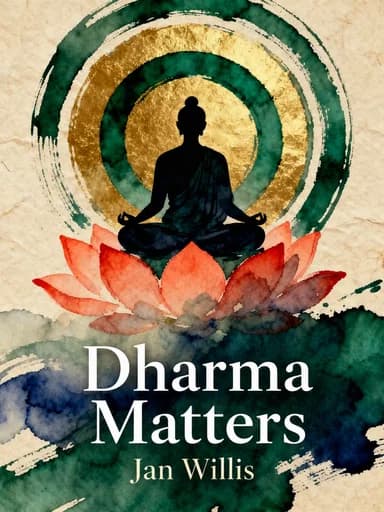
In "Dharma Matters," pioneering Buddhist scholar Jan Willis - named by TIME as a "spiritual innovator" - brilliantly examines race, gender, and tantra through eighteen groundbreaking essays. Sharon Salzberg calls this Baptist-Buddhist perspective "destined to become an authoritative resource" in contemporary spiritual discourse.
Janice Dean Willis, author of Dharma Matters: Women, Race, and Tantra, is a renowned Buddhist scholar and professor emerita at Wesleyan University. She is celebrated for her work on gender, race, and Tibetan Buddhism.
A pioneering African American voice in Buddhist studies, Willis blends academic rigor with personal narrative, informed by her upbringing in Jim Crow Alabama and her decades-long study under Tibetan masters. Her memoir, Dreaming Me: Black, Baptist, and Buddhist, chronicles her journey from the Civil Rights era to becoming a leading authority on Buddhist philosophy.
A TIME "spiritual innovator" and Ebony "Power 150" honoree, Willis has taught at institutions like Columbia University and contributed to platforms including NPR and On Faith.
Dharma Matters reflects her lifelong commitment to bridging social justice and contemplative practice, cementing her legacy as a transformative figure in modern Buddhism.
Dharma Matters explores the intersections of Buddhism, race, and gender through essays that blend academic rigor with personal memoir. It addresses themes like social justice, Tantric practices, and the challenges faced by Black women in Buddhist academia. Willis critiques systemic inequities while advocating for Buddhism’s role in healing racial trauma, drawing from her experiences as a scholar and practitioner.
This book appeals to readers interested in Buddhism’s application to social justice, scholars of race/gender studies, and practitioners seeking to reconcile spirituality with activism. It’s particularly relevant for those exploring African American Buddhist perspectives or Tibetan Tantra’s transformative potential.
Yes. Willis offers unique insights into Buddhism’s capacity to address racism and sexism, combining scholarly analysis with autobiographical reflections. The essays provide actionable frameworks for applying Tantric principles to modern activism, making it a vital read for socially engaged Buddhists.
Willis reinterprets Tantra as a tool for dismantling oppressive systems, arguing that its emphasis on transforming negativity aligns with anti-racist work. She highlights rituals and meditations that empower marginalized communities to reclaim agency, bridging ancient practices with contemporary struggles.
As a Black woman raised in Jim Crow Alabama who became a leading Buddhist scholar, Willis’s lived experiences inform her critiques of institutional racism in both academic and spiritual contexts. Her dual identity as an insider/outsider enriches the book’s analysis.
Willis challenges the erasure of Black voices in predominantly white Buddhist communities and critiques the commodification of practices divorced from their ethical foundations. She calls for inclusive sanghas that prioritize racial equity.
While Dreaming Me chronicles her personal journey, Dharma Matters expands into broader social analysis. Both books integrate autobiography with Buddhist philosophy, but the latter offers more explicit frameworks for systemic change.
Yes. Its lessons on combating internalized racism, fostering resilience, and building inclusive communities apply universally. Willis’s accessible writing bridges Buddhist concepts with secular social justice work.
The book responds to claims that Buddhism avoids “political” issues, arguing that true Dharma practice necessitates challenging oppression. Willis also counters stereotypes about Tantra being apolitical or solely esoteric.
It provides a blueprint for integrating mindfulness with movements like Black Lives Matter, showing how Buddhist principles can sustain long-term advocacy while preventing burnout. Willis’s work is cited in interfaith anti-racism initiatives.
Sinta o livro através da voz do autor
Transforme conhecimento em insights envolventes e ricos em exemplos
Capture ideias-chave em um instante para aprendizado rápido
Aproveite o livro de uma forma divertida e envolvente
The woman's body is better for enlightenment.
Gender makes no difference at all in one's capacity for enlightenment.
Divida as ideias-chave de Dharma Matters em pontos fáceis de entender para compreender como equipes inovadoras criam, colaboram e crescem.
Destile Dharma Matters em dicas de memória rápidas que destacam os princípios-chave de franqueza, trabalho em equipe e resiliência criativa.

Experimente Dharma Matters através de narrativas vívidas que transformam lições de inovação em momentos que você lembrará e aplicará.
Pergunte qualquer coisa, escolha a voz e co-crie insights que realmente ressoem com você.

Criado por ex-alunos da Universidade de Columbia em San Francisco
"Instead of endless scrolling, I just hit play on BeFreed. It saves me so much time."
"I never knew where to start with nonfiction—BeFreed’s book lists turned into podcasts gave me a clear path."
"Perfect balance between learning and entertainment. Finished ‘Thinking, Fast and Slow’ on my commute this week."
"Crazy how much I learned while walking the dog. BeFreed = small habits → big gains."
"Reading used to feel like a chore. Now it’s just part of my lifestyle."
"Feels effortless compared to reading. I’ve finished 6 books this month already."
"BeFreed turned my guilty doomscrolling into something that feels productive and inspiring."
"BeFreed turned my commute into learning time. 20-min podcasts are perfect for finishing books I never had time for."
"BeFreed replaced my podcast queue. Imagine Spotify for books — that’s it. 🙌"
"It is great for me to learn something from the book without reading it."
"The themed book list podcasts help me connect ideas across authors—like a guided audio journey."
"Makes me feel smarter every time before going to work"
Criado por ex-alunos da Universidade de Columbia em San Francisco

Obtenha o resumo de Dharma Matters como PDF ou EPUB gratuito. Imprima ou leia offline a qualquer momento.
Standing before her class in the 1970s, Jan Willis faced a challenging question from a young Black student: "What does this Buddha guy and his Buddhism have to do with me?" This question would shape her entire career. As someone who had marched with Martin Luther King Jr. before studying with Tibetan Buddhist masters, Willis embodied an unusual intersection of identities. Her journey from segregated Alabama to becoming one of Buddhism's most respected scholars represents a remarkable fusion of spiritual traditions. This "Baptist-Buddhist" scholar created a body of work that speaks to universal human liberation while addressing the specific challenges faced by marginalized communities in American Buddhism. Born in segregated coal-mining camps outside Birmingham, Willis's spiritual journey began in a devout Baptist family. At fifteen, she marched with Dr. King, witnessing firsthand how faith could fuel resistance to oppression. Later, as a college student, she traveled to Nepal where she encountered Tibetan Buddhist refugees who had fled Chinese occupation. In these exiled Tibetans, Willis recognized fellow refugees who possessed remarkable spiritual resilience despite profound historical trauma. Throughout her career, she maintained a nondualistic approach, famously stating, "I can use Buddhist methods to realize Baptist ideals." Her scholarship represents an early form of "African-American Buddhist studies," distinguished by her unflagging concern for social justice.