Capítulo 1
Unveiling the Cosmic Tapestry
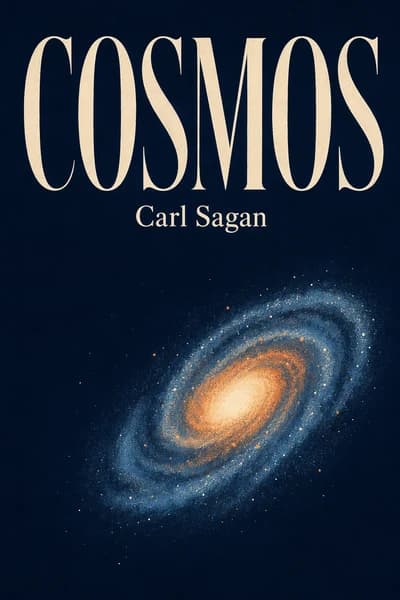
In a universe teeming with billions of galaxies, Carl Sagan's "Cosmos" stands as a singular beacon that illuminates our place in the vastness of space. Unlike most science books that merely inform, Cosmos transforms raw information into profound knowledge and wonder. Since its publication in 1980, this masterpiece has sold over 5 million copies and been translated into 40 languages, making it one of the most influential science books ever written. The U.S. Library of Congress designated it among the 88 "books that shaped America" - a testament to its cultural significance. What makes this work extraordinary is how it weaves astronomy, biology, history, anthropology, and philosophy into a coherent narrative that speaks to our deepest questions about existence. When Neil deGrasse Tyson revived the Cosmos television series in 2014, he acknowledged standing on the shoulders of Sagan, whose ability to make complex scientific concepts accessible to everyone transformed public understanding of science. At its core, Cosmos isn't merely about stars and planets-it's about us, our origins, and our responsibility to preserve the pale blue dot we call home.
Capítulo 2
The Shores of the Cosmic Ocean
The Cosmos encompasses everything that exists, ever existed, or will exist-a concept so vast it defies ordinary comprehension. Our contemplations of it stir profound emotional responses-a tingling spine, a catch in the voice-as we approach the greatest mysteries of existence. The vastness of cosmic space and time makes human concerns seem trivial, yet paradoxically reveals our remarkable potential through curiosity and courage.
Our understanding emerges from balancing skepticism with imagination-the latter carrying us to unexplored realms while the former distinguishes fact from fancy. Earth's surface represents merely the shore of a cosmic ocean we've barely begun to explore, having only dampened our toes. Something within us recognizes this ocean as our origin and longs to return.
The immensity of space requires measurement in light-years rather than familiar earthly units. In this vastness, planets are precious rarities-the odds of randomly finding ourselves near one are less than one in a billion trillion trillion. From an intergalactic vantage point, we'd see countless galaxies as wispy tendrils of light, each containing billions of stars and potentially billions of planets. Given these overwhelming numbers, it seems far more likely that life exists elsewhere than that Earth alone is inhabited.
Our journey through space reveals the Local Group of galaxies, past the Andromeda galaxy, into our own Milky Way with its 400 billion stars of all types and ages. Each star system exists in isolation, separated by light-years, possibly surrounded by planets in various stages of evolution. Some may harbor intelligent life that, like us, gradually discovers its place in the Cosmos.
This cosmic perspective was first glimpsed by ancient minds like Eratosthenes, who measured Earth's circumference with remarkable accuracy 2,200 years ago. Using just sticks, eyes, feet, and curiosity, he became the first person to accurately measure a planet's size. With shadows in Alexandria falling at a 7-degree angle while those in Syene cast none, he calculated Earth's circumference as 40,000 kilometers-an achievement that inspired subsequent voyages of exploration and forever changed humanity's understanding of our place in the universe.
Capítulo 3
One Voice in the Cosmic Fugue
The possibility of life elsewhere in the universe raises profound questions about our own origins. Would extraterrestrial life be carbon-based like Earth life? Would it resemble terrestrial organisms or be stunningly different? The abundance of organic molecules detected in interstellar clouds suggests that life's building blocks are widespread throughout the cosmos, hinting that given enough time, life's emergence might be a cosmic inevitability-though its evolution into intelligence may be rare.
Evolution's power becomes evident in examples like Japan's Heike crab, whose shells bear markings resembling samurai faces. After the naval battle of 1185 where Emperor Antoku and the Heike clan perished, fishermen began throwing back crabs with face-like patterns, believing them to embody drowned samurai spirits. This practice created evolutionary pressure-crabs with more samurai-like shell patterns survived to reproduce while others were eaten. This demonstrates artificial selection, where humans unconsciously shaped another species' evolution by selecting which individuals would survive based on appearance.
Humans have deliberately shaped plants and animals for thousands of years through selective breeding. Ten thousand years ago, there were no dairy cows with distended udders, specialized dog breeds, or large ears of corn. By controlling which individuals reproduce, we've transformed wild ancestors into domesticated varieties that serve our needs. The dramatic changes achieved in just thousands of years-sheep wool increasing from one kilogram of rough hair to twenty kilograms of fine down, or milk production rising hundredfold-demonstrate evolution's power when selection pressures are applied.
If humans can create new varieties through artificial selection, nature must do the same through natural selection-Darwin and Wallace's great discovery. In nature's prolific abundance, more creatures are born than can survive, and the environment selects those variants better suited for survival. Mutations provide the raw material, and environmental pressures select which ones persist. The process works through death and time-countless deaths of imperfectly adapted organisms and immense spans of time for favorable mutations to accumulate.
Earth condensed from interstellar matter 4.6 billion years ago, with life emerging around 4 billion years ago in the primitive oceans. The first life wasn't even a cell, but humble molecules that, by accident, learned to make crude copies of themselves. DNA evolved as the master molecule of life, with mutations-random changes in nucleotides-driving evolution. Four billion years ago, Earth was a molecular Eden without predators, where self-reproducing molecules competed and evolved. Specialized molecules eventually joined to form the first cells. Sex, invented two billion years ago, dramatically accelerated evolution by allowing organisms to exchange whole sections of genetic code rather than relying solely on random mutations.
Green plants fundamentally altered Earth's atmosphere by generating oxygen-a poison to early life forms that created an evolutionary crisis. Today, 99 percent of our atmosphere is biologically produced; the sky itself is made by life. For three billion years, microscopic blue-green algae dominated Earth, until the Cambrian explosion 600 million years ago unleashed a proliferation of complex life forms.
Capítulo 4
The Harmony of Worlds
The universe exists in a perfect balance for science to flourish-neither completely static nor randomly chaotic, but governed by discernible patterns and natural laws. Humans have always excelled at understanding these patterns, which allowed our ancestors to hunt, build fires, and eventually develop science. The night sky offered our earliest laboratory, where we projected our cultural preoccupations onto star patterns, creating constellations that reflected our interests and concerns.
Ancient peoples built sophisticated devices to track celestial movements across cultures and continents. The Anasazi constructed a ceremonial kiva in Chaco Canyon with a window precisely positioned to capture the sunrise on June 21, the year's longest day. Similar astronomical alignments appear at Angkor Wat, Stonehenge, Abu Simbel, and Chichen Itza. In the American Southwest, three upright slabs were positioned to create a "sun dagger" that bisects a carved spiral on the summer solstice and flanks it with two light beams on winter solstice.
Astronomy emerged from practical necessity-tracking animal migrations, knowing when fruits ripened, planting and harvesting at appropriate times, and coordinating tribal gatherings. The celestial cycles-the reappearing crescent moon, the sun rising after eclipse or nightfall-also provided metaphors for immortality and surviving death. As measurement precision improved, record-keeping became essential, spurring the development of mathematics and writing.
While astronomy developed as an empirical science, astrology emerged as a curious assault of mysticism into science. Modern astrology traces back to Ptolemy, who codified Babylonian traditions. Today, astrology remains far more popular than astronomy-more astrologers than astronomers exist, horoscopes appear in nearly every newspaper. Yet astrology fails basic tests: twins born minutes apart often have radically different fates, and astrologers cannot predict character or future events when given only birth details.
Ptolemy, working in Alexandria's Library in the second century, developed a geocentric model of the universe where Earth stood immobile at center while celestial bodies revolved around it. To explain the planets' peculiar retrograde motions, he devised an ingenious system of spheres with smaller off-center wheels (epicycles). This model predicted planetary positions with reasonable accuracy for its time but hindered astronomical progress for a millennium until Copernicus proposed his revolutionary sun-centered system in 1543.
Kepler's laws revealed the clockwork of the solar system. His first two laws showed planets move in ellipses and sweep out equal areas in equal times, while his third "harmonic law" established that the squares of planetary periods are proportional to the cubes of their distances from the Sun. Beyond merely describing planetary motion, Kepler sought underlying causes, suggesting magnetism as the force that made planets speed up near the Sun and slow when distant-a stunning anticipation of universal gravitation.
Newton discovered the law of inertia and the nature of gravitational force, showing that the same universal force that pulls an apple earthward keeps the Moon in orbit. This inverse square law-where force declines as the square of distance increases-explains planetary motion and allowed Newton to derive all of Kepler's laws mathematically. From these principles, he proudly wrote in the Principia, "I now demonstrate the frame of the System of the World."
Capítulo 5
Heaven and Hell
The Earth appears placid, with changes occurring slowly enough that we may never personally witness major natural disasters. This breeds complacency, despite clear evidence of catastrophic events preserved on other planetary landscapes. Such devastating events, unthinkable in human timescales, become inevitable over millions of years.
The Tunguska Event of June 30, 1908, when a massive fireball crossed the Siberian sky and exploded, leveling 2,000 square kilometers of forest, offers a sobering reminder of cosmic dangers. This event was likely caused by an icy cometary fragment about 100 meters across-the size of a football field-weighing a million tons and moving at 30 kilometers per second. Such an impact today might be mistaken for a nuclear explosion, potentially triggering nuclear war, as it would simulate all effects of a one-megaton nuclear burst except for gamma radiation and radioactive fallout.
Throughout history, comets evoked fear and superstition, challenging the notion of an unchanging cosmos. They were seen as harbingers of disaster-Babylonians thought them celestial beards, Greeks flowing hair, Arabs flaming swords. Some religious figures like Andreas Celichius claimed comets were "the thick smoke of human sins" kindled by divine anger.
Comets may have contributed significantly to planetary atmospheres-Mars' current water could be explained by a recent cometary impact. Newton speculated that Earth's oceans originated from comets and that cometary "spirit" sustains life. Far beyond the planets exists a vast spherical cloud containing a trillion cometary nuclei. Occasionally, gravitational disturbances send these kilometer-sized "snowballs" into highly elliptical orbits toward the inner solar system, where solar heating creates their characteristic tails.
Between Mars and Jupiter lie countless asteroids-tiny terrestrial planets, the largest being a few hundred kilometers across. Many have irregular shapes and tumble through space. This asteroid belt functions as a great grinding mill, with frequent collisions producing smaller and smaller fragments. Some of these pieces occasionally strike Earth as meteorites.
Venus has nearly identical mass, size and density to Earth, making it our sister planet. But what lies beneath its featureless clouds? The first real clues came through spectroscopy, which revealed Venus's atmosphere contains enormous quantities of carbon dioxide but, surprisingly, no detectable water vapor. The breakthrough came from radio astronomy in 1956, when Venus was discovered emitting radio waves indicating extremely high temperatures.
Venus is a planet-wide catastrophe. Surface temperatures reach around 480C (900F)-hotter than most household ovens-with crushing atmospheric pressure 90 times Earth's, equivalent to being 1 kilometer deep in Earth's oceans. The atmosphere is 96% carbon dioxide with traces of nitrogen, water vapor, and other gases. Venus's distinctive yellowish clouds consist primarily of concentrated sulfuric acid with small amounts of hydrochloric and hydrofluoric acids.
Venus's extreme heat results from a massive greenhouse effect. Sunlight passes through its semi-transparent clouds and reaches the surface. The heated surface tries to radiate this energy back to space as infrared radiation, but the carbon dioxide and water vapor in Venus's atmosphere trap this heat almost completely. Earth also has a greenhouse effect that keeps our oceans liquid and makes life possible. While Venus has its 90 atmospheres of CO2 in gaseous form, Earth has an equivalent amount locked in limestone and other carbonates.
Capítulo 6
Blues for a Red Planet
Mars has captivated human imagination like no other planet, becoming a mythic arena onto which we project our earthly hopes and fears. Its apparent Earth-like features-polar ice caps, white clouds, dust storms, seasonal surface changes, and 24-hour day-have made it tempting to imagine as an inhabited world. Yet our psychological predispositions shouldn't mislead us; only evidence matters, and the definitive evidence about life on Mars isn't yet in.
H.G. Wells' 1897 classic "The War of the Worlds" captured humanity's haunting fear and fascination with potential life beyond Earth, particularly on Mars. Three years earlier, Percival Lowell established an observatory dedicated to studying Mars, building on Giovanni Schiaparelli's 1877 observation of "canali" (channels) on Mars-mistranslated as "canals," implying intelligent design. This sparked Mars mania across Europe and America.
In 1907, Alfred Russel Wallace, co-discoverer of evolution by natural selection, delivered a devastating critique of Lowell's theories. Wallace demonstrated that Lowell had miscalculated Martian temperatures, which were actually below freezing almost everywhere. He argued that Mars had much thinner air than Lowell calculated, should be covered with craters like the Moon, and that any attempt to transport water across such a desert planet would be "the work of madmen."
Despite Wallace's critique and other astronomers' inability to confirm the canals, Lowell's vision gained popular acceptance. It resonated with the nineteenth century's engineering marvels-the Suez Canal, Corinth Canal, Panama Canal, and American irrigation projects. If humans could build such structures, why not more advanced Martians battling planetary desiccation?
The Viking mission faced numerous constraints in selecting landing sites. Sites needed to be low elevation (for atmospheric braking), with minimal winds, moderate latitudes for communication, and surfaces neither too rough nor too soft. After traveling 100 million kilometers, both landers touched down safely-a triumph of engineering with an element of luck. The first images showed a surprisingly Earth-like landscape with rocks, sand drifts and distant hills reminiscent of the American Southwest.
Though Viking found no visible life, Mars' history parallels Earth's when our planet had CO2-rich atmosphere and harsh UV radiation. Since microbes thrived on Earth for three billion years before large organisms colonized land, Viking was designed to search for microscopic life. The Viking landers carried experiments that yielded initially promising results. Two of the three biology experiments appeared positive-one showed something in Martian soil breaking down Earth nutrients as if microbes were metabolizing it, and another showed soil combining with Earth gases as if photosynthetic organisms were creating organic matter.
However, scientists now believe these results may be misleading. Very little effort had been made to calibrate the experiments with plausible inorganic Martian materials. Recent experiments show that montmorillonite clays (identified on Mars by Mariner 9 and Viking) can reproduce key features of the "successful" Viking experiments. The clays have complex active surfaces that adsorb and release gases and catalyze chemical reactions.
Capítulo 7
Travelers' Tales
The Voyager missions represent our first true interplanetary voyages, carrying instruments to distant worlds just as Dutch sailing vessels once carried explorers to new continents. These journeys, whether across oceans or space, share similar motivations: curiosity, national pride, commercial interests, and the thirst for discovery.
The Voyager 2 spacecraft, launched in August 1977, represents humanity's first true interstellar vessel. Weighing nearly a ton and powered by nuclear energy, it carries sophisticated instruments including cameras, spectrometers, and sensors. By July 1979, it had reached Jupiter, navigating through dangerous radiation belts and debris rings. Its trajectory would use Jupiter's gravity to propel it toward Saturn, then Uranus and Neptune, before leaving our solar system entirely to wander among the stars.
The revolutionary Dutch Republic of the seventeenth century exemplifies the spirit of exploration that now drives our ventures into space. Having declared independence from Spain, Holland embraced the European Enlightenment and built its economy on global maritime trade. The Dutch East India Company sent ships worldwide, combining commercial exploitation with scientific curiosity.
The connection between Holland's exploratory power and its intellectual achievements was profound. Technological advances in shipbuilding fostered innovation in all fields. The challenges of navigation demanded better scientific understanding, while encounters with exotic lands shook established beliefs.
Huygens' contributions to astronomy were revolutionary. He was the first to measure another planet's size, discover Venus' cloud cover, draw Mars' surface features, determine the Martian day length, and recognize Saturn's ring system. He also discovered Titan, Saturn's largest moon. Beyond astronomy, Huygens invented the pendulum clock to solve the longitude problem in navigation, created the spiral balance spring for watches, and made fundamental contributions to mechanics and probability theory.
The Voyager spacecraft are spiritual descendants of both the Dutch sailing expeditions and Huygens' scientific vision-caravels bound for the stars. Like ancient explorers who returned with tales of exotic lands, Voyagers send back modern "travelers' tales" of worlds previously unimagined: shattered crystal spheres, cobwebbed globes, potato-shaped moons, and underground oceans.
Of all Voyager's discoveries, the findings on Io proved most remarkable. Before the mission, scientists knew only that Io was extremely red and exhibited strange changes in its infrared properties. Voyager revealed a bizarre multicolored surface unlike any other in the solar system, mysteriously devoid of impact craters despite being near the asteroid belt. Linda Morabito of the Navigation Team accidentally discovered the first active volcano beyond Earth while enhancing an image. Voyager ultimately revealed nine large active volcanoes and hundreds of extinct ones.
Capítulo 8
The Backbone of Night
I grew up in Bensonhurst, Brooklyn, intimately knowing my immediate neighborhood but viewing the territory beyond 86th Street as alien and mysterious. As a child, I wondered about the stars-those twinkling lights whose nature adults couldn't explain. When I received my first library card, I discovered an astonishing truth: stars were suns, just incredibly distant ones.
This revelation expanded my cosmos immeasurably. I reasoned that if our sun had planets, other stars must too, possibly harboring life. This childhood wonder sparked my astronomical ambitions during humanity's first era of planetary exploration.
Our ancestors gazed at the night sky, creating stories about star patterns. Some believed stars were distant campfires of other tribes, others imagined them as holes in a great skin revealing flame beyond. They noticed wandering stars (planets) and pondered their nature. The !Kung Bushmen called the Milky Way "the backbone of night," believing it held up the darkness. These early metaphors eventually evolved into elaborate mythologies with gods controlling nature's unpredictable forces.
Around 2,500 years ago, a revolutionary intellectual awakening occurred in Ionia. Suddenly, people proposed that everything was made of atoms, that humans evolved from simpler forms, that diseases weren't caused by demons, and that Earth orbited the Sun. This revolution transformed Chaos into Cosmos-revealing an ordered universe with natural laws. Ionia's unique position at cultural crossroads, its merchant-driven economy, widespread literacy, and political diversity created perfect conditions for free inquiry without enforced conformity.
Thales and Anaximander pioneered scientific thinking in Miletus. Anaximander conducted experiments measuring seasons with shadows, created the first Greek sundial and celestial globe, and proposed Earth remained unsupported at the universe's center. He conceived of spontaneous life originating in mud and evolving through transmutation, believing in infinite inhabited worlds cycling through dissolution and regeneration-all without invoking divine intervention.
Empedocles performed the first recorded experiment on air using a clepsydra (water thief), proving that invisible air could exert pressure and occupy space. His contemporary Democritus of Abdera developed atomic theory, arguing that everything consists of indivisible atoms moving through void-a purely mechanistic view of reality without divine intervention.
As Ionian science flourished, religious opposition grew. Anaxagoras was imprisoned for impiety after teaching that the Moon reflected the Sun's light, that the Sun was a "fiery stone" larger than the Peloponnesus, and that the Moon had mountains. Though released through Pericles' intervention, this marked the turning of the tide against scientific inquiry in Greece.
The brilliant Ionian experimental method was largely abandoned for two thousand years due to anti-empirical attitudes. Plato urged astronomers to think about the heavens but not observe them. The slave economy played a crucial role in science's decline-experimentation required manual labor, which slaveholders disdained, yet only they had leisure for intellectual pursuits.
Capítulo 9
Travels in Space and Time
Space and time are interwoven-we cannot look into space without looking back in time. Light travels incredibly fast, but cosmic distances are vast. When we observe Beta Andromedae, we see it as it was 75 years ago. The Andromeda Galaxy appears to us as it was 2 million years ago, before humans existed. The most distant quasars show us the universe 8-10 billion years ago, before Earth formed.
This finite speed of light creates a fundamental constraint in Einstein's special theory of relativity: nothing can travel faster than light. This isn't merely an engineering challenge like breaking the sound barrier, but a fundamental law of nature. Einstein's revolutionary insight came from simple questions about simultaneity-how events might appear different to observers moving at different speeds. His conclusion: there are no privileged reference frames in the universe, and light's speed remains constant regardless of the observer's motion.
Time dilation-the slowing of time at speeds approaching light-offers a theoretical pathway to the stars. A traveler moving near light speed would hardly age while decades passed for friends back home. While light-speed travel remains impossible, engineers have designed potential starships like Project Orion, which would use nuclear explosions for propulsion, and Project Daedalus, which assumes future nuclear fusion technology. With continuous 1g acceleration, a spacecraft could approach light speed, allowing travelers to reach Barnard's Star in 8 years ship-time, the galactic center in 21 years, or even circumnavigate the universe in 56 years-though billions of years would pass on Earth.
While we can travel into the future through relativistic effects, traveling to the past raises paradoxes. If you prevented your parents from meeting, you would never exist to make the journey. Some physicists propose that alternative histories could exist side by side-different timelines where every imaginable history plays out. History consists of deeply interwoven threads where small events at critical junctures might profoundly change outcomes.
What if the scientific tradition of the ancient Ionian Greeks had survived and flourished? If science and experimental methods had been pursued 2,000 years before the Industrial Revolution, we might have saved ten or twenty centuries. Leonardo's contributions might have been made a thousand years ago, Einstein's five hundred. In such an alternate Earth, we might already be venturing to the stars, with great fleets of interstellar transports under construction, perhaps marked with Greek symbols.
Evidence suggests planetary systems are abundant throughout the galaxy. In our vicinity, Jupiter, Saturn and Uranus each has a satellite system resembling our solar system in miniature. Though we cannot yet directly see planets around other stars, we can detect their gravitational influence. With perhaps a hundred billion planetary systems in the galaxy, we'll find worlds of breathtaking diversity-some with multiple suns or moons, particle rings spanning horizons, or views of gaseous nebulae.
Capítulo 10
The Lives of the Stars
To make an apple pie requires ingredients made of molecules, which are made of atoms-most of which were created inside stars. Only hydrogen formed in the Big Bang; everything else was cooked in stellar furnaces. Matter is mostly empty space-atoms are clouds of electrons surrounding tiny nuclei. Yet these empty structures hold firm through electrical forces, preventing my elbow from passing through the table.
Atoms are incredibly small-one hundred million would span your fingertip, with nuclei a hundred thousand times smaller still. The emptiness of matter is profound; what prevents objects from passing through each other is the electrical repulsion between electron clouds. Cutting an atom transmutes elements, as medieval alchemists dreamed of doing. Modern physics has reduced the sensible world to astonishing simplicity: protons, neutrons and electrons arranged in various patterns make essentially everything.
The universe is 99 percent hydrogen and helium, the two simplest elements. All other elements evolved from these primordial gases under extreme conditions. Creating heavier elements requires overcoming electrical repulsion by bringing nuclear particles close together, which happens only at temperatures of tens of millions of degrees-conditions found only inside stars.
Stars and their planets form through gravitational collapse of interstellar gas clouds. Nuclear fusion ignites when compressed hydrogen atoms begin combining into helium, releasing energy as photons that take a million years to reach the surface. The Sun converts 400 million tons of hydrogen into helium every second in a controlled thermonuclear reaction that has sustained it for five billion years.
When the Sun exhausts its central hydrogen in 5-6 billion years, fusion will migrate outward while the core contracts and heats until helium begins fusing into carbon and oxygen. The Sun will expand into a red giant, engulfing Mercury, Venus and likely Earth. Its atmosphere will eventually pulse and spew outward, creating a planetary nebula-a beautiful shell of glowing gas illuminated by the exposed hot stellar core. Finally, the Sun will become a white dwarf, cooling slowly over billions of years to a dark, dead black dwarf.
Atoms synthesized in stellar interiors return to space through red giant winds, planetary nebulae, and supernova explosions. Stars forge elements sequentially-hydrogen fuses to helium, helium to carbon, carbon to oxygen, and in massive stars, all the way to iron. The nitrogen in our DNA, calcium in our teeth, iron in our blood, and carbon in our apple pies were all cooked in ancient stars. Some rarer elements form during supernova explosions themselves. Life and stars are intimately connected: our atoms were forged in stars; a nearby supernova likely triggered the solar system's formation; solar energy sparked the complex molecules leading to life; almost all life runs on sunlight; and cosmic rays from distant supernovae cause mutations that drive evolution. We are, in the most literal sense, made of starstuff.
A star's mass determines its ultimate fate. While our Sun will become a red giant and white dwarf, more massive stars face dramatic ends. When stars several times the Sun's mass exhaust their nuclear fuel after just millions of years, they generate iron cores that collapse catastrophically. The implosion forces electrons into protons, creating neutron stars-essentially giant atomic nuclei about 30 kilometers across. For even more massive stars, typically five times the Sun's mass or greater, gravity overwhelms all resistance, creating black holes-regions where space-time is so severely warped that nothing, not even light, escapes.
Capítulo 11
Who Speaks for Earth?
We have only recently discovered the Cosmos-for most of human existence, we believed Earth was the entire universe. Now we understand we inhabit a fragile world adrift in cosmic immensity. National boundaries are not evident when we view the Earth from space, and fanatical ethnic or religious chauvinisms seem absurd when we see our planet as a fragile blue crescent against the bastion of stars.
The human species now undertakes a venture as important as colonizing land-breaking Earth's shackles both metaphorically and physically. Yet our energies focus on war. By the late twentieth century, nuclear weapons had proliferated worldwide, with a single thermonuclear bomb containing the destructive force of the entire Second World War. The 15,000 targeted warheads represented over 10,000 megatons-a World War II every second for an afternoon.
Nuclear deterrence depends on psychological manipulation-occasional postures of irrationality make nuclear threats credible. The danger is that pretended irrationality becomes real. This global balance of terror holds Earth's citizens hostage, with each superpower testing the other's limits through military provocations. Almost half the world's scientists work on military matters, rewarded with high salaries and honors while protected by secrecy from responsibility for their actions.
Our cerebral cortex, devoted to reason, gives us the capacity to cooperate and care for one another. Altruism is built into us. We've brilliantly deciphered Nature's patterns, yet our global civilization teeters on failure in its most important task: preserving life on Earth. Shouldn't we vigorously explore fundamental redesigns of our economic, political, social and religious institutions?
Laboratory experiments reveal that mammals raised without physical affection develop abnormal characteristics. James Prescott's cross-cultural analysis of 400 preindustrial societies shows cultures lavishing physical affection on infants tend toward nonviolence. Where infants receive physical affection and adolescent sexuality isn't repressed, the likelihood of a violent society drops to just 2 percent. Recent centuries have seen remarkable progress-the near-elimination of slavery, growing equality for women, and increasing revulsion against war.
Science-that characteristically human endeavor-gives us a true picture of our place in a Cosmos of exploding stars, forming galaxies, and possible extraterrestrial civilizations. It works through two simple rules: no sacred truths, and discard what contradicts facts. Alexandria once housed humanity's greatest scientific civilization, where discoveries in mathematics, physics, astronomy, and medicine laid foundations we still build upon. Yet those brilliant minds never challenged their society's assumptions about slavery or shared knowledge with the masses.
Hypatia-mathematician, astronomer, physicist, and philosopher-moved freely through male domains in Roman Alexandria despite being a woman in a time when women were treated as property. As Christianity consolidated power, she stood at the epicenter of social upheaval, maintaining her friendship with the Roman governor and representing science and learning. Archbishop Cyril's parishioners murdered her brutally in 415 CE, flaying her with abalone shells before burning her remains and obliterating her works.
Our achievements rest on 40,000 generations of human predecessors, most nameless and forgotten. From the Big Bang's explosive birth through hydrogen atoms condensing into stars, from nuclear fusion creating heavy elements to planetary formation, from simple molecules in primordial oceans evolving into self-replicating organisms to the development of plants, animals, and finally humans-this is our cosmic heritage. In fifteen billion years, hydrogen atoms have transformed into beings who can send spacecraft to other worlds.
Human history shows a slowly expanding circle of loyalty-from family to tribe to nation. Now we must extend it to the entire planet. We are a rare and endangered species; in a hundred billion galaxies, there are no other humans. Our space exploration uses the same technologies as warfare, but redirects them toward life rather than death. We are the Cosmos grown to self-awareness, and our obligation to survive extends beyond ourselves to the ancient universe from which we spring.




![[cosmos-by-carl-sagan:c0000] Cosmos p1-1](/_next/image?url=https%3A%2F%2Fd1y2du6z1jfm9e.cloudfront.net%2Fassets%2Fpodcast%2Fgreen.png&w=1024&q=50)
![[cosmos-by-carl-sagan:c0001] Cosmos p1-1](/_next/image?url=https%3A%2F%2Fd1y2du6z1jfm9e.cloudfront.net%2Fassets%2Fpodcast%2Fpurple.png&w=1024&q=50)
![[cosmos-by-carl-sagan:c0002] Cosmos p1-1](/_next/image?url=https%3A%2F%2Fd1y2du6z1jfm9e.cloudfront.net%2Fassets%2Fpodcast%2Fblue.png&w=1024&q=50)


