The definitive guide to qualitative research methodology that revolutionized social science. Cited in countless graduate programs, this methodological masterpiece earned author Alexander George the prestigious Johan Skytte Prize. What complex real-world problems could you solve using their rigorous case study framework?
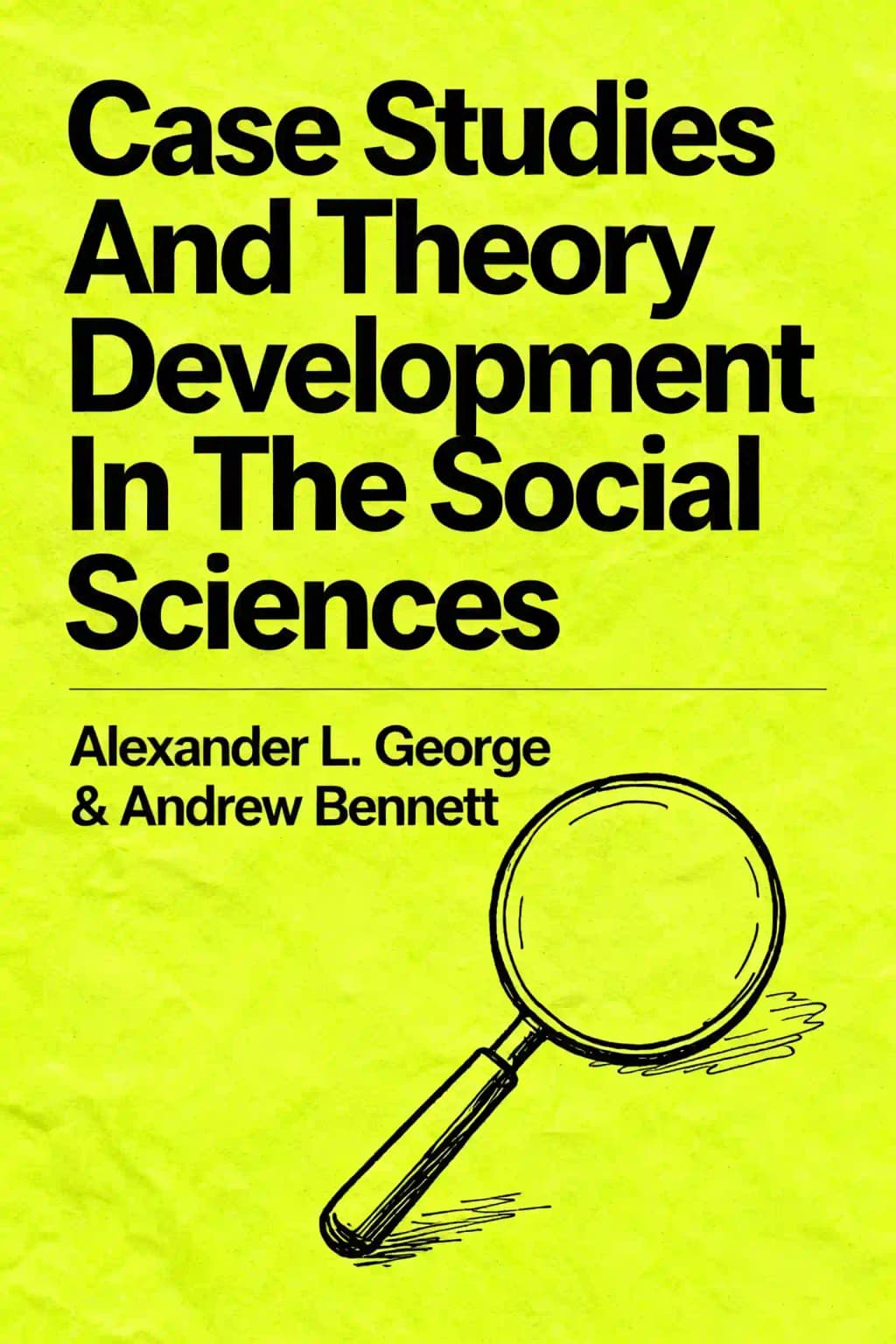
Alexander L. George (1920–2006) and Andrew Bennett are renowned scholars in political science and international relations, co-authoring the seminal work Case Studies and Theory Development in the Social Sciences.
George, a MacArthur Fellow and Bancroft Prize winner, served as the Graham H. Stuart Professor Emeritus at Stanford University, pioneering methodologies like structured, focused comparison and process tracing. His research bridged political psychology and Cold War crisis management, earning recognition from institutions like RAND Corporation.
Bennett, a professor at Georgetown University, builds on George’s legacy, advancing case study rigor in social science research.
Their book—part of the Belfer Center Studies in International Security series—remains a cornerstone in academic curricula, widely used in doctoral programs for its framework on comparative analysis and causal inference. Translated globally, it has influenced generations of scholars in developing policy-relevant theories.
Case Studies and Theory Development in the Social Sciences by Alexander L. George and Andrew Bennett provides a framework for using case studies to build and test theories in political science and related fields. It emphasizes process tracing, comparative analysis, and methodological rigor, offering practical guidelines for researchers to link empirical data to theoretical insights.
This book is essential for graduate students, academics, and policymakers engaged in qualitative research. It’s particularly valuable for those studying international relations, political psychology, or policy analysis, as it bridges methodological gaps between academia and real-world decision-making.
Yes, it’s a cornerstone text for qualitative researchers. The book’s systematic approach to case study design and its integration of theory with empirical evidence make it indispensable for scholars aiming to deepen analytical rigor in social science research.
Process tracing, a method popularized by Alexander L. George, involves analyzing causal mechanisms within individual case studies to uncover how and why specific outcomes occur. The book details its use for validating theories and avoiding spurious correlations.
Unlike quantitative approaches, the book advocates for deep, context-rich case analyses to explore complex causal relationships. It argues that case studies complement statistical methods by providing nuanced explanations rather than broad correlations.
Key frameworks include:
George and Bennett acknowledge critiques about subjectivity and replication challenges. They counter by outlining steps to ensure transparency, such as explicit hypothesis testing and triangulation with other methods.
Examples include U.S. Cold War foreign policy decisions, crisis management, and coercive diplomacy. These cases demonstrate how theoretical insights can inform policy design and strategic planning.
Drawing on his expertise in political psychology and decades at Stanford/RAND, George integrates interdisciplinary perspectives—balancing academic rigor with practical policy relevance. His earlier work on deterrence and leadership informs the methodology.
Some scholars argue the methodology is time-intensive and less scalable than quantitative approaches. However, proponents value its depth for explaining complex phenomena like international conflicts.
It emphasizes theoretical purpose over convenience, recommending cases that test specific hypotheses, fill knowledge gaps, or represent extreme/typical examples. Diversity in case selection strengthens validity.
It remains a foundational guide for qualitative researchers, particularly in advancing mixed-methods approaches. Its emphasis on process tracing has influenced contemporary studies in diplomacy, conflict resolution, and organizational behavior.
Sinta o livro através da voz do autor
Transforme conhecimento em insights envolventes e ricos em exemplos
Capture ideias-chave em um instante para aprendizado rápido
Aproveite o livro de uma forma divertida e envolvente
Case studies offer unique strengths in exploring causal mechanisms.
I didn't know what variables were important until I got there.
Think of process-tracing as detective work.
Researchers often choose critical cases that allow for strong tests.
Divida as ideias-chave de Case Studies and Theory Development in the Social Sciences (BCSIA Studies in International Security) em pontos fáceis de entender para compreender como equipes inovadoras criam, colaboram e crescem.
Destile Case Studies and Theory Development in the Social Sciences (BCSIA Studies in International Security) em dicas de memória rápidas que destacam os princípios-chave de franqueza, trabalho em equipe e resiliência criativa.

Experimente Case Studies and Theory Development in the Social Sciences (BCSIA Studies in International Security) através de narrativas vívidas que transformam lições de inovação em momentos que você lembrará e aplicará.
Pergunte qualquer coisa, escolha a voz e co-crie insights que realmente ressoem com você.

Criado por ex-alunos da Universidade de Columbia em San Francisco
"Instead of endless scrolling, I just hit play on BeFreed. It saves me so much time."
"I never knew where to start with nonfiction—BeFreed’s book lists turned into podcasts gave me a clear path."
"Perfect balance between learning and entertainment. Finished ‘Thinking, Fast and Slow’ on my commute this week."
"Crazy how much I learned while walking the dog. BeFreed = small habits → big gains."
"Reading used to feel like a chore. Now it’s just part of my lifestyle."
"Feels effortless compared to reading. I’ve finished 6 books this month already."
"BeFreed turned my guilty doomscrolling into something that feels productive and inspiring."
"BeFreed turned my commute into learning time. 20-min podcasts are perfect for finishing books I never had time for."
"BeFreed replaced my podcast queue. Imagine Spotify for books — that’s it. 🙌"
"It is great for me to learn something from the book without reading it."
"The themed book list podcasts help me connect ideas across authors—like a guided audio journey."
"Makes me feel smarter every time before going to work"
Criado por ex-alunos da Universidade de Columbia em San Francisco

Obtenha o resumo de Case Studies and Theory Development in the Social Sciences (BCSIA Studies in International Security) como PDF ou EPUB gratuito. Imprima ou leia offline a qualquer momento.
In the battleground between quantitative and qualitative research methods, case studies have often been dismissed as the weaker approach. Yet some of the most groundbreaking insights in political science and international relations emerged from carefully designed case studies. What if the key to understanding complex social phenomena isn't always found in statistical correlations but in the meticulous investigation of specific cases? This methodological masterpiece by George and Bennett rejects the false dichotomy between methods, demonstrating instead how they serve complementary purposes in the pursuit of knowledge. Think of statistical methods as satellite imagery providing a broad overview of terrain, while case studies function as ground-level exploration - both essential for complete understanding. Case studies offer unique strengths that statistical approaches simply cannot match. They achieve high conceptual validity by allowing researchers to identify and measure indicators that best represent theoretical concepts across different contexts. Consider how variables like "democracy" or "political culture" resist consistent measurement through statistical coding - case researchers can refine these concepts through contextualized comparison. Perhaps most importantly, case studies excel at identifying new variables and hypotheses through intensive study of deviant cases. When unexpected answers emerge during fieldwork, entirely new theoretical directions can develop. As one researcher noted during fieldwork in post-Soviet states, "I didn't know what variables were important until I got there and started talking to people."