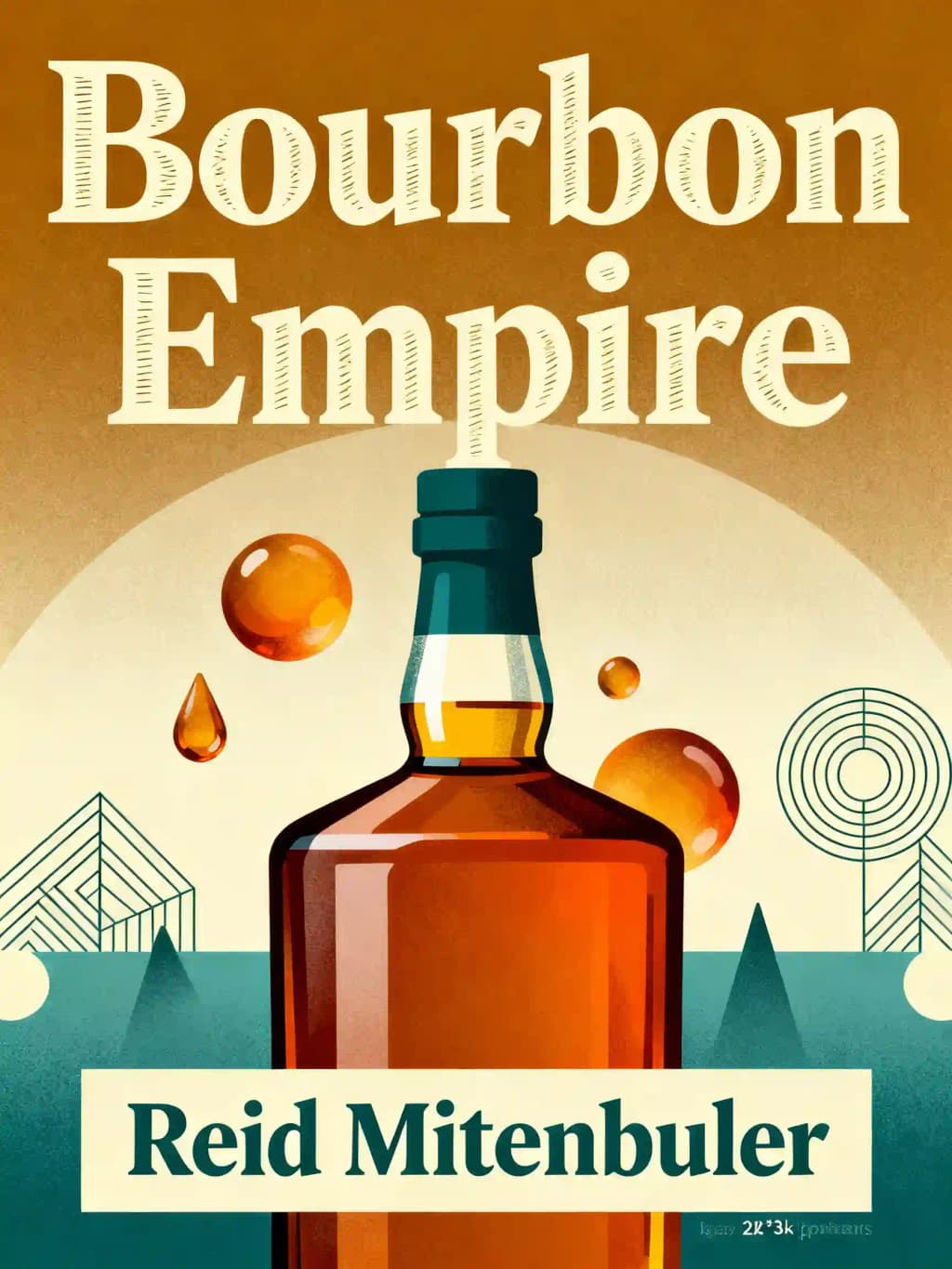
Discover America's true spirit in "Bourbon Empire" - where whiskey, politics, and capitalism collide. Praised by The New York Times and chef Sean Brock, Mitenbuler exposes how bourbon's rich history shaped American society. Did you know the Whiskey Rebellion of 1794 fundamentally altered our nation's trajectory?
Reid Mitenbuler is the acclaimed author of Bourbon Empire: The Past and Future of America’s Whiskey and a leading voice in American spirits history. Blending business, cultural, and industrial narratives, his work dissects bourbon’s myths while exploring its role in shaping U.S. identity—from post-Revolutionary economics to modern marketing.
A Los Angeles-based writer, Mitenbuler’s expertise extends to animation history in Wild Minds: The Artists and Rivalries That Inspired the Golden Age of Animation, showcasing his knack for untangling complex cultural legacies.
His articles on whiskey and drinking culture have appeared in The Atlantic, Slate, and Whisky Advocate, cementing his authority in niche historiography. Praised by Kirkus Reviews as “illuminating” and “well-paced,” Bourbon Empire is hailed for demystifying the industry’s tall tales and revealing its ties to broader American themes like capitalism and reinvention.
Mitenbuler’s deep research and engaging prose make his works essential for enthusiasts of spirited history.
Bourbon Empire explores bourbon’s history from its 19th-century origins to its global prominence, debunking myths about its creation and tracing its cultural, economic, and political influence. The book covers key events like Prohibition, postwar rebranding strategies, and the 1964 Congressional Resolution that cemented bourbon as a uniquely American product. It also critiques marketing narratives and examines controversies, including slavery’s role in early distillation.
Whiskey enthusiasts, history buffs, and readers interested in American cultural identity will find this book compelling. It appeals to those curious about corporate storytelling in alcohol marketing and the intersection of industry and politics. Critics note its dense historical detail may cater more to dedicated readers than casual audiences.
Yes, for its thorough research and engaging storytelling, though some find the later chapters repetitive. It balances bourbon’s romanticized myths with gritty realities, offering fresh perspectives on familiar brands. While critics highlight uneven pacing, the book remains a seminal work on whiskey history.
The book details how enslaved laborers were integral to early distillation, maintaining stills and crops. It contrasts this history with the industry’s later omission of these contributions, highlighting how modern brands often sanitize their origins.
Prohibition forced legal distilleries to close, but bootlegging and medicinal licenses kept production alive. Post-Repeal, brands like Schenley Distillers stockpiled inventory and rebranded bourbon as a luxury product, leveraging marketing to revive its image.
Reid Mitenbuler traces bourbon’s international rise to strategic campaigns targeting European markets, framing it as a premium export. The 1964 Congressional Resolution, which legally defined bourbon as a U.S. product, aided this expansion by mimicking protections for Scotch and Cognac.
The book challenges tales like Elijah Craig’s accidental discovery of charred-barrel aging, arguing many origin stories are marketing fabrications. It emphasizes how brands invented heritage to appeal to consumers.
Unlike Scotch’s terroir-driven identity, bourbon’s history is tied to U.S. industrialization and politics. Mitenbuler notes that bourbon’s 1964 legal definition mirrored European protections but emerged from corporate lobbying rather than tradition.
Some reviewers critique repetitive sections and uneven focus, particularly its harsh assessment of modern craft distillers. The latter chapters are seen as overly opinionated compared to the neutral historical analysis earlier.
Mitenbuler critiques contemporary marketing gimmicks but acknowledges their historical precedents. He argues today’s “small-batch” narratives echo past tactics, though he questions whether innovation aligns with quality.
The resolution legally defined bourbon as a distinct U.S. product, banning foreign imports labeled as bourbon. This protectionist move, driven by Schenley’s Lewis Rosenstiel, boosted exports and solidified its luxury status.
Sinta o livro através da voz do autor
Transforme conhecimento em insights envolventes e ricos em exemplos
Capture ideias-chave em um instante para aprendizado rápido
Aproveite o livro de uma forma divertida e envolvente
Bourbon embodies American capitalism like few other products.
Bourbon is a shapeshifter-refined or rough depending on context.
Hamilton remains whiskey drinkers' eternal villain.
Kentucky filled historical gaps with colorful mythology.
These embellished American success stories matter.
Divida as ideias-chave de Bourbon empire em pontos fáceis de entender para compreender como equipes inovadoras criam, colaboram e crescem.
Destile Bourbon empire em dicas de memória rápidas que destacam os princípios-chave de franqueza, trabalho em equipe e resiliência criativa.

Experimente Bourbon empire através de narrativas vívidas que transformam lições de inovação em momentos que você lembrará e aplicará.
Pergunte qualquer coisa, escolha a voz e co-crie insights que realmente ressoem com você.

Criado por ex-alunos da Universidade de Columbia em San Francisco
"Instead of endless scrolling, I just hit play on BeFreed. It saves me so much time."
"I never knew where to start with nonfiction—BeFreed’s book lists turned into podcasts gave me a clear path."
"Perfect balance between learning and entertainment. Finished ‘Thinking, Fast and Slow’ on my commute this week."
"Crazy how much I learned while walking the dog. BeFreed = small habits → big gains."
"Reading used to feel like a chore. Now it’s just part of my lifestyle."
"Feels effortless compared to reading. I’ve finished 6 books this month already."
"BeFreed turned my guilty doomscrolling into something that feels productive and inspiring."
"BeFreed turned my commute into learning time. 20-min podcasts are perfect for finishing books I never had time for."
"BeFreed replaced my podcast queue. Imagine Spotify for books — that’s it. 🙌"
"It is great for me to learn something from the book without reading it."
"The themed book list podcasts help me connect ideas across authors—like a guided audio journey."
"Makes me feel smarter every time before going to work"
Criado por ex-alunos da Universidade de Columbia em San Francisco

Obtenha o resumo de Bourbon empire como PDF ou EPUB gratuito. Imprima ou leia offline a qualquer momento.
Bourbon whiskey embodies America's contradictions like few other products. In 1964, Congress declared it "a distinctive product of the United States," but this patriotic-sounding resolution was actually engineered by Lewis Rosenstiel of Schenley Distillers Corporation to protect his massive whiskey surplus in international markets. Over time, this dry legal language transformed into the romantic "America's Native Spirit" marketing we know today. This disconnect between bourbon's marketed image and business reality runs throughout its history. From humble beginnings as a way for frontier farmers to preserve surplus grain value to today's premium collectibles, bourbon's journey mirrors America's own: humble origins, innovation, wealth, corruption, downfall, and redemption. Unlike beer's everyman image or wine's sophistication, bourbon is a shapeshifter-refined or rough depending on context. What makes it uniquely American isn't just its corn-based recipe or Kentucky limestone water, but how it embodies our national contradictions: independence alongside corporate consolidation, tradition alongside innovation, and authenticity alongside clever marketing. When we sip bourbon, we're tasting not just aged grain spirit but America's complex economic and cultural history in liquid form.