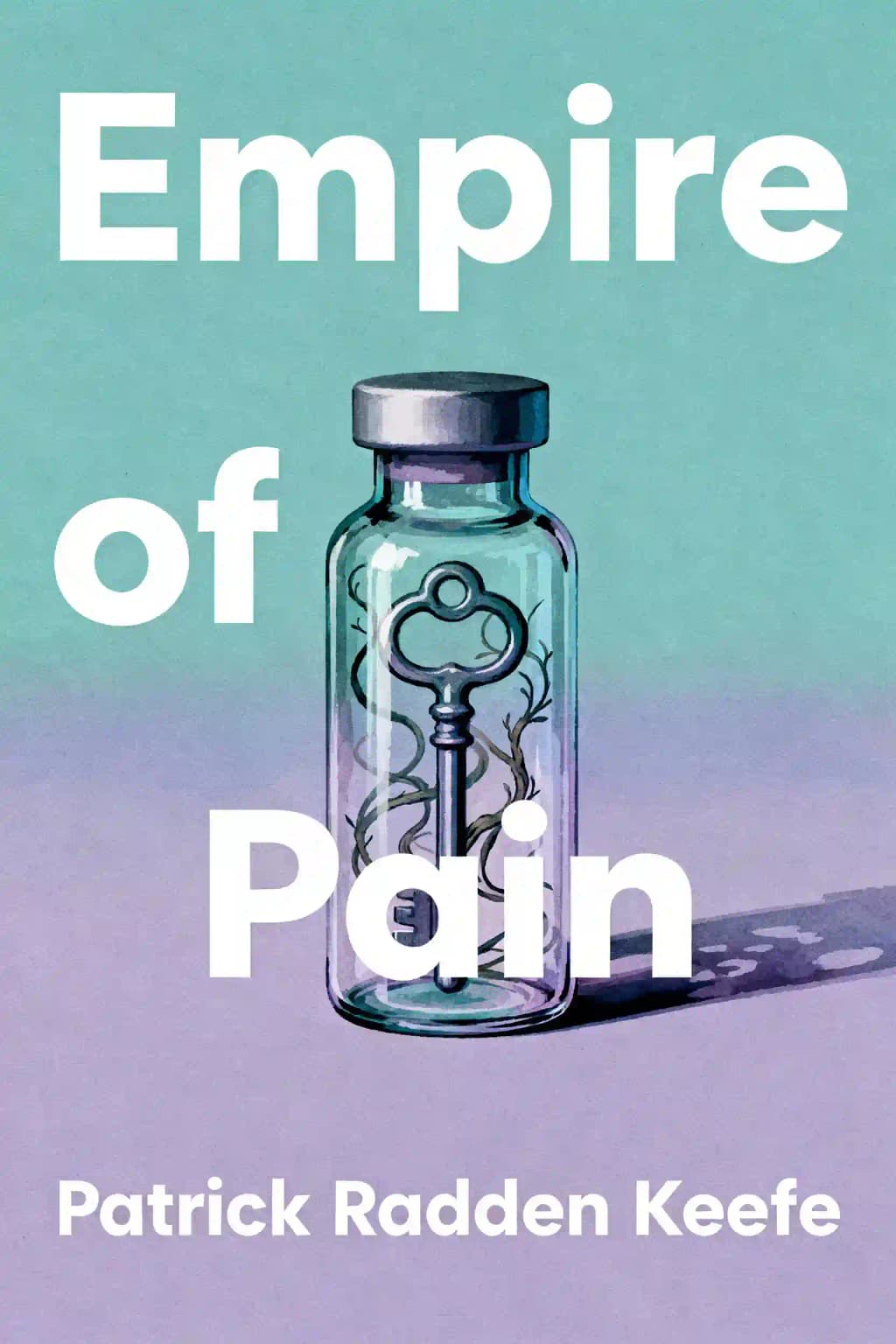
"Empire of Pain" exposes the Sackler dynasty behind America's devastating opioid crisis. Obama's favorite book of 2021 reveals how one family's greed killed thousands. "So many 'they did what?' moments" - this expose inspired Netflix's "Painkiller" and changed pharmaceutical accountability forever.
Patrick Radden Keefe, the New York Times bestselling author of Empire of Pain: The Secret History of the Sackler Dynasty, is an award-winning investigative journalist renowned for his deep dives into systemic corruption and power dynamics. A staff writer at The New Yorker since 2006, Keefe specializes in narrative nonfiction that exposes hidden truths, from corporate malfeasance to historical conflicts.
His work on Empire of Pain—a searing exploration of the Sackler family’s role in the opioid crisis—draws on his expertise in unearthing documents and conducting penetrating interviews, honed through earlier books like Say Nothing (a National Book Critics Circle Award winner) and The Snakehead.
Keefe’s reporting has earned accolades including the Orwell Prize and a Guggenheim Fellowship. His podcast Wind of Change, investigating Cold War espionage, topped 2020 year-end lists. Empire of Pain, a finalist for the FT Business Book of the Year, has been translated into 20 languages and cemented Keefe’s reputation as a master chronicler of institutional accountability. The book’s adaptation into a limited series is currently in development.
Empire of Pain investigates the Sackler dynasty, the wealthy family behind Purdue Pharma, and their role in fueling the opioid crisis through aggressive marketing of OxyContin. Patrick Radden Keefe traces three generations of Sacklers, exposing their manipulation of medical regulations, exploitation of vulnerable communities, and use of philanthropy to whitewash their reputation. The book blends corporate history with a moral reckoning of greed and accountability.
This book is essential for readers interested in investigative journalism, corporate ethics, or public health crises. It appeals to fans of narrative nonfiction, true crime, and those seeking to understand systemic failures that enabled the opioid epidemic. Policymakers, healthcare professionals, and ethics scholars will find its insights into pharmaceutical marketing practices particularly relevant.
Yes. Hailed as a "masterpiece of narrative reporting" (The Washington Post), Empire of Pain won the 2021 Baillie Gifford Prize and was shortlisted for the National Book Critics Circle Award. Keefe’s rigorous research and gripping prose make it a definitive account of corporate impunity, though some critique its dense detail in early chapters.
Purdue Pharma, led by Sackler family members, falsely claimed OxyContin provided 12-hour pain relief despite internal studies showing efficacy waned at 8 hours. They incentivized doctors to prescribe higher doses, targeted regions with manual labor industries (e.g., West Virginia coal miners), and downplayed addiction risks. Sales reps used deceptive tactics, including funding research to exaggerate the drug’s safety.
The book condemns the Sacklers’ prioritization of profit over public health, their legal evasion tactics, and use of philanthropy to obscure their role in the opioid crisis. Keefe emphasizes how Purdue Pharma’s practices exploited regulatory loopholes and marginalized communities, leading to over 500,000 overdose deaths in the U.S. since 1999.
Keefe illustrates systemic failures: Purdue Pharma paid billions in settlements but avoided admitting wrongdoing, while the Sacklers shielded personal wealth via offshore accounts. The U.S. legal system, he argues, often protects wealthy corporations over individuals, enabling cycles of harm without meaningful consequences.
The Sacklers donated to museums, universities, and cultural institutions (e.g., the Met’s Sackler Wing), using philanthropy to launder their reputation. These contributions, funded by OxyContin profits, shifted public perception from “drug profiteers” to “benevolent patrons” until advocacy groups exposed the hypocrisy.
Some reviewers note excessive detail in early chapters about the Sacklers’ pre-OxyContin history, which slows pacing. Keefe also repeats key points (e.g., the 12-hour efficacy myth) for emphasis, which a few readers find redundant. Despite this, the book is widely praised for its depth and narrative force.
Unlike Beth Macy’s Dopesick (focused on victims) or Sam Quinones’ Dreamland (trafficking networks), Empire of Pain centers on the Sacklers’ systemic greed. Keefe’s approach mirrors Bad Blood’s corporate exposé style, blending meticulous research with dramatic family dynamics akin to HBO’s Succession.
A pivotal line from Bob Dylan appears in the book: "Steal a little and they put you in jail, steal a lot and they make you king." This encapsulates Keefe’s thesis about wealth shielding the Sacklers from accountability. Another standout quote: "The quicker you let go, the sooner you can move forward"—a twisted mantra of Purdue’s aggressive sales strategy.
The opioid crisis persists, with synthetic opioids like fentanyl causing record deaths. Keefe’s examination of regulatory failures, corporate lobbying, and wealth inequality remains urgent. The book serves as a cautionary tale for ongoing battles over pharmaceutical ethics and corporate accountability in healthcare.
A staff writer at The New Yorker, Keefe specializes in investigative narratives (Say Nothing, The Snakehead). His expertise in unraveling complex histories and legal battles shines here, combining forensic detail with gripping storytelling to humanize systemic corruption.
Sinta o livro através da voz do autor
Transforme conhecimento em insights envolventes e ricos em exemplos
Capture ideias-chave em um instante para aprendizado rápido
Aproveite o livro de uma forma divertida e envolvente
"They had blood money, and they knew it."
"It's nothing to us," remarked one executive.
"The Sackler empire is a completely integrated operation"
"If you lose your good name, you can never get it back."
"35, single and psychoneurotic"
Divida as ideias-chave de Empire of Pain em pontos fáceis de entender para compreender como equipes inovadoras criam, colaboram e crescem.
Destile Empire of Pain em dicas de memória rápidas que destacam os princípios-chave de franqueza, trabalho em equipe e resiliência criativa.

Experimente Empire of Pain através de narrativas vívidas que transformam lições de inovação em momentos que você lembrará e aplicará.
Pergunte qualquer coisa, escolha a voz e co-crie insights que realmente ressoem com você.

Criado por ex-alunos da Universidade de Columbia em San Francisco
"Instead of endless scrolling, I just hit play on BeFreed. It saves me so much time."
"I never knew where to start with nonfiction—BeFreed’s book lists turned into podcasts gave me a clear path."
"Perfect balance between learning and entertainment. Finished ‘Thinking, Fast and Slow’ on my commute this week."
"Crazy how much I learned while walking the dog. BeFreed = small habits → big gains."
"Reading used to feel like a chore. Now it’s just part of my lifestyle."
"Feels effortless compared to reading. I’ve finished 6 books this month already."
"BeFreed turned my guilty doomscrolling into something that feels productive and inspiring."
"BeFreed turned my commute into learning time. 20-min podcasts are perfect for finishing books I never had time for."
"BeFreed replaced my podcast queue. Imagine Spotify for books — that’s it. 🙌"
"It is great for me to learn something from the book without reading it."
"The themed book list podcasts help me connect ideas across authors—like a guided audio journey."
"Makes me feel smarter every time before going to work"
Criado por ex-alunos da Universidade de Columbia em San Francisco

Obtenha o resumo de Empire of Pain como PDF ou EPUB gratuito. Imprima ou leia offline a qualquer momento.
$600 million. That's what Purdue Pharma paid in 2007 for misleading doctors and patients about OxyContin. The fine made headlines as one of the largest pharmaceutical settlements in history. Behind closed doors, though, the Sackler family-Purdue's owners-were laughing. They'd paid themselves more than that in a single year. "It's nothing to us," one executive remarked. This moment reveals everything about how one family transformed American medicine into a profit machine fueled by addiction, all while plastering their name across museum wings and university buildings. Their strategy was breathtakingly simple: sell pills that hook patients, blame the victims when they get addicted, and use charitable donations to scrub away the bloodstains. For decades, it worked flawlessly. The Sacklers became synonymous with culture and healing even as their drug claimed hundreds of thousands of lives-more American casualties than the entire Vietnam War.