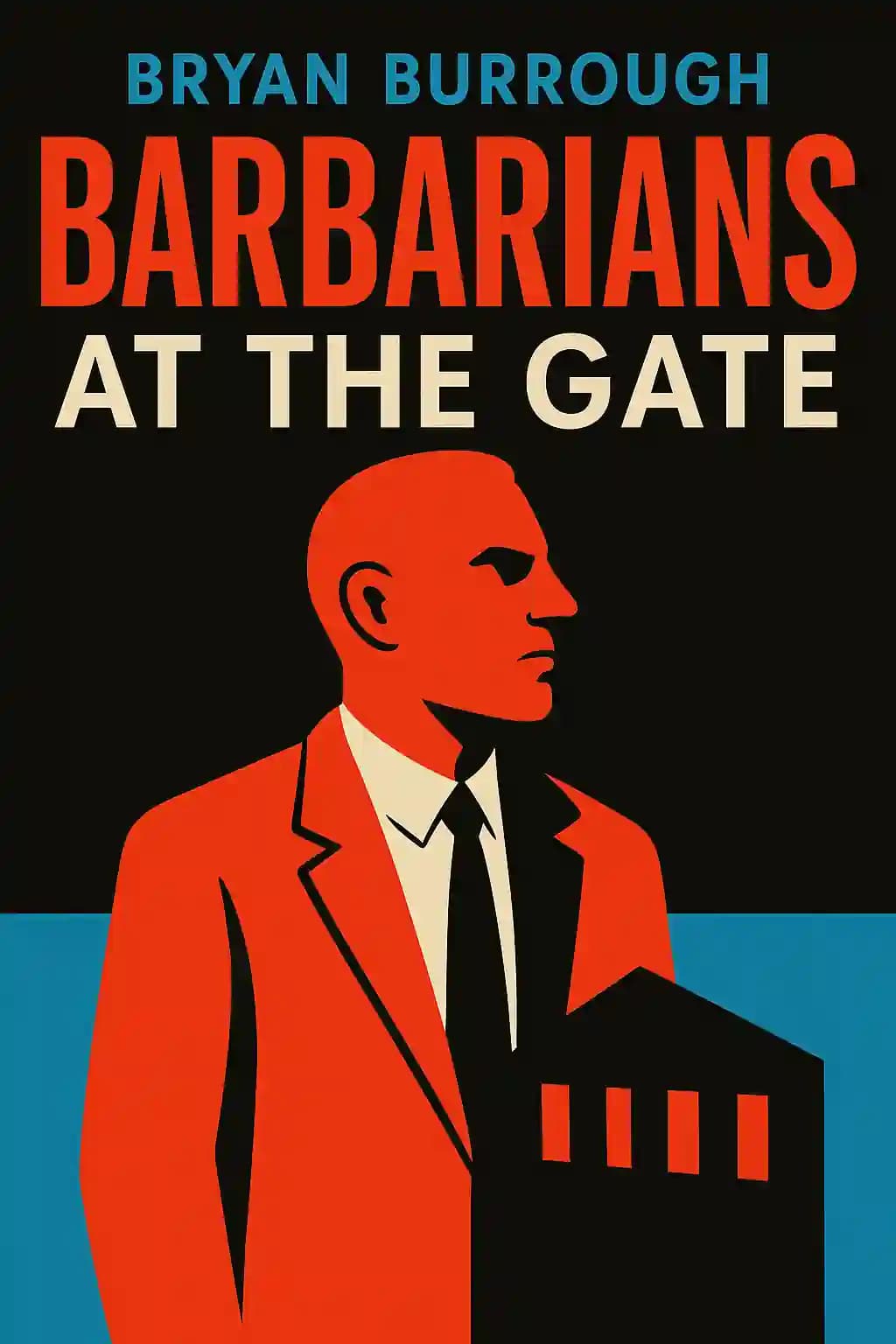
Dive into the cutthroat 1980s takeover battle that defined Wall Street excess. This #1 New York Times bestseller for 39 weeks exposes corporate greed with thriller-like intensity. What shocking tactics turned a $25 billion deal into required reading for every aspiring business titan?
Bryan Burrough, bestselling author of Barbarians at the Gate: The Fall of RJR Nabisco, is a Pulitzer Prize-finalist journalist renowned for his gripping narratives about corporate power and American history.
A University of Missouri journalism graduate, Burrough honed his expertise during a decade at The Wall Street Journal, where he won three Gerald Loeb Awards for financial reporting. His co-authored exposé of the 1988 RJR Nabisco leveraged buyout—a landmark work of business nonfiction—remains a Wall Street classic and was adapted into an Emmy-nominated HBO film.
Burrough further solidified his authority through Vanity Fair contributions and books like Public Enemies (2004), which dissects 1930s crime waves, and The Big Rich (2009), chronicling Texas oil dynasties. As Editor at Large for Texas Monthly, his 2023 true-crime podcast Stephenville reached top-10 podcast charts.
His upcoming The Gunfighters (2025) continues his exploration of Western mythology. Barbarians at the Gate has sold over 2 million copies worldwide and is frequently cited as one of Fortune’s “75 Smartest Business Books.”
Barbarians at the Gate chronicles the 1988 leveraged buyout (LBO) of RJR Nabisco, a landmark corporate takeover battle involving Wall Street titans like Henry Kravis, Ross Johnson, and Ted Forstmann. The book exposes the greed, excess, and financial maneuvers that defined 1980s Wall Street, culminating in KKR’s record $25 billion acquisition—a deal that reshaped modern finance.
Finance professionals, business students, and readers interested in corporate history will find this book essential. Its gripping narrative also appeals to general audiences drawn to high-stakes drama, flawed characters, and critiques of unchecked capitalism.
Yes—it’s widely hailed as the definitive account of Wall Street’s excesses. The Wall Street Journal called it “one of the finest business narratives ever written,” blending investigative rigor with page-turning storytelling about ambition and moral compromise.
CEO Ross Johnson initiated the LBO to privatize RJR Nabisco, aiming to profit personally while sidestepping shareholder scrutiny. His move triggered a brutal bidding war among private equity firms, fueled by junk bonds and unprecedented debt.
The title references the fall of Rome, framing Wall Street raiders as “barbarians” storming corporate gates. Battles like the “cookie wars” and terms like “troops” reinforce cutthroat competition and strategic maneuvering.
Ted Forstmann coined “barbarians” to criticize rivals like Kravis, whom he viewed as destroying ethical finance. The phrase became shorthand for 1980s Wall Street’s destructive LBO culture.
Some readers find its dense financial details challenging, while others argue it glamorizes greed. However, most praise its balanced reporting and enduring relevance to modern corporate scandals.
Both expose financial recklessness, but Barbarians focuses on corporate takeovers (1980s) while The Big Short tackles mortgage crises (2000s). Barbarians offers deeper character studies, while The Big Short simplifies complex instruments.
The book warns against short-term profit chasing, hubris, and ethical decay. Johnson’s downfall illustrates how arrogance and poor oversight can destroy corporate value.
Its themes—corporate greed, debt-fueled growth, and regulatory gaps—mirror modern issues like hedge fund activism and tech industry LBOs. The 20th-anniversary edition updates post-deal fallout, reinforcing its timeless cautionary tale.
Sinta o livro através da voz do autor
Transforme conhecimento em insights envolventes e ricos em exemplos
Capture ideias-chave em um instante para aprendizado rápido
Aproveite o livro de uma forma divertida e envolvente
"The chief executive can do whatever he wants" became his overriding principle.
Nabisco had become a stagnant organization that "venerated past glories"
Johnson had no master plan for Nabisco, preferring to wait for opportunistic moves.
Even decades later, the tale serves as a cautionary fable about greed, ambition.
Johnson transformed Standard Brands into what employees called "Phi Delta Johnson"
Divida as ideias-chave de Barbarians at the Gate em pontos fáceis de entender para compreender como equipes inovadoras criam, colaboram e crescem.
Destile Barbarians at the Gate em dicas de memória rápidas que destacam os princípios-chave de franqueza, trabalho em equipe e resiliência criativa.

Experimente Barbarians at the Gate através de narrativas vívidas que transformam lições de inovação em momentos que você lembrará e aplicará.
Pergunte qualquer coisa, escolha a voz e co-crie insights que realmente ressoem com você.

Criado por ex-alunos da Universidade de Columbia em San Francisco
"Instead of endless scrolling, I just hit play on BeFreed. It saves me so much time."
"I never knew where to start with nonfiction—BeFreed’s book lists turned into podcasts gave me a clear path."
"Perfect balance between learning and entertainment. Finished ‘Thinking, Fast and Slow’ on my commute this week."
"Crazy how much I learned while walking the dog. BeFreed = small habits → big gains."
"Reading used to feel like a chore. Now it’s just part of my lifestyle."
"Feels effortless compared to reading. I’ve finished 6 books this month already."
"BeFreed turned my guilty doomscrolling into something that feels productive and inspiring."
"BeFreed turned my commute into learning time. 20-min podcasts are perfect for finishing books I never had time for."
"BeFreed replaced my podcast queue. Imagine Spotify for books — that’s it. 🙌"
"It is great for me to learn something from the book without reading it."
"The themed book list podcasts help me connect ideas across authors—like a guided audio journey."
"Makes me feel smarter every time before going to work"
Criado por ex-alunos da Universidade de Columbia em San Francisco

Obtenha o resumo de Barbarians at the Gate como PDF ou EPUB gratuito. Imprima ou leia offline a qualquer momento.
Picture a CEO so confident in his invincibility that he decides to buy his own company-and triggers the greatest corporate battle in American history. In October 1988, Ross Johnson, the flamboyant head of RJR Nabisco, casually announced his plan to take the company private for $17.6 billion. What seemed like a done deal exploded into a six-week war that would captivate Wall Street, shock the public, and forever change how we think about corporate power. The fight pitted Johnson's lavish management team against Henry Kravis, the quiet architect of the leveraged buyout revolution. By the time the dust settled, the price had soared to $25 billion-the largest corporate takeover ever attempted. This wasn't just a business transaction. It was a morality play about greed, ambition, and the corrosive effects of unchecked power, set against the backdrop of 1980s excess. The story became so iconic that "barbarians at the gate" entered the lexicon as shorthand for corporate raiders, and the tale remains required reading in business schools as a cautionary lesson about what happens when personal ambition collides with fiduciary duty.