Capítulo 1
The Art of Asking Questions That Illuminate Truth
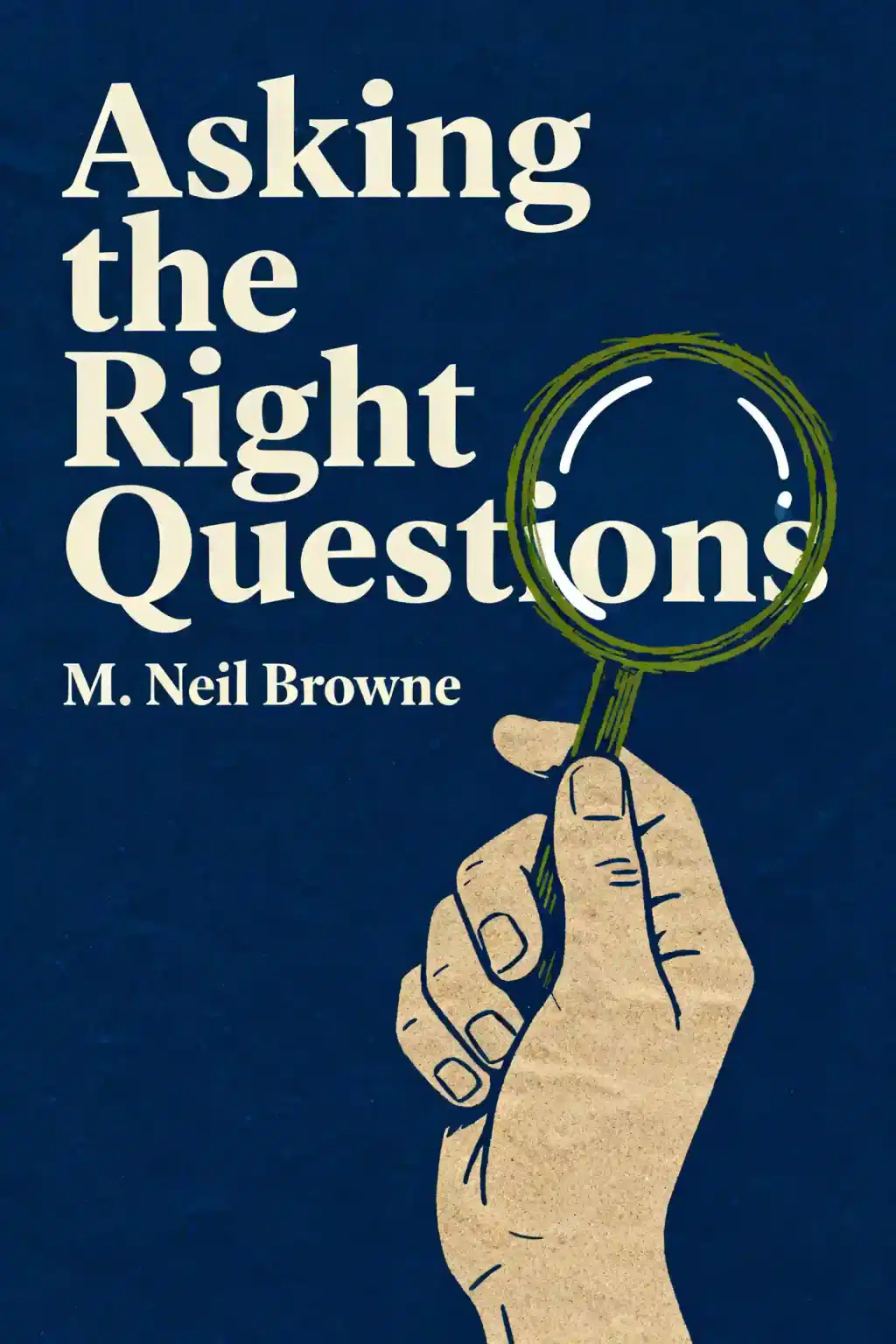
Ever been in a heated debate where you felt your opponent was missing something crucial? Or read a news article that left you wondering if there was more to the story? In our information-saturated world, the ability to ask incisive questions has become not just valuable but essential. "Asking the Right Questions" by M. Neil Browne and Stuart M. Keeley has become a cornerstone text for developing this critical skill, selling over two million copies since its first publication. The book has been adopted by universities across disciplines from business to nursing, and even military academies use it to train future leaders. What makes this guide so enduring is its practical approach to navigating our increasingly complex information landscape, where experts contradict each other and persuasion attempts bombard us constantly. In a world where critical thinking has become both more difficult and more necessary, this book offers a lifeline of clarity and intellectual autonomy.
Capítulo 2
Navigating Our Noisy, Confusing World
We live in a world where independence in decision-making is constantly challenged. Unlike an imaginary world where persuaders provide complete information, experts agree, and our minds remain calm and reflective, our actual environment is filled with half-truths and conflicting advice. Even simple questions generate numerous unverified claims from those trying to sell products or ideas.
Our brains often default to what psychologists call "fast thinking" or "System 1 thinking"-automatic, emotionally-driven responses rather than rational evaluation. This mental shortcut served our ancestors well when quick decisions meant survival, but it's poorly suited for today's complex information environment.
Adding to this confusion, experts often sound more certain than warranted and frequently contradict each other. Consider these examples: health organizations offer conflicting advice about sun exposure; studies on pet ownership's health benefits reach opposite conclusions; experts hold contradictory opinions on cell phone radiation risks. David Freedman's book "Wrong" documents countless instances where expert consensus later proved mistaken or incomplete.
Given this confusing decision-making environment, we must assert rational control over our beliefs and conclusions. Critical thinking teaches skills and attitudes that empower us to discover answers that make sense while selectively learning from others. This liberates us to supervise who we are becoming rather than being controlled by others' agendas.
Critical thinking involves awareness of interrelated questions, ability to ask and answer them appropriately, and desire to actively use them. These critical questions help evaluate arguments, guide discussions, and improve our own thinking and writing. Rather than passively absorbing information like a sponge, critical thinking requires actively "panning for gold"-sifting through information to find what's valuable while discarding what isn't.
Capítulo 3
The Values and Social Nature of Critical Thinking
Critical thinking can be practiced in two opposing ways: weak-sense critical thinking defends current beliefs by resisting opposing viewpoints, while strong-sense critical thinking applies critical questions to all claims, including our own. Strong-sense thinking helps protect against self-deception by forcing us to examine our initial beliefs. This doesn't mean abandoning them-critical examination can strengthen beliefs when warranted.
The distinction reflects open-mindedness versus closed-mindedness. To truly value an opinion, it should be one we've selected after understanding and evaluating alternatives. This requires substantial practice and a willingness to engage with perspectives different from our own.
Other people are our most valuable resource for developing facts, opinions and conclusions. Values-abstract ideas we consider worthwhile-shape how we interact with others and form our standards of conduct. While we naturally seek out those with similar value priorities, the challenge is to actively engage with those whose values differ from our own, as this expands our understanding.
Four primary values drive effective critical thinking: (1) Autonomy-forming one's own conclusions by considering diverse perspectives; (2) Curiosity-genuinely listening to gain insights from others; (3) Humility-recognizing that everyone makes mistakes; and (4) Respect for good reasoning regardless of its source. While we should act confidently on our beliefs, we should hold them with enough tentativeness to still wonder, "Might I be wrong?"
Since critical thinking is inherently social, we must consider how others react when we question their beliefs. While fellow critical thinkers welcome questions as part of a shared search for better answers, many people experience questioning as annoying or unfriendly. Some may interpret critical inquiry as meanness, being unaccustomed to someone showing genuine interest in understanding their viewpoint.
Capítulo 4
Mental Habits That Betray Our Thinking
Critical questioning can make others uncomfortable, as if they're being cross-examined in court. People unaccustomed to explaining their reasoning may become defensive or withdraw from conversation entirely. Since many aren't used to having their beliefs questioned, critical thinkers must be diplomatic and aware of how their questions affect relationships.
Our minds constantly process information using two systems: "fast thinking" (System 1) makes snap judgments based on limited information, while "slow thinking" (System 2) evaluates information rationally. The core message of critical thinking is to SLOW DOWN when considering important matters. While System 2 can overrule System 1's hasty judgments, we often sacrifice accuracy for speed.
Stereotypes substitute for slow thinking by attributing specific characteristics to people based on group membership. While stereotypes might occasionally save time, they're rarely accurate or fair. They short-circuit evaluation and prevent us from considering valuable information.
Our cognitive capabilities are undermined by mental habits that push us toward unexamined conclusions:
The halo effect occurs when we notice one positive or negative trait in someone and then associate that quality with everything about them. If a celebrity has a great singing voice and donates to charity, we're surprised to learn about their drug addiction because we've overgeneralized their goodness.
Belief perseverance is our tendency to maintain existing opinions despite contradictory evidence. This leads to confirmation bias, where we only accept evidence that supports what we already believe. We often overestimate our competence and consider ourselves unbiased while seeing others as biased.
The availability heuristic is a mental shortcut where we form conclusions based solely on immediately available information rather than seeking additional data. This System 1 thinking laziness leads us to rely on what we already know instead of investigating further.
We frequently respond to questions with answers that don't address what was actually asked. When Keith Richards was asked whether his feud with Mick Jagger was over, he replied, "Mick and I are professionals. We do what is necessary to make our music"-completely avoiding the actual question.
Egocentrism refers to the central role we assign to our own world and experiences, rather than considering others' perspectives. Our personal concerns feel more compelling than distant tragedies. This self-focus undermines critical thinking, as we give our own beliefs immediate credence without examining them.
Perhaps the biggest obstacle is wishful thinking-what Stephen Colbert called "truthiness"-where we prefer concepts we wish to be true rather than what's actually true. We form beliefs to match our make-believe world rather than fitting our beliefs to facts. The only antidote is actively using critical questions to resist these powerful tendencies.
Capítulo 5
Finding the Issue and Conclusion: The First Critical Questions
When analyzing arguments, we must first identify what type of issue is being addressed. Descriptive issues raise questions about the accuracy of descriptions of reality, often beginning with words like "Does," "What," or "Is" (e.g., "Does musical training improve math ability?"). Prescriptive issues begin with words like "Should," "Ought," or "Must," and require answers about how the world ought to be.
Finding the basic question or issue can be straightforward when explicitly stated, but often must be inferred from clues in the communication. Consider what the author is reacting to or check their background for context. In many cases, you'll need to locate the conclusion first before you can identify the issue.
To identify the conclusion, ask "What is the writer trying to prove?" The conclusion is the statement the writer wants you to believe based on other statements. The basic structure of persuasive communication is "This because of that"-where "this" is the conclusion and "that" is the supporting evidence. Conclusions are inferred through reasoning, not merely stated as unsupported opinions.
Five key clues help identify conclusions: (1) Ask what the issue is, since conclusions respond to issues; (2) Look for indicator words like "therefore," "consequently," or "thus"; (3) Check likely locations-conclusions often appear at the beginning or end; (4) Remember what conclusions are not (examples, statistics, definitions, background information); and (5) Consider the context and author's background.
When writing yourself, make your meaning crystal clear to readers who lack access to your inner thoughts. Take time to determine and narrow your issue before writing, and leave readers with absolutely no doubt about your argument. Make your conclusion and reasons easily identifiable, as this not only makes the reader's task easier but may improve the logic of your writing.
Capítulo 6
Identifying and Evaluating Reasons
To identify reasons, readers must approach arguments with a questioning attitude, particularly asking "why" the writer believes their conclusion. Certain indicator words typically signal the presence of reasons, following the structure "this, because of that." These include "because," "as a result of," "for the reason that," "in view of," "is supported by," "studies show," and sequential markers like "first...second...third."
When dealing with complex reasoning that isn't well organized, it can be difficult to track the logical structure-especially when conclusions function as reasons for other conclusions. To overcome this challenge, readers should develop their own organizing procedure to keep reasons and conclusions separate and in logical patterns.
Once reasons are identified, they must be revisited repeatedly during analysis since the conclusion's strength depends entirely on the merit of its supporting reasons. Weak reasons inevitably create weak reasoning!
Weak-sense critical thinking occurs when reasons are created merely to defend previously held opinions. When someone eagerly shares opinions as conclusions but becomes puzzled or angry when asked for reasons, weak-sense critical thinking is likely at work. Strong critical thinkers allow their conclusions to stand or fall based on supporting reasons, avoiding "reverse logic" or "backward reasoning" where reasons become mere afterthoughts.
Since reasoning forms the most important aspect of academic writing, writers must be particularly attentive to their reasons during both prewriting and writing stages. Even when writing about familiar topics, additional research remains important-previous research might have been one-sided, informal, or outdated. Strong critical thinkers continually explore breadth of reasons and evidence.
When writing, keep your audience foremost in mind by displaying reasons openly. Use indicator words and phrases that signal "Here comes one of my reasons!" Another helpful technique is providing a "blueprint"-an outline or sketch introducing reasons early in the writing so readers know what to expect.
Capítulo 7
Clarifying Ambiguous Language
Our language is complex, with most words having multiple meanings. Terms like "freedom," "obscenity," and "fairness" create serious problems when evaluating arguments because their meanings are unclear. When someone argues that something is "obscene," we cannot judge the quality of reasoning without knowing what they mean by this term.
To identify ambiguous terms, first examine the stated issue for key terms that may have multiple plausible meanings. Look for terms that must be clarified before you can evaluate the argument. For example, in issues like "Does high income produce happiness?" terms like "high income" and "happiness" need definition. Focus on terms crucial to the reasoning structure, particularly those in reasons and conclusions.
When examining terms for ambiguity, avoid assuming you and the author mean the same thing. Instead of mind reading, ask "What do you mean by that?" The test for identifying significant ambiguity is whether you can express multiple alternative meanings that each make sense in context, and whether these different meanings affect how well a reason supports a conclusion.
Once you've identified ambiguity that affects reasoning, you can demonstrate why the argument needs more work. As a critical thinker, you cannot agree with reasoning until ambiguities that affect it are clarified. This question provides a fair-minded basis for disagreement when you and the persuader are using different meanings for key terms.
Advertising frequently employs ambiguity to persuade consumers of product superiority. Terms like "works great," "extra-strength," or "good man" can have multiple interpretations, with advertisers hoping you'll assign the most attractive meaning.
Since writers rarely define key terms explicitly, context becomes your primary guide to meaning. Context includes the writer's background, traditional uses of terms within particular controversies, and surrounding statements. For example, "human rights" means different things to different people-a Norwegian government official might emphasize employment rights and healthcare, while an American senator might focus on freedoms of speech and religion.
Words have both denotative meanings (agreed-upon explicit descriptive referents) and connotative meanings (emotional associations). Loaded terms trigger strong emotional reactions that can short-circuit critical thinking by bypassing descriptive meaning circuits. Research shows people respond differently to terms with similar definitions but different emotional impacts-preferring "tax relief" to "tax cuts" or "death taxes" to "estate taxes."
Capítulo 8
Uncovering Hidden Assumptions
When searching for assumptions, focus only on those that affect the quality of the argument's structure. Look specifically for assumptions needed for reasons to support conclusions (linkage assumptions) and those necessary for a reason to be true.
Value conflicts explain why reasonable people reach dramatically different conclusions on issues like abortion, government transparency, or censorship. These conflicts arise from different frames of reference that influence which reasons people find compelling. For example, when a university fired faculty members, students emphasized fairness while administrators prioritized efficiency.
Value assumptions are taken-for-granted beliefs about the relative importance of competing values. While most people share many values (honesty, cooperation, flexibility), what differentiates our positions is the relative intensity with which we hold specific values when they conflict. These unstated preferences for particular values over others in specific contexts function as value assumptions that significantly impact conclusions.
A writer's background offers valuable insights into their value assumptions. Examining their profession, political affiliation, or social position reveals what interests they naturally protect. However, we must use caution: group membership doesn't guarantee identical thinking among all members.
In prescriptive arguments, different positions lead to different consequences, each with varying likelihood and desirability. How desirable a consequence seems depends on personal value preferences. By examining the reasons given for a conclusion, we can determine what value priorities make these reasons more compelling than counterarguments.
Most information sources rarely announce their underlying value assumptions, often being unconscious of them themselves. Understanding others' value priorities creates greater appreciation of their perspectives. Jonathan Haidt's "The Righteous Mind" suggests that political disagreements could become more constructive if both sides recognized each other's core values.
While value assumptions reveal what goals a communicator considers important, descriptive assumptions reveal what they take for granted about the nature of the world and people. These might include assumptions about whether people are lazy or achievement-oriented, cooperative or competitive, biologically determined or environmentally shaped.
Finding assumptions requires examining the gap between conclusions and reasons. Ask "How do you get from the reason to the conclusion?" and "If the reasons were true, could the conclusion still be false?" Look for unstated ideas supporting reasons, and try identifying with both the writer and their opposition to uncover hidden assumptions.
Capítulo 9
Detecting Fallacies in Reasoning
Instead of requiring readers to memorize lengthy lists of fallacies, a questioning approach helps identify faulty reasoning. While knowing common fallacy names helps in communicating about reasoning problems, the skill lies in recognizing deceptive reasoning patterns.
Evaluating assumptions is key to identifying fallacies. The more questionable an assumption, the less relevant the reasoning. Common fallacies include:
The ad hominem fallacy-attacking the person rather than addressing their arguments-diverts attention from the actual reasoning to irrelevant personal characteristics.
The slippery slope fallacy assumes one action will inevitably lead to an uncontrollable chain of events.
The searching for perfect solutions fallacy rejects a partial solution because it doesn't solve the entire problem.
The appeal to popularity fallacy makes the mistaken assumption that when an idea is popular, it must be good. Public opinion often lacks sufficient study to provide reasoned judgment.
Certain fallacies work by diverting attention from legitimate reasoning. Glittering generalities use vague, emotionally appealing virtue words that discourage close examination. Red herrings introduce irrelevant topics to shift attention away from the original issue.
"Begging the question" occurs when an argument appears to provide support but actually restates the conclusion in different terms. The example given shows how claiming "reading traditional textbooks is superior to E-texts because it's advantageous to have materials in textbook format" merely restates the conclusion rather than providing actual evidence.
When identifying fallacies, readers have legitimate grounds to reject that portion of the communicator's argument. However, in the spirit of constructive critical thinking, one should still consider any non-fallacious reasons offered. With oral arguments, the best approach is to ask whether the person has better reasons for their conclusion.
Capítulo 10
Evaluating Evidence: From Intuition to Research Studies
Almost all reasoning includes beliefs about the world that communicators want us to accept as "facts." These factual claims can appear as conclusions, reasons, or assumptions. When evaluating such claims, we should first ask why we should believe them and whether they need supporting evidence. Claims without evidence are "mere assertions" that deserve serious questioning.
Factual claims appear in three forms: as descriptive conclusions (e.g., "frequent use of headphones may cause hearing loss"), as reasons supporting conclusions (e.g., "gun-related crimes have increased"), or as descriptive assumptions linking reasons to conclusions (e.g., "students learn critical thinking through active discussions").
We typically accept factual claims when they appear to be undisputed common knowledge, when they're conclusions from well-reasoned arguments, or when they're supported by solid evidence. Evidence refers to explicit information shared to justify the dependability of factual claims.
Intuition relies on "gut feelings" or "common sense" without consciously expressed reasons. Its major problem is that it's private-others can't judge its dependability, making it impossible to resolve conflicting intuitive beliefs. Critical thinkers should determine whether claims relying on intuition have other evidential support.
Personal experiences often serve as evidence through phrases like "I know someone who..." While these experiences are vivid in memory, relying on them often leads to hasty generalization fallacies. A single experience or even several experiences don't provide a representative sample. Personal experiences can demonstrate possibilities but can't show what's typical or probable.
Case examples use detailed descriptions of specific individuals or events to support conclusions. These are compelling because of their vividness and interesting details that generate emotional reactions. While dramatic cases might increase support for positions, they can lead us to ignore broader evidence. Case examples demonstrate important possibilities and put personal faces on statistics, but shouldn't be mistaken for proof of what's typical.
Testimonials are quoted statements from individuals (often celebrities) endorsing products or services based on personal experience. As evidence, testimonials are rarely helpful without information about the expertise, interests, values, and biases behind them. Their key problems include selectivity (carefully chosen positive responses rather than typical reactions) and expectancy effects (people seeing what they expect to see).
Appeals to authority rely on "experts" who supposedly know more than most people about a topic. While appealing to authority can strengthen arguments, authorities are often wrong and frequently disagree. To evaluate authority claims, we should ask: How much expertise does the authority have? Were they in a position to have good access to facts? Are they relatively free from distorting influences like personal bias or financial interest? Have they developed a reputation for making dependable claims?
Capítulo 11
Research Studies, Statistics, and Missing Information
Personal observation, while often trusted as evidence, can be highly unreliable. What we "see" is filtered through our values, biases, attitudes, and expectations. We tend to see what we wish to see, selecting aspects consistent with our prior experience.
Research studies that systematically collect observations by trained scientists are often regarded as a strong form of evidence. The scientific method attempts to avoid built-in biases through publicly verifiable data, control procedures to reduce error, and precision in language. However, even scientific research must be approached with caution.
Research evidence varies greatly in quality and can be problematic for several reasons: research varies in quality; findings often contradict one another; findings support rather than prove conclusions; researchers have biases; communicators often distort research conclusions; research "facts" change over time; artificial research settings may limit real-world application; and financial interests can affect research outcomes.
To evaluate research findings, consider: the quality of the source; whether the report details special strengths; how recently the research was conducted; whether findings have been replicated; how selective the communicator has been in choosing studies; whether the communicator demonstrates strong-sense critical thinking; and whether there are reasons someone might have distorted the findings.
When evaluating research generalizations, we must examine the sampling procedures. Effective sampling requires adequate numbers, breadth, and randomness. The larger the sample, the more dependable the conclusion. The sample must have diversity matching the population about which conclusions are drawn. Random sampling ensures all potential subjects have equal chance of selection.
Many statistics are merely educated guesses due to various obstacles: ambiguity of key terms, difficulties identifying relevant persons or events, people's unwillingness to provide truthful information, failure to report events, and physical barriers to observation.
There are three different types of averages, each yielding different values: mean (sum of values divided by number of values), median (middle value when arranged from highest to lowest), and mode (most frequently occurring value). The type of average used can dramatically alter perception. When encountering "average" values, always question which type is being used and how it might change the significance of the information.
Statistics often deceive when they prove one thing but claim to prove something different. Two effective strategies can help identify such deception: First, ignore the statistics and ask what evidence would actually support the conclusion, then compare with what's provided. Second, examine the statistics closely while ignoring the conclusion, then determine what conclusion they actually support.
Detecting omitted information protects you from being manipulated by those presenting selective information to shape your decisions. "Significant omitted information" refers specifically to information that would affect whether you should be influenced by an argument-information that fundamentally shapes the reasoning.
Capítulo 12
Embracing Multiple Possible Conclusions
This final chapter examines how a single set of reasons can lead to multiple possible conclusions rather than just one. When evaluating arguments, we must consider alternative conclusions that might be equally or more consistent with the given reasons.
Dichotomous thinking-seeing issues in black/white or yes/no terms-severely restricts our thinking by assuming only two possible answers when many alternatives exist. This rigid approach fails to understand the importance of context. When people engage in dichotomous thinking, they overlook numerous options and positive consequences that could result from choosing alternatives.
Most important controversies allow for multiple conclusions beyond simple yes/no answers. For example, "Should the United States engage in peacekeeping in other countries?" can be answered with qualified positions like "Yes, when the country is intricately tied to the United States," or "Yes, if the U.S. role is limited to keeping peace rather than fighting."
If-clauses are powerful tools for creating multiple conclusions by stating conditions that enable particular conclusions. They acknowledge uncertainty about claims or assumptions while still allowing us to reach tentative positions. Using if-clauses demonstrates intellectual humility-we don't pretend to know more than we do about complex issues.
While facts and logic are valuable guides, they only take us part of the way toward forming beliefs. Recognizing multiple possible conclusions consistent with the available facts liberates us from inflexible thinking and enhances personal choice. This recognition frees us from the notion that there's only one "correct" answer dictated by facts and logic, allowing us to experience the excitement of thoughtful decision-making.
Critical thinking is a tool that can perform well or poorly depending on how it's used. The authors urge readers to approach discussions with curiosity rather than a "gotcha" attitude. They emphasize that critical thinking isn't just a classroom exercise but provides a basis for partnership and action. After finding the best answer to a question, we should act on it, using critical thinking to create an identity we can be proud of and benefit our communities.