Are top AI models actually smarter, or just lucky? Learn why benchmark margins of error are often understated and how to measure true model skill.
Best quote from Why AI Benchmarks Are Less Accurate Than They Look
“
An empirical science is only as good as its measuring tools. We need to move away from 'vibe-based' engineering and toward actual, rigorous science by acknowledging the noise and uncertainty in AI benchmarks.
”
C
Generated by Carl
Input question
https://cameronrwolfe.substack.com/p/status-LLM-Evals and https://www.anthropic.com/research/statistical-approach-to-model-evals
Host voices
Nia
Eli
Knowledge sources
Frequently Asked Questions
The SEM is critical because it provides a measure of how much a model's score might fluctuate due to the specific questions chosen for a test, which researchers call the "luck of the draw." Without reporting the SEM or confidence intervals, a raw score like 75% is just a single data point that ignores statistical noise. By calculating the SEM, researchers can determine if a performance gap between two models is a genuine reflection of superior skill or simply a result of overlapping margins of error.
Clustering is a statistical technique used when questions in a benchmark are related to the same source material, such as a long passage or a specific legal case. If a model fails to understand a central theme in a passage, it will likely miss all five or six questions associated with it, meaning those questions are not independent trials. Anthropic’s research found that failing to account for these clusters can make the margin of error appear three times smaller than it actually is, leading to false conclusions about a model's reliability.
For multiple-choice questions, researchers can eliminate the randomness of a model "rolling the dice" on a single answer by looking at its internal probability distribution. Instead of forcing the model to output a specific letter and grading it as a pass or fail, researchers can record the model's internal confidence level—such as an 85% probability for the correct answer—as the score. This method, known as using log probabilities, provides a much more stable and precise measurement of the model's underlying knowledge without requiring multiple expensive test runs.
A paired-differences test compares two models by looking at the specific difference in their scores on every individual question, rather than just comparing their final averages. Because top-tier models often struggle with the same difficult or poorly phrased questions, looking at the difference allows the "noise" of question difficulty to cancel out. This technique focuses purely on the variance in how the models respond to the same stimuli, making the "signal" of which model is truly better much clearer and more scientifically robust.
Power analysis is a mathematical tool used to determine the minimum number of questions required in a benchmark to detect a specific difference in model performance. It helps researchers avoid "false negatives," where a model might actually be better than a competitor, but the test is too small to prove it statistically. By performing a power analysis beforehand, developers can ensure their experiments are "powered" enough to find the truth, saving time and resources that might otherwise be wasted on inconclusive evaluations.
From Columbia University alumni | built in San Francisco
BeFreed Brings Together A Global Community Of Curious Minds
4.7
avg rating
7.84k+ App Rating
BeFreed Community
Seriously I haven’t even explored this app fully yet but from using it the last few days I am so impressed... BeFreed is on a different level from any other learning app I have used. This makes it ultra engaging and can actually improve your concentration which is great for all the doom scrollers!
@ladyInfinity
I bought BeFreed exactly 23 days ago, and I have used it every single day since. It has completely embedded itself into my daily workflow and learning habit.
@jayallen
The truth is, the app has exceeded all my expectations. I can ask it to generate audio on any topic, whatever it may be, and the result is impressive. My professional field is a specialization in psychotherapy and it is multidisciplinary; however, the answers are very accurate.
@Raguipa
What I appreciate most is how much it's reduced my scrolling – I'm spending less time searching and more time absorbing information. The combination of full audiobooks, podcasts, the learning plans are brilliant.
@colonyofcreatorsNGO
I have been a PhotoReading Accelerated Learning Instructor for the past 24 years... books and reading and learning are my thing, and BeFreed has done a great job in providing an innovative approach to disseminating and delivering information in an easy to consume way.
@BeFreed user
It is not just a book summary app, I have used the 'fun reading' option and it's a much better summary and way to grasp ideas the traditional way, that alone is worth this deal.
@austinakon
I love this app. Used it for several days and I cannot stop listening. Such a great way to start.
@jcrules328
I really like the program; I have already tested it for around one month, and I feel that it's an amazing gem. It works so well because I can use BeFreed to create my own topics, and the voice is so good with unlimited choice of narrations.
@DanielCZ
Seriously I haven’t even explored this app fully yet but from using it the last few days I am so impressed... BeFreed is on a different level from any other learning app I have used. This makes it ultra engaging and can actually improve your concentration which is great for all the doom scrollers!
@ladyInfinity
I bought BeFreed exactly 23 days ago, and I have used it every single day since. It has completely embedded itself into my daily workflow and learning habit.
@jayallen
The truth is, the app has exceeded all my expectations. I can ask it to generate audio on any topic, whatever it may be, and the result is impressive. My professional field is a specialization in psychotherapy and it is multidisciplinary; however, the answers are very accurate.
@Raguipa
What I appreciate most is how much it's reduced my scrolling – I'm spending less time searching and more time absorbing information. The combination of full audiobooks, podcasts, the learning plans are brilliant.
@colonyofcreatorsNGO
I have been a PhotoReading Accelerated Learning Instructor for the past 24 years... books and reading and learning are my thing, and BeFreed has done a great job in providing an innovative approach to disseminating and delivering information in an easy to consume way.
@BeFreed user
It is not just a book summary app, I have used the 'fun reading' option and it's a much better summary and way to grasp ideas the traditional way, that alone is worth this deal.
@austinakon
I love this app. Used it for several days and I cannot stop listening. Such a great way to start.
@jcrules328
I really like the program; I have already tested it for around one month, and I feel that it's an amazing gem. It works so well because I can use BeFreed to create my own topics, and the voice is so good with unlimited choice of narrations.
@DanielCZ
I love the fact that I can get useful, condensed, information and ideas in a 8 - 15 minute podcast style audio. I'm not a general fan of podcasts because of all the fluff, but this cuts through all that.
@BeFreed user
I am finishing up my doctorate, and have to read a lot of unfamiliar material... With BeFreed, you simply enter a prompt, and the app finds source material for you and generates an audio podcast. I find the process in BeFreed to be more streamlined than NotebookLM.
@Brad
I often search YouTube for something to listen to whilst making breakfast, when I'm out walking, commuting, etc, and BeFreed has provided an even more targeted approach, without the adverts and the fluff!
@BeFreed user
The absolute best part about this platform is its versatility. There is literally no subject that is off-topic. It handles whatever you throw at it... It is rare to find an learning tool with zero limitations that actually delivers on its promises.
@jayallen
BeFreed is fantastic. The user-friendly design means I spend less time navigating and more time learning. The mix of audiobooks, podcasts, and learning plans is a genius combo that has completely changed my daily routine.
@BeFreed user
At the start I needed a while to understand how to create podcasts in italian language and boom! It is so great! I can ask to explain every argument and it does so well and so smartly!
@matteo77
BeFreed has become my daily app for audio books tools... What I like the most is the way you put your text and come with an audio that you can listen on the go.
@kotanzu1
I love the fact that I can get useful, condensed, information and ideas in a 8 - 15 minute podcast style audio. I'm not a general fan of podcasts because of all the fluff, but this cuts through all that.
@BeFreed user
I am finishing up my doctorate, and have to read a lot of unfamiliar material... With BeFreed, you simply enter a prompt, and the app finds source material for you and generates an audio podcast. I find the process in BeFreed to be more streamlined than NotebookLM.
@Brad
I often search YouTube for something to listen to whilst making breakfast, when I'm out walking, commuting, etc, and BeFreed has provided an even more targeted approach, without the adverts and the fluff!
@BeFreed user
The absolute best part about this platform is its versatility. There is literally no subject that is off-topic. It handles whatever you throw at it... It is rare to find an learning tool with zero limitations that actually delivers on its promises.
@jayallen
BeFreed is fantastic. The user-friendly design means I spend less time navigating and more time learning. The mix of audiobooks, podcasts, and learning plans is a genius combo that has completely changed my daily routine.
@BeFreed user
At the start I needed a while to understand how to create podcasts in italian language and boom! It is so great! I can ask to explain every argument and it does so well and so smartly!
@matteo77
BeFreed has become my daily app for audio books tools... What I like the most is the way you put your text and come with an audio that you can listen on the go.
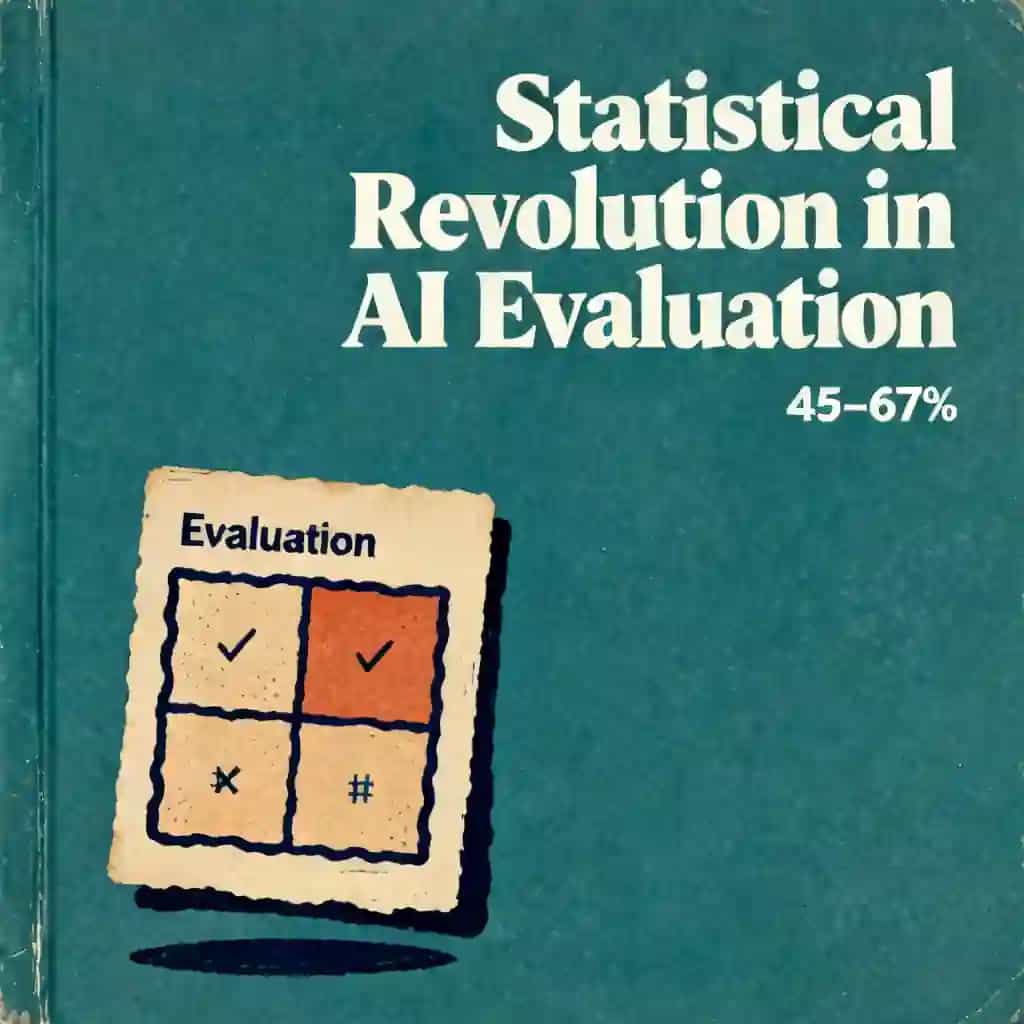
AI leaderboards often ignore statistical noise. Learn how Anthropic’s new approach to error bars provides a more accurate way to rank model performance.
Model rankings look clear until you add error bars. Learn how to use statistical rigor to find the real signal in AI evaluations and avoid false leads.
Discover how proper statistical methods are transforming AI evaluation from simple score competitions to rigorous scientific experiments, revealing that many benchmark rankings may be meaningless noise.











![[2411.00640] Adding Error Bars to Evals: A Statistical Approach to ...](/_next/image?url=https%3A%2F%2Fd1y2du6z1jfm9e.cloudfront.net%2Fassets%2Fpodcast%2Fyellow.png&w=1024&q=50)