The Value of Everything: Making vs. Taking | Mariana Mazzucato
Explore Mariana Mazzucato's The Value of Everything. Learn the difference between true value creation and value extraction in the context of the global economy.
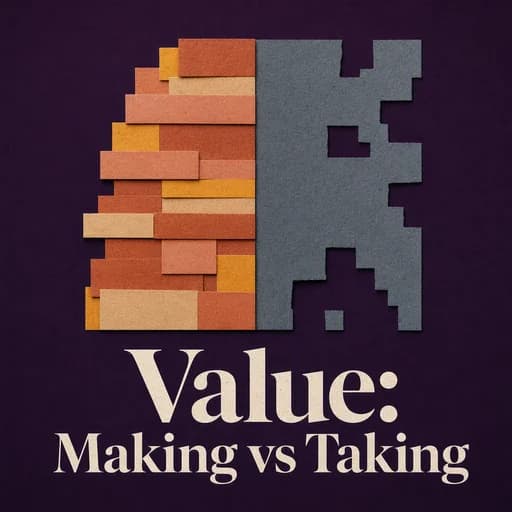
Best quote from The Value of Everything: Making vs. Taking | Mariana Mazzucato
We’ve lost the ability to distinguish between people who actually make things and people who just move things around—or worse, take a cut of what others have built. We cannot fix inequality or drive genuine innovation until we can distinguish between making wealth and taking it.
Generated by Aditya
Create a premium audio lesson based exclusively on Mariana Mazzucato's 'The Value of Everything'. The lesson must follow a narrative structure focusing on the central question: 'What actually creates economic value vs. value extraction?' Use a master-educator tone for an intelligent non-expert. Requirements: 1) Present the strongest competing argument before evaluating Mazzucato's position for every major topic. 2) State Confidence levels (High/Moderate/Low) for major conclusions. 3) Cover the evolution of value theory, GDP accounting, financialization, the 'Entrepreneurial State' (e.g., Apple, pharma), and rent-seeking. 4) Connect concepts to everyday life (wages, healthcare, tech). 5) Use specific book examples: Goldman Sachs, Gilead, 2008 crisis. 6) Conclude with the central thesis and 5 key takeaways. Strictly use the provided source: 'Mariana Mazzucato - The Value of Everything_ Making and Taking in the Global Economy-Penguin (26 Apr'.


Frequently Asked Questions
According to Mariana Mazzucato in The Value of Everything, value creation involves actually producing new goods and services that benefit society. In contrast, value extraction is the process of siphoning off a share of what has already been produced by others. The podcast explores how our modern economy often struggles to distinguish between those who make things and those who simply move wealth around for their own gain.
In the discussion of The Value of Everything, wealth creation is often presented as a well-crafted story that may not reflect reality. While we often associate it with tech founders or scientists, the book argues that the term is frequently misused by industries that extract value rather than create it. This confusion makes it difficult to identify who is truly contributing to the economy versus those who are merely taking a cut of existing wealth.
The podcast highlights a specific example from the 2008 financial crisis involving Goldman Sachs CEO Lloyd Blankfein. Despite the bank receiving a $125 billion taxpayer bailout, Blankfein claimed his employees were among the most productive in the world. This raises a central puzzle regarding how an industry can claim high productivity and value creation when it requires massive public rescues to survive, illustrating the tension between making and taking.
From Columbia University alumni built in San Francisco
"Instead of endless scrolling, I just hit play on BeFreed. It saves me so much time."


"I never knew where to start with nonfiction—BeFreed’s book lists turned into podcasts gave me a clear path."


"Perfect balance between learning and entertainment. Finished ‘Thinking, Fast and Slow’ on my commute this week."
"Crazy how much I learned while walking the dog. BeFreed = small habits → big gains."
"Reading used to feel like a chore. Now it’s just part of my lifestyle."

"Feels effortless compared to reading. I’ve finished 6 books this month already."
"BeFreed turned my guilty doomscrolling into something that feels productive and inspiring."

"BeFreed turned my commute into learning time. 20-min podcasts are perfect for finishing books I never had time for."
"BeFreed replaced my podcast queue. Imagine Spotify for books — that’s it. 🙌"

"It is great for me to learn something from the book without reading it."
"The themed book list podcasts help me connect ideas across authors—like a guided audio journey."
"Makes me feel smarter every time before going to work"
From Columbia University alumni built in San Francisco
"Instead of endless scrolling, I just hit play on BeFreed. It saves me so much time."
"I never knew where to start with nonfiction—BeFreed’s book lists turned into podcasts gave me a clear path."
"Perfect balance between learning and entertainment. Finished ‘Thinking, Fast and Slow’ on my commute this week."
"Crazy how much I learned while walking the dog. BeFreed = small habits → big gains."
"Reading used to feel like a chore. Now it’s just part of my lifestyle."
"Feels effortless compared to reading. I’ve finished 6 books this month already."
"BeFreed turned my guilty doomscrolling into something that feels productive and inspiring."
"BeFreed turned my commute into learning time. 20-min podcasts are perfect for finishing books I never had time for."
"BeFreed replaced my podcast queue. Imagine Spotify for books — that’s it. 🙌"
"It is great for me to learn something from the book without reading it."
"The themed book list podcasts help me connect ideas across authors—like a guided audio journey."
"Makes me feel smarter every time before going to work"
"Instead of endless scrolling, I just hit play on BeFreed. It saves me so much time."
"I never knew where to start with nonfiction—BeFreed’s book lists turned into podcasts gave me a clear path."
"Perfect balance between learning and entertainment. Finished ‘Thinking, Fast and Slow’ on my commute this week."
"Crazy how much I learned while walking the dog. BeFreed = small habits → big gains."
"Reading used to feel like a chore. Now it’s just part of my lifestyle."
"Feels effortless compared to reading. I’ve finished 6 books this month already."
"BeFreed turned my guilty doomscrolling into something that feels productive and inspiring."
"BeFreed turned my commute into learning time. 20-min podcasts are perfect for finishing books I never had time for."
"BeFreed replaced my podcast queue. Imagine Spotify for books — that’s it. 🙌"
"It is great for me to learn something from the book without reading it."
"The themed book list podcasts help me connect ideas across authors—like a guided audio journey."
"Makes me feel smarter every time before going to work"
"Instead of endless scrolling, I just hit play on BeFreed. It saves me so much time."
"I never knew where to start with nonfiction—BeFreed’s book lists turned into podcasts gave me a clear path."
"Perfect balance between learning and entertainment. Finished ‘Thinking, Fast and Slow’ on my commute this week."
"Crazy how much I learned while walking the dog. BeFreed = small habits → big gains."
"Reading used to feel like a chore. Now it’s just part of my lifestyle."
"Feels effortless compared to reading. I’ve finished 6 books this month already."
"BeFreed turned my guilty doomscrolling into something that feels productive and inspiring."
"BeFreed turned my commute into learning time. 20-min podcasts are perfect for finishing books I never had time for."
"BeFreed replaced my podcast queue. Imagine Spotify for books — that’s it. 🙌"
"It is great for me to learn something from the book without reading it."
"The themed book list podcasts help me connect ideas across authors—like a guided audio journey."
"Makes me feel smarter every time before going to work"