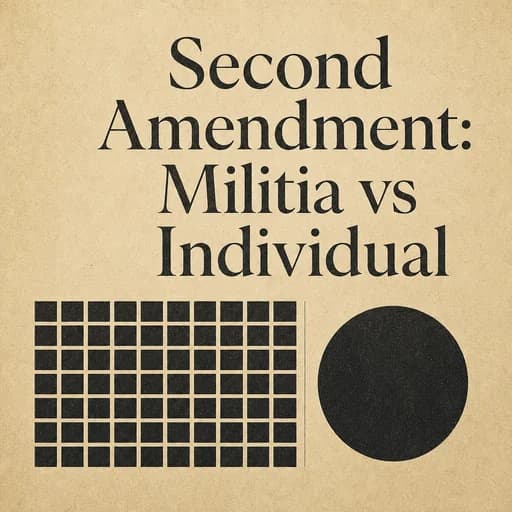
Best quote from The Second Amendment: Militia vs. Individual Rights Explained
The Second Amendment is a dialogue between the past and the present, reflecting the Founders' fear of standing armies and the Reconstruction generation's need for personal self-defense to protect the 'security of a free State.'

This audio lesson was created by a BeFreed community member
Constitutional law, especially the Bill of Rights and the Second Amendment.





Frequently Asked Questions
In constitutional law, the Second Amendment is divided into two distinct parts. The prefatory clause mentions a 'well regulated Militia' being 'necessary to the security of a free State,' which sets the stage or explains the purpose of the amendment. The operative clause is the second part, which states the 'right of the people to keep and bear Arms.' This latter part carries the actual legal command, and understanding the relationship between these two clauses is essential for interpreting the Bill of Rights today.
This is a central debate in constitutional law. While the amendment mentions a 'well regulated Militia,' Jackson explains that the term 'the people' is used consistently throughout the Bill of Rights. In the First and Fourth Amendments, 'the people' refers to individual rights held by everyone rather than a specific group like a state-run military. This suggests that the Founding Fathers intended to protect an individual right to keep and bear arms, even though they included a prefatory clause regarding the militia.
The Founding Fathers included the mention of a 'well regulated Militia' as a prefatory clause to explain the purpose behind the right. While some might view it as flavor text, it was intended to set the context for why the right to keep and bear arms was necessary for the security of a free state. However, legal experts note that this purpose does not necessarily limit the operative clause, which explicitly protects the rights of 'the people' rather than just those serving as soldiers.
Discover more
Exit 205: 2nd Amendment Podcast Blueprint
This program is designed for aspiring creators and advocates looking to lead informed discussions on constitutional rights. It bridges the gap between deep legal history and modern digital media production for maximum influence.
Understanding the U.S. Constitution & Rights
This learning plan provides a comprehensive foundation for understanding the legal framework that governs American life. It is ideal for students, civic-minded citizens, and professionals seeking to navigate the complexities of individual rights and judicial power in a modern context.

Studio approfondito Seconda Guerra Mondiale
Questo percorso è essenziale per comprendere le dinamiche che hanno plasmato il mondo moderno e le radici dei conflitti contemporanei. È ideale per studenti di storia, appassionati di geopolitica o chiunque desideri onorare la memoria storica attraverso un'analisi critica e umana.

Your Daily Workplace Shield
Understanding your fundamental rights is essential for navigating the modern professional landscape with confidence and security. This plan is designed for employees at any level who want to ensure they are treated fairly, paid accurately, and protected from workplace hazards or unfair treatment.

American history
This comprehensive American history learning plan provides essential context for understanding the forces that shaped the United States into the nation it is today. It's ideal for students, professionals, and curious learners who want to grasp how past events inform current political debates, social movements, and America's role in the world. Anyone seeking to be an informed citizen or to understand American culture, politics, and society will benefit from this foundational knowledge.

History of the world wars
This learning plan provides essential context for understanding the modern world, as the two world wars fundamentally transformed global politics, economics, and society in ways that still resonate today. It's ideal for history enthusiasts, students of international relations, educators, and anyone seeking to comprehend how 20th-century conflicts shaped current geopolitical dynamics, humanitarian law, and our collective responsibility to prevent future atrocities.

Judicial system
This learning plan is essential for anyone seeking to understand how the rule of law maintains societal order and protects individual liberties. It is particularly beneficial for aspiring legal professionals, civic-minded citizens, or students of political science.

Democracy
This learning plan is essential for anyone seeking to understand why democracies worldwide face unprecedented challenges and what can be done to preserve them. It's particularly valuable for engaged citizens, aspiring policy professionals, educators, and anyone concerned about the future of democratic governance in an era of polarization and institutional strain.
From Columbia University alumni built in San Francisco
"Instead of endless scrolling, I just hit play on BeFreed. It saves me so much time."


"I never knew where to start with nonfiction—BeFreed’s book lists turned into podcasts gave me a clear path."


"Perfect balance between learning and entertainment. Finished ‘Thinking, Fast and Slow’ on my commute this week."
"Crazy how much I learned while walking the dog. BeFreed = small habits → big gains."
"Reading used to feel like a chore. Now it’s just part of my lifestyle."

"Feels effortless compared to reading. I’ve finished 6 books this month already."
"BeFreed turned my guilty doomscrolling into something that feels productive and inspiring."

"BeFreed turned my commute into learning time. 20-min podcasts are perfect for finishing books I never had time for."
"BeFreed replaced my podcast queue. Imagine Spotify for books — that’s it. 🙌"

"It is great for me to learn something from the book without reading it."
"The themed book list podcasts help me connect ideas across authors—like a guided audio journey."
"Makes me feel smarter every time before going to work"
From Columbia University alumni built in San Francisco
"Instead of endless scrolling, I just hit play on BeFreed. It saves me so much time."
"I never knew where to start with nonfiction—BeFreed’s book lists turned into podcasts gave me a clear path."
"Perfect balance between learning and entertainment. Finished ‘Thinking, Fast and Slow’ on my commute this week."
"Crazy how much I learned while walking the dog. BeFreed = small habits → big gains."
"Reading used to feel like a chore. Now it’s just part of my lifestyle."
"Feels effortless compared to reading. I’ve finished 6 books this month already."
"BeFreed turned my guilty doomscrolling into something that feels productive and inspiring."
"BeFreed turned my commute into learning time. 20-min podcasts are perfect for finishing books I never had time for."
"BeFreed replaced my podcast queue. Imagine Spotify for books — that’s it. 🙌"
"It is great for me to learn something from the book without reading it."
"The themed book list podcasts help me connect ideas across authors—like a guided audio journey."
"Makes me feel smarter every time before going to work"
"Instead of endless scrolling, I just hit play on BeFreed. It saves me so much time."
"I never knew where to start with nonfiction—BeFreed’s book lists turned into podcasts gave me a clear path."
"Perfect balance between learning and entertainment. Finished ‘Thinking, Fast and Slow’ on my commute this week."
"Crazy how much I learned while walking the dog. BeFreed = small habits → big gains."
"Reading used to feel like a chore. Now it’s just part of my lifestyle."
"Feels effortless compared to reading. I’ve finished 6 books this month already."
"BeFreed turned my guilty doomscrolling into something that feels productive and inspiring."
"BeFreed turned my commute into learning time. 20-min podcasts are perfect for finishing books I never had time for."
"BeFreed replaced my podcast queue. Imagine Spotify for books — that’s it. 🙌"
"It is great for me to learn something from the book without reading it."
"The themed book list podcasts help me connect ideas across authors—like a guided audio journey."
"Makes me feel smarter every time before going to work"
"Instead of endless scrolling, I just hit play on BeFreed. It saves me so much time."
"I never knew where to start with nonfiction—BeFreed’s book lists turned into podcasts gave me a clear path."
"Perfect balance between learning and entertainment. Finished ‘Thinking, Fast and Slow’ on my commute this week."
"Crazy how much I learned while walking the dog. BeFreed = small habits → big gains."
"Reading used to feel like a chore. Now it’s just part of my lifestyle."
"Feels effortless compared to reading. I’ve finished 6 books this month already."
"BeFreed turned my guilty doomscrolling into something that feels productive and inspiring."
"BeFreed turned my commute into learning time. 20-min podcasts are perfect for finishing books I never had time for."
"BeFreed replaced my podcast queue. Imagine Spotify for books — that’s it. 🙌"
"It is great for me to learn something from the book without reading it."
"The themed book list podcasts help me connect ideas across authors—like a guided audio journey."
"Makes me feel smarter every time before going to work"