BeFreed
    Categories>Psychology>The Need for Touch: Why We Can’t Put Down Our Phones

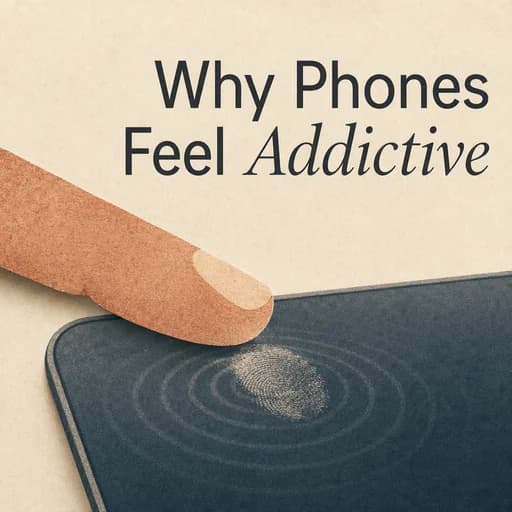
    The Need for Touch: Why We Can’t Put Down Our Phones

    16 min
    |
    |
    Aug 11, 2026
    PsychologyTechnologySelf-Growth

    Explore how the physical 'need for touch' drives smartphone addiction. Learn about Marco Giancola's research on sensory traits and problematic social media use.

    The Need for Touch: Why We Can’t Put Down Our Phones
    Choose how it's told

    One episode. Many ways to hear it.

    Same ideas from The Need for Touch: Why We Can’t Put Down Our Phones. Pick the voice, depth, and pace that fits you. Switch anytime.

    Transcript & chapters

    Chapter 1

    The Invisible Thread Between Your Palm and Your Brain

    Have you ever felt that sudden, sharp jolt of panic when you reach into your pocket and realize your phone isn’t there—that momentary lapse of connection that feels less like losing a tool and more like losing a limb? It is a visceral sensation, one that goes far beyond the fear of missing a text or losing your way without a map. There is something deeper happening in that physical space where your skin meets the glass and metal of your device. You might think your relationship with your smartphone is defined by what happens on the screen—the likes, the news, the endless scroll of images—but recent research suggests that a significant predictor of your digital habits might actually be the physical act of touching the device itself. We have long looked at digital addiction through the lens of psychology and social needs, focusing on our craving for attention or our fear of being left out, but a study published in late 2025 by Marco Giancola and his colleagues at the University of L'Aquila invites us to look at the palm of our hands. They found that a specific sensory trait called the "need for touch" is a robust predictor of problematic smartphone and social media use, while also predicting problematic smartphone and social media use alongside other psychological factors. This means that for you, the physical sensation of swiping, tapping, and even just holding that slab of glass might be providing a sensory reward that keeps you coming back, regardless of whether there is anything new to see. It is a fundamental shift in how we understand our digital lives—moving from the "why" of social connection to the "how" of physical reinforcement. As we move forward, we are going to unpack how this sensory-motivational loop works and why your brain might be treating a vibration or a smooth haptic pulse as a reward on par with the social validation you receive from a "like". This isn't just about screen time—it's about the architecture of your habits and the physical reality of being human in a digital age.
    Chapter 2

    Defining the Modern Digital Compulsion

    To understand why your phone feels so inseparable from your daily existence, we have to look at the frameworks researchers use to define these behaviors. The study by Giancola and his team focuses on two distinct but overlapping concepts: problematic smartphone use, or PSU, and problematic social media use, known as PSMU. PSU is described as a compulsive, unregulated pattern of phone use that starts to get in the way of your actual life—your work, your sleep, and your face-to-face relationships. It isn't just about being on your phone a lot—it’s about that feeling of being unable to stop, even when you know you should. Researchers often look at this through three specific pathways: excessive reassurance-seeking, where you use the phone to feel validated; impulsivity, where you just can’t help yourself; and extraversion, where the phone becomes an outlet for a high need for stimulation. Then you have PSMU, which is more about the specific platforms you use. This is characterized by things like "salience"—meaning social media dominates your thoughts—and "withdrawal," which is that irritability or sadness you feel when you can't check your notifications. The researchers utilized a powerful framework called the I-PACE model—which stands for Interaction of Person-Affect-Cognition-Execution—to map out how these behaviors take root. Essentially, this model says that your tech use is a result of who you are (your personality), how you feel (your affective response), how you think (your cognitive response), and how you act (your executive control). By studying 430 emerging adults, mostly students around the age of 19, the research team sought to find the missing piece of this puzzle. They wanted to know if there was something beyond your personality or your emotions that was driving the bus. They landed on the "need for touch"—the individual tendency to prefer and enjoy tactile sensations. If you are someone who finds the physical act of touching objects inherently rewarding, your smartphone isn't just a tool—it's a sensory playground. This realization changes the game because it suggests that your phone is designed to exploit a very basic, very human drive for haptic information.

    Keep learning with this episode

    Take the ideas from this episode into a guided learning experience in BeFreed.

    Chapter 3

    The Personality Trap and the Vulnerable Self

    Before we get deep into the sensory mechanics, we need to talk about the personality traits that have long been the usual suspects in digital addiction research: narcissism and the fear of missing out, or FoMO. We often hear that social media is a haven for "grandiose narcissists"—the people who use their platforms to show off, seek power, and maintain an inflated self-image. But the Giancola study sheds light on a more subtle and perhaps more common driver: "vulnerable narcissism". If you fall into this category, you might struggle with low self-esteem or a high sensitivity to rejection. For you, the smartphone isn't a megaphone to the world—it’s a shield. It provides a "safer" way to interact with people where you can control the narrative and avoid the immediate sting of face-to-face social friction. The research found that vulnerable narcissism was a consistent positive predictor of both problematic smartphone and social media use. Interestingly, grandiose narcissism—the loud, assertive kind—actually lost its significance once other factors like sensory needs and emotions were brought into the picture. This suggests that the "show-off" factor might be less important than the "self-protection" factor. And then there is FoMO, which the researchers confirmed is one of the strongest affective mechanisms at play. FoMO is that gnawing negative emotional state that comes from feeling like others are having more rewarding experiences than you are. It drives you to stay constantly connected, not necessarily because you want to be, but because you are afraid of what happens if you aren't. But even with these powerful psychological forces at work, the study found that something else was happening under the surface—a sensory-motivational predisposition that reinforces these habits every time your finger hits the screen. This means that while your personality might get you to pick up the phone, the physical sensation of using it is what makes it so hard to put down.
    Chapter 4

    Why Haptic Rewards Are Harder to Resist

    If you've ever found yourself scrolling through a social media feed without actually reading anything—just flicking your thumb up and up—you have experienced the power of the haptic reward. The Giancola study explains that smartphones offer a constant stream of sensorimotor feedback through swiping, tapping, and scrolling. Over time, these repetitive actions become "intrinsically rewarding". To understand this, we have to distinguish between primary and secondary rewards. Primary rewards are things like food, water, or warmth—things you need for survival. Secondary rewards are things that you learn to associate with a positive outcome. In the context of your phone, those little vibrations, haptic pulses, and even the smooth feel of the glass become secondary rewards. They have been paired so many times with socially meaningful outcomes—like a message from a friend or a "like" on a photo—that the touch itself starts to feel good. This is why the "need for touch" is such a big deal. For people who naturally crave tactile sensations, the smartphone provides a perfect, portable loop of physical gratification. The research showed that need for touch predicts problematic use even after you account for personality and emotion regulation. It is a sensory predisposition that increases what researchers call the "baseline reward potential" of the device. In other words, before you even open an app, the mere act of holding and interacting with the device is already giving your brain a hit of pleasure. This haptic reinforcement can keep you engaged even when you aren't particularly bored or looking for social connection. It transforms the smartphone from a communication device into a physical habit that is reinforced every time you touch it.

    Keep learning with this episode

    Take the ideas from this episode into a guided learning experience in BeFreed.

    Chapter 5

    The Regulation Gap and the Power of Reframing

    If the need for touch and the fear of missing out are the accelerators for problematic use, then emotion regulation is the brake. But as the study reveals, not all brakes are created equal. The researchers looked at two specific strategies you might use to handle your emotions: cognitive reappraisal and emotion suppression. Cognitive reappraisal is the healthy stuff—it’s when you take a stressful or negative situation and reframe how you think about it to change how you feel. For example, if you see a friend at a party you weren't invited to, you might tell yourself, "They probably just forgot to mention it, and I could use the rest anyway." The study found that people who are good at this kind of reframing are significantly less likely to fall into problematic smartphone or social media use. On the flip side, emotion suppression—where you just try to push your feelings down and keep them to yourself—didn't seem to help or hurt much in this specific context. This tells us something vital about how you can protect yourself. If you don't have the skills to process your boredom, stress, or social anxiety through reframing, you are much more likely to use your phone as a way to "cope" with those negative states. The phone becomes a "mood modifier," a way to distract yourself from the discomfort of your own thoughts. But here’s the kicker: if you also have a high need for touch, the physical pleasure of using the phone makes that distraction even more effective and harder to break. It creates a double-whammy where you are emotionally vulnerable and physically reinforced. Understanding this regulation gap is key because it shows that managing your digital life isn't just about willpower—it's about building the psychological tools to handle your emotions so you don't have to reach for a haptic "security blanket" every time you feel a little uneasy.

    Chapter 6

    When the Device Becomes the Reward

    One of the most striking findings in this research is that the need for touch actually has a stronger effect on problematic smartphone use than it does on social media use. Think about that for a second. We usually assume that social media is the "drug" and the phone is just the "needle." But the data suggests that for some of you, the needle itself is addictive. The study found a regression coefficient of 0.24 for the link between need for touch and PSU, compared to 0.12 for social media use. This means that while social media use is driven heavily by social and affective motives—like that fear of missing out—the overall use of your smartphone is driven much more by the physical, haptic gratifications of the device itself. This lines up with what researchers call the "three developmental pathways" of smartphone addiction. First, the tactile feedback can soothe your uncertainty, reinforcing your need to constantly check the phone for reassurance. Second, the "hedonic quality"—the pure physical pleasure—of touching the screen can lower your impulse control, making it easier to just start clicking around without a plan. And third, that sensorimotor pleasure amplifies the reward you get from communicating with others, making you even more likely to engage in the kind of high-stimulation, extraverted phone use that leads to problems. This is a fundamental change in how we think about "screen time." It suggests that the problem isn't just what you are looking at—it's the fact that you are touching it. By recognizing that haptic reinforcement is a "transdiagnostic mechanism"—something that underlies many different types of digital engagement—we can start to see why simply deleting an app might not be enough if the physical pull of the device remains.

    Keep learning with this episode

    Take the ideas from this episode into a guided learning experience in BeFreed.

    Chapter 7

    The Sensory Loop and the I-PACE Model

    To really grasp how these findings fit together, we have to look back at that I-PACE model we mentioned earlier—the Interaction of Person-Affect-Cognition-Execution model. The Giancola study proposes that we should position the "need for touch" squarely in the "Person" domain. It’s a sensory-motivational predisposition that you carry with you. Once you have that predisposition, it starts to shape the other parts of the model. When you use your phone, the tactile gratification "amplifies affective relief". Basically, if you are feeling stressed (Affect) and you pick up your phone, the physical act of swiping makes you feel better faster than if you were just looking at a static screen. This then increases the "attentional salience" of the device (Cognition)—your brain starts to prioritize the phone because it knows a physical reward is coming. Over time, this strengthens the "behavioral repetition" (Execution), turning a conscious choice into an automatic habit. This is why the study is so important—it expands our understanding of digital addiction beyond just "it’s a social thing" or "it’s a narcissism thing". It integrates the "embodied" dimension of technology use. You aren't just a brain in a vat looking at images; you are a physical being interacting with a physical object. The study used a sample of emerging adults between 18 and 21 years old, a group that has grown up with these touch-based interfaces as a primary way of interacting with the world. For this generation, the line between the digital and the physical is almost non-existent, making the sensory contingencies of these interfaces incredibly powerful. By mapping these sensory loops, the researchers are giving us a blueprint for why these devices are so uniquely effective at capturing our attention and refusing to let go.

    Chapter 8

    A Practical Playbook for Reclaiming Your Focus

    Now that you know your phone is essentially a haptic reward machine, what can you actually do about it? The Giancola study doesn't just offer theory; it points toward very specific, practical strategies for intervention. If you find yourself struggling with compulsive phone use, the first step is to "break the sensory loop". One of the most effective things you can do is reduce haptic feedback. Go into your settings and turn off those little vibrations that happen when you type or get a notification. By removing that physical "buzz," you are taking away a key secondary reward that reinforces your engagement. Another strategy is "stimulus control". This means changing your environment to reduce the temptation to touch the device. If the mere physical presence of the phone triggers that "need for touch," try putting it in another room or inside a drawer when you need to focus. You can also work on your "cognitive reappraisal" skills. The next time you feel that urge to reach for your phone because you are bored or anxious, stop and try to reframe the situation. Instead of seeing the boredom as something to be "cured" by your phone, try to see it as a moment of quiet that your brain needs to recharge. The study clearly shows that being able to reframe your emotional experiences is a powerful protective factor against problematic use. Finally, be aware of your own "vulnerable narcissism" or FoMO. If you know you tend to use your phone to avoid rejection or to feel connected to others, try to find face-to-face ways to meet those needs. The goal isn't to stop using technology, but to move from a "compulsive technology engagement" driven by sensory loops to an "intentional" use that serves your actual goals. By targeting not just the motives for using your phone, but the sensory mechanics of the interface itself, you can start to pull back the curtain on your habits and take back control.
    Keep learning with this episode

    Take the ideas from this episode into a guided learning experience in BeFreed.

    Chapter 9

    Beyond the Screen and Into the Real

    As we wrap up this exploration of the invisible threads connecting our hands and our digital lives, it is worth reflecting on what this research truly reveals about being human today. We have spent a long time thinking of our smartphones as windows—portals that take us somewhere else, to another person’s life or a distant news event. But the work of Giancola and his team reminds us that a smartphone is also a mirror and a tool of touch. It is an object that we hold, swipe, and tap thousands of times a day, and those physical interactions have a profound impact on our psychological well-being. By recognizing that the "need for touch" is a major player in digital addiction, we can stop blaming ourselves for a lack of willpower and start looking at the design of the tools we use. We can see that the fear of missing out and the vulnerabilities of narcissism are separate predictors of problematic smartphone and social media use, while need for touch reflects how sensory features maintain and reinforce the behavior once initiated that is very hard to resist. But we also see a path forward. We see that by building our skills in cognitive reappraisal and by being intentional about the sensory feedback we allow into our lives, we can break those loops. It is about moving from being a passive recipient of haptic rewards to an active participant in our own mental and physical reality. I want to thank you for taking the time to sit with these complex ideas and for being willing to look at your own habits with a critical, yet compassionate, eye. As you go through your day, I encourage you to just notice—the next time you reach for your phone, ask yourself: "Am I looking for a person, or am I just looking for the feel of the glass?" That simple moment of awareness might be the first step in reclaiming the space between your palm and your brain. Thank you for listening, and I hope this gives you a new way to think about the technology in your pocket and the world at your fingertips.

    ★★★★★

    You made it to the end of The Need for Touch: Why We Can’t Put Down Our Phones

    “23 days in and I have used it every single day. It is part of my daily habit now.”

    jayallen

    Best quote from The Need for Touch: Why We Can’t Put Down Our Phones

    “

    We usually assume that social media is the 'drug' and the phone is just the 'needle,' but the data suggests that for some, the needle itself is addictive through the physical, haptic gratifications of the device.

    ”
    B

    Generated by Brad

    Input question

    Summarize the key findings of the research report 'Don’t touch my s' (Giancola et al., 2025) provided in the attached PDF (fdpys-3-1617529.pdf). Focus on the core results and implications of the study.

    Host voices
    Lenaplay
    Knowledge sources
    fdpys-3-1617529.pdf

    Frequently Asked Questions

    The 'need for touch' is a specific sensory trait that describes the physical craving to interact with objects. According to research by Marco Giancola and colleagues at the University of L'Aquila, this tactile drive is a robust predictor of problematic smartphone and social media use. It suggests that the physical act of swiping, tapping, and holding a device may be more influential in forming digital habits than the content on the screen itself.

    While many attribute digital addiction to psychological factors like a fear of missing out, new research highlights the importance of physical sensations. The visceral panic felt when a phone is missing suggests the device feels like an extension of the body. This study indicates that the sensory experience of touching glass and metal drives our digital habits, often carrying more weight than traditional personality traits associated with addiction.

    The study was published in late 2025 by Marco Giancola and his team at the University of L'Aquila. Their work invites a shift in perspective, moving away from purely psychological or social explanations for smartphone addiction toward sensory-based drivers. By focusing on the 'need for touch,' the researchers identified a key factor that explains why individuals struggle to disconnect from their devices and social media platforms.

    From Columbia University alumni | built in San Francisco

    BeFreed Brings Together A Global Community Of Curious Minds

    4.7

    avg rating

    7.84k+ App Rating

    BeFreed Community

    Seriously I haven’t even explored this app fully yet but from using it the last few days I am so impressed... BeFreed is on a different level from any other learning app I have used. This makes it ultra engaging and can actually improve your concentration which is great for all the doom scrollers!

    @ladyInfinity

    I bought BeFreed exactly 23 days ago, and I have used it every single day since. It has completely embedded itself into my daily workflow and learning habit.

    @jayallen

    The truth is, the app has exceeded all my expectations. I can ask it to generate audio on any topic, whatever it may be, and the result is impressive. My professional field is a specialization in psychotherapy and it is multidisciplinary; however, the answers are very accurate.

    @Raguipa

    What I appreciate most is how much it's reduced my scrolling – I'm spending less time searching and more time absorbing information. The combination of full audiobooks, podcasts, the learning plans are brilliant.

    @colonyofcreatorsNGO

    I have been a PhotoReading Accelerated Learning Instructor for the past 24 years... books and reading and learning are my thing, and BeFreed has done a great job in providing an innovative approach to disseminating and delivering information in an easy to consume way.

    @BeFreed user

    It is not just a book summary app, I have used the 'fun reading' option and it's a much better summary and way to grasp ideas the traditional way, that alone is worth this deal.

    @austinakon

    I love this app. Used it for several days and I cannot stop listening. Such a great way to start.

    @jcrules328

    I really like the program; I have already tested it for around one month, and I feel that it's an amazing gem. It works so well because I can use BeFreed to create my own topics, and the voice is so good with unlimited choice of narrations.

    @DanielCZ

    Seriously I haven’t even explored this app fully yet but from using it the last few days I am so impressed... BeFreed is on a different level from any other learning app I have used. This makes it ultra engaging and can actually improve your concentration which is great for all the doom scrollers!

    @ladyInfinity

    I bought BeFreed exactly 23 days ago, and I have used it every single day since. It has completely embedded itself into my daily workflow and learning habit.

    @jayallen

    The truth is, the app has exceeded all my expectations. I can ask it to generate audio on any topic, whatever it may be, and the result is impressive. My professional field is a specialization in psychotherapy and it is multidisciplinary; however, the answers are very accurate.

    @Raguipa

    What I appreciate most is how much it's reduced my scrolling – I'm spending less time searching and more time absorbing information. The combination of full audiobooks, podcasts, the learning plans are brilliant.

    @colonyofcreatorsNGO

    I have been a PhotoReading Accelerated Learning Instructor for the past 24 years... books and reading and learning are my thing, and BeFreed has done a great job in providing an innovative approach to disseminating and delivering information in an easy to consume way.

    @BeFreed user

    It is not just a book summary app, I have used the 'fun reading' option and it's a much better summary and way to grasp ideas the traditional way, that alone is worth this deal.

    @austinakon

    I love this app. Used it for several days and I cannot stop listening. Such a great way to start.

    @jcrules328

    I really like the program; I have already tested it for around one month, and I feel that it's an amazing gem. It works so well because I can use BeFreed to create my own topics, and the voice is so good with unlimited choice of narrations.

    @DanielCZ

    I love the fact that I can get useful, condensed, information and ideas in a 8 - 15 minute podcast style audio. I'm not a general fan of podcasts because of all the fluff, but this cuts through all that.

    @BeFreed user

    I am finishing up my doctorate, and have to read a lot of unfamiliar material... With BeFreed, you simply enter a prompt, and the app finds source material for you and generates an audio podcast. I find the process in BeFreed to be more streamlined than NotebookLM.

    @Brad

    I often search YouTube for something to listen to whilst making breakfast, when I'm out walking, commuting, etc, and BeFreed has provided an even more targeted approach, without the adverts and the fluff!

    @BeFreed user

    The absolute best part about this platform is its versatility. There is literally no subject that is off-topic. It handles whatever you throw at it... It is rare to find an learning tool with zero limitations that actually delivers on its promises.

    @jayallen

    BeFreed is fantastic. The user-friendly design means I spend less time navigating and more time learning. The mix of audiobooks, podcasts, and learning plans is a genius combo that has completely changed my daily routine.

    @BeFreed user

    At the start I needed a while to understand how to create podcasts in italian language and boom! It is so great! I can ask to explain every argument and it does so well and so smartly!

    @matteo77

    BeFreed has become my daily app for audio books tools... What I like the most is the way you put your text and come with an audio that you can listen on the go.

    @kotanzu1

    I love the fact that I can get useful, condensed, information and ideas in a 8 - 15 minute podcast style audio. I'm not a general fan of podcasts because of all the fluff, but this cuts through all that.

    @BeFreed user

    I am finishing up my doctorate, and have to read a lot of unfamiliar material... With BeFreed, you simply enter a prompt, and the app finds source material for you and generates an audio podcast. I find the process in BeFreed to be more streamlined than NotebookLM.

    @Brad

    I often search YouTube for something to listen to whilst making breakfast, when I'm out walking, commuting, etc, and BeFreed has provided an even more targeted approach, without the adverts and the fluff!

    @BeFreed user

    The absolute best part about this platform is its versatility. There is literally no subject that is off-topic. It handles whatever you throw at it... It is rare to find an learning tool with zero limitations that actually delivers on its promises.

    @jayallen

    BeFreed is fantastic. The user-friendly design means I spend less time navigating and more time learning. The mix of audiobooks, podcasts, and learning plans is a genius combo that has completely changed my daily routine.

    @BeFreed user

    At the start I needed a while to understand how to create podcasts in italian language and boom! It is so great! I can ask to explain every argument and it does so well and so smartly!

    @matteo77

    BeFreed has become my daily app for audio books tools... What I like the most is the way you put your text and come with an audio that you can listen on the go.

    @kotanzu1

    See more on how BeFreed is discussed
    129.7K19.5K
    55.2K19.2K
    154.2K10827355
    48.1K2.5K
    81.2K6.6K
    82.3K1.8K
    Start your learning journey, now
    BeFreed app
    BeFreed

    Learn Anything, Personalized

    DiscordLinkedIn
    Featured book summaries
    Crucial ConversationsThe Perfect MarriageInto the WildNever Split the DifferenceAttachedGood to GreatSay Nothing
    Trending categories
    Self HelpCommunication SkillRelationshipMindfulnessPhilosophyInspirationProductivity
    Celebrities' reading list
    Elon MuskCharlie KirkBill GatesSteve JobsAndrew HubermanJoe RoganJordan Peterson
    Award winning collection
    Pulitzer PrizeNational Book AwardGoodreads Choice AwardsNobel Prize in LiteratureNew York TimesCaldecott MedalNebula Award
    Featured Topics
    ManagementAmerican HistoryWarTradingStoicismAnxietySex
    Best books by Year
    2025 Best Non Fiction Books2024 Best Non Fiction Books2023 Best Non Fiction Books
    Featured authors
    Chimamanda Ngozi AdichieGeorge OrwellO. J. SimpsonBarbara O'NeillWinston ChurchillCharlie Kirk
    BeFreed vs other apps
    BeFreed vs. Other Book Summary AppsBeFreed vs. ElevenReaderBeFreed vs. ReadwiseBeFreed vs. Anki
    Learning tools
    Knowledge VisualizerAI Podcast Generator
    Information
    About Usarrow
    Pricingarrow
    FAQarrow
    Blogarrow
    Careerarrow
    Partnershipsarrow
    Ambassador Programarrow
    Directoryarrow
    BeFreed
    Try now
    © 2026 BeFreed
    Term of UsePrivacy Policy
    BeFreed

    Learn Anything, Personalized

    DiscordLinkedIn
    Featured book summaries
    Crucial ConversationsThe Perfect MarriageInto the WildNever Split the DifferenceAttachedGood to GreatSay Nothing
    Trending categories
    Self HelpCommunication SkillRelationshipMindfulnessPhilosophyInspirationProductivity
    Celebrities' reading list
    Elon MuskCharlie KirkBill GatesSteve JobsAndrew HubermanJoe RoganJordan Peterson
    Award winning collection
    Pulitzer PrizeNational Book AwardGoodreads Choice AwardsNobel Prize in LiteratureNew York TimesCaldecott MedalNebula Award
    Featured Topics
    ManagementAmerican HistoryWarTradingStoicismAnxietySex
    Best books by Year
    2025 Best Non Fiction Books2024 Best Non Fiction Books2023 Best Non Fiction Books
    Learning tools
    Knowledge VisualizerAI Podcast Generator
    Featured authors
    Chimamanda Ngozi AdichieGeorge OrwellO. J. SimpsonBarbara O'NeillWinston ChurchillCharlie Kirk
    BeFreed vs other apps
    BeFreed vs. Other Book Summary AppsBeFreed vs. ElevenReaderBeFreed vs. ReadwiseBeFreed vs. Anki
    Information
    About Usarrow
    Pricingarrow
    FAQarrow
    Blogarrow
    Careerarrow
    Partnershipsarrow
    Ambassador Programarrow
    Directoryarrow
    BeFreed
    Try now
    © 2026 BeFreed
    Term of UsePrivacy Policy

    More like this

    Escaping Your Phone's Dopamine Trap book cover
    How to Break Up with Your PhoneAttention SpanMastering Focus: Brain Science to Beat DistractionDigital Minimalism
    25 sources
    Escaping Your Phone's Dopamine Trap
    Discover how to break free from the 2,600 daily phone touches that hijack your productivity. Learn practical strategies to overcome digital addiction and reclaim your attention for what truly matters.
    13 min
    The Dopamine Trap: Why We Can't Stop Scrolling book cover
    Dopamine NationHookedIndistractableDigital Minimalism
    34 sources
    The Dopamine Trap: Why We Can't Stop Scrolling
    BeFreed
    Discover why your brain keeps reaching for your phone 150 times daily despite minimal enjoyment. Drawing from Stanford psychiatrist Anna Lembke's research, Tristan Harris's tech ethics insights, and neuroscientist Kent Berridge's work, this episode reveals the hidden mechanics of screen addiction and practical solutions to reclaim your attention.
    10 min
    Digital Drift: The Science of Modern Cravings book cover
    IrresistibleChapter 7: Dopamine Loops: The Neurochemistry of Eng... | Algorithmic Addiction | DataField.DevDopamine And Social Media: The Neuroscience Of ScrollingModern attention systems are designed to harvest your focus and this has become a silent tax on strategic judgment, productivity, and capital allocation… | by Firuz Alimov | Medium
    7 sources
    Digital Drift: The Science of Modern Cravings
    We feel a restless pull toward our screens, yet end up feeling empty. Discover how algorithms hijack your brain and how to reclaim your focus.
    14 min
    Phone Habits and the Frictionless Slide book cover
    Break Your Smartphone Addiction the Atomic Habits Way – 14 Actionable Tips - EntreResource.comSmall Steps, Big Change: Screen Time Reduction with Atomic Habits | Rijul (Habit expert) — Rijul AroraAtomic Habits — The Four Laws of Behavior Change Applied to Your Cell PhoneHow to Make Your Future Habits Easy
    5 sources
    Phone Habits and the Frictionless Slide
    Struggling to put your phone down? Learn how to redesign your environment and add friction to digital habits so you can reclaim your focus.
    642 min
    Why doomscrolling is so hard to stop book cover
    IrresistibleThe Dopamine TrapMind GamesBreaking Addiction
    28 sources
    Why doomscrolling is so hard to stop
    Struggling to put your phone down? Discover why your brain treats headlines like predators and how to reclaim your focus from the digital dopamine trap.
    19 min
    Digital Autopilot: Breaking the Phone Reflex book cover
    Digital MinimalismHow to Break up with Your PhoneHow to Reduce Screen Time: 12 Methods Ranked from Easiest to Most Extreme (2026)Break free from digital distractions: a science-backed plan
    7 sources
    Digital Autopilot: Breaking the Phone Reflex
    We pick up our phones dozens of times a day without thinking. Learn how to engineer your digital environment to break the loop and reclaim your time.
    13 min
    The Scrolling Loop: Breaking Digital Procrastination book cover
    How to Stop Doom Scrolling: The Neuroscience of the UrgeBreaking Bad Habits: The Neuroscience of Lasting Behavior ChangeHow to Stop Scrolling and Start Doing (ADHD Productivity Hack)How to Stop Doomscrolling at Work (When You’re Avoiding Tasks) - Routine & Habit Tracker App Tips
    8 sources
    The Scrolling Loop: Breaking Digital Procrastination
    Struggling to put down your phone? Learn why your brain treats scrolling like a slot machine and how to build a better dopamine menu.
    829 min
    The Digital Hypodermic Needle book cover
    Taking the first step towards better mental health: Reduced daily smartphone use leads to less problematic smartphone use, fear of missing out, depression and dysfunctional emotion regulation - ScienceDirectDaily Screen Time Among Teenagers - CDCPhone Addiction Statistics 2025 | Time Out AppExcessive screen time is associated with mental health problems in ...
    8 sources
    The Digital Hypodermic Needle
    Phones are engineered to hijack our neurochemistry, leaving us drained. Discover the science of digital dopamine and how to reclaim your focus.
    26 min