Sartre: hell is other people, and he meant it
We often feel trapped by the judgment of others. Explore Jean-Paul Sartre’s 'gaze' to see how human interaction shapes—and limits—your sense of self.
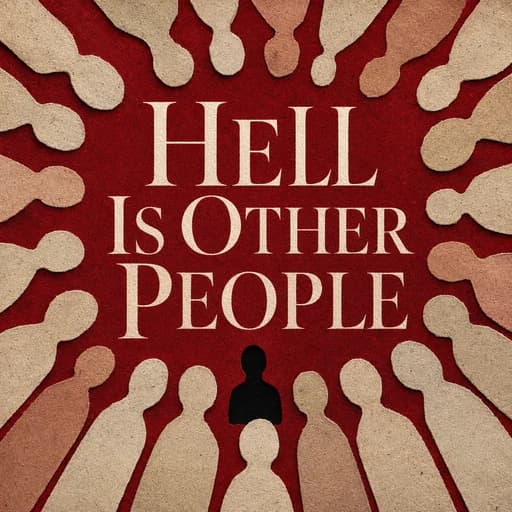
Best quote from Sartre: hell is other people, and he meant it
Sartre’s insight is that your relationships with others are the very place where your freedom goes to die, yet they are also the only place where you can truly be seen.
Generated with BeFreed
Sartre: hell is other people, and he meant it






Frequently Asked Questions
This famous line from the play No Exit is often misinterpreted as a complaint about annoying social interactions or crowds. In reality, Sartre was describing a profound ontological conflict: the way human interaction fundamentally alters your sense of self. Because you cannot fully know yourself without the "look" of another person, you become dependent on their gaze to understand who you are. "Hell" arises when we become trapped by the judgments of others, allowing their categorization of us—as a coward, a hero, or a failure—to fix our identity in a way we cannot control.
The "Look" refers to the moment you become aware that another person is perceiving you, which shifts your status from a "subject" to an "object." When you are alone, you are the center of your own world; however, the moment another person enters, the center of the world shifts to them. You realize you are an object in their universe, and they possess the "key to your existence" because they can see the "outside" of you that you can never reach. This objectification is the original meaning of conflict for Sartre because two people cannot both be the absolute center of the same universe simultaneously.
Sartre viewed romantic love as a struggle for dominance between two free subjects. In a relationship, an individual often tries to capture the other person's freedom so that the partner must see them as a "beloved" or essential object. However, because the other person is a free consciousness, their gaze is always "leaking" out, seeing things about the partner that were not intended to be shown. This creates a cycle of manipulation and jealousy where each person tries to turn the other into an object while desperately trying to remain a subject themselves.
Sartre suggested that the "hellish" nature of relationships is conditional, occurring only when our interactions are "vitiated" or corrupted by bad faith. Bad faith involves lying to oneself and others by pretending we aren't responsible for our actions. To move toward "Heaven," individuals must undergo a "radical conversion" toward authenticity. This means acknowledging both your own radical freedom and the freedom of the other person. By recognizing the "subject-hood" of others rather than treating them as objects or judges, it is possible to form a "relation of being to being" that escapes the cycle of objectification.
Sartre used the experience of shame as a technical proof against solipsism (the idea that only one's own mind exists). He argued that shame is not a private thought but a "recognition" that you are as another person sees you—such as a person caught looking through a keyhole. You cannot be ashamed of yourself by yourself; the feeling requires the presence of an "Other" to judge the action. Therefore, the "affective" experience of shame provides indubitable proof that other consciousnesses exist, as they are the necessary condition for that feeling to occur.
From Columbia University alumni built in San Francisco
"Instead of endless scrolling, I just hit play on BeFreed. It saves me so much time."


"I never knew where to start with nonfiction—BeFreed’s book lists turned into podcasts gave me a clear path."


"Perfect balance between learning and entertainment. Finished ‘Thinking, Fast and Slow’ on my commute this week."
"Crazy how much I learned while walking the dog. BeFreed = small habits → big gains."
"Reading used to feel like a chore. Now it’s just part of my lifestyle."

"Feels effortless compared to reading. I’ve finished 6 books this month already."
"BeFreed turned my guilty doomscrolling into something that feels productive and inspiring."

"BeFreed turned my commute into learning time. 20-min podcasts are perfect for finishing books I never had time for."
"BeFreed replaced my podcast queue. Imagine Spotify for books — that’s it. 🙌"

"It is great for me to learn something from the book without reading it."
"The themed book list podcasts help me connect ideas across authors—like a guided audio journey."
"Makes me feel smarter every time before going to work"
From Columbia University alumni built in San Francisco
"Instead of endless scrolling, I just hit play on BeFreed. It saves me so much time."
"I never knew where to start with nonfiction—BeFreed’s book lists turned into podcasts gave me a clear path."
"Perfect balance between learning and entertainment. Finished ‘Thinking, Fast and Slow’ on my commute this week."
"Crazy how much I learned while walking the dog. BeFreed = small habits → big gains."
"Reading used to feel like a chore. Now it’s just part of my lifestyle."
"Feels effortless compared to reading. I’ve finished 6 books this month already."
"BeFreed turned my guilty doomscrolling into something that feels productive and inspiring."
"BeFreed turned my commute into learning time. 20-min podcasts are perfect for finishing books I never had time for."
"BeFreed replaced my podcast queue. Imagine Spotify for books — that’s it. 🙌"
"It is great for me to learn something from the book without reading it."
"The themed book list podcasts help me connect ideas across authors—like a guided audio journey."
"Makes me feel smarter every time before going to work"
"Instead of endless scrolling, I just hit play on BeFreed. It saves me so much time."
"I never knew where to start with nonfiction—BeFreed’s book lists turned into podcasts gave me a clear path."
"Perfect balance between learning and entertainment. Finished ‘Thinking, Fast and Slow’ on my commute this week."
"Crazy how much I learned while walking the dog. BeFreed = small habits → big gains."
"Reading used to feel like a chore. Now it’s just part of my lifestyle."
"Feels effortless compared to reading. I’ve finished 6 books this month already."
"BeFreed turned my guilty doomscrolling into something that feels productive and inspiring."
"BeFreed turned my commute into learning time. 20-min podcasts are perfect for finishing books I never had time for."
"BeFreed replaced my podcast queue. Imagine Spotify for books — that’s it. 🙌"
"It is great for me to learn something from the book without reading it."
"The themed book list podcasts help me connect ideas across authors—like a guided audio journey."
"Makes me feel smarter every time before going to work"
"Instead of endless scrolling, I just hit play on BeFreed. It saves me so much time."
"I never knew where to start with nonfiction—BeFreed’s book lists turned into podcasts gave me a clear path."
"Perfect balance between learning and entertainment. Finished ‘Thinking, Fast and Slow’ on my commute this week."
"Crazy how much I learned while walking the dog. BeFreed = small habits → big gains."
"Reading used to feel like a chore. Now it’s just part of my lifestyle."
"Feels effortless compared to reading. I’ve finished 6 books this month already."
"BeFreed turned my guilty doomscrolling into something that feels productive and inspiring."
"BeFreed turned my commute into learning time. 20-min podcasts are perfect for finishing books I never had time for."
"BeFreed replaced my podcast queue. Imagine Spotify for books — that’s it. 🙌"
"It is great for me to learn something from the book without reading it."
"The themed book list podcasts help me connect ideas across authors—like a guided audio journey."
"Makes me feel smarter every time before going to work"