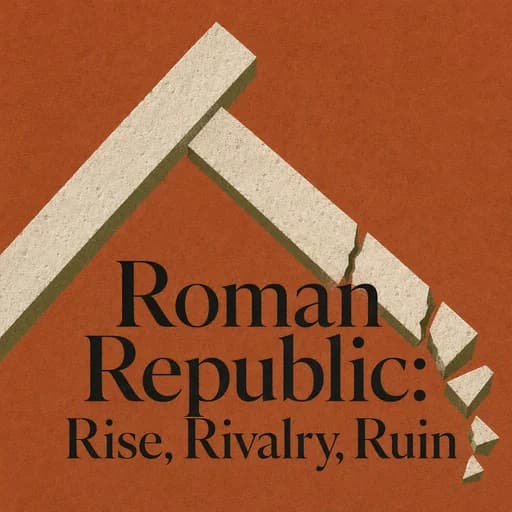
The Roman Republic: Rise, Rivalry, and the Birth of Res Publica
Explore the birth of the Roman Republic, from the exile of Tarquin the Proud to the rise of the Res publica, Roman consuls, and the radical system of imperium.
Best quote from The Roman Republic: Rise, Rivalry, and the Birth of Res Publica
The Roman Republic was founded on a deep-seated fear of tyranny, which led to a system defined by two core principles: collegiality and annuality. It was a government built on the idea of mutual suspicion as a safeguard for liberty.
Generated by Aaron Holiday
Create a lesson covering both the Early Roman Republic (including the Punic Wars) and the later period involving the Rise of Caesar and the Collapse of the Republic. The lesson should be structured as a formal lecture designed for the listener to take detailed notes on key historical content.






Frequently Asked Questions
The Roman Republic was established in 509 BC following a violent political shift in the Roman Forum. According to historical tradition, the last monarch, Tarquin the Proud, was expelled after a scandal involving his son and the noblewoman Lucretia. This transition marked the end of the kingdom and the birth of the Res publica, or the 'thing of the people,' driven by a deep-seated fear of tyranny and a desire to prevent any single individual from holding absolute power again.
To safeguard liberty and prevent the return of monarchy, the Romans transformed the old kingly power known as imperium into a system defined by collegiality and annuality. Instead of a king, they elected two magistrates called consuls to lead for a single year. This radical experiment ensured that power was split in half and limited by time, creating a government built on mutual suspicion and a system of checks and balances to protect the city's new identity.
Roman consuls were the primary magistrates of the elective oligarchy, serving as a dual leadership team to ensure no one person held total control. Each consul was elected for a one-year term and possessed the power to veto the actions of the other. This structure was designed specifically to create a balance of power, utilizing the principle of collegiality to ensure that the government remained a fragile but functional experiment in shared authority and public service.
From Columbia University alumni built in San Francisco
"Instead of endless scrolling, I just hit play on BeFreed. It saves me so much time."


"I never knew where to start with nonfiction—BeFreed’s book lists turned into podcasts gave me a clear path."


"Perfect balance between learning and entertainment. Finished ‘Thinking, Fast and Slow’ on my commute this week."
"Crazy how much I learned while walking the dog. BeFreed = small habits → big gains."
"Reading used to feel like a chore. Now it’s just part of my lifestyle."

"Feels effortless compared to reading. I’ve finished 6 books this month already."
"BeFreed turned my guilty doomscrolling into something that feels productive and inspiring."

"BeFreed turned my commute into learning time. 20-min podcasts are perfect for finishing books I never had time for."
"BeFreed replaced my podcast queue. Imagine Spotify for books — that’s it. 🙌"

"It is great for me to learn something from the book without reading it."
"The themed book list podcasts help me connect ideas across authors—like a guided audio journey."
"Makes me feel smarter every time before going to work"
From Columbia University alumni built in San Francisco
"Instead of endless scrolling, I just hit play on BeFreed. It saves me so much time."
"I never knew where to start with nonfiction—BeFreed’s book lists turned into podcasts gave me a clear path."
"Perfect balance between learning and entertainment. Finished ‘Thinking, Fast and Slow’ on my commute this week."
"Crazy how much I learned while walking the dog. BeFreed = small habits → big gains."
"Reading used to feel like a chore. Now it’s just part of my lifestyle."
"Feels effortless compared to reading. I’ve finished 6 books this month already."
"BeFreed turned my guilty doomscrolling into something that feels productive and inspiring."
"BeFreed turned my commute into learning time. 20-min podcasts are perfect for finishing books I never had time for."
"BeFreed replaced my podcast queue. Imagine Spotify for books — that’s it. 🙌"
"It is great for me to learn something from the book without reading it."
"The themed book list podcasts help me connect ideas across authors—like a guided audio journey."
"Makes me feel smarter every time before going to work"
"Instead of endless scrolling, I just hit play on BeFreed. It saves me so much time."
"I never knew where to start with nonfiction—BeFreed’s book lists turned into podcasts gave me a clear path."
"Perfect balance between learning and entertainment. Finished ‘Thinking, Fast and Slow’ on my commute this week."
"Crazy how much I learned while walking the dog. BeFreed = small habits → big gains."
"Reading used to feel like a chore. Now it’s just part of my lifestyle."
"Feels effortless compared to reading. I’ve finished 6 books this month already."
"BeFreed turned my guilty doomscrolling into something that feels productive and inspiring."
"BeFreed turned my commute into learning time. 20-min podcasts are perfect for finishing books I never had time for."
"BeFreed replaced my podcast queue. Imagine Spotify for books — that’s it. 🙌"
"It is great for me to learn something from the book without reading it."
"The themed book list podcasts help me connect ideas across authors—like a guided audio journey."
"Makes me feel smarter every time before going to work"
"Instead of endless scrolling, I just hit play on BeFreed. It saves me so much time."
"I never knew where to start with nonfiction—BeFreed’s book lists turned into podcasts gave me a clear path."
"Perfect balance between learning and entertainment. Finished ‘Thinking, Fast and Slow’ on my commute this week."
"Crazy how much I learned while walking the dog. BeFreed = small habits → big gains."
"Reading used to feel like a chore. Now it’s just part of my lifestyle."
"Feels effortless compared to reading. I’ve finished 6 books this month already."
"BeFreed turned my guilty doomscrolling into something that feels productive and inspiring."
"BeFreed turned my commute into learning time. 20-min podcasts are perfect for finishing books I never had time for."
"BeFreed replaced my podcast queue. Imagine Spotify for books — that’s it. 🙌"
"It is great for me to learn something from the book without reading it."
"The themed book list podcasts help me connect ideas across authors—like a guided audio journey."
"Makes me feel smarter every time before going to work"