BeFreed
    Categories>Productivity>The Morning Agenda: Moving Beyond Autopilot and Decision Fatigue

    The Morning Agenda: Moving Beyond Autopilot and Decision Fatigue

    18 min
    |
    |
    Aug 23, 2026
    • Productivity
    • Self-Growth

    Stop autopilot working and reclaim your morning. Learn how to manage decision fatigue and protect your cognitive resources for better productivity and focus.

    The Morning Agenda: Moving Beyond Autopilot and Decision Fatigue
    0:00 / 0:00
    Choose how it's told

    One episode. Many ways to hear it.

    Same ideas from The Morning Agenda: Moving Beyond Autopilot and Decision Fatigue. Pick the voice, depth, and pace that fits you. Switch anytime.

    Transcript & chapters

    Chapter 1

    The Hidden Cost of the Autopilot Morning

    If you have ever reached for your phone before your eyes were even fully open, you have already handed over the keys to your day. It is a relatable scene—the alarm goes off, you grope for the device, and within seconds, you are swimming in a sea of forty unread messages and urgent Slack pings. In that single moment, your brain spikes with anxiety and you shift into a reactive state that can last until sunset. You think you are being productive by "getting a head start," but research suggests you are actually depleting your most valuable cognitive resources on low-value tasks. The hard truth is that for most people, the first two hours of the workday determine its entire direction, yet we often spend those hours in a state of "decision fatigue," where the quality of our choices declines as the day drags on.

    You might feel like your inability to stick to a plan is a personal failing—a lack of discipline or willpower—but it is actually a structure problem. Your prefrontal cortex is freshest in the morning, right before the world begins to demand things from you. When you spend that premium mental energy triaging an inbox, you are essentially trying to do your hardest work later in the day with a "depleted" brain. This episode is about reclaiming that window. We are going to look at how to stop being an "autopilot" worker and start becoming an intentional architect of your time.

    By the time we finish, you will understand why a "power hour" of focused work is worth more than four hours of fragmented effort. You will see how simple environmental tweaks—like moving your phone across the room—can bypass the need for willpower entirely. We are moving away from vague goals like "having a productive morning" and toward a rigorous, engineering-based approach to your schedule. It starts with a fundamental shift in how you view your morning agenda, moving it from a "to-do list" to a strategic "launch sequence." This transition begins long before the sun comes up, and understanding the mechanics of that preparation is where the real transformation happens.
    Chapter 2

    The Night Before is the True Morning

    The secret to a focused morning is realizing that your day actually begins the night before. If you wait until you are sitting at your desk with a cup of coffee to decide what matters most, you have already lost. This is because every decision you make—even small ones like what to wear or what to eat—drains a tiny bit of your daily "willpower reservoir". By pre-deciding your morning agenda in the evening, you skip what experts call the "morning decision tax". You wake up knowing what to do, rather than spending your best hours deciding what to do.

    Think of it as setting the "default settings" for your life. Just as a computer program has preset configurations, your brain has "autopilot settings" developed over years of repetition—like checking email first thing because it provides a quick hit of dopamine. To change these, you need to engage in "night-before prep". This involves three specific actions. First, review your schedule for the coming day so you aren't blindsided by a 9 a.m. meeting. Second, lay out your essentials—workout clothes, work attire, or even your coffee mug. Third, and most importantly, identify your "Most Important Task" or MIT.

    The MIT should be the one thing that, if completed, would make the day feel like a success. It is not a list of ten things; it is 1–3 important tasks. When you write this down on a physical index card and leave it on your keyboard, you are creating a "forcing function"—a feature that makes the correct action easier than the incorrect one. Instead of waking up and wondering "where do I start?", your "morning self" simply inherits the wisdom of your "evening self". This reduces morning anxiety and ensures that your highest-quality mental energy is preserved for the work that actually moves the needle.

    Furthermore, this evening ritual helps with what David Allen calls "mind-like-water"—getting the next day's tasks onto paper so they stop looping in your head while you try to sleep. Research suggests that about 35.2% of adults in the U.S. get seven or fewer hours of sleep, which directly impairs focus and energy. A clear plan acts as a psychological "shutdown ritual," allowing you to transition into the deep rest required to fuel the next day's focus. Once you have secured this foundation, you can stop worrying about "how" to start and focus entirely on the "what."

    Keep learning with this episode

    Take the ideas from this episode into a guided learning experience in BeFreed.

    Chapter 3

    Engineering the Bootstrap Moment

    In software engineering, the "bootstrap" is the initial set of operations that a computer performs when it is switched on to load the main operating system. Your morning has a bootstrap moment, too—it is the exact second your alarm goes off. If this moment fails, the rest of the system collapses. Many people struggle here because they rely on willpower, which is at its lowest point when you are half-asleep. To fix this, you have to move from "willpower architecture" to "friction engineering".

    One of the most effective ways to engineer this bootstrap is to move your alarm across the room. It sounds simple, but it forces physical movement, which is a "forcing function" that prevents you from mindlessly hitting snooze. Snoozing is a trap; while you think you are getting five more minutes of rest, you are actually disrupting your sleep cycle and making the eventual wake-up harder. If getting out of bed feels impossible, try the "five-second rule"—count down from five and force yourself to stand up once you hit zero.

    Once you are vertical, the goal is "physical activation." This does not mean a grueling two-hour gym session. Even five minutes of movement—stretching, jumping jacks, or a short walk—increases blood flow to the prefrontal cortex and elevates proteins like BDNF that support neuron health. This is the "substrate" on which your deep work runs. You are essentially "priming the pump" of your brain. Hydration is another non-negotiable part of this launch sequence. Drinking a full glass of water immediately upon waking combats the dehydration caused by sleep and sets a foundation for better focus.

    The most critical part of this engineering, however, is the "phone-free zone." If your phone is your alarm, the temptation to check notifications is almost overwhelming. Some people use technical defenses, like locking their devices until 7 a.m. or leaving the phone in another room entirely for the first 45 minutes of the day. This prevents "phone engagement before work," a common failure mode where you lose about eight minutes. By removing the device, you aren't "resisting" the distraction; you are making the distraction physically inaccessible. This creates a clear path from your bed to your desk, allowing you to transition from "personal mode" to "professional mode" without the interference of other people's priorities.

    Chapter 4

    The Power Hour and the Myth of Multi-Tasking

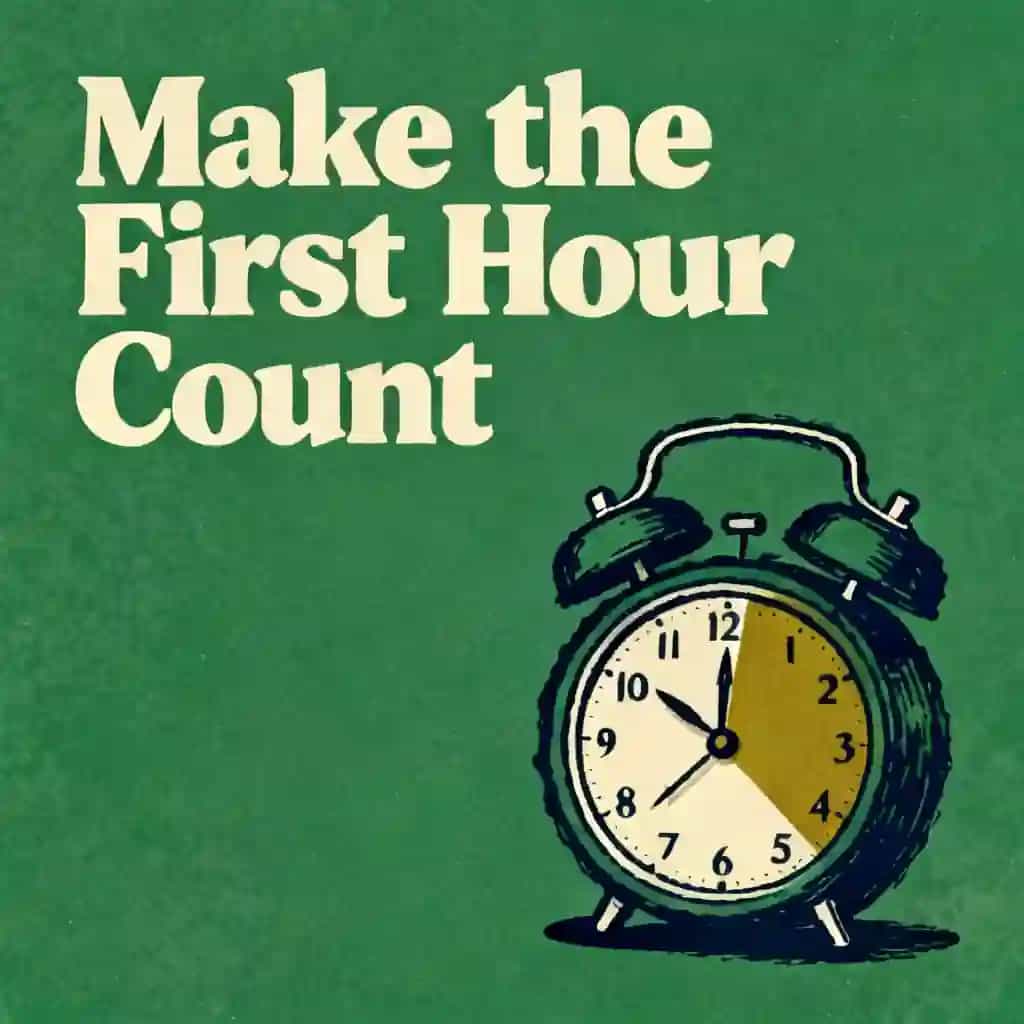
    Once you have successfully "bootstrapped" your morning, you enter the most critical window of the day: the Power Hour. This is a 60-minute block dedicated entirely to your Most Important Task, with zero distractions. The logic here is grounded in the concept of "attention residue"—the cognitive cost of switching from one task to another. When you check a "quick" Slack message in the middle of a project, part of your brain stays stuck on that message, making it impossible to reach a state of "flow".

    The Power Hour is not just about time management; it is about protecting your "premium cognitive fuel". Most knowledge workers spend their mornings in "reactive mode"—answering emails, attending stand-up meetings, and reacting to notifications. By the time they get to their "real" work, their mental energy is depleted. The Power Hour flips this. You do the hardest, most cognitively demanding work first, before the day's chaos takes over. This creates a "guaranteed win" before 10 a.m., which builds a psychological momentum that carries you through the rest of the day.

    To make this work, you must be ruthless about "Technical" and "Social" defenses. Technical defense means turning off notifications, using website blockers, and putting your phone away. Social defense is the harder part—it requires communicating to your team or family that you are unreachable during this window. Many people fear that they will miss something "urgent," but in reality, very few things are so critical they cannot wait 60 minutes. In fact, responding to an email within two to three hours is still considered incredibly fast by professional standards.

    If you are a manager or a founder, this is even more vital. Your job is often defined by strategic thinking and high-stakes decisions, both of which require a "fresh" prefrontal cortex. If you spend your first 90 minutes in a "briefing-first" pattern—reviewing your calendar, your task list, and overnight context without responding—you enter your day informed rather than ambushed. You are leading the day, not following it. The Power Hour is the anchor that keeps your entire schedule from drifting into the weeds of low-impact busywork.

    Keep learning with this episode

    Take the ideas from this episode into a guided learning experience in BeFreed.

    Chapter 5

    Choosing Your Framework for Reality

    Not every morning looks the same, and trying to force a "one-size-fits-all" routine is a recipe for failure. Your role determines your planning needs. For instance, if you are a writer, developer, or researcher whose output depends on uninterrupted blocks, "Time-Blocking" is your best friend. This involves assigning every minute of your workday a label on the calendar—deep work, meetings, email, lunch. It makes your assumptions about time visible, forcing you to have a "real conversation with reality".

    On the other hand, if you are a manager with a high volume of tasks and the authority to delegate, the "Eisenhower Matrix" is more effective. This 2x2 grid helps you separate the "Urgent" from the "Important." Most people live in the "Urgent" column, reacting to fires all day. The matrix forces you to look at the "Important/Not Urgent" quadrant—things like strategy, relationship building, and health—where "compounding returns" actually live. If it is not important and not urgent, you cut it. If it is urgent but not important, you delegate it.

    For those who feel completely overwhelmed, the "MIT" or "Most Important Task" method is the simplest starting point. You pick one to three things that must get done. If you finish them, the rest of the day is "gravy". This lowers the bar enough that the habit of planning can survive even a "bad" week. Then there is the "Ivy Lee Method," which dates back to 1918. You write down six tasks in order of priority and work on task number one until it is finished before moving to number two. It removes the constant, draining question of "what should I do next?"

    Finally, consider "Energy Mapping." This is based on chronobiology research suggesting that most adults peak in the late morning, dip in the early afternoon, and have a second, smaller peak in the evening. By matching your hardest tasks to your peak energy windows, you work with your biology instead of against it. A 50-minute task during your peak is often more productive than two hours spent on the same task during your "afternoon dip". The key is to pick the framework that fits your current role, not the one you wish you had.

    Chapter 6

    The Ritual of Transition

    Getting to your desk is only half the battle; the other half is successfully transitioning from "personal time" to "professional time." This shift benefits from a "work-start ritual" that signals to your brain that the "deep work" phase has begun. This ritual should be brief—two to five minutes—and should lead directly into your first focus block. It could be as simple as making a fresh cup of coffee, sitting at a specific workspace, or writing one sentence in a planning note.

    The directness of this transition is what makes it "protective". If your ritual includes "just checking email for a second," you are establishing a neural pattern that reactive work is the priority. You want to establish the opposite pattern: focus-first. This is why many productivity experts recommend a "Power Hour" before you ever open Slack or email. By completing a meaningful task first, you "win the morning," and that sense of accomplishment makes you more resilient to the distractions that will inevitably arrive later.

    Self-care also plays a role here. Things like "positive affirmations" or a few minutes of meditation can help combat "limiting beliefs" and support a confident mindset. If you start your day feeling like you are already behind, you are more likely to make poor decisions and succumb to distractions. However, if you use your morning beverage time to breathe deeply and be present, you are "regulating your mood" for the challenges ahead.

    Think of your morning as a series of phases: the "Foundation" (sleep and prep), the "Launch Sequence" (movement and hydration), and the "Focus Phase" (prioritization and deep work). Each phase builds on the last. If you skip the "Foundation," the "Focus Phase" will feel like a struggle. If you skip the "Launch Sequence," your brain won't be fully "online" for the work. By being intentional about these transitions, you move away from a "fragmented" day and toward a "unified" one, where your personal well-being supports your professional output.

    Keep learning with this episode

    Take the ideas from this episode into a guided learning experience in BeFreed.

    Chapter 7

    Analyzing Your Failure Modes

    Even the best-engineered systems fail. The difference between someone who "quits" a routine and someone who "masters" it is how they handle those failures. Instead of just recording that you "had a bad morning," you should perform a "failure mode analysis". This is a term borrowed from manufacturing engineering where you systematically identify where a process went wrong. Was the failure "FM-1: Alarm dismissed and return to bed," or was it "FM-4: First task resistance"?.

    When you log the specific point where your system diverged from the plan, you can create targeted fixes. For example, if your failure is "vertical but undirected"—meaning you are out of bed but don't know what to do next—the fix is better "pre-specification" of your first task the night before. If the failure is "phone engagement," the fix is moving the phone further away. This "granular tracking" makes your morning "legible" in a way that simple pass/fail tracking does not.

    Consistency is key, but "rigidity" can be a trap. Most people overestimate their available focus time by 30% to 50%. If you fill every minute of your calendar, the first surprise—a sick kid, a flat tire, an urgent call—will break the whole day. The solution is to leave 25% to 40% "slack" or "white space" in your schedule. This allows your plan to "fail gracefully" when components of your life don't cooperate.

    Social accountability is another powerful tool for correcting failure modes. Knowing that a friend or colleague is waiting for a "check-in" can change the "calculus" of the decision to stay in bed. It adds a "legible external commitment" that operates even when your self-regulatory resources are low. You are not "trying harder"; you are changing the "environment" in which you make the choice. Over time, these environmental decisions become automatic, and the "effort" of the routine disappears.

    Chapter 8

    A Practical Playbook for Your First Week

    If you are ready to take back your mornings, do not try to change 22 habits at once. Start with a "Minimum Viable Morning"—the smallest possible system that delivers your core outcome. For most, that outcome is: "I am at my desk, working on my most important task, within a set timeframe". Here is a simple, four-step protocol for your first seven days.

    First, tonight, write exactly one Most Important Task on a physical note card and place it on your keyboard. Be specific—not "work on project," but "draft three paragraphs of the introduction". Specificity removes the ambiguity that kills momentum. Second, move your phone to the other side of the room before you go to sleep. This is your primary "forcing function".

    Third, when you wake up, do not touch your phone until you have completed your full 60-minute power hour. This is the "golden rule" of the Power Hour. Everything in your inbox can wait. Fourth, use a physical timer—like a kitchen timer or an hourglass—to create a "psychological container" for your work. A phone timer is a trap because picking it up exposes you to notifications. When the timer goes off, you have "won," and you can then check your messages as a reward.

    After a week, perform a "retrospective". Look back at what went well and what could have been better. Did you hit "first task resistance"? Maybe the task was too big. Did you find yourself back in bed? Maybe you need that social accountability layer. Use a "habit tracker" to visualize your progress, but remember: the goal is "showing up," not "perfection". A "bad" week where you still did one MIT a day is still a week where you shipped five important things. That is the power of a structured agenda.

    Keep learning with this episode

    Take the ideas from this episode into a guided learning experience in BeFreed.

    Chapter 9

    The Compounding Power of Intentionality

    As we bring this together, it is worth reflecting on why this level of detail matters. It is not about being a "productivity robot" or squeezing every second out of the day. It is about "reclaiming your agency." When you set a morning agenda, you are deciding that your goals matter more than the "near-constant inflow of information" that tries to steal your attention. You are moving from a "reactive" life to a "proactive" one.

    The first two hours of your day are a "cold-start problem". Once the system is running, it stays running with much less effort. By focusing your energy strategically, you can do "more work in less time and with less struggle". This is the real reward: the "greater productivity" that allows you to actually "switch off" in the evening without the anxiety of unfinished work. You are building a "professional identity" as someone who gets things done, and that confidence compounds over weeks and months.

    Take a moment to consider which part of your morning currently feels the most "out of control." Is it the initial wake-up? The transition to work? Or the "reactive invasion" of email?. Whatever it is, you now have the tools to engineer a solution. You don't need a "perfect" morning; you just need a "reliable" one that supports your well-being and your work-life balance.

    I want to thank you for spending this time with me, looking deeply at the mechanics of your day. It is a rare thing to step back and examine the "autopilot" settings of our lives. My hope is that tomorrow morning, when that alarm goes off across the room, you feel less like you are "fighting" the day and more like you are "launching" it. You have the plan, you have the structure, and you have the most important task already waiting for you. The rest is just showing up.

    ★★★★★

    You made it to the end of The Morning Agenda: Moving Beyond Autopilot and Decision Fatigue

    “23 days in and I have used it every single day. It is part of my daily habit now.”

    jayallen

    Best quote from The Morning Agenda: Moving Beyond Autopilot and Decision Fatigue

    “

    The secret to a focused morning is realizing that your day actually begins the night before. By pre-deciding your agenda in the evening, you skip the 'morning decision tax' and preserve your highest-quality mental energy for the work that actually moves the needle.

    ”
    L

    Generated by Lara

    Input question

    Setting an effective morning agenda to ensure better use of time and reduce distractions throughout the day.

    Host voices
    Lenaplay
    Knowledge sources
    Best morning routine: 22 habits for a productive day [2026] - Asana
    link
    https://asana.com/resources/best-morning-routine
    Morning Routine for Deep Work: Design Your First 2 Hours | today
    link
    https://www.planyour.today/guides/morning-routine-for-deep-work
    How to Plan Your Day: 5 Frameworks That Work (2026) | HabitBox Blog
    link
    https://habitbox.app/blog/how-to-plan-your-day
    Power Hour Productivity: 5 Proven Steps to Win Mornings
    link
    https://deepfocusdaily.com/power-hour-productivity/
    Timing Matters: Design the Day for Maximum Productivity - Wharton
    link
    https://executiveeducation.wharton.upenn.edu/thought-leadership/wharton-at-work/2023/10/design-your-day-for-productivity/
    Daily Productivity Checklist: Morning, Workday, Evening | iDel
    link
    https://idel.com/daily-productivity-checklist/

    Frequently Asked Questions

    The Morning Agenda focuses on helping individuals stop being autopilot workers and start becoming intentional architects of their time. It explores how reaching for a phone immediately upon waking shifts the brain into a reactive state, causing anxiety and depleting cognitive resources. The episode emphasizes that the first two hours of the workday are critical for determining the direction and success of the entire day.

    Decision fatigue occurs when the quality of a person's choices declines as the day progresses. By spending the first hours of the day on low-value tasks like triaging an inbox, individuals exhaust their prefrontal cortex when it is at its freshest. This leads to a depleted brain later in the afternoon, making it much harder to complete high-value work or stick to an intentional schedule.

    The prefrontal cortex is most effective in the morning before the world begins to make demands on your time. This part of the brain provides the premium mental energy needed for difficult tasks and complex decision-making. Protecting this window of time allows you to use your most valuable cognitive resources on your hardest work rather than wasting that energy on reactive tasks like unread emails or Slack pings.

    While many people believe an inability to follow a plan is a personal failing of willpower or discipline, it is actually a structure problem. The Morning Agenda explains that without a proper framework, you naturally fall into a reactive state. By understanding how to manage your cognitive resources and avoid autopilot habits, you can fix the structural issues that lead to decision fatigue and unproductive work patterns.

    From Columbia University alumni | built in San Francisco

    BeFreed Brings Together A Global Community Of Curious Minds

    4.7

    avg rating

    7.84k+ App Rating

    BeFreed Community

    Seriously I haven’t even explored this app fully yet but from using it the last few days I am so impressed... BeFreed is on a different level from any other learning app I have used. This makes it ultra engaging and can actually improve your concentration which is great for all the doom scrollers!

    @ladyInfinity

    I bought BeFreed exactly 23 days ago, and I have used it every single day since. It has completely embedded itself into my daily workflow and learning habit.

    @jayallen

    The truth is, the app has exceeded all my expectations. I can ask it to generate audio on any topic, whatever it may be, and the result is impressive. My professional field is a specialization in psychotherapy and it is multidisciplinary; however, the answers are very accurate.

    @Raguipa

    What I appreciate most is how much it's reduced my scrolling – I'm spending less time searching and more time absorbing information. The combination of full audiobooks, podcasts, the learning plans are brilliant.

    @colonyofcreatorsNGO

    I have been a PhotoReading Accelerated Learning Instructor for the past 24 years... books and reading and learning are my thing, and BeFreed has done a great job in providing an innovative approach to disseminating and delivering information in an easy to consume way.

    @BeFreed user

    It is not just a book summary app, I have used the 'fun reading' option and it's a much better summary and way to grasp ideas the traditional way, that alone is worth this deal.

    @austinakon

    I love this app. Used it for several days and I cannot stop listening. Such a great way to start.

    @jcrules328

    I really like the program; I have already tested it for around one month, and I feel that it's an amazing gem. It works so well because I can use BeFreed to create my own topics, and the voice is so good with unlimited choice of narrations.

    @DanielCZ

    Seriously I haven’t even explored this app fully yet but from using it the last few days I am so impressed... BeFreed is on a different level from any other learning app I have used. This makes it ultra engaging and can actually improve your concentration which is great for all the doom scrollers!

    @ladyInfinity

    I bought BeFreed exactly 23 days ago, and I have used it every single day since. It has completely embedded itself into my daily workflow and learning habit.

    @jayallen

    The truth is, the app has exceeded all my expectations. I can ask it to generate audio on any topic, whatever it may be, and the result is impressive. My professional field is a specialization in psychotherapy and it is multidisciplinary; however, the answers are very accurate.

    @Raguipa

    What I appreciate most is how much it's reduced my scrolling – I'm spending less time searching and more time absorbing information. The combination of full audiobooks, podcasts, the learning plans are brilliant.

    @colonyofcreatorsNGO

    I have been a PhotoReading Accelerated Learning Instructor for the past 24 years... books and reading and learning are my thing, and BeFreed has done a great job in providing an innovative approach to disseminating and delivering information in an easy to consume way.

    @BeFreed user

    It is not just a book summary app, I have used the 'fun reading' option and it's a much better summary and way to grasp ideas the traditional way, that alone is worth this deal.

    @austinakon

    I love this app. Used it for several days and I cannot stop listening. Such a great way to start.

    @jcrules328

    I really like the program; I have already tested it for around one month, and I feel that it's an amazing gem. It works so well because I can use BeFreed to create my own topics, and the voice is so good with unlimited choice of narrations.

    @DanielCZ

    I love the fact that I can get useful, condensed, information and ideas in a 8 - 15 minute podcast style audio. I'm not a general fan of podcasts because of all the fluff, but this cuts through all that.

    @BeFreed user

    I am finishing up my doctorate, and have to read a lot of unfamiliar material... With BeFreed, you simply enter a prompt, and the app finds source material for you and generates an audio podcast. I find the process in BeFreed to be more streamlined than NotebookLM.

    @Brad

    I often search YouTube for something to listen to whilst making breakfast, when I'm out walking, commuting, etc, and BeFreed has provided an even more targeted approach, without the adverts and the fluff!

    @BeFreed user

    The absolute best part about this platform is its versatility. There is literally no subject that is off-topic. It handles whatever you throw at it... It is rare to find an learning tool with zero limitations that actually delivers on its promises.

    @jayallen

    BeFreed is fantastic. The user-friendly design means I spend less time navigating and more time learning. The mix of audiobooks, podcasts, and learning plans is a genius combo that has completely changed my daily routine.

    @BeFreed user

    At the start I needed a while to understand how to create podcasts in italian language and boom! It is so great! I can ask to explain every argument and it does so well and so smartly!

    @matteo77

    BeFreed has become my daily app for audio books tools... What I like the most is the way you put your text and come with an audio that you can listen on the go.

    @kotanzu1

    I love the fact that I can get useful, condensed, information and ideas in a 8 - 15 minute podcast style audio. I'm not a general fan of podcasts because of all the fluff, but this cuts through all that.

    @BeFreed user

    I am finishing up my doctorate, and have to read a lot of unfamiliar material... With BeFreed, you simply enter a prompt, and the app finds source material for you and generates an audio podcast. I find the process in BeFreed to be more streamlined than NotebookLM.

    @Brad

    I often search YouTube for something to listen to whilst making breakfast, when I'm out walking, commuting, etc, and BeFreed has provided an even more targeted approach, without the adverts and the fluff!

    @BeFreed user

    The absolute best part about this platform is its versatility. There is literally no subject that is off-topic. It handles whatever you throw at it... It is rare to find an learning tool with zero limitations that actually delivers on its promises.

    @jayallen

    BeFreed is fantastic. The user-friendly design means I spend less time navigating and more time learning. The mix of audiobooks, podcasts, and learning plans is a genius combo that has completely changed my daily routine.

    @BeFreed user

    At the start I needed a while to understand how to create podcasts in italian language and boom! It is so great! I can ask to explain every argument and it does so well and so smartly!

    @matteo77

    BeFreed has become my daily app for audio books tools... What I like the most is the way you put your text and come with an audio that you can listen on the go.

    @kotanzu1

    See more on how BeFreed is discussed
    129.7K19.5K
    55.2K19.2K
    154.2K10827355
    48.1K2.5K
    81.2K6.6K
    82.3K1.8K
    Start your learning journey, now
    BeFreed app
    BeFreed

    Learn Anything, Personalized

    DiscordLinkedIn
    Featured book summaries
    Crucial ConversationsThe Perfect MarriageInto the WildNever Split the DifferenceAttachedGood to GreatSay Nothing
    Trending categories
    Self HelpCommunication SkillRelationshipMindfulnessPhilosophyInspirationProductivity
    Celebrities' reading list
    Elon MuskCharlie KirkBill GatesSteve JobsAndrew HubermanJoe RoganJordan Peterson
    Award winning collection
    Pulitzer PrizeNational Book AwardGoodreads Choice AwardsNobel Prize in LiteratureNew York TimesCaldecott MedalNebula Award
    Featured Topics
    ManagementAmerican HistoryWarTradingStoicismAnxietySex
    Best books by Year
    2025 Best Non Fiction Books2024 Best Non Fiction Books2023 Best Non Fiction Books
    Featured authors
    Chimamanda Ngozi AdichieGeorge OrwellO. J. SimpsonBarbara O'NeillWinston ChurchillCharlie Kirk
    BeFreed vs other apps
    BeFreed vs. Other Book Summary AppsBeFreed vs. ElevenReaderBeFreed vs. ReadwiseBeFreed vs. Anki
    Learning tools
    Knowledge VisualizerAI Podcast Generator
    Information
    About Usarrow
    Pricingarrow
    FAQarrow
    Blogarrow
    Careerarrow
    Partnershipsarrow
    Ambassador Programarrow
    Directoryarrow
    BeFreed
    Try now
    © 2026 BeFreed
    Term of UsePrivacy Policy
    BeFreed

    Learn Anything, Personalized

    DiscordLinkedIn
    Featured book summaries
    Crucial ConversationsThe Perfect MarriageInto the WildNever Split the DifferenceAttachedGood to GreatSay Nothing
    Trending categories
    Self HelpCommunication SkillRelationshipMindfulnessPhilosophyInspirationProductivity
    Celebrities' reading list
    Elon MuskCharlie KirkBill GatesSteve JobsAndrew HubermanJoe RoganJordan Peterson
    Award winning collection
    Pulitzer PrizeNational Book AwardGoodreads Choice AwardsNobel Prize in LiteratureNew York TimesCaldecott MedalNebula Award
    Featured Topics
    ManagementAmerican HistoryWarTradingStoicismAnxietySex
    Best books by Year
    2025 Best Non Fiction Books2024 Best Non Fiction Books2023 Best Non Fiction Books
    Learning tools
    Knowledge VisualizerAI Podcast Generator
    Featured authors
    Chimamanda Ngozi AdichieGeorge OrwellO. J. SimpsonBarbara O'NeillWinston ChurchillCharlie Kirk
    BeFreed vs other apps
    BeFreed vs. Other Book Summary AppsBeFreed vs. ElevenReaderBeFreed vs. ReadwiseBeFreed vs. Anki
    Information
    About Usarrow
    Pricingarrow
    FAQarrow
    Blogarrow
    Careerarrow
    Partnershipsarrow
    Ambassador Programarrow
    Directoryarrow
    BeFreed
    Try now
    © 2026 BeFreed
    Term of UsePrivacy Policy

    More like this

    The 90-Minute Morning Startup book cover
    Best Morning Routines to Prime Your Brain in 2026 | NeurosityI Rebuilt My Morning Routine Around the Science. Here’s What Worked10 Minute Morning Mindfulness Routine for FocusThis is the optimal morning routine, according to science | BBC Science Focus Magazine
    6 sources
    The 90-Minute Morning Startup
    Starting your day with stress and screens can ruin your focus. Learn to align with your brain's natural biology for lasting clarity and presence.
    1068 min
    The Architecture of a Morning Routine book cover
    Reframing PKM as Personal Infrastructure?Morning chains | How to Think AIWhy Your Morning Routine Fails (And What Actually Works) | When Notes FlyMorning Routine Fails: The Architecture Fix Nobody Talks - Resilient Wisdom
    6 sources
    The Architecture of a Morning Routine
    Stop relying on willpower to start your day. Learn how to design a 'personal infrastructure' that works with your biology instead of against it.
    1085 min
    Morning routine habits for a better start book cover
    Own the Day, Own Your LifeMy Morning RoutineGetting COMFYThe 5 AM Club
    24 sources
    Morning routine habits for a better start
    Stop starting your day stressed by your phone. Learn how simple biological anchors like light and movement reset your brain for a focused, calm morning.
    20 min
    The Morning Transition book cover
    The Morning Transition
    Struggling to shake off morning brain fog? Learn how to align your biology and environment to move from buffering to being fully present and alert.
    20 min
    The Science of a Sustainable Morning book cover
    Atomic HabitsWhy we sleepThis is the optimal morning routine, according to science | BBC Science Focus MagazineHow to Build a Sustainable Morning Routine: Science-Based Guide
    7 sources
    The Science of a Sustainable Morning
    Exhausted by extreme hustle-culture rituals? Learn how to align your first 90 minutes with your brain's biology to boost energy without the burnout.
    1246 min
    Morning Clarity: From Tension to Order book cover
    Morning Clarity: From Tension to Order
    Waking up scattered is a biological reflex, not a failure. Learn to transform morning anxiety into a steady, intentional start through simple order.
    1083 min
    The Morning Brain: Biology of Peak Focus book cover
    Best Morning Routines to Prime Your Brain in 2026 | NeurosityThe Perfect Morning Routine: 2026 TemplateMorning Routine Habits That Actually Stick — Without Waking Up at 5am (2026 Science Guide) | DropDrop8 hours of sleep, coffee, newspapers and zero emails before breakfast: Inside Jeff Bezos’ unhurried morning routine - Lifestyle News | The Financial Express
    4 sources
    The Morning Brain: Biology of Peak Focus
    Struggling with afternoon crashes? Learn how to align your morning habits with your brain's natural neurochemistry to ensure all-day mental clarity.
    1489 min
    The First Hour Rule book cover
    Psychology says the most disciplined morning habit isn't waking up early, meditating, or cold plunging, it's the specific discipline of not touching your phone until you've had at least one quiet conversation with your own mindPhone-Free Morning Habit: The First Hour Rule (Science-Backed 2026)Raptitude Experiment Log No. 38 — Dopamine ManagementThe First Hour Rule: How to Win Your Morning (No Phone Protocol)
    6 sources
    The First Hour Rule
    Starting your day with a screen triggers a cycle of reactive anxiety. Discover how an analog morning routine can reclaim your focus and peace of mind.
    19 min