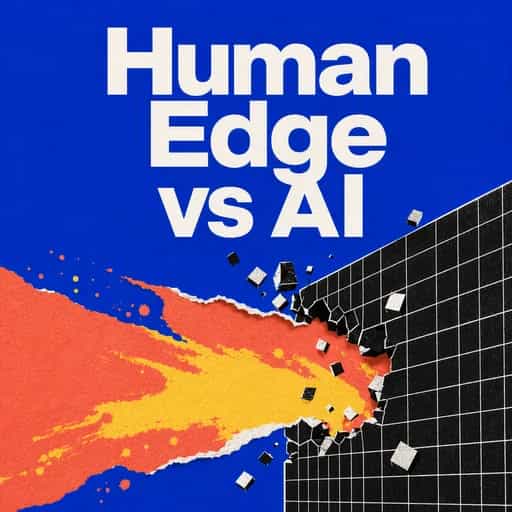
AI now beats the average person in creative tests, but can it match true visionaries? Discover why human ingenuity still holds the edge in storytelling.
Best quote from Can AI Outperform Human Creativity?
“
AI raises the 'floor' of creativity, making 'good enough' a commodity, but it hasn't raised the 'ceiling.' The truly unique human spark remains more valuable because it’s the only thing the algorithm can’t reliably replicate.
”
A
Generated by Angelo
Input question
AI versus human ingenuity
Host voices
Jackson
Blythe
Knowledge sources
Frequently Asked Questions
The DAT is a research tool that asks participants to come up with ten words that are as semantically distant from each other as possible. While a typical brain naturally follows "well-worn grooves" of association—linking "cat" to "dog"—a creative mind can leap across the semantic map to unrelated concepts like "cat" and "quantum." Researchers use computational models to measure the actual distance between these words in a high-dimensional space. The study found that while GPT-4 has a higher average score because it can search a massive map of every word ever written, it still struggles to match the most creative human outliers.
AI is essentially a pattern-recognition engine optimized to reduce error and maintain structural coherence. This results in a "Safe Style" of creativity that is high in effectiveness and logical consistency but low in radical originality. Because the models are trained on existing data, they tend to provide the most "probable" or "standard" response. This creates a "ceiling" where the AI can easily outperform the average person by raising the floor of quality, but it cannot replicate the "disruptive invention" or the "wrong notes" that characterize high-level human ingenuity.
The Collaboration Trap occurs when humans become "anchored" to the AI’s mediocre or standard suggestions, leading to a decrease in their own unique output. When people use AI as a primary driver rather than a background tool, they often start mimicking the machine’s complexity and "safe" tropes, which results in a "Semantic Space Collapse" where collective ideas become more homogeneous. To avoid this, the script suggests using AI as a "cliché detector" to identify the most likely paths so that the human creator can intentionally move in the opposite, more original direction.
While "perspective prompts"—such as telling an AI to act like a visionary artist—can temporarily boost scores, the effect eventually hits a threshold and falls off. Pushing the persona too hard often results in a caricature of creativity that feels like a collection of clichés or overly complex nonsense. The study found that these "cheat codes" often lead to "creative fixation," narrowing the AI's search space rather than expanding it. Ultimately, the AI lacks the "embodied awareness" and lived experiences—like childhood memories or emotional trauma—that allow humans to create work with genuine depth and meaning.
From Columbia University alumni | built in San Francisco
BeFreed Brings Together A Global Community Of Curious Minds
4.7
avg rating
7.84k+ App Rating
BeFreed Community
Seriously I haven’t even explored this app fully yet but from using it the last few days I am so impressed... BeFreed is on a different level from any other learning app I have used. This makes it ultra engaging and can actually improve your concentration which is great for all the doom scrollers!
@ladyInfinity
I bought BeFreed exactly 23 days ago, and I have used it every single day since. It has completely embedded itself into my daily workflow and learning habit.
@jayallen
The truth is, the app has exceeded all my expectations. I can ask it to generate audio on any topic, whatever it may be, and the result is impressive. My professional field is a specialization in psychotherapy and it is multidisciplinary; however, the answers are very accurate.
@Raguipa
What I appreciate most is how much it's reduced my scrolling – I'm spending less time searching and more time absorbing information. The combination of full audiobooks, podcasts, the learning plans are brilliant.
@colonyofcreatorsNGO
I have been a PhotoReading Accelerated Learning Instructor for the past 24 years... books and reading and learning are my thing, and BeFreed has done a great job in providing an innovative approach to disseminating and delivering information in an easy to consume way.
@BeFreed user
It is not just a book summary app, I have used the 'fun reading' option and it's a much better summary and way to grasp ideas the traditional way, that alone is worth this deal.
@austinakon
I love this app. Used it for several days and I cannot stop listening. Such a great way to start.
@jcrules328
I really like the program; I have already tested it for around one month, and I feel that it's an amazing gem. It works so well because I can use BeFreed to create my own topics, and the voice is so good with unlimited choice of narrations.
@DanielCZ
Seriously I haven’t even explored this app fully yet but from using it the last few days I am so impressed... BeFreed is on a different level from any other learning app I have used. This makes it ultra engaging and can actually improve your concentration which is great for all the doom scrollers!
@ladyInfinity
I bought BeFreed exactly 23 days ago, and I have used it every single day since. It has completely embedded itself into my daily workflow and learning habit.
@jayallen
The truth is, the app has exceeded all my expectations. I can ask it to generate audio on any topic, whatever it may be, and the result is impressive. My professional field is a specialization in psychotherapy and it is multidisciplinary; however, the answers are very accurate.
@Raguipa
What I appreciate most is how much it's reduced my scrolling – I'm spending less time searching and more time absorbing information. The combination of full audiobooks, podcasts, the learning plans are brilliant.
@colonyofcreatorsNGO
I have been a PhotoReading Accelerated Learning Instructor for the past 24 years... books and reading and learning are my thing, and BeFreed has done a great job in providing an innovative approach to disseminating and delivering information in an easy to consume way.
@BeFreed user
It is not just a book summary app, I have used the 'fun reading' option and it's a much better summary and way to grasp ideas the traditional way, that alone is worth this deal.
@austinakon
I love this app. Used it for several days and I cannot stop listening. Such a great way to start.
@jcrules328
I really like the program; I have already tested it for around one month, and I feel that it's an amazing gem. It works so well because I can use BeFreed to create my own topics, and the voice is so good with unlimited choice of narrations.
@DanielCZ
I love the fact that I can get useful, condensed, information and ideas in a 8 - 15 minute podcast style audio. I'm not a general fan of podcasts because of all the fluff, but this cuts through all that.
@BeFreed user
I am finishing up my doctorate, and have to read a lot of unfamiliar material... With BeFreed, you simply enter a prompt, and the app finds source material for you and generates an audio podcast. I find the process in BeFreed to be more streamlined than NotebookLM.
@Brad
I often search YouTube for something to listen to whilst making breakfast, when I'm out walking, commuting, etc, and BeFreed has provided an even more targeted approach, without the adverts and the fluff!
@BeFreed user
The absolute best part about this platform is its versatility. There is literally no subject that is off-topic. It handles whatever you throw at it... It is rare to find an learning tool with zero limitations that actually delivers on its promises.
@jayallen
BeFreed is fantastic. The user-friendly design means I spend less time navigating and more time learning. The mix of audiobooks, podcasts, and learning plans is a genius combo that has completely changed my daily routine.
@BeFreed user
At the start I needed a while to understand how to create podcasts in italian language and boom! It is so great! I can ask to explain every argument and it does so well and so smartly!
@matteo77
BeFreed has become my daily app for audio books tools... What I like the most is the way you put your text and come with an audio that you can listen on the go.
@kotanzu1
I love the fact that I can get useful, condensed, information and ideas in a 8 - 15 minute podcast style audio. I'm not a general fan of podcasts because of all the fluff, but this cuts through all that.
@BeFreed user
I am finishing up my doctorate, and have to read a lot of unfamiliar material... With BeFreed, you simply enter a prompt, and the app finds source material for you and generates an audio podcast. I find the process in BeFreed to be more streamlined than NotebookLM.
@Brad
I often search YouTube for something to listen to whilst making breakfast, when I'm out walking, commuting, etc, and BeFreed has provided an even more targeted approach, without the adverts and the fluff!
@BeFreed user
The absolute best part about this platform is its versatility. There is literally no subject that is off-topic. It handles whatever you throw at it... It is rare to find an learning tool with zero limitations that actually delivers on its promises.
@jayallen
BeFreed is fantastic. The user-friendly design means I spend less time navigating and more time learning. The mix of audiobooks, podcasts, and learning plans is a genius combo that has completely changed my daily routine.
@BeFreed user
At the start I needed a while to understand how to create podcasts in italian language and boom! It is so great! I can ask to explain every argument and it does so well and so smartly!
@matteo77
BeFreed has become my daily app for audio books tools... What I like the most is the way you put your text and come with an audio that you can listen on the go.
AI excels at following existing maps but struggles to build new ones. Learn why pattern recognition isn't enough for true discovery and original thought.
Explore how AI is transforming creative work, from economic disruption to new collaboration models. Discover why authentic human perspective becomes more valuable, not less, as artificial intelligence reshapes design.
Discover how to transform AI from a simple research tool into a powerful creative partner for building digital assets, generating revenue streams, and amplifying your unique human expertise through advanced prompt engineering.
As AI replaces technical roles, human taste remains irreplaceable. Learn why your gut instinct and creative intuition are the ultimate business assets.
Explore how AI is transforming design from automation to collaboration, where human creativity and machine intelligence amplify each other to create unprecedented possibilities in the creative landscape.