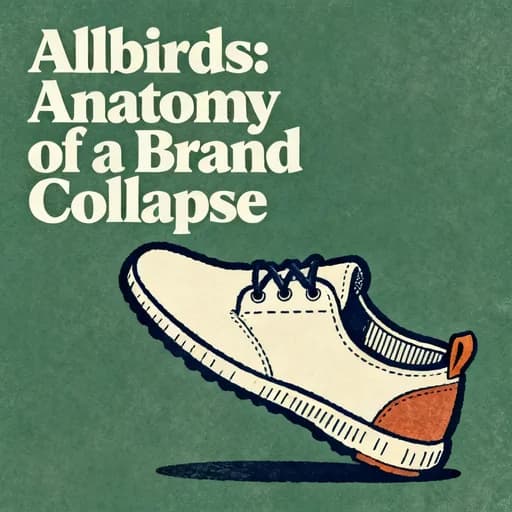
Allbirds and the Billion-Dollar Brand Collapse
When a $4 billion valuation vanishes, what went wrong? Explore how Allbirds traded product focus for rapid expansion and a bizarre final pivot.
Best quote from Allbirds and the Billion-Dollar Brand Collapse
The Allbirds collapse is a masterclass in what happens when a company mistakes a 'moment' for a 'moat,' revealing that a great story is often a mask for a fragile structure.
Generated with BeFreed
The Decision That Sank a Billion-Dollar Brand






Frequently Asked Questions
The collapse was driven by a "DTC Trap" where the company prioritized expensive marketing and rapid expansion over product durability and profitability. Allbirds mistook a temporary fashion trend for a permanent competitive advantage, leading them to over-expand into physical retail and unsuccessful product categories like wool leggings and performance running shoes. By the time the brand was sold in 2026, its valuation had plummeted from $4.1 billion to just $39 million because the business model never achieved structural profitability.
Brand equity is the value and trust a company builds in its core product, while brand permission is the limit of where customers are willing to follow that brand into new categories. Allbirds had high equity in casual sneakers but lacked the "permission" to sell workout apparel or technical gear. When they launched wool leggings that were translucent or made customers overheat, they discovered that liking a brand's shoes does not automatically translate to wanting their apparel, leading to wasted capital and brand dilution.
While sustainability is a powerful marketing story, research shows that most consumers prioritize style, price, comfort, and durability when making a purchase. Sustainability acts as a "tie-breaker" between two equal products rather than the primary reason for buying. If a "green" product fails to deliver on basic quality—such as Allbirds' natural materials wearing out too quickly—the sustainability mission becomes a liability rather than a foundation for growth.
In a pivot described as a "satire of Silicon Valley desperation," the original company rebranded as "NewBird AI." They shifted from manufacturing sustainable footwear to providing GPU-as-a-service cloud computing. This move represented a complete abandonment of their founding mission, moving from eco-friendly wool products to the high-energy consumption of AI processing, before the brand name and designs were ultimately sold to the American Exchange Group.
The primary lesson is that a compelling story is not a substitute for a functional business structure. Investors and consumers should look for brands that "compound on their craft" by obsessing over atomic-level details, such as precision fit and product durability, rather than those chasing "astronomic" valuations through aggressive marketing. True sustainability is found in durability; a product that lasts for years is more valuable and eco-friendly than a "natural" product that requires frequent replacement.
From Columbia University alumni built in San Francisco
"Instead of endless scrolling, I just hit play on BeFreed. It saves me so much time."


"I never knew where to start with nonfiction—BeFreed’s book lists turned into podcasts gave me a clear path."


"Perfect balance between learning and entertainment. Finished ‘Thinking, Fast and Slow’ on my commute this week."
"Crazy how much I learned while walking the dog. BeFreed = small habits → big gains."
"Reading used to feel like a chore. Now it’s just part of my lifestyle."

"Feels effortless compared to reading. I’ve finished 6 books this month already."
"BeFreed turned my guilty doomscrolling into something that feels productive and inspiring."

"BeFreed turned my commute into learning time. 20-min podcasts are perfect for finishing books I never had time for."
"BeFreed replaced my podcast queue. Imagine Spotify for books — that’s it. 🙌"

"It is great for me to learn something from the book without reading it."
"The themed book list podcasts help me connect ideas across authors—like a guided audio journey."
"Makes me feel smarter every time before going to work"
From Columbia University alumni built in San Francisco
"Instead of endless scrolling, I just hit play on BeFreed. It saves me so much time."
"I never knew where to start with nonfiction—BeFreed’s book lists turned into podcasts gave me a clear path."
"Perfect balance between learning and entertainment. Finished ‘Thinking, Fast and Slow’ on my commute this week."
"Crazy how much I learned while walking the dog. BeFreed = small habits → big gains."
"Reading used to feel like a chore. Now it’s just part of my lifestyle."
"Feels effortless compared to reading. I’ve finished 6 books this month already."
"BeFreed turned my guilty doomscrolling into something that feels productive and inspiring."
"BeFreed turned my commute into learning time. 20-min podcasts are perfect for finishing books I never had time for."
"BeFreed replaced my podcast queue. Imagine Spotify for books — that’s it. 🙌"
"It is great for me to learn something from the book without reading it."
"The themed book list podcasts help me connect ideas across authors—like a guided audio journey."
"Makes me feel smarter every time before going to work"
"Instead of endless scrolling, I just hit play on BeFreed. It saves me so much time."
"I never knew where to start with nonfiction—BeFreed’s book lists turned into podcasts gave me a clear path."
"Perfect balance between learning and entertainment. Finished ‘Thinking, Fast and Slow’ on my commute this week."
"Crazy how much I learned while walking the dog. BeFreed = small habits → big gains."
"Reading used to feel like a chore. Now it’s just part of my lifestyle."
"Feels effortless compared to reading. I’ve finished 6 books this month already."
"BeFreed turned my guilty doomscrolling into something that feels productive and inspiring."
"BeFreed turned my commute into learning time. 20-min podcasts are perfect for finishing books I never had time for."
"BeFreed replaced my podcast queue. Imagine Spotify for books — that’s it. 🙌"
"It is great for me to learn something from the book without reading it."
"The themed book list podcasts help me connect ideas across authors—like a guided audio journey."
"Makes me feel smarter every time before going to work"
"Instead of endless scrolling, I just hit play on BeFreed. It saves me so much time."
"I never knew where to start with nonfiction—BeFreed’s book lists turned into podcasts gave me a clear path."
"Perfect balance between learning and entertainment. Finished ‘Thinking, Fast and Slow’ on my commute this week."
"Crazy how much I learned while walking the dog. BeFreed = small habits → big gains."
"Reading used to feel like a chore. Now it’s just part of my lifestyle."
"Feels effortless compared to reading. I’ve finished 6 books this month already."
"BeFreed turned my guilty doomscrolling into something that feels productive and inspiring."
"BeFreed turned my commute into learning time. 20-min podcasts are perfect for finishing books I never had time for."
"BeFreed replaced my podcast queue. Imagine Spotify for books — that’s it. 🙌"
"It is great for me to learn something from the book without reading it."
"The themed book list podcasts help me connect ideas across authors—like a guided audio journey."
"Makes me feel smarter every time before going to work"