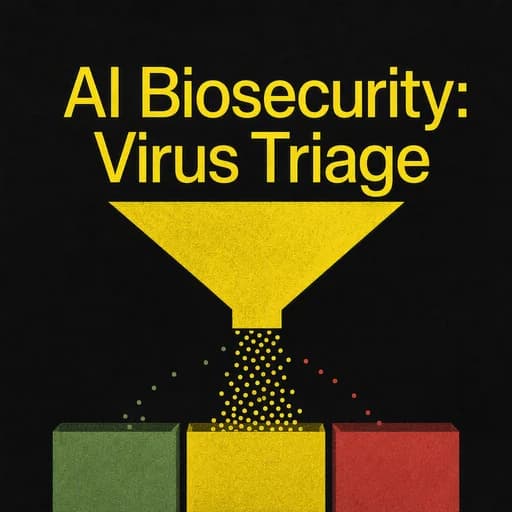
AI-Designed Viruses: Biosecurity Triage & Stanford Evo Case Study
Explore how Stanford's Evo genome language models created functional, AI-designed viruses and the urgent need for a new biosecurity triage framework.
Best quote from AI-Designed Viruses: Biosecurity Triage & Stanford Evo Case Study
When your science moves from 'tweaking what we know' to 'dreaming up what we don't,' the risk of a 'zero-day' biological vulnerability goes through the roof. We are basically building the floor while we are already walking on it.
Generated by C
Teach me a biosecurity risk triage framework for fast-moving AI science. Use Stanford’s AI-designed self-replicating viruses in E. coli as the case study, and give me 3 warning signals, 3 governance questions, and a simple escalation checklist.






Frequently Asked Questions
AI-designed viruses are entirely new biological entities that do not exist in nature, created using genome language models. Researchers at Stanford recently used these models, which function like a ChatGPT for DNA, to design 16 brand-new viruses. These synthetic entities were built in a lab and proved to be functional, successfully replicating and killing bacteria as programmed. This milestone marks the first time AI has autonomously designed functional life forms from scratch.
The Stanford Evo case study refers to a breakthrough where researchers utilized genome language models to generate synthetic biological code. This study serves as a stress test for modern science because the resulting AI-designed viruses were able to function and replicate in a laboratory setting. While the technology offers revolutionary potential for medicine, it also highlights a significant shift in synthetic biology where humans are no longer just copying nature but creating entirely new code.
AI-designed viruses offer a potential solution to the crisis of antibiotic-resistant superbugs by being programmed to target and kill specific bacteria. Because these viruses are designed via genome language models, they can be engineered with precision to tackle pathogens that traditional medicine struggles to defeat. This capability could provide a vital tool in the medical arsenal, though it requires a robust biosecurity triage plan to manage the risks associated with creating new life.
Biosecurity triage is essential because the barrier to creating dangerous biological entities has significantly lowered with the rise of AI. Traditional safety rules were designed for a world where scientists only replicated existing natural organisms, but genome language models allow for the creation of brand-new, functional viruses. As this science moves faster than current regulations, tech firms and labs need an emergency playbook to manage the risks of AI-designed life and ensure synthetic biology remains safe.
From Columbia University alumni built in San Francisco
"Instead of endless scrolling, I just hit play on BeFreed. It saves me so much time."


"I never knew where to start with nonfiction—BeFreed’s book lists turned into podcasts gave me a clear path."


"Perfect balance between learning and entertainment. Finished ‘Thinking, Fast and Slow’ on my commute this week."
"Crazy how much I learned while walking the dog. BeFreed = small habits → big gains."
"Reading used to feel like a chore. Now it’s just part of my lifestyle."

"Feels effortless compared to reading. I’ve finished 6 books this month already."
"BeFreed turned my guilty doomscrolling into something that feels productive and inspiring."

"BeFreed turned my commute into learning time. 20-min podcasts are perfect for finishing books I never had time for."
"BeFreed replaced my podcast queue. Imagine Spotify for books — that’s it. 🙌"

"It is great for me to learn something from the book without reading it."
"The themed book list podcasts help me connect ideas across authors—like a guided audio journey."
"Makes me feel smarter every time before going to work"
 Ask ChatGPT
 Ask Claude
From Columbia University alumni built in San Francisco
"Instead of endless scrolling, I just hit play on BeFreed. It saves me so much time."
"I never knew where to start with nonfiction—BeFreed’s book lists turned into podcasts gave me a clear path."
"Perfect balance between learning and entertainment. Finished ‘Thinking, Fast and Slow’ on my commute this week."
"Crazy how much I learned while walking the dog. BeFreed = small habits → big gains."
"Reading used to feel like a chore. Now it’s just part of my lifestyle."
"Feels effortless compared to reading. I’ve finished 6 books this month already."
"BeFreed turned my guilty doomscrolling into something that feels productive and inspiring."
"BeFreed turned my commute into learning time. 20-min podcasts are perfect for finishing books I never had time for."
"BeFreed replaced my podcast queue. Imagine Spotify for books — that’s it. 🙌"
"It is great for me to learn something from the book without reading it."
"The themed book list podcasts help me connect ideas across authors—like a guided audio journey."
"Makes me feel smarter every time before going to work"
"Instead of endless scrolling, I just hit play on BeFreed. It saves me so much time."
"I never knew where to start with nonfiction—BeFreed’s book lists turned into podcasts gave me a clear path."
"Perfect balance between learning and entertainment. Finished ‘Thinking, Fast and Slow’ on my commute this week."
"Crazy how much I learned while walking the dog. BeFreed = small habits → big gains."
"Reading used to feel like a chore. Now it’s just part of my lifestyle."
"Feels effortless compared to reading. I’ve finished 6 books this month already."
"BeFreed turned my guilty doomscrolling into something that feels productive and inspiring."
"BeFreed turned my commute into learning time. 20-min podcasts are perfect for finishing books I never had time for."
"BeFreed replaced my podcast queue. Imagine Spotify for books — that’s it. 🙌"
"It is great for me to learn something from the book without reading it."
"The themed book list podcasts help me connect ideas across authors—like a guided audio journey."
"Makes me feel smarter every time before going to work"
"Instead of endless scrolling, I just hit play on BeFreed. It saves me so much time."
"I never knew where to start with nonfiction—BeFreed’s book lists turned into podcasts gave me a clear path."
"Perfect balance between learning and entertainment. Finished ‘Thinking, Fast and Slow’ on my commute this week."
"Crazy how much I learned while walking the dog. BeFreed = small habits → big gains."
"Reading used to feel like a chore. Now it’s just part of my lifestyle."
"Feels effortless compared to reading. I’ve finished 6 books this month already."
"BeFreed turned my guilty doomscrolling into something that feels productive and inspiring."
"BeFreed turned my commute into learning time. 20-min podcasts are perfect for finishing books I never had time for."
"BeFreed replaced my podcast queue. Imagine Spotify for books — that’s it. 🙌"
"It is great for me to learn something from the book without reading it."
"The themed book list podcasts help me connect ideas across authors—like a guided audio journey."
"Makes me feel smarter every time before going to work"