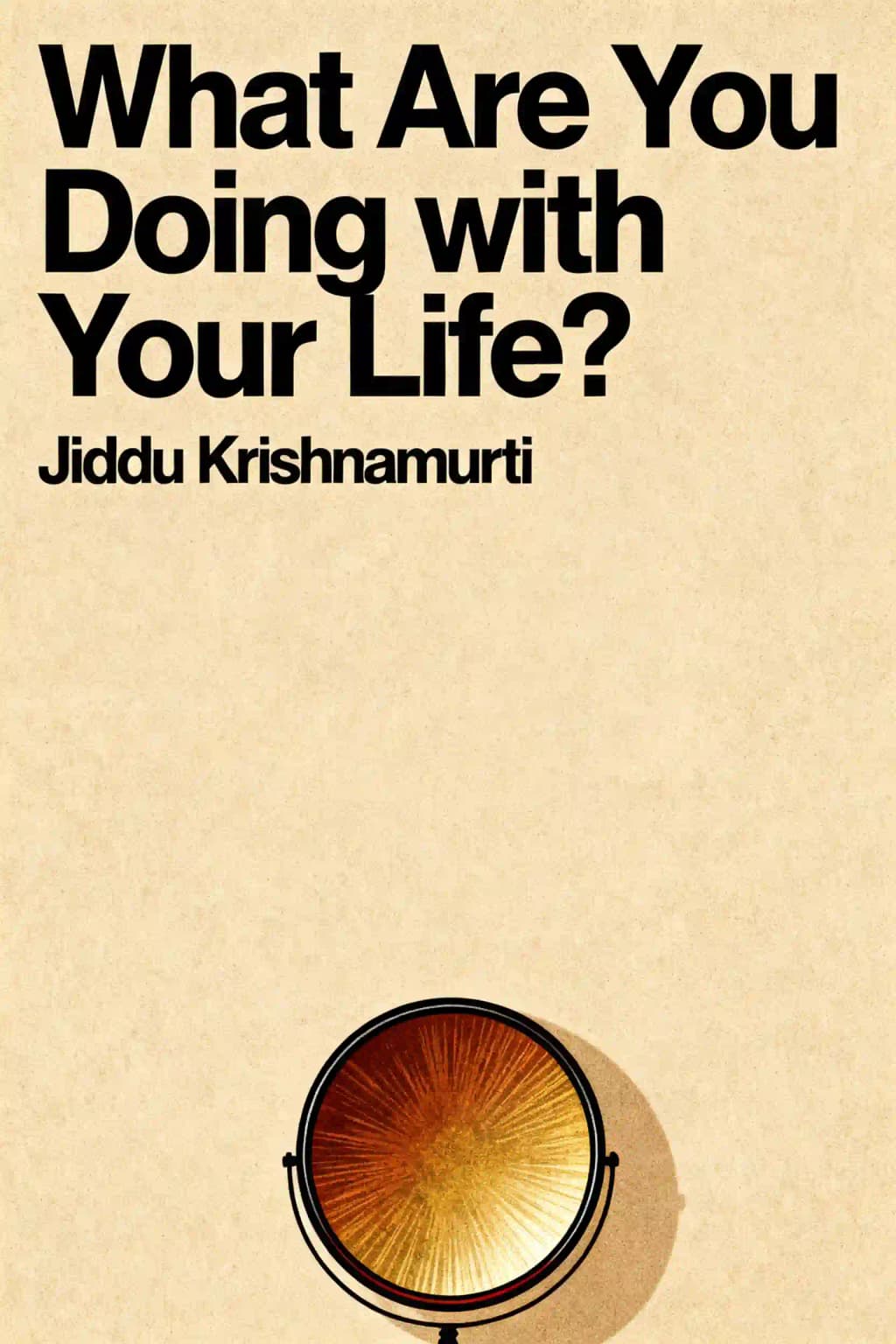
In "What Are You Doing With Your Life?", Krishnamurti challenges you to break free from societal conditioning and discover authentic self-awareness. Hailed by the Dalai Lama as "one of the greatest thinkers of the age," this transformative guide arrives precisely when you're questioning everything.
Jiddu Krishnamurti (1895–1986), author of What Are You Doing With Your Life?, was an Indian-born philosopher and spiritual teacher renowned for his groundbreaking explorations of consciousness, self-inquiry, and psychological freedom. A pivotal figure in 20th-century spirituality, Krishnamurti rejected traditional guru-disciple dynamics after dissolving his early association with the Theosophical Society, advocating instead for independent exploration of truth.
His works, including seminal titles like Freedom from the Known and The First and Last Freedom, dissect themes of existential purpose, societal conditioning, and inner transformation through direct observation of thought. Krishnamurti’s insights stemmed from decades of global dialogues and lectures, later compiled into over 60 translated books that continue guiding seekers worldwide.
Founder of educational institutions emphasizing holistic learning, his writings remain foundational in mindfulness practices and progressive pedagogy. What Are You Doing With Your Life? distills his signature blend of philosophical rigor and accessible wisdom, reflecting his lifelong mission to awaken individuals to self-understanding. Translated into 50+ languages, his works have influenced thinkers across psychology, education, and leadership disciplines.
What Are You Doing With Your Life? explores existential themes like purpose, relationships, and self-awareness through philosophical inquiry. Krishnamurti challenges readers to reject societal conditioning, embrace introspection, and find meaning by engaging fully with the present moment. The book emphasizes personal responsibility, arguing that true transformation arises from understanding oneself rather than relying on external systems or authorities.
This book suits anyone questioning their life’s direction, philosophy enthusiasts, or seekers of self-discovery. It’s particularly valuable for individuals navigating uncertainty, mentors guiding others, or readers interested in non-dogmatic spiritual growth. Krishnamurti’s insights appeal to those open to questioning societal norms and embracing introspection.
Yes, for its timeless, thought-provoking approach to existential questions. Krishnamurti’s rejection of rigid doctrines and focus on self-inquiry offers fresh perspectives on happiness and purpose. While abstract at times, its emphasis on living authentically makes it a compelling read for those seeking mental clarity or personal transformation.
Krishnamurti argues that life’s purpose lies in living fully within the present, not seeking external validation or predefined answers. He suggests that fixation on future goals or past conditioning distracts from appreciating life’s inherent richness. True fulfillment, he claims, emerges from self-awareness and embracing uncertainty.
The book advises confronting these emotions mindfully rather than avoiding them. Krishnamurti posits that boredom and loneliness reveal deeper unmet needs, urging readers to engage with these feelings as opportunities for self-discovery. By observing them without judgment, individuals can uncover insights into their true desires.
“Choiceless awareness” refers to observing thoughts and emotions without reaction or analysis. Krishnamurti views this practice as essential for breaking free from conditioned patterns, enabling clarity and genuine self-understanding. It underpins his approach to meditation and personal growth.
Krishnamurti rejects gurus, religions, and societal structures as hindrances to authentic living. He argues that relying on external systems stifles individual responsibility and creativity. True change, he asserts, arises from internal inquiry rather than adherence to dogma.
Unlike step-by-step self-help guides, Krishnamurti’s work avoids prescriptive advice, focusing instead on dismantling mental constructs. His philosophy aligns with Eckhart Tolle’s present-moment awareness but contrasts with structured approaches like James Clear’s Atomic Habits. It appeals to readers seeking depth over quick fixes.
Critics note its abstract style and lack of practical strategies, which may overwhelm readers seeking actionable steps. Some find Krishnamurti’s rejection of all systems overly idealistic. However, supporters argue its value lies in provoking deeper reflection rather than offering superficial solutions.
Krishnamurti describes happiness as a byproduct of self-awareness and freedom from fear. He warns against pursuing it directly, as attachment to outcomes breeds dissatisfaction. Instead, he advocates embracing life’s impermanence and finding joy in mindful engagement.
In an era of rapid change and AI-driven uncertainty, Krishnamurti’s call for inner stability resonates deeply. His focus on critical thinking and emotional resilience addresses modern anxieties about purpose and identity, making the book a timely guide for navigating complexity.
저자의 목소리로 책을 느껴보세요
지식을 흥미롭고 예시가 풍부한 인사이트로 전환
핵심 아이디어를 빠르게 캡처하여 신속하게 학습
재미있고 매력적인 방식으로 책을 즐기세요
Truth is a pathless land.
What we are within is projected outward.
Self-knowledge comes through relationship, not isolation.
There's no such thing as free thinking.
Happiness is derivative, a by-product.
What Are You Doing with Your Life?의 핵심 아이디어를 이해하기 쉬운 포인트로 분해하여 혁신적인 팀이 어떻게 창조하고, 협력하고, 성장하는지 이해합니다.
생생한 스토리텔링을 통해 What Are You Doing with Your Life?을 경험하고, 혁신 교훈을 기억에 남고 적용할 수 있는 순간으로 바꿉니다.
무엇이든 묻고, 학습 스타일을 선택하고, 나에게 맞는 인사이트를 함께 만들어보세요.

샌프란시스코에서 컬럼비아 대학교 동문들이 만들었습니다
"Instead of endless scrolling, I just hit play on BeFreed. It saves me so much time."
"I never knew where to start with nonfiction—BeFreed’s book lists turned into podcasts gave me a clear path."
"Perfect balance between learning and entertainment. Finished ‘Thinking, Fast and Slow’ on my commute this week."
"Crazy how much I learned while walking the dog. BeFreed = small habits → big gains."
"Reading used to feel like a chore. Now it’s just part of my lifestyle."
"Feels effortless compared to reading. I’ve finished 6 books this month already."
"BeFreed turned my guilty doomscrolling into something that feels productive and inspiring."
"BeFreed turned my commute into learning time. 20-min podcasts are perfect for finishing books I never had time for."
"BeFreed replaced my podcast queue. Imagine Spotify for books — that’s it. 🙌"
"It is great for me to learn something from the book without reading it."
"The themed book list podcasts help me connect ideas across authors—like a guided audio journey."
"Makes me feel smarter every time before going to work"
샌프란시스코에서 컬럼비아 대학교 동문들이 만들었습니다

What Are You Doing with Your Life? 요약을 무료 PDF 또는 EPUB으로 받으세요. 인쇄하거나 오프라인에서 언제든 읽을 수 있습니다.
What if the very search for meaning is what keeps us from finding it? Jiddu Krishnamurti, whom Time magazine named among the five saints of the 20th century, spent 65 years traveling the world with a revolutionary message: true freedom comes only through understanding yourself. Unlike most spiritual teachers, he established no formal practice, insisting that "truth is a pathless land." Even Steve Jobs reportedly kept Krishnamurti's books on his iPad. Why? Because Krishnamurti's approach cuts through the noise of spiritual marketplaces with a simple yet profound invitation: look at yourself without judgment, without escape, and discover what lies beyond the conditioned mind. The self-our ideas, memories, experiences, ambitions-is the result of centuries of conditioning. This conditioning creates a divided consciousness that separates and isolates. Yet we've all experienced extraordinary moments when this self disappears-moments of love, of complete attention, when there's no sense of effort or striving. These glimpses reveal a possibility beyond the self's constant activity, a freedom that can't be pursued but emerges naturally when we understand ourselves as we are.
Are you ever truly connected to anyone? Or is your relationship merely between two images you've created about each other? True relationship only becomes possible when there is no image, when I can look at you without the filter of my past experiences. For most of us, relationships are based on dependency - economic or psychological. This creates fear, possessiveness, and friction. We feel enriched through another, more complete, and fear losing this source of completeness. The fundamental question becomes: can we love without possessing? Can we be related without creating dependency? Relationship is the mirror in which we discover ourselves. Without relationship, we don't exist - to be is to be related. Yet we turn relationships into problems because we don't understand ourselves within them. When we realize that what matters is our response rather than others' actions, relationship undergoes a radical transformation. We can be harmonious with another only when we're harmonious within ourselves.
Why do we constantly seek happiness? Most define it as getting what they want - possessions, achievements, success. But the moment we become conscious of happiness, it vanishes. Like humility, true happiness cannot be pursued - it arrives unbidden. When we see something beautiful, we want to possess it. In this process, we create dependence and fear, losing the very joy we sought to capture. We move from enjoyment to enjoyment, but the "me" that wants more remains at the center. Only when this "me" in all its subtle forms ends can there be a state of bliss - an ecstasy without corruption. Sex becomes a problem because in that act there's complete absence of self-consciousness - a moment where the "me" ceases. Desiring more of this self-abnegation, it becomes all-important. Sex offers momentary freedom while everything else leads to conflict. The real problem isn't sex but how to be free from the self. The confusion begins when pleasure becomes memory demanding repetition. Whether sexual, artistic, or intellectual, we crave repetition, which darkens the mind and creates false values. Understanding pleasure doesn't mean denying it - pleasure is fundamental to life. But we must see how thought transforms natural delight into craving for more.
Intelligence emerges when we act in perfect harmony-intellectually and emotionally. Our education develops intellect through theories without affection, but true intelligence requires unity of mind and heart in action. All thinking is conditioned by our background and environment; there's no free thinking. Through awareness-not willful determination which creates conflict-we can uncondition the mind. Understanding appears when the mind is quiet, when thought and verbalization cease. Don't analyze your thoughts and emotions-become intensely aware of them as they function. The "must" and "must not" approach has crippled your thinking and feeling. This isn't advocating licentiousness, but freedom from compulsion. Can you observe yourself without reaction? Can you simply be aware that you're a Hindu, Socialist, Christian without judging it as right or wrong? This awareness without reaction dissolves conditioning. Knowledge isn't wisdom or intelligence. Wisdom can't be bought, found in books, or accumulated. It comes through self-abnegation and an open mind-not through information, but by observing our thoughts, feelings, and relationships. Intelligence exceeds intellect by integrating reason and love, arising only through self-knowledge.
We carry both external fears (losing jobs, security, status) and internal fears (failure, loneliness, emptiness, death). These fears shape our responses to life. Fear darkens the mind, breeds violence, and prevents psychological freedom. Much of our brain structure is inherited from animals, explaining our violent and competitive tendencies. Physical fear is part of this animal heritage - a natural self-preservation response. Can we free ourselves from both our animal inheritance and societal conditioning? To discover something truly different, we must first achieve freedom from fear. Fear arises through thought about the future or past. Fear always exists in relation to something, and thought creates this relationship. Thought breeds both fear and pleasure - thinking about past pain creates fear of its return, while thinking about past pleasure increases desire. When we give complete attention to anything, there is no observer, no thinker, no center from which we observe. In complete attention, the self-centered thought process ceases. Total attention eliminates the observer - the center of thought that breeds fear.
Where attachment exists, love cannot, and dependency breeds fear. Love isn't something to cultivate or practice-making compassion a mental exercise defeats its essence. Love emerges naturally when we understand relationship fully and when the mind quiets, not filling the heart with its fabrications. Desire isn't love; it pursues pleasure and creates conflict. Beyond understanding desire lies a bliss that transcends mere gratification. We often don't truly love our children-they become habits or possessions. True caring resembles tending a newly planted tree-providing proper soil, protection, and daily attention as part of your being. If we loved our children this way, we would create different education systems, eliminate war and poverty, and transcend competition and nationalism. Our failure to love has allowed these destructive patterns to persist.
True meditation isn't about mantras or special postures - these dull the mind. It's attending to everything in your life: your interactions with family, colleagues, and strangers. Unlike concentration, which excludes and resists, attention observes every thought and movement without distraction. Meditation brings clarity through natural silence, not forced discipline. When you're attentive to every word, gesture, feeling, and motive without correction, silence emerges organically, creating effortless discipline. Self-knowledge is essential to meditation. Being fully aware of your daily activities and responses matters more than isolating yourself to meditate before an image. A truly still mind comes from understanding, not forced discipline, and only this stillness can know creation. Peace is your personal responsibility, reflected in your daily life. Living peacefully - without hatred, envy, power-seeking, or competition - creates freedom from which love emerges. Only a loving mind truly understands harmony with all that exists.