1장
The Awakening Beyond Thought: Where Intelligence Meets the Immeasurable
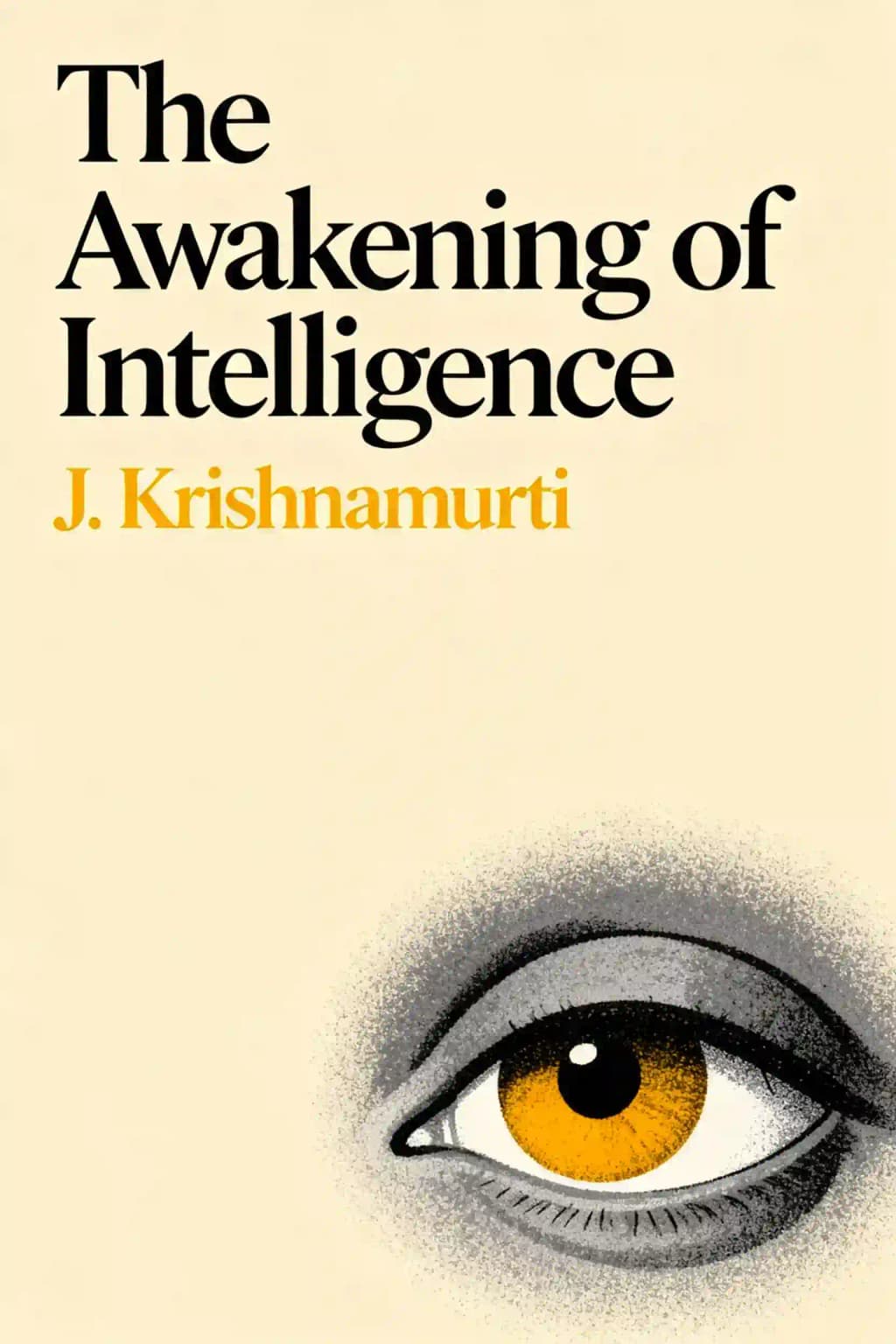
Jiddu Krishnamurti's "The Awakening of Intelligence" has quietly transformed millions of lives since its publication, yet remains one of philosophy's best-kept secrets. While not as commercially popular as works by Eckhart Tolle or Deepak Chopra, this collection of dialogues and talks has profoundly influenced luminaries from physicist David Bohm to spiritual teacher Ram Dass. Bruce Lee famously kept Krishnamurti's works in his personal library, finding in them a philosophical foundation for his own approach to martial arts as "the style of no style." The book's radical challenge to all forms of authority and psychological conditioning continues to resonate across disciplines-from psychology to education to spiritual inquiry-offering a path to intelligence that transcends the limitations of thought itself.
2장
The Prison of Fragmented Perception
We live in a world of increasing fragmentation-divided by nationality, religion, ideology, and the endless classifications we impose on ourselves and others. Yet Krishnamurti challenges us to see that this outer chaos merely reflects our inner state. "I am the world, and the world is me," he states, not as poetic metaphor but as literal fact. The wars, environmental destruction, and social disorder we witness are the external manifestation of our own fragmented consciousness.
This fragmentation begins with the fundamental division between the observer and the observed-the "me" that believes itself separate from its experiences. When I feel anger, I say "I am angry," creating an artificial separation between myself and the emotion. This division initiates conflict, as the "I" tries to control, suppress, or change what it observes. Yet this observer is itself merely another fragment of thought, conditioned by past experiences, knowledge, and cultural programming.
Consider how we typically approach jealousy. We feel jealous, then immediately create a mental entity-the "I"-that claims to be separate from jealousy and attempts to control it. This creates internal conflict, wasting tremendous energy. Krishnamurti proposes a radical alternative: what if there is no separate entity? What if "I am jealousy" rather than "I have jealousy"? When we perceive this directly, without mental commentary, the division dissolves, and with it, the conflict.
This insight extends to all our perceptions. When we look at a tree, do we actually see the living organism before us, or merely our mental image of "tree" based on past knowledge? Our relationships suffer from the same distortion-we relate not to the living person before us but to our accumulated images of them. These images act as barriers, preventing direct contact and genuine relationship. The more sensitive we become, the more these images accumulate, creating an ever-thickening wall between ourselves and reality.
The fundamental challenge is learning to see without the filter of thought-to observe directly, without the burden of the past intervening between perception and reality. This requires extraordinary attention to the mechanics of our own thinking.
3장
The Limits of Thought and Knowledge
Thought has built our civilizations, created our technologies, and solved countless practical problems. Yet Krishnamurti points to its fundamental limitation: thought can only operate within the field of the known. It is always old, always of the past, always limited by memory and experience. Like a computer, it can only process what has been programmed into it. This programming comes from our cultural conditioning, education, personal experiences, and accumulated knowledge - all of which belong to yesterday.
When we face the challenges of living - relationship difficulties, psychological suffering, existential questions - we habitually turn to thought for solutions. But thought, being of time and the past, cannot grasp the living, moving present. It's like trying to capture a flowing river with a photograph - the moment you do so, it's already something else. Consider how we handle relationship conflicts: we immediately resort to past experiences, remembered advice, or learned patterns of behavior, none of which address the unique, present moment of the interaction.
Think about how we approach fear. When we feel afraid, thought immediately intervenes, analyzing the fear, comparing it to past experiences, seeking ways to escape or overcome it. But this very process - the movement of thought - is what sustains and amplifies the fear. Thought creates psychological time - the projection into future uncertainty - which is the very substance of fear. For instance, when facing a job interview, thought projects various scenarios of failure, creating anxiety that didn't exist before the mental projection.
Knowledge and thought are necessary for practical functions - cooking a meal, building a bridge, performing surgery. But we've extended their domain into areas where they become destructive. When thought tries to resolve psychological issues, it inevitably creates division and conflict. The thinker who wants to change is itself a product of thought, creating an illusory division that perpetuates suffering. This is evident in our attempts at self-improvement, where the "self" trying to improve is itself a construct of thought.
Imagine you're driving south while believing you're heading north. No matter how fast you drive or how sophisticated your vehicle becomes, you'll never reach your northern destination. Similarly, thought seeking freedom from itself is moving in the wrong direction entirely. The very entity seeking transformation is itself the barrier to change. We see this pattern in meditation practices where the thinking mind attempts to achieve a state beyond thinking - an inherent contradiction.
What's needed isn't more knowledge or better thinking but a fundamentally different quality of perception - one that emerges when thought recognizes its own limitations and naturally becomes quiet. This recognition isn't achieved through effort or discipline but through direct seeing of "what is" without attempting to change it. Like a mirror that simply reflects without judgment or interpretation, this quality of attention operates outside the framework of thought and time. When we observe our anger, for instance, without the interference of thought's judgments or attempts to change it, a different kind of understanding emerges - immediate, fresh, and transformative.
The challenge isn't to perfect thought but to understand its proper place. Just as we wouldn't use a hammer to stitch fabric, we shouldn't use thought to address issues that require a different kind of intelligence - the intelligence of direct perception and awareness.
4장
Beyond the Observer and the Observed
At the heart of Krishnamurti's teaching lies a revolutionary insight: the observer is the observed. This isn't a philosophical concept but a direct perception that transforms our relationship with experience. When we truly see that the thinker is not separate from thought, that the experiencer is not separate from experience, a profound shift occurs.
Consider how we typically respond to a sunset. We see its beauty, and immediately thought enters: "What a beautiful sunset! I must remember this. How can I capture this feeling again?" In that moment, we've divided experience into the observer who wants to possess the beauty and the observed beauty itself. This division ends the direct perception and begins the process of memory, comparison, and pursuit.
The same happens in relationships. When someone says something hurtful, we immediately create an image-both of them as hurtful and of ourselves as hurt. These images accumulate over time, creating barriers between people. "The more sensitive one is," Krishnamurti notes, "the greater the burden of images." Eventually, we're not relating to actual people but to our accumulated images of them.
The key insight is that these images form only in moments of inattention. When we're completely attentive to what's happening-without judgment, without the past interfering-no image forms. This complete attention is not concentration on an object but a state of awareness that encompasses everything without selection or exclusion.
I recently witnessed this principle in action while mediating a conflict between two colleagues. Each had built such elaborate images of the other that genuine communication had become impossible. When I asked them to describe what they were feeling in the present moment-without reference to past grievances-something remarkable happened. The space between them cleared, and for a brief moment, they saw each other directly, without the filter of accumulated hurts. That momentary connection did more to resolve their conflict than hours of discussing who said what and when.
This shift from divided perception to wholeness isn't achieved through practice or method. It happens in the moment we see the falseness of division itself. When we perceive that the observer claiming to control thought is itself thought, the whole structure of division collapses, revealing a different quality of awareness altogether.
5장
The Nature of Intelligence
What emerges when thought recognizes its own limitations? Krishnamurti calls this intelligence - not the intelligence measured by IQ tests or demonstrated through academic achievement, but a fundamentally different quality of perception that operates beyond the field of thought. This intelligence represents a radical departure from our conventional understanding of mental capacity, emerging as a holistic form of awareness that transcends the mechanical processes of memory and calculation.
This intelligence isn't personal - it doesn't belong to anyone. It emerges when the mind discovers its own fallibility and naturally becomes humble. This humility isn't practiced or cultivated but arises spontaneously with the recognition of thought's limitations. Intelligence flowers in the state of "not knowing," when the mind is free from the burden of certainty and the accumulation of knowledge. This state of not knowing isn't ignorance but rather an openness that allows for fresh perception.
Intelligence is like the space between thoughts - not something to be achieved or developed, but what remains when the constant movement of thought subsides. It operates in a different dimension than thought, seeing the whole rather than fragments, perceiving directly rather than through the filter of the past. This quality of perception is immediate and untainted by memory, prejudice, or preconception. It's similar to how an artist might see a landscape without immediately categorizing or naming its components, taking in the whole scene in one undivided perception.
Consider how differently intelligence and thought approach a problem. Thought analyzes, compares with past experiences, applies known methods, and projects future outcomes. When faced with a relationship conflict, for instance, thought might immediately recall past hurts, project future scenarios, or apply psychological theories. Intelligence, by contrast, sees the entire situation at once, without the division between observer and problem. This seeing itself is action - immediate, complete, without the time-gap that thought creates between perception and response.
Intelligence isn't opposed to thought but encompasses it, using thought when appropriate for practical matters while remaining free from its limitations in psychological domains. When intelligence operates, thought becomes a tool rather than a master, applied where useful and naturally quiet otherwise. For example, in technical matters like engineering or mathematics, thought functions precisely and effectively. But in understanding oneself or in relationship with others, intelligence operates without the interference of psychological thought.
This intelligence manifests as harmony between mind, heart, and body - a state where there is no conflict between thinking, feeling, and acting. The body becomes sensitive without being indulgent, responding appropriately to pleasure and pain without psychological attachment. The heart becomes compassionate without sentimentality, capable of deep feeling without emotional entanglement. The mind functions with clarity without being trapped in concepts, able to use knowledge without being bound by it.
The awakening of intelligence brings with it a natural order that isn't imposed through discipline or control. This order is virtue - not the practiced morality of society but a living, dynamic response to each situation without the burden of rules or principles. When intelligence functions, goodness flowers naturally, without effort or struggle. This virtue isn't the result of cultivation or practice but emerges from the clarity of perception that intelligence brings.
6장
The Art of Seeing and Listening
How does one awaken this intelligence? Not through methods or systems, which are all products of thought, but through the art of seeing and listening with total attention. This attention is not concentration-which is exclusion-but a state of awareness that excludes nothing.
When we truly see something-a tree, a face, a problem-without the screen of thought intervening, perception has an entirely different quality. It becomes direct, immediate, and complete. This seeing isn't limited to visual perception but extends to listening, feeling, and understanding.
Most of us don't know how to listen. When someone speaks, we're already formulating our response, comparing what's said with what we already know, judging whether we agree or disagree. This internal dialogue prevents us from actually hearing what's being communicated. True listening happens when the mind is completely silent, receptive without reaction.
I experienced this distinction while hiking in a forest after reading Krishnamurti. For years, I'd walked these same trails, always naming the trees, birds, and plants I encountered-oak, cardinal, trillium-feeling satisfied with my knowledge. But this time, I deliberately suspended naming and categorizing. What emerged was astonishing-colors appeared more vivid, movements more alive, the entire forest pulsing with a presence I'd never noticed before. The difference wasn't in the forest but in the quality of attention I brought to it.
This quality of attention isn't something to be practiced or developed over time. It happens in the moment when we see the limitation of our habitual way of perceiving. When we recognize how our naming, categorizing, and judging create a barrier between ourselves and what we observe, attention naturally shifts to a different dimension.
The same principle applies to self-observation. When we look at ourselves-our reactions, emotions, thoughts-we typically do so through the filter of judgment, trying to change what we see according to some ideal. But true observation happens without the observer-without the entity that judges and tries to control. It's simply seeing what is, without any movement to change it.
This seeing without the observer is the beginning of meditation-not as a practice or technique, but as a state of awareness that transforms our relationship with life itself.
7장
The Religious Mind and Meditation
For Krishnamurti, religion has nothing to do with beliefs, rituals, or organized institutions. The truly religious mind is one that has freed itself from all authority, tradition, and second-hand knowledge to discover the sacred directly. This discovery isn't the result of seeking but emerges when the mind is completely free from the known.
Traditional approaches to meditation-systems, methods, techniques-all belong to the field of thought and therefore cannot access what lies beyond thought. True meditation begins with freedom, not as a distant goal but as the very foundation of inquiry. It requires questioning every authority, including one's own experiences and conclusions.
Meditation isn't sitting quietly for twenty minutes twice a day while the rest of life continues unchanged. It's a way of living in which every action, relationship, and thought is approached with complete attention. This attention brings order-not the mechanical order of discipline but the living order that emerges when the mind sees clearly without distortion.
The meditative mind understands the nature of thought without trying to control or suppress it. It sees how thought creates the thinker, how memory projects itself as the "me" that claims to be separate from experience. This seeing isn't analysis but direct perception that transforms the very structure of consciousness.
When the mind is completely quiet-not through control but through understanding-it can encounter what Krishnamurti calls "the immeasurable." This isn't a mystical experience to be pursued but what remains when all pursuit ends, when the mind is free from the burden of becoming and achievement.
I've noticed this principle at work in creative endeavors. When I'm trying to write something brilliant or original, the effort itself blocks the flow of creativity. But when I'm simply present with the subject, without ambition or fear, insights emerge that surprise me with their clarity and depth. The quiet mind becomes a vessel for something that thought alone could never produce.
This quietness isn't dullness or passivity but a state of extraordinary alertness and sensitivity. The brain cells themselves undergo a transformation, becoming rejuvenated and fresh. When the mind is free from the constant chatter of thought, perception becomes crystal clear, and action flows without the friction of conflict.
The religious mind, in Krishnamurti's sense, is one that lives in this state of attention and order. It's not seeking experiences or accumulating knowledge but constantly dying to the known to discover what lies beyond. This dying isn't morbid but a continuous renewal that keeps perception fresh and relationships alive.
8장
Relationship and Love
At the core of human existence lies relationship-not just with other people but with nature, ideas, and oneself. Yet most relationships are based on images, dependencies, and the pursuit of security rather than direct contact with what is.
We typically use relationships to escape our own emptiness and loneliness. We depend on others for comfort, pleasure, and a sense of identity. This dependency inevitably leads to fear, jealousy, and possession-the very opposite of love. True relationship begins when we no longer use others as means to our own psychological ends.
Krishnamurti challenges the conventional understanding of love, suggesting that what most people call love is actually pleasure, attachment, and dependency. Real love emerges only when the mind is free from the pursuit of pleasure and the avoidance of pain-when relationship isn't based on what we can get but on sharing without demand.
This love isn't personal or exclusive but a quality of relationship that extends to everything we encounter. It's not a feeling but a state of being in which there is no division between oneself and others. When we truly realize "I am the world and the world is me," compassion flows naturally without effort or practice.
The barrier to this love is the "me" with its constant self-concern-worrying about its progress, security, and fulfillment. This self-concern creates isolation even in intimate relationships, as each person remains centered on their own needs and fears rather than being fully present with the other.
True relationship requires freedom from images-the accumulated impressions and conclusions we form about others based on past interactions. These images prevent us from seeing the living reality of another person, who is constantly changing and moving. When we relate through images, we're relating to the past rather than the present moment.
The challenge is to meet each person afresh, without the burden of memory and expectation. This doesn't mean forgetting practical information but being psychologically free from the past. When we meet someone with whom we've had conflict, can we see them directly, without the screen of past hurts intervening?
This quality of relationship extends beyond people to our connection with nature, ideas, and the whole movement of life. When the mind is free from division, everything is met with the same attention and care. This is the beginning of love-not as an emotion or attachment but as the natural expression of a mind that sees the fundamental unity of existence.
9장
The Immeasurable and the Sacred
Throughout his dialogues, Krishnamurti points to something beyond the reach of thought-what he variously calls the immeasurable, the sacred, or simply "that which is." This isn't presented as a belief or concept but as what remains when the mind is completely free from the known.
Thought, being measurement and comparison, can never access the immeasurable. All our attempts to grasp the infinite through finite means, to capture the timeless through time-bound thought, inevitably fail. What's required isn't more sophisticated thinking but a fundamentally different approach to existence itself.
The sacred isn't found through seeking but emerges when all seeking ends. It's not a goal to be achieved but what is revealed when the mind is completely quiet, free from the movement of becoming. This quietness isn't forced or practiced but comes naturally when we understand the limitations of thought and the nature of the self.
Intelligence forms the bridge between the measurable world of thought and the immeasurable dimension beyond. This intelligence isn't personal but belongs to the whole-it's what connects the particular to the universal, the finite to the infinite. When intelligence functions, the mind can use thought for practical purposes while remaining open to what lies beyond thought.
The religious life, in Krishnamurti's sense, is one that holds both dimensions-functioning effectively in the world of measurement while being rooted in the immeasurable. This isn't a matter of balance or integration but of living from a different center altogether-one that isn't created by thought or bound by time.
When the mind is free from the pursuit of pleasure, the avoidance of pain, and the constant movement of becoming, it naturally encounters what is sacred. This sacredness isn't separate from daily life but is the very ground of existence itself. It's found not in temples or rituals but in the quality of attention we bring to each moment.
The awakening of intelligence is ultimately the discovery of this sacred dimension-not as something other than ourselves but as our most essential nature. When the mind is free from the limitations of thought, what remains is a silence that is alive, a space that is infinite, and an intelligence that connects us to the whole movement of life.
This is not a conclusion to be accepted or rejected but an invitation to discover for oneself the possibility of living with a mind that is truly free-free from conditioning, free from division, and free from the burden of the past. In this freedom lies the awakening of intelligence that transforms not only our individual lives but the consciousness of humanity itself.