1장
The Eternal Wait: A Modern Existential Masterpiece
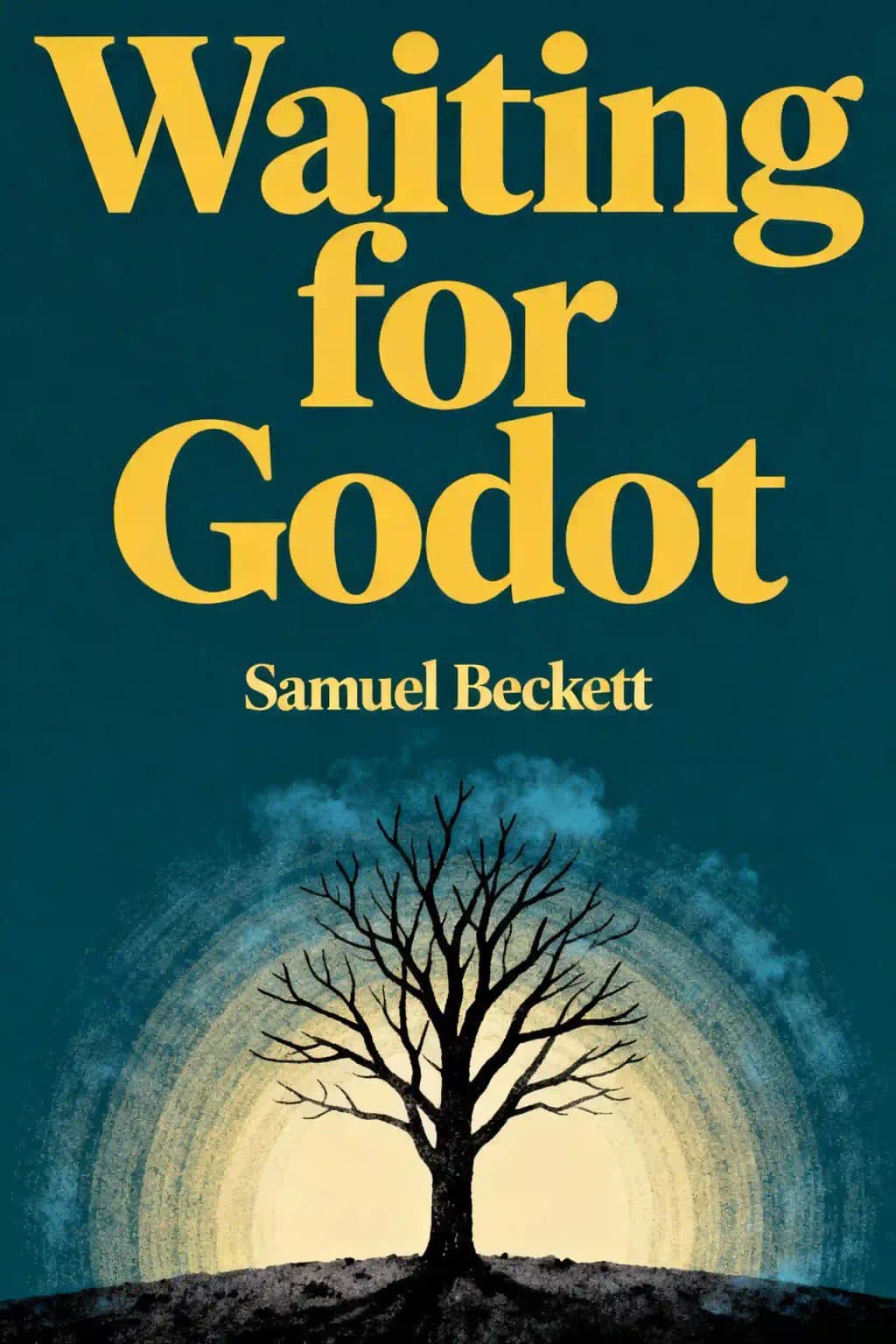
Samuel Beckett's "Waiting for Godot" has been hailed as "the most significant English language play of the 20th century." First performed in 1953, this absurdist tragicomedy has perplexed, fascinated, and moved audiences worldwide for decades. Steve Jobs cited it as one of his favorite works, claiming its exploration of meaning in seeming meaninglessness profoundly influenced his design philosophy. The play's cultural impact is immeasurable-its very title has entered our lexicon as shorthand for futile waiting, and its sparse setting (just a tree and a country road) revolutionized theatrical minimalism. Despite its seemingly simple premise of two tramps waiting for someone who never arrives, this work continues to resonate deeply across generations, speaking to our universal search for purpose in an indifferent universe. What makes this particular waiting room so enduring in our collective imagination?
2장
The Perpetual Waiting Game: Existence as Anticipation
Vladimir and Estragon-affectionately nicknamed Didi and Gogo-exist in a liminal space where waiting has become their primary occupation. Their lives revolve around a single purpose: meeting someone named Godot. This waiting isn't merely a temporary state but has become their permanent condition, their very reason for being. "Nothing to be done," Estragon declares in the opening line, struggling with his boot-a phrase that echoes throughout the play as a refrain of resignation, becoming almost a philosophical mantra that underscores their existential predicament.
The waiting itself takes on metaphysical dimensions, transforming from a simple act into a state of being that defines their existence. Days blend together indistinguishably, with only subtle changes (like the sudden appearance of leaves on the previously barren tree) marking the passage of time. The characters themselves seem unsure how long they've been waiting-perhaps fifty years, as they later suggest. Their confusion about time extends to their memories of yesterday, which remain hazy and contradictory, suggesting that even their past is as uncertain as their future. The tree serves as the only constant landmark in their world, yet even it changes mysteriously between acts, further blurring the lines between reality and illusion.
What makes this waiting particularly poignant is its purposelessness and the characters' complex relationship with their task. When questioned about who Godot is or why they must meet him, the tramps offer contradictory or vague responses, sometimes claiming he's a acquaintance, other times suggesting he's a potential savior or employer. They can't remember when or where the appointment was made, what was promised, or even if they're waiting in the right place. Yet they cling to this task with desperate determination, as though their very existence depends on it. "What are we doing here, that is the question," Vladimir muses, immediately answering his own query: "We are waiting for Godot to come." This circular logic becomes both their prison and their comfort.
This endless anticipation creates a paradoxical existence: the tramps are simultaneously trapped by their commitment to wait and sustained by it. Without the promise of Godot's arrival, they would have no purpose at all, no reason to continue their daily routine of meeting at the same spot. Their waiting becomes a microcosm of the human condition-we all live in anticipation of something, whether it's success, love, understanding, or salvation. The tragedy and comedy of their situation emerge from this tension between the absurdity of their endless wait and the dignity of their persistence. Their various attempts to "pass the time"-through conversation, games, and even contemplating suicide-highlight both the futility of their situation and their remarkable resilience in facing it.
The ritual of waiting becomes a form of secular faith, complete with its own customs and uncertainties. Like religious devotees, Vladimir and Estragon maintain their vigil despite having no proof that their wait will ever end or that Godot even exists. Their faith in his eventual arrival, however wavering, provides the only structure in their otherwise chaotic world.
3장
The Symbiotic Relationship: Dependency and Identity
Vladimir and Estragon's relationship forms the emotional core of the play, revealing a complex interdependence that is both sustaining and constraining. Their bond is characterized by constant bickering, reconciliation, and mutual need. "Don't touch me! Don't question me! Don't speak to me! Stay with me!" Estragon cries at one point, encapsulating the contradictory nature of their connection.
The two tramps complete each other in fundamental ways. Vladimir is more intellectual, philosophical, and concerned with memory and meaning. He remembers their appointment with Godot and insists on waiting. Estragon is more physical, immediate, and forgetful, constantly plagued by his boots, hunger, and the beatings he receives nightly from mysterious assailants. Vladimir remembers the past that Estragon forgets; Estragon feels the physical pain that Vladimir intellectualizes.
Their dialogues often follow a pattern of repetition and miscommunication, yet beneath this surface dysfunction lies a profound intimacy. They have developed rituals of interaction-sharing a carrot, exchanging hats, attempting to hang themselves together-that provide structure to their otherwise formless existence. "We always find something, eh Didi, to give us the impression we exist?" Estragon observes, highlighting how their interactions affirm their reality.
The question of separation haunts them throughout the play. "I sometimes wonder if we wouldn't have been better off alone, each one for himself," Estragon suggests, only to immediately dismiss the idea: "It's not worth while now." Their fifty-year companionship has made them inseparable, despite their differences. When Vladimir rescues Estragon from drowning in the Rhone, it symbolizes their fundamental connection-they save each other from the void of solitary existence.
Their relationship mirrors many human partnerships-marriages, friendships, business partnerships-where individuals become so intertwined that separation seems impossible, even when the relationship itself becomes strained. The play asks us to consider: Do we stay together out of habit, fear of loneliness, or genuine need? Is dependency a form of love or a prison? Vladimir and Estragon suggest it might be both simultaneously.
4장
Power Dynamics: The Master-Slave Dialectic
The arrival of Pozzo and Lucky in both acts introduces a stark contrast to Vladimir and Estragon's relatively egalitarian relationship. Pozzo, a wealthy landowner, leads Lucky, his servant, by a rope around his neck. This explicit master-slave dynamic provides a disturbing counterpoint to the main characters' more subtle interdependence.
Pozzo treats Lucky as property, commanding him to dance, think, and carry his belongings. He announces proudly, "I am Pozzo! Pozzo! Does that name mean nothing to you?" His identity is entirely wrapped up in his dominance over others and his social position. Lucky, meanwhile, remains silent except when commanded to "think"-at which point he delivers a rambling, fragmented monologue that suggests considerable intelligence trapped within his servile condition.
What makes this relationship particularly unsettling is its apparent voluntary nature. When asked why Lucky doesn't put down his heavy bags, Pozzo explains: "He wants to impress me, so I'll keep him." The implication is chilling-Lucky chooses his servitude out of fear of abandonment. This dynamic shifts dramatically in the second act when Pozzo returns blind and dependent on Lucky to guide him. The rope still connects them, but the power has subtly redistributed.
This relationship serves as a microcosm of social hierarchies and power structures. It raises uncomfortable questions about how power operates in society: Do the oppressed participate in their own subjugation? Can the powerful ever escape their dependency on those they dominate? The play offers no easy answers but suggests that all power relationships contain hidden complexities and reversals.
The tramps' reaction to this pair is equally revealing. They initially fear Pozzo, believing he might be Godot, then become fascinated by the spectacle of his dominance. They briefly consider intervening when Lucky is mistreated but ultimately do nothing substantial. Their passive observation of suffering mirrors our own tendency to witness injustice without taking action, raising questions about our collective moral responsibility.
5장
Time's Cruel Elasticity: Memory and Forgetting
Time in "Waiting for Godot" functions unlike conventional dramatic time-it stretches, contracts, repeats, and occasionally seems to stop entirely. The characters themselves struggle to track its passage. "That passed the time," Estragon remarks after an exchange, to which Vladimir responds, "It would have passed in any case." This casual observation reveals a profound truth: time continues regardless of human activity, yet our perception of it depends entirely on how we fill it.
Memory becomes unreliable in this temporal wilderness. Estragon consistently forgets what happened the previous day, even forgetting having met Pozzo and Lucky despite their memorable encounter. "I'm not a historian," he declares when Vladimir presses him to remember. Vladimir, by contrast, clings desperately to memory as proof of existence: "But we were here together, I could swear to it! Picking grapes for a man called... I forget his name."
This memory gap creates an existential crisis. Without reliable memory, personal identity becomes fragmented. Are we the same person from moment to moment if we can't remember our past? Vladimir confronts this directly when he desperately asks the Boy messenger: "You're sure you saw me, you won't come and tell me tomorrow that you never saw me!"
The play's structure reinforces this temporal disorientation. The second act largely mirrors the first, with key differences that create an uncanny sense of deja vu. The tree sprouts leaves, Pozzo becomes blind, Lucky becomes mute, but the fundamental situation remains unchanged. This repetition with variation suggests both the cyclical nature of existence and the subtle deterioration that occurs with each cycle.
Perhaps most disturbing is how quickly significant events are forgotten or normalized. Vladimir briefly contemplates the meaning of Lucky's "think" speech before dismissing it. Pozzo's blindness is accepted with minimal questioning. The Boy's message that Godot will "surely come tomorrow" is received with the same mixture of hope and skepticism each time. This casual acceptance of the extraordinary reflects our own remarkable ability to adapt to almost any circumstance, for better or worse.
6장
Language as Both Bridge and Barrier
"Waiting for Godot" is fundamentally a play about communication-its possibilities, limitations, and absurdities. The characters talk incessantly, yet genuine understanding remains elusive. Their conversations circle endlessly, filled with misunderstandings, non sequiturs, and repetitions that simultaneously connect and separate them.
Vladimir and Estragon's exchanges often follow a pattern: one makes a statement, the other misinterprets or diverts, they briefly argue, then reconcile before starting again. Consider this typical exchange:
VLADIMIR: We're waiting for Godot.
ESTRAGON: Ah! (Pause.) You're sure it was here?
VLADIMIR: What?
ESTRAGON: That we were to wait.
VLADIMIR: He said by the tree. (They look at the tree.) Do you see any others?
This seemingly simple conversation reveals profound communication challenges. Vladimir assumes shared knowledge that Estragon doesn't possess. Estragon questions basic premises Vladimir takes for granted. Their words connect them while simultaneously highlighting the gaps in their understanding.
Language in the play frequently breaks down entirely. Lucky's famous "think" speech-a torrent of fragmented philosophical and scientific jargon-represents language at its most excessive yet meaningless. Beginning coherently with "Given the existence as uttered forth in the public works of Puncher and Wattmann," it gradually deteriorates into repetitive nonsense that the other characters physically restrain him from continuing.
Silence, too, becomes a powerful communicative force. The stage directions repeatedly indicate pauses, silences, and moments when characters are "at a loss." These gaps in speech often convey more than words could-the terror of meaninglessness, the comfort of companionship, or the weight of waiting. The final moments of both acts, when the tramps agree to leave but remain motionless, create a profound silence that speaks volumes about their condition.
The play's linguistic games-wordplay, repetition, misunderstanding-aren't merely comic devices but philosophical explorations of how language shapes reality. When Vladimir and Estragon debate whether the tree is a willow or something else, they're not simply arguing about botany but about how naming things determines our perception of them. Their frequent question "What do we do now?" reveals language's inability to bridge the gap between thought and action.
7장
The Absent Center: Godot and the Quest for Meaning
The most significant character in "Waiting for Godot" never appears on stage. Godot-whose identity, nature, and purpose remain mysterious-functions as the absent center around which the entire play revolves. This deliberate void at the heart of the drama creates space for multiple interpretations while maintaining the essential tension of unfulfilled expectation. Like a black hole in space, Godot's absence exerts a powerful gravitational pull on everything around it, shaping the behavior, dialogue, and very existence of the other characters.
Who or what is Godot? The characters themselves seem uncertain, their confusion mirroring our own. When Estragon asks directly, "Personally, I wouldn't even know him if I saw him," Vladimir can only respond with vague descriptions of an arrangement involving "a kind of prayer... a vague supplication." The Boy messenger describes him as an old man with a white beard who "does nothing," prompting Vladimir's anguished cry, "Christ have mercy on us!" These fragmentary descriptions serve only to deepen the mystery, creating a figure that is simultaneously specific and universal.
This calculated ambiguity has led to countless interpretations of Godot as representing God, death, meaning, salvation, or any form of external validation humans seek. Literary critics have variously interpreted him as a symbol of divine grace, political liberation, artistic fulfillment, or psychological wholeness. Beckett himself famously refused to provide a definitive answer, reportedly saying, "If I knew who Godot was, I would have said so in the play." This refusal to explain becomes part of the play's meaning, suggesting that the search for absolute certainty may be futile.
What's more significant than Godot's identity is the function he serves in the tramps' lives. He provides purpose, however tenuous, to their existence. "We're waiting for Godot," becomes their mantra, their reason for enduring, repeated like a prayer or incantation throughout the play. When Estragon suggests abandoning their wait ("And if we dropped him?"), Vladimir's response is telling: "He'd punish us." Their commitment stems not just from hope but from fear-fear of meaninglessness, of divine retribution, of losing the organizing principle of their lives. This dynamic mirrors many human relationships with authority figures, belief systems, and life goals.
The Boy's repeated message that Godot "won't come this evening but surely tomorrow" creates a perpetual deferral of fulfillment. This endless postponement mirrors many human experiences: religious salvation promised in an afterlife, political utopias always on the horizon, personal fulfillment always one achievement away. The genius of the play lies in how it captures this universal experience of anticipation without specifying what exactly is being anticipated. The waiting itself becomes both the means and the end, a condition of existence rather than a temporary state.
This structure of eternal waiting reflects modern existential anxiety, where traditional sources of meaning have become uncertain but the human need for purpose persists. The characters' desperate attempts to fill time with games, conversations, and routines echo our own strategies for coping with existence's fundamental uncertainty. Their persistence in waiting, despite all evidence that Godot will never arrive, becomes both tragic and heroic, embodying humanity's stubborn insistence on finding meaning in an apparently meaningless universe.
8장
Existential Comedy: Humor in the Face of Meaninglessness
Despite its bleak philosophical underpinnings, "Waiting for Godot" is frequently and genuinely funny. Its humor emerges not despite its existential themes but because of them-finding comedy in the very absurdity of human existence. The play's subtitle, "A Tragicomedy in Two Acts," acknowledges this essential duality.
The comedy takes various forms, from physical slapstick (Estragon's struggles with his boot, Vladimir's bladder problems) to verbal wordplay and the vaudevillian routines the tramps perform to "pass the time." When Vladimir suggests they hang themselves from the tree and Estragon responds enthusiastically, "Let's hang ourselves immediately!" there's a darkly comic juxtaposition between the serious subject and the childlike enthusiasm.
This humor serves multiple functions. First, it creates breathing room within the philosophical density of the play, making its existential questions more accessible. Second, it reflects how humans actually cope with meaninglessness-through jokes, games, and distractions. Finally, it suggests that laughter itself might be a meaningful response to an absurd universe.
The characters are acutely aware of their comic nature. "Nothing is funnier than unhappiness," Nell observes in Beckett's later play "Endgame," and this principle operates throughout "Godot." Vladimir and Estragon frequently comment on their own ridiculousness: "We always find something, eh Didi, to give us the impression we exist?" Their self-awareness creates both comedy and pathos-they know they're playing roles but can't stop playing them.
The hat-swapping routine, where the characters pass hats in increasingly elaborate patterns, exemplifies how the play finds meaning in meaningless activity. The routine serves no purpose beyond itself, yet in its precision and absurdity, it creates a moment of pure theatrical joy. Similarly, when Vladimir and Estragon debate whether to help the fallen Pozzo, their circular reasoning ("Let's go." "We can't." "Why not?" "We're waiting for Godot.") becomes a comic routine that reveals the fundamental paradox of their situation.
This fusion of comedy and despair reflects Beckett's unique philosophical perspective. Rather than presenting meaninglessness as cause for despair alone, he suggests that the recognition of life's absurdity can be liberating and even amusing. The characters' ability to laugh at their predicament represents a kind of heroism-a refusal to surrender to despair even when hope seems unfounded.
9장
The Persistence of Hope in a Godless Universe
For all its bleakness, "Waiting for Godot" contains a stubborn, irrational hope that persists against overwhelming evidence. The tramps continue waiting despite repeated disappointments. They contemplate suicide but never complete the act. They consider parting ways but remain together. This persistence in the face of futility creates the play's most profound emotional resonance.
The tree that stands at center stage throughout the play becomes a powerful symbol of this paradoxical hope. Barren in Act I, it mysteriously sprouts leaves in Act II. This unexplained regeneration suggests the possibility of renewal even in the most desolate landscape. Vladimir notices this change immediately: "It must be spring," he observes, finding evidence of natural cycles continuing despite the characters' static situation.
The Boy messenger, too, represents a tenuous connection to possibility. Though his message is always the same-Godot won't come today but surely tomorrow-his very appearance confirms that the tramps haven't been forgotten entirely. Their wait has been acknowledged by someone, even if fulfillment remains perpetually deferred.
Most poignantly, the play's famous final lines in both acts-"Well, shall we go?" "Yes, let's go." (They do not move.)-capture the essential tension between aspiration and inertia. The characters articulate a desire for change while remaining physically unable to enact it. Yet the very articulation of this desire represents a form of hope, however minimal.
Vladimir's statement near the play's end-"We'll hang ourselves tomorrow. (Pause.) Unless Godot comes." "And if he comes?" "We'll be saved."-reveals that beneath their cynicism and despair, the tramps maintain a fundamental belief in the possibility of salvation. The nature of this salvation remains undefined, but the conviction that it might arrive tomorrow keeps them going today.
This stubborn hope mirrors what philosopher Albert Camus called "the absurd hero"-one who recognizes life's fundamental meaninglessness yet continues to engage with it fully. Vladimir and Estragon may be trapped in an endless cycle, but their continued engagement with each other, with Pozzo and Lucky, and with the promise of Godot suggests that meaning might be found not in final fulfillment but in the very act of persistent waiting.
10장
The Universal in the Particular: Why Godot Endures
"Waiting for Godot" achieves universality precisely through its specificity. By focusing on two particular tramps on a country road waiting for someone who never arrives, Beckett created a work that speaks to the human condition across cultures and generations. The play's minimal setting, sparse language, and archetypal characters allow it to function as a kind of theatrical Rorschach test, reflecting whatever existential concerns viewers bring to it.
The play has been successfully performed in vastly different contexts-from a famous 1957 production at San Quentin prison, where inmates reportedly connected deeply with its portrayal of meaningless waiting, to a celebrated 1993 production in war-torn Sarajevo aptly titled "Waiting for Godot while waiting for Godot." Each audience finds in it a reflection of their specific circumstances while recognizing the universal experience of waiting for something that may never come.
What makes the play particularly resonant in our contemporary world is how it anticipates many features of modern existence. Its characters, trapped in cycles of distraction and deferral, mirror our own screen-mediated lives where we constantly wait for notifications, updates, and connections. The tramps' struggle to remember yesterday speaks to our information-saturated present where significant events are quickly forgotten. Their attempts to "pass the time" reflect our own increasingly sophisticated methods of distraction.
Yet beyond these contemporary parallels, the play touches something timeless in human experience-the tension between our desire for meaning and the universe's apparent indifference. Vladimir's plaintive question, "Was I sleeping, while the others suffered?" captures the moral uncertainty many feel in the face of global suffering. Estragon's simple declaration, "I can't go on like this," followed by the inevitable continuation, speaks to the resilience and fragility of human endurance.
Perhaps most powerfully, the play affirms the value of human connection in a meaningless universe. Vladimir and Estragon may be trapped in futile waiting, but they wait together. Their companionship, however fraught with misunderstanding and occasional cruelty, provides what meaning exists in their world. "We always find something, eh Didi, to give us the impression we exist?" This simple observation contains the play's most profound truth-that in our connections with others, however imperfect, we find confirmation of our own existence.
In a world increasingly characterized by uncertainty, deferral, and mediated experience, "Waiting for Godot" continues to speak with remarkable clarity. Its genius lies not in providing answers but in articulating questions we all face: How do we create meaning in an apparently meaningless universe? How do we endure when fulfillment seems perpetually deferred? And most essentially, how do we wait with dignity for whatever may or may not come?