Discover why our evolutionary leap from trees to savannah explains modern happiness, leadership, and social dynamics. Von Hippel's witty exploration reveals a surprising truth: our ancient adaptations still drive behavior today - from cooperation to competition - offering a fresh lens on what truly makes us human.
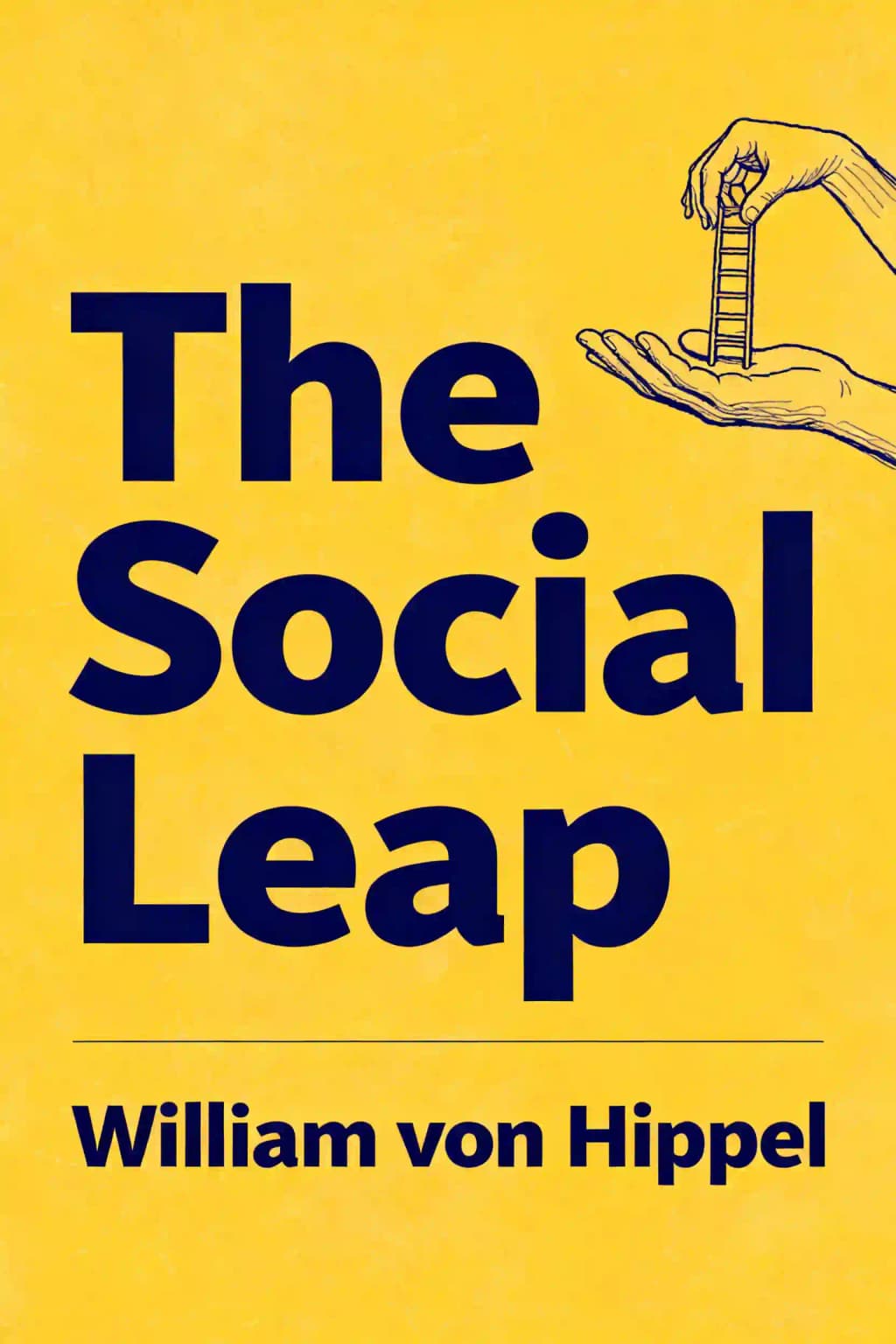
William von Hippel is the author of The Social Leap: The New Evolutionary Science of Who We Are, Where We Come From, and What Makes Us Happy, and is an award-winning evolutionary psychologist and professor renowned for his research on human social behavior.
Born in Iowa City and raised in Alaska, von Hippel earned his PhD from the University of Michigan and taught at Ohio State University before becoming a professor at the University of Queensland.
His work explores themes of human evolution, social connectivity, and happiness, informed by over 150 peer-reviewed publications and decades of academic leadership. A frequent media contributor, his insights have been featured in The New York Times, The Economist, and the BBC.
Von Hippel’s follow-up book, The Social Paradox: Autonomy, Connection, and Why We Need Both to Find Happiness, expands on these themes. The Social Leap received the Society for Personality and Social Psychology’s 2019 Book Prize and has been translated into multiple languages, solidifying its status as a seminal work in evolutionary psychology.
The Social Leap explores how evolutionary pressures shaped human behavior, social structures, and happiness. It traces key transitions—like our ancestors’ move from forests to savannahs—to explain traits such as cooperation, creativity, and cognitive biases. William von Hippel combines anthropology, psychology, and biology to show how ancient adaptations influence modern relationships, work, and societal norms.
This book suits readers interested in evolutionary psychology, human behavior, or the origins of social dynamics. It’s ideal for fans of Sapiens seeking a psychology-focused perspective, professionals studying teamwork/leadership, and anyone curious about why humans exaggerate, gossip, or form biases. Casual readers will appreciate its accessible, story-driven science.
Yes—it’s praised for blending rigorous research with engaging storytelling. Von Hippel avoids dense academic jargon, making complex concepts like sexual selection and tribal psychology relatable. Critics highlight its fresh take on happiness, arguing that understanding our evolutionary past helps navigate modern social challenges.
The book attributes collaboration to survival pressures on the savannah, where early humans relied on group problem-solving. Von Hippel argues that sharing resources and knowledge became embedded in our psychology, fostering trust and innovation. This evolutionary legacy still drives teamwork in workplaces and communities today.
Key ideas include:
Von Hippel links happiness to evolutionary mismatches—modern comforts (like social media) clash with ancestral needs for close-knit communities. He suggests prioritizing meaningful relationships and embracing challenges, as our brains reward behaviors that once ensured survival.
Both books explore human evolution, but The Social Leap focuses on psychological adaptations rather than broad historical narratives. Von Hippel emphasizes individual behaviors (e.g., jealousy, altruism), while Harari examines cultural and technological shifts. Fans of one often enjoy the other for complementary insights.
Yes—Von Hippel’s research on collaboration and social intelligence offers insights for team dynamics and decision-making. For example, fostering trust aligns with our evolutionary preference for reliable allies, while understanding cognitive biases can improve negotiation strategies.
It contrasts small, egalitarian hunter-gatherer groups with today’s hierarchical societies. Von Hippel argues that urbanization and technology have amplified loneliness and competition, yet our brains remain wired for intimate, cooperative communities.
Some reviewers note its pop-science approach may oversimplify complex evolutionary theories. While accessible, academics might seek deeper dives into specific studies or counterarguments about human adaptability. Nonetheless, it’s widely regarded as a compelling introduction.
As a psychology professor and evolutionary researcher, von Hippel draws on 30+ years of studies in social cognition and primatology. His work in Australia and collaborations with global experts lend credibility to the book’s interdisciplinary claims.
저자의 목소리로 책을 느껴보세요
지식을 흥미롭고 예시가 풍부한 인사이트로 전환
핵심 아이디어를 빠르게 캡처하여 신속하게 학습
재미있고 매력적인 방식으로 책을 즐기세요
Being forced out of a group on the dangerous grasslands meant almost certain death.
Cooking released more nutrients and calories from food.
Even the strongest couldn't survive without social savvy.
The social world is dynamically interactive.
Farming demanded fundamental psychological shifts.
The Social Leap의 핵심 아이디어를 이해하기 쉬운 포인트로 분해하여 혁신적인 팀이 어떻게 창조하고, 협력하고, 성장하는지 이해합니다.
The Social Leap을 빠른 기억 단서로 압축하여 솔직함, 팀워크, 창의적 회복력의 핵심 원칙을 강조합니다.

생생한 스토리텔링을 통해 The Social Leap을 경험하고, 혁신 교훈을 기억에 남고 적용할 수 있는 순간으로 바꿉니다.
무엇이든 물어보고, 목소리를 선택하고, 진정으로 공감되는 인사이트를 함께 만들어보세요.

샌프란시스코에서 컬럼비아 대학교 동문들이 만들었습니다
"Instead of endless scrolling, I just hit play on BeFreed. It saves me so much time."
"I never knew where to start with nonfiction—BeFreed’s book lists turned into podcasts gave me a clear path."
"Perfect balance between learning and entertainment. Finished ‘Thinking, Fast and Slow’ on my commute this week."
"Crazy how much I learned while walking the dog. BeFreed = small habits → big gains."
"Reading used to feel like a chore. Now it’s just part of my lifestyle."
"Feels effortless compared to reading. I’ve finished 6 books this month already."
"BeFreed turned my guilty doomscrolling into something that feels productive and inspiring."
"BeFreed turned my commute into learning time. 20-min podcasts are perfect for finishing books I never had time for."
"BeFreed replaced my podcast queue. Imagine Spotify for books — that’s it. 🙌"
"It is great for me to learn something from the book without reading it."
"The themed book list podcasts help me connect ideas across authors—like a guided audio journey."
"Makes me feel smarter every time before going to work"
샌프란시스코에서 컬럼비아 대학교 동문들이 만들었습니다

The Social Leap 요약을 무료 PDF 또는 EPUB으로 받으세요. 인쇄하거나 오프라인에서 언제든 읽을 수 있습니다.
Ever felt that inexplicable dread walking alone through darkness? That primal fear isn't your imagination - it's your evolutionary heritage speaking. When our ancestors were forced from the protective rainforest onto the dangerous East African savannah, they faced a life-or-death challenge that would forever alter human destiny. Unlike baboons who developed massive jaws for defense, our ancestors were relatively weak and vulnerable. Their ingenious solution? Cooperation on an unprecedented scale. The fossil record tells a fascinating story. Lucy and other early hominids from 3-4 million years ago show anatomical features perfectly designed for throwing - mobile wrists, flexible upper arms, and horizontal shoulders. These adaptations enabled collective defense through stone-throwing, a strategy so effective that even small groups could drive off large predators. This created powerful evolutionary pressure that fundamentally transformed human psychology. Those who enjoyed working together and could be trusted by others gained an enormous survival advantage. This necessity for cooperation selected for individuals who felt pleasure from collaboration and distress from exclusion. Being forced out of a group on the dangerous grasslands meant almost certain death, making social rejection a powerful evolutionary force that still affects us today. Had our ancestors developed different solutions - better hiding or running abilities - humans as we know them would never have evolved. Three million years after leaving the forest, our ancestors still resembled chimps more than humans, though they walked upright and likely used simple stone tools. The real game-changer came when Homo erectus made the most important innovation in human history: controlling fire. This breakthrough transformed existence by providing protection from predators while revolutionizing food preparation. Cooking released more nutrients and calories from food, allowing evolution of larger brains and faster metabolism. It also freed us from the eight hours of daily chewing required by raw food - time that could be devoted to language and social interaction.