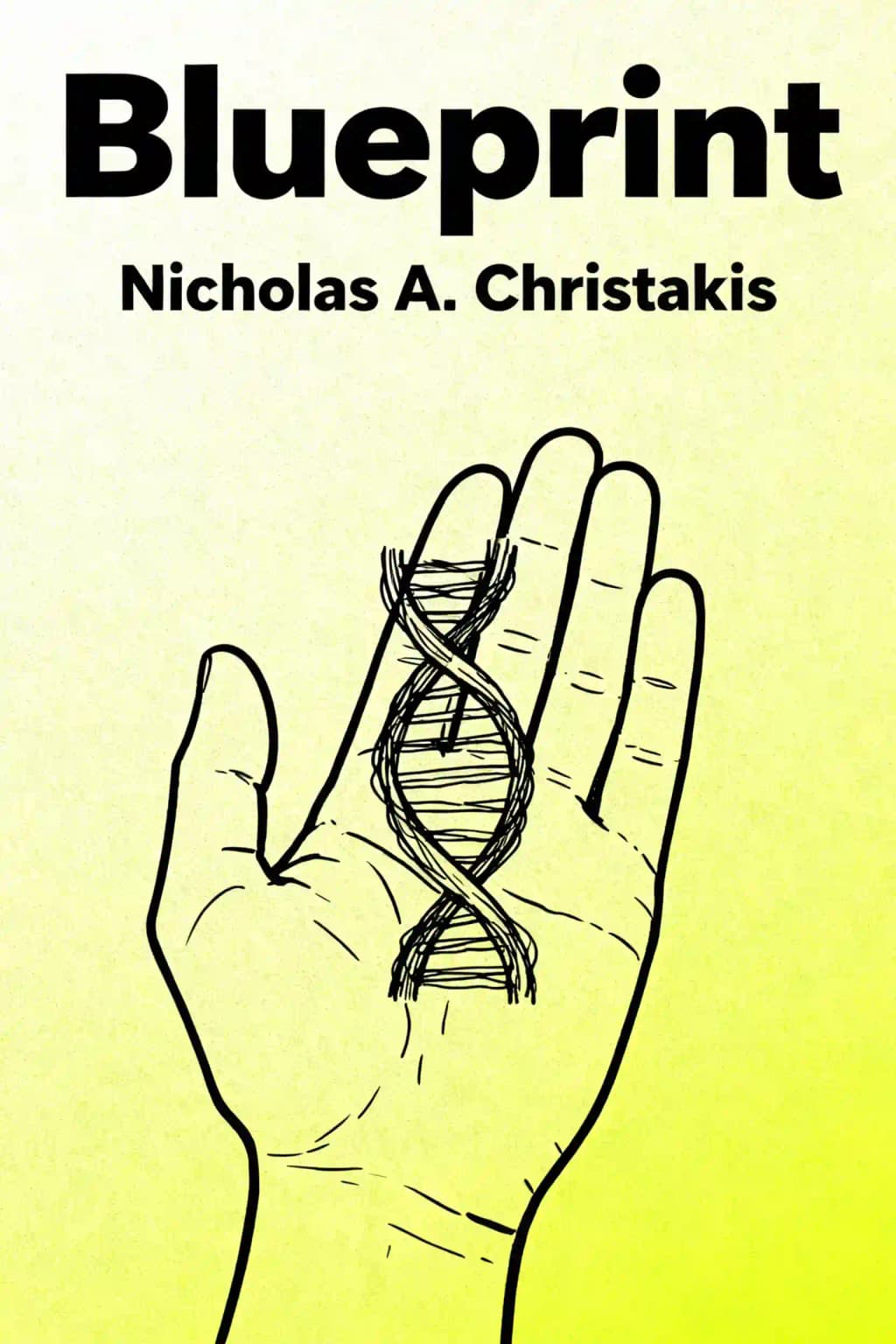
In "Blueprint," Yale's Nicholas Christakis reveals how evolution wired us for goodness, not just survival. Praised by Humans of New York's Brandon Stanton as "essential for unstable times," this interdisciplinary masterpiece challenges our cynicism - are kindness and cooperation actually biological necessities?
Nicholas A. Christakis, author of Blueprint: The Evolutionary Origins of a Good Society, is a Sterling Professor of Social and Natural Science at Yale University and a leading authority on social networks and evolutionary sociology.
A physician and sociologist by training, Christakis draws on his multidisciplinary background to explore how innate human traits shape societies—a theme central to Blueprint, which argues for an evolutionary “social suite” of cooperation and altruism.
His research at Yale’s Human Nature Lab and prior bestselling book Connected: The Surprising Power of Our Social Networks (translated into 20 languages) established his reputation for blending rigorous science with accessible insights.
Named to Time magazine’s 100 Most Influential People list in 2009, Christakis frequently contributes to major media and academic discourse on societal structures. His subsequent book, Apollo’s Arrow, analyzed pandemic-era social dynamics and became a New York Times bestseller.
Blueprint has been translated into over ten languages and underscores Christakis’s enduring focus on humanity’s capacity for collective flourishing.
Blueprint explores how human evolution shaped our innate capacity to build cooperative societies, emphasizing genetic predispositions for traits like friendship, love, and cooperation. Nicholas A. Christakis argues that a "social suite" of eight behaviors forms the foundation of all human communities, using examples from shipwrecks, animal societies, and cross-cultural studies to show our biological drive toward collective goodness.
This book is ideal for readers interested in evolutionary biology, sociology, or anthropology, as well as those seeking a science-backed perspective on human interconnectedness. It appeals to advocates of societal progress who want data-driven insights into why kindness and cooperation persist despite human flaws.
Yes—Christakis combines rigorous research from genetics, network science, and history to challenge pessimistic views of human nature. Its compelling case for an evolutionary "blueprint" for goodness offers a refreshing counterpoint to narratives focused solely on humanity’s destructive tendencies.
The core idea is the social suite: eight universal traits encoded in human genetics, including partnership, friendship, cooperation, and social learning. Christakis shows how these traits emerge spontaneously in diverse groups, from stranded sailors to online communities, proving their biological basis.
The book argues that genes influence not just individual behaviors but societal structures. For example, evolved capacities for empathy and reciprocity enable humans to self-organize into functional communities, even in extreme conditions like post-shipwreck survival scenarios.
Christakis analyzes historical shipwrecks where survivors formed egalitarian societies, utopian communes, and animal groups (e.g., dolphins). He also examines online networks and AI-driven experiments to demonstrate the universality of the social suite.
The book highlights parallels between human social structures and those of elephants, dolphins, and primates, showing shared traits like cooperation and grieving. However, humans uniquely combine these traits with cumulative culture, enabling large-scale collaboration.
Some scholars argue Christakis understates cultural variability and historical oppression’s role in shaping societies. Critics suggest the "social suite" may reflect Western ideals rather than universal truths, though the author counters with cross-cultural evidence.
In an era of polarization, the book provides a scientific basis for optimism about humanity’s capacity for unity. Its insights help reframe debates about social media, governance, and conflict resolution through an evolutionary lens.
As a physician and sociologist, Christakis integrates disciplines like network science and genetics—a approach reflected in the book’s interdisciplinary depth. His research on how social networks shape behavior grounds the thesis in empirical data.
Unlike Sapiens (focused on cultural history) or The Selfish Gene (emphasizing competition), Blueprint uniquely argues that natural selection favors cooperation. It bridges evolutionary biology and social sciences, offering a cohesive theory of human sociability.
저자의 목소리로 책을 느껴보세요
지식을 흥미롭고 예시가 풍부한 인사이트로 전환
핵심 아이디어를 빠르게 캡처하여 신속하게 학습
재미있고 매력적인 방식으로 책을 즐기세요
Humans are fundamentally social creatures.
Our genes guide us to create social environments.
Friendship, cooperation, and equitable resource distribution are essential.
Groups that successfully manifested the social suite fared significantly better.
Our evolutionary blueprint constrains and guides our social organization.
Blueprint의 핵심 아이디어를 이해하기 쉬운 포인트로 분해하여 혁신적인 팀이 어떻게 창조하고, 협력하고, 성장하는지 이해합니다.
Blueprint을 빠른 기억 단서로 압축하여 솔직함, 팀워크, 창의적 회복력의 핵심 원칙을 강조합니다.

생생한 스토리텔링을 통해 Blueprint을 경험하고, 혁신 교훈을 기억에 남고 적용할 수 있는 순간으로 바꿉니다.
무엇이든 물어보고, 목소리를 선택하고, 진정으로 공감되는 인사이트를 함께 만들어보세요.

샌프란시스코에서 컬럼비아 대학교 동문들이 만들었습니다
"Instead of endless scrolling, I just hit play on BeFreed. It saves me so much time."
"I never knew where to start with nonfiction—BeFreed’s book lists turned into podcasts gave me a clear path."
"Perfect balance between learning and entertainment. Finished ‘Thinking, Fast and Slow’ on my commute this week."
"Crazy how much I learned while walking the dog. BeFreed = small habits → big gains."
"Reading used to feel like a chore. Now it’s just part of my lifestyle."
"Feels effortless compared to reading. I’ve finished 6 books this month already."
"BeFreed turned my guilty doomscrolling into something that feels productive and inspiring."
"BeFreed turned my commute into learning time. 20-min podcasts are perfect for finishing books I never had time for."
"BeFreed replaced my podcast queue. Imagine Spotify for books — that’s it. 🙌"
"It is great for me to learn something from the book without reading it."
"The themed book list podcasts help me connect ideas across authors—like a guided audio journey."
"Makes me feel smarter every time before going to work"
샌프란시스코에서 컬럼비아 대학교 동문들이 만들었습니다

Blueprint 요약을 무료 PDF 또는 EPUB으로 받으세요. 인쇄하거나 오프라인에서 언제든 읽을 수 있습니다.
Why do societies separated by oceans and millennia organize themselves in strikingly similar ways? From Manhattan to the Mongolian steppes, humans form friendships, fall in love, cooperate with strangers, and create hierarchies. This isn't coincidence or cultural contamination-it's biology. We carry within our DNA an evolutionary blueprint for building good societies, a set of social instructions refined over millions of years. This "social suite" includes eight universal features: recognizing individuals, loving partners and children, forming friendships, creating structured networks, cooperating beyond kinship, preferring our own groups, establishing mild hierarchies, and teaching one another. These aren't cultural inventions we can discard like outdated fashion. They're biological adaptations as fundamental to our species as our opposable thumbs. While cultures vary dramatically in language, cuisine, and custom, these variations play out against a backdrop of profound social similarity-a unity far deeper than our differences.