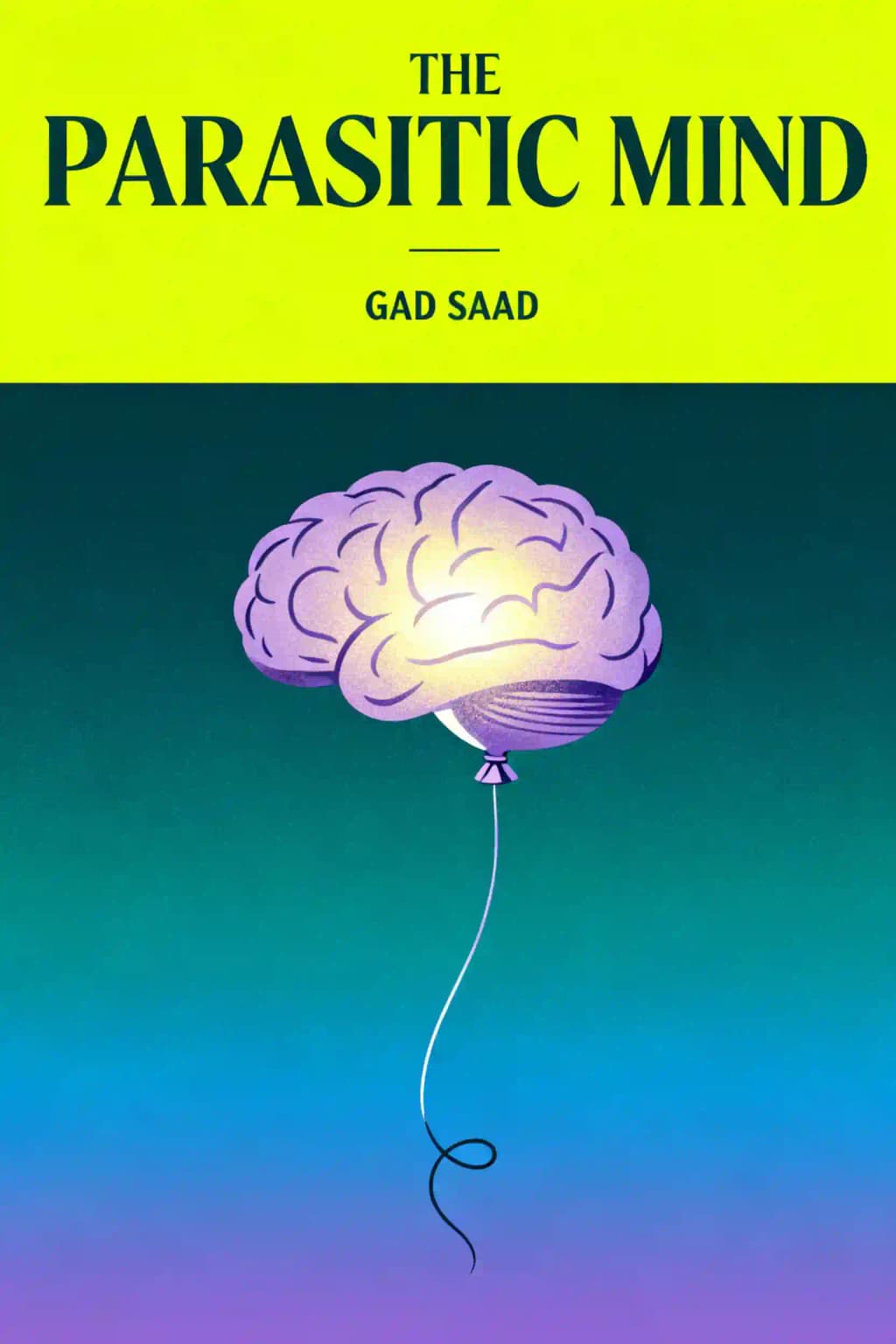
Gad Saad's international bestseller exposes how "idea pathogens" are destroying rational thought in society. With razor-sharp wit and scientific precision, he offers an intellectual vaccine against the mind viruses infecting universities and culture. Jordan Peterson calls it "essential reading for the resistance."
Gad Saad, best-selling author of The Parasitic Mind, is a professor of marketing at Concordia University and a trailblazing expert in evolutionary psychology and consumer behavior.
Born in Beirut and shaped by his survival of the Lebanese Civil War, Saad’s work critiques ideological threats to free speech, scientific inquiry, and meritocracy—themes central to his 2020 polemic on societal "mind parasites."
A prolific thinker, he authored The Consuming Instinct and The Evolutionary Bases of Consumption, bridging Darwinian principles to modern consumerism. His blog for Psychology Today and YouTube channel, THE SAAD TRUTH, boast millions of views, while his media footprint spans The New York Times, The Economist, and high-profile podcasts like The Joe Rogan Experience.
A Concordia Research Chair holder and visiting professor at Northwood University, Saad blends academic rigor with fearless cultural commentary. The Parasitic Mind became an international bestseller, resonating globally for its defense of intellectual freedom against tribalism and ideological conformity.
The Parasitic Mind argues that modern society is infected by dangerous ideologies ("idea pathogens") like social justice extremism and postmodernism, which hijack rational thought. Gad Saad uses evolutionary psychology and biological analogies to explain how these ideologies spread like mental parasites, eroding free speech, scientific rigor, and common sense. The book critiques cancel culture, academic groupthink, and reality-denying movements like gender ideology.
This book is ideal for readers concerned about censorship, culture wars, or the rise of irrational ideologies. It resonates with critical thinkers, free-speech advocates, and those seeking tools to combat "woke" dogma. Academics, journalists, and policymakers will find its analysis of institutional conformity particularly relevant.
Yes—Saad’s blend of humor, scientific rigor, and fearless critique makes it a standout. It offers actionable frameworks like Ostrich Parasitic Syndrome (rejecting reality) and Collective Munchausen (exploiting victimhood). While polarizing, its defense of reason and free inquiry provides a vital counter-narrative to modern identity politics.
Coined by Saad, OPS describes the tendency to reject objective truths (e.g., biological sex) to uphold ideologically convenient myths. Sufferers construct alternative realities (“Unicornia”) where science and logic are dismissed. Examples include denying gender binaries or historical facts to avoid "offending" sensibilities.
Saad compares harmful ideologies to biological parasites that hijack cognition. These "mind viruses" (e.g., radical feminism, trans-activism) spread by exploiting tribal psychology and emotional manipulation. They survive by silencing dissent—similar to how pathogens suppress immune responses.
Critics argue Saad prioritizes analogy over causal evidence when linking ideologies to parasitism. Some find his tone combative, and his framing of “Social Justice Cults” oversimplifies complex movements. However, supporters praise his courage in tackling taboo topics.
Saad condemns academia for rewarding conformity over intellectual diversity. He highlights “safe spaces,” canceled speakers, and the rise of pseudo-disciplines promoting victimhood. Universities, once hubs of debate, now foster Homeostasis of Victimology—a cycle where grievance becomes identity.
This term describes tactics used by ideologues to silence opponents, such as:
Saad roots his analysis in evolutionary instincts, arguing tribal identity and status-seeking make humans vulnerable to ideological manipulation. For example, virtue signaling exploits our desire for social approval, while victim narratives tap into protective instincts.
Both books critique campus culture and identity politics, but Saad focuses on ideology as a parasitic force, while Haidt/Lukianoff emphasize psychological safety’s harm to resilience. Saad’s approach is more confrontational, using evolutionary frameworks over social psychology.
Saad directly challenges progressive sacred cows like gender fluidity and anti-racism training. His unapologetic style and dismissal of “hurt feelings” as censorship fuel outrage among activists but resonate with anti-woke audiences.
저자의 목소리로 책을 느껴보세요
지식을 흥미롭고 예시가 풍부한 인사이트로 전환
핵심 아이디어를 빠르게 캡처하여 신속하게 학습
재미있고 매력적인 방식으로 책을 즐기세요
Truth enables genuine freedom, while freedom creates the conditions necessary for pursuing truth.
Universities are simultaneously sources of scientific truth and promoters of outlandish anti-truths.
Questioning them led to professional ostracism.
Death lurked everywhere.
Now you can wear this, not hide your identity, and be proud of who you are.
The Parasitic Mind의 핵심 아이디어를 이해하기 쉬운 포인트로 분해하여 혁신적인 팀이 어떻게 창조하고, 협력하고, 성장하는지 이해합니다.
생생한 스토리텔링을 통해 The Parasitic Mind을 경험하고, 혁신 교훈을 기억에 남고 적용할 수 있는 순간으로 바꿉니다.
무엇이든 묻고, 학습 스타일을 선택하고, 나에게 맞는 인사이트를 함께 만들어보세요.

샌프란시스코에서 컬럼비아 대학교 동문들이 만들었습니다
"Instead of endless scrolling, I just hit play on BeFreed. It saves me so much time."
"I never knew where to start with nonfiction—BeFreed’s book lists turned into podcasts gave me a clear path."
"Perfect balance between learning and entertainment. Finished ‘Thinking, Fast and Slow’ on my commute this week."
"Crazy how much I learned while walking the dog. BeFreed = small habits → big gains."
"Reading used to feel like a chore. Now it’s just part of my lifestyle."
"Feels effortless compared to reading. I’ve finished 6 books this month already."
"BeFreed turned my guilty doomscrolling into something that feels productive and inspiring."
"BeFreed turned my commute into learning time. 20-min podcasts are perfect for finishing books I never had time for."
"BeFreed replaced my podcast queue. Imagine Spotify for books — that’s it. 🙌"
"It is great for me to learn something from the book without reading it."
"The themed book list podcasts help me connect ideas across authors—like a guided audio journey."
"Makes me feel smarter every time before going to work"
샌프란시스코에서 컬럼비아 대학교 동문들이 만들었습니다

The Parasitic Mind 요약을 무료 PDF 또는 EPUB으로 받으세요. 인쇄하거나 오프라인에서 언제든 읽을 수 있습니다.
What if the greatest threat to your mind isn't external propaganda, but ideas that function like biological parasites-hijacking your reasoning, distorting your perception, and compelling you to spread them to others? This unsettling possibility sits at the heart of a provocative analysis of modern intellectual life. Drawing from personal experience fleeing religious persecution in Lebanon's civil war and decades observing academia's transformation, this perspective offers a diagnosis: certain ideologies operate exactly like parasites in nature, manipulating host behavior for their own survival. Just as Toxoplasma gondii makes mice lose their fear of cats, these mental parasites make otherwise intelligent people reject obvious truths. Whether this diagnosis resonates or repels you, understanding how ideas can function parasitically reveals something profound about our current cultural moment and the battles raging across campuses, newsrooms, and dinner tables.
Growing up Jewish in 1960s Beirut meant navigating precarious existence. Lebanon's Jewish population had plummeted from over 20,000 to mere hundreds. The danger became visceral when an elementary school classmate announced his dream of becoming a "Jew killer" to thunderous applause. When civil war erupted in 1975, neighbors transformed overnight into potential executioners. Ahmad, a longtime service worker, appeared at their door during heavy fighting, his conversation shifting from casual to menacing. His parting words: "I'll be back for you." Escape required paying PLO militia members to escort the family through active gunfire to the airport. Only in Canadian airspace did his mother place a Star of David around his neck: "Now you can wear this and be proud of who you are." These experiences forged two unshakeable commitments: freedom and truth. This refugee-turned-professor now engages across platforms - from peer-reviewed journals to Joe Rogan's podcast, reaching millions. The freedom-seeking spirit that rebelled against religious conformity now manifests as intellectual courage, readily admitting error when evidence demands. This epistemic humility builds trust even as it makes him controversial in politically correct circles where certain questions remain forbidden.
Parasites manipulate hosts in remarkable ways. The lancet fluke forces ants to climb grass stalks where grazing animals will eat them. Toxoplasma gondii makes mice attracted to cat urine, ensuring they get eaten and the parasite reaches its feline host. These organisms override survival instincts to ensure transmission. Modern ideological phenomena function identically. Postmodernism rejects objective truth. Radical feminism denies biological sex differences. Social constructivism views humans as blank slates. Combined with cancel culture and identity politics, these ideas override critical thinking and compel hosts to spread them aggressively. This pattern is termed "Ostrich Parasitic Syndrome" - disordered thinking that makes people bury their heads rather than confront uncomfortable evidence. The infection begins in universities, which simultaneously produce rigorous science and promote anti-truths. During doctoral studies at Cornell in the early 1990s, one encounters both: evolutionary research alongside postmodernist journals publishing incomprehensible nonsense. This "biophobia" - fear of biological explanations for human behavior - exemplifies how universities reward conformity while punishing innovation. Graduates carry these ideas into media, politics, and corporations, where mechanisms like trigger warnings and safe spaces protect parasitic ideas from criticism.
Marketing reveals how emotional and rational systems serve different purposes-perfume ads engage feelings while mutual fund commercials target analysis. Problems arise when misapplied: voting from emotion rather than reason, or making financial decisions from impulse. University mottos reference "truth" and "wisdom"-never "emotion." Yet truth increasingly surrenders to emotional concerns across Western institutions. Dutch parliamentarian Geert Wilders faced prosecution for criticizing Islam. Prosecutors stated: "It is irrelevant whether Wilders's witnesses might prove his observations correct. What's relevant is that his observations are illegal." Truth itself becomes criminal when conflicting with protected sensibilities. This reality prompted a blunt declaration: "Fuck your feelings." No research question should be off-limits. "Progressives" often adopt consequentialist ethics-altering facts to avoid hurt feelings rather than accepting that truth exists independent of consequences. The 2016 Trump election revealed this dynamic spectacularly. Academics predicted economic collapse and democracy's end-hysterical reactions inspiring satirical videos about imaginary "Trump's Jew-hating death squads." Democratic politicians abandoned the presumption of innocence during Brett Kavanaugh's confirmation, believing decades-old accusations despite research questioning eyewitness testimony reliability. When feelings override facts, even foundational legal principles become negotiable.
A truly liberal society rests on two essential foundations: guaranteed freedom to debate any idea, and unwavering commitment to reason and science. These pillars built Western civilization's greatest achievements-more than competition, property rights, or work ethic. Many Westerners misunderstand free speech. Blocking someone on social media isn't restricting their speech-it's exercising your right not to listen. More concerning is when tech giants like Google, YouTube, Facebook, and Twitter wield "more collective power than all the rulers, priests, and politicians of history." These platforms should be regulated as utilities, just as phone companies can't disconnect service based on conversation content. Even more troubling is academic self-censorship. Professors and students fear expressing opinions contrary to progressive orthodoxy, facing lost research positions and forced silence-not in authoritarian regimes but in North American universities where "Ideological Stalinism" reigns. A 2017 Ryerson University event on campus free speech was itself shut down by protesters. This leads to an absolutist position: even Holocaust deniers deserve free speech. Satire and mockery serve as powerful tools against falsehoods. Truth withstands ridicule; lies cannot.
Gravity doesn't care about your gender. The periodic table remains constant regardless of ethnicity. Science is inherently apolitical-truths exist independent of researchers' identities. Yet identity politics increasingly infiltrates scientific institutions. Canada Research Chairs mandate diversity quotas. The March for Science adopted identity-focused mission statements. When criticized for lacking women speakers at an evolutionary consumption symposium, the response was clear: "I don't subscribe to identity politics and certainly not in science." The critic maintained an all-female research lab while advocating diversity elsewhere. The movement to "indigenize" university curricula represents a particularly troubling trend. While indigenous peoples accumulated valuable ecological knowledge, elevating traditional ways of knowing to equal epistemological status with the scientific method undermines science's universal nature. The scientific method's strength lies in systematic hypothesis testing, replication, and peer review-independent of cultural context. "Polylogism"-the notion that different races possess distinct ways of knowing-is fundamentally anti-scientific. Ironically, evolutionary psychology provides a powerful argument against racism by showing how human cognitive architecture evolved through universal selective pressures, producing fundamentally similar minds across all racial groups. Universities should function as intellectual marketplaces where diverse perspectives compete through rigorous debate. Today's ideologically homogeneous universities have become "anti-Darwinian cesspools" where conformity matters more than truth. The entertainment industry shows a 93:7 Democrat-Republican ratio, academia 90:10, and tech companies show even starker skews-Netflix (99.6% Democratic donations), Google (96%).
Fighting back requires building "nomological networks of cumulative evidence"-assembling proof from multiple disciplines to create unassailable cases. Strength comes from convergence across diverse fields, not single studies. Consider men's preference for hourglass figures. Women with 0.7 waist-to-hip ratios show optimal fertility. Escort ads across cultures emphasize these proportions. Ancient Venus figurines display similar ideals. Brain imaging reveals male reward centers activate more strongly to such figures. Most tellingly, congenitally blind men develop identical preferences through touch alone, ruling out visual cultural influence. Multiple evidence streams similarly demolish claims that toy preferences stem from socialization: newborns show sex-specific tracking; prenatal testosterone links to masculinized play; girls with congenital adrenal hyperplasia show masculinized preferences despite typical socialization; male juvenile chimps prefer wheeled toys while females prefer plush objects; gender-egalitarian Sweden maintains sex-typical preferences. The battle demands courage. Don't self-censor or assume others will defend reason. Social media has democratized platforms-every voice counts. Real virtue requires cost, not empty gestures. Appeasement never works. Criticizing ideologies doesn't make you bigoted. For decades, idea pathogens from universities have assaulted science, reason, and freedom. The cure: pursuing truth and recommitting to Scientific Revolution and Enlightenment virtues. In this battle, silence equals surrender.