1장
When Jerks Run the Workplace: The Hidden Cost of Toxic Behavior
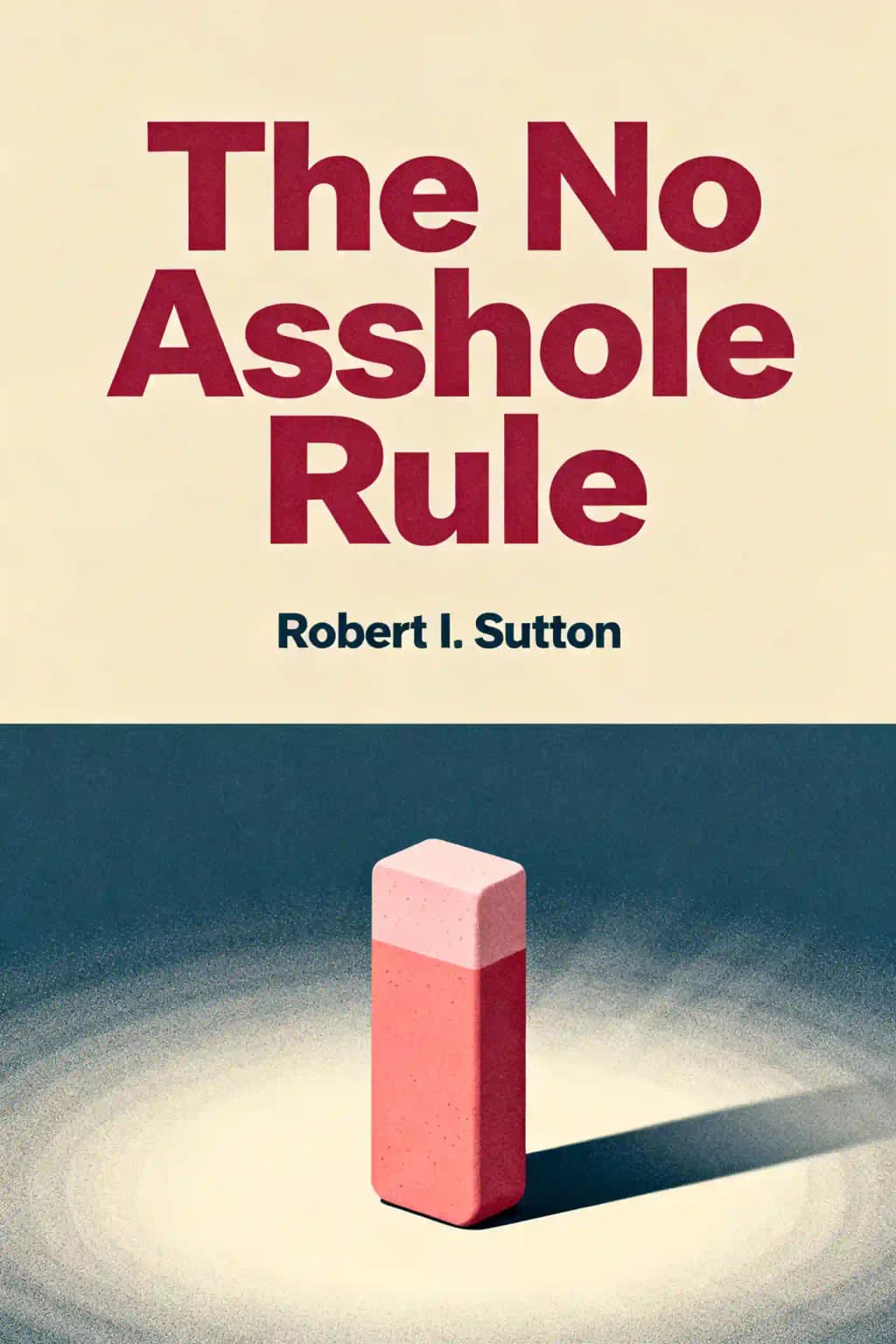
Have you ever worked with someone who made you dread going to the office? The type of person who belittles colleagues in meetings, takes credit for others' work, or sends scathing emails at 2 AM? If so, you've encountered what Stanford professor Robert Sutton calls a "certified asshole" in his groundbreaking book that sparked a workplace revolution. When it was first published, "The No Asshole Rule" became an instant phenomenon, spending six months on the New York Times bestseller list and being translated into 27 languages. Even Oprah Winfrey recommended it to her audience, saying it articulated "what many of us have felt but couldn't express." The book's cultural impact has been so profound that Google adopted its principles in their hiring practices, and countless organizations have implemented "no jerk rules" based on Sutton's research. What makes this book particularly compelling is how it combines rigorous research with practical wisdom about one of the most pervasive yet under-discussed workplace problems: how mean-spirited people poison organizations and what we can do about it.
2장
Defining the Problem: What Makes Someone a Workplace Asshole?
Not everyone who annoys us deserves the label "asshole." Sutton provides two specific tests to identify truly toxic individuals: First, does the target feel oppressed, humiliated, de-energized, or belittled after interacting with the alleged asshole? Second, does the alleged asshole aim their venom at people less powerful rather than those more powerful? This distinction helps separate momentary bad behavior from a persistent pattern of demeaning conduct. The key is looking for repeated patterns rather than isolated incidents, as even the most professional people can have occasional lapses in judgment.
The difference between "temporary assholes" (people who occasionally act badly) and "certified assholes" (those with a persistent pattern) is crucial. Nearly everyone acts like a jerk sometimes - perhaps during high-stress periods or personal crises - but certified assholes consistently leave a trail of victims feeling diminished and disrespected. They employ an extensive arsenal of tactics: personal insults, invading personal territory, uninvited physical contact, threats (both veiled and direct), sarcastic "jokes," withering emails, status slaps, public shaming, rude interruptions, two-faced attacks, dirty looks, and treating people as invisible. These behaviors often escalate over time as the perpetrator becomes more emboldened by lack of consequences.
Consider former Warnaco CEO Linda Wachner, who would "dress you down and make you feel knee-high" when targets didn't meet numbers, often with crude references to sex, race, or ethnicity. Her behavior reportedly created such a toxic environment that talented executives would refuse job offers despite attractive compensation packages. Or Hollywood producer Scott Rudin, notorious for throwing objects at assistants and firing staff for trivial reasons like bringing the wrong type of muffin. He once went through 119 assistants in a single year. Another example is "Chain Saw Al" Dunlap, whose reign at Sunbeam was marked by routine public humiliation of executives and creating an atmosphere of constant fear.
Importantly, the rule doesn't advocate replacing jerks with spineless wimps. Constructive conflict over ideas-not personal attacks-drives performance. Intel's Andy Grove exemplified this by inviting challenges to his ideas while focusing on finding truth, not putting people down. He would often say, "Let's look at the data" rather than relying on authority or intimidation. Similarly, Pixar's practice of "plussing" encourages criticism of ideas while prohibiting personal attacks. Research confirms that teams engaging in idea-based conflict perform better, while those engaging in personal conflict suffer decreased creativity and satisfaction. Studies show productivity can drop by 30-40% when employees experience persistent workplace bullying.
The prevalence of workplace assholes is staggering: studies show 27% of workers experience mistreatment, with about one-sixth reporting persistent psychological abuse. Between 10-20% of employees report experiencing incivility at least weekly. Most abuse (50-80%) comes from superiors to subordinates, with men and women victimized at similar rates, typically by someone of the same gender. The financial cost is equally shocking - estimates suggest toxic employees can cost organizations millions in lost productivity, increased turnover, and legal liability. One study found that replacing a toxic employee can cost an average of $12,500, not including the hidden costs of damaged team morale and reputation.
3장
The Devastating Impact: Why Jerks Destroy Organizations
Mean-spirited people inflict massive damage on victims, bystanders, organizational performance, and ironically, even themselves. The harm victims suffer is most conspicuous, with targets reporting reduced job satisfaction, trouble concentrating, and mental and physical health problems including anxiety, feelings of worthlessness, and depression. Research shows negative interactions have five times the impact on mood than positive ones-it takes numerous positive encounters to offset energy sapped by a single toxic interaction. Studies indicate that victims often experience physical symptoms like insomnia, headaches, and digestive issues, leading to increased sick days and decreased productivity.
Bennett Tepper's comprehensive research on abusive supervision found that employees with demeaning bosses quit at accelerated rates - up to 200% higher than average - while those who remained suffered reduced work satisfaction, less commitment, and heightened depression and burnout. The damage comes not from dramatic episodes but accumulated small indignities-the nasty stares, camouflaged insults, and exclusions that take their toll on mental health and organizational commitment. These micro-aggressions often include behaviors like eye-rolling during presentations, excluding individuals from important emails, or making subtle disparaging remarks about someone's competence.
Assholes damage more than their immediate targets-coworkers, family members, and friends suffer ripple effects. Employees with abusive supervisors face greater work-family conflict, with studies showing their personal relationships deteriorate by up to 50%. Witnesses experience increased stress, with studies showing nearly 50% of employees witness bullying though only 25% are direct victims. Fear pervades these environments; research found over one-third of witnesses wanted to help victims but were afraid. About 20% of witnesses ultimately quit their jobs, showing how toxic behavior poisons entire workplaces. The psychological term "secondary trauma" describes how witnesses internalize the stress they observe.
Even the jerks themselves become victims of their own actions through career setbacks and humiliation. Research by Rob Cross found that being an "energizer" drives positive performance evaluations, while "de-energizers" receive lower evaluations and are 40% less likely to be promoted. Even successful assholes often get fired despite their accomplishments, like Indiana coach Bob Knight or Uber's Travis Kalanick, whose aggressive leadership styles ultimately led to their downfall.
Organizations harboring assholes suffer from fear-based cultures where employees focus on self-protection rather than improvement. At American Airlines, CEO Robert Crandall's intimidating approach backfired as employees devoted energy to avoiding blame rather than improving performance. Similarly, Amy Edmondson found nursing units with intimidating supervisors reported fewer errors-not because they made fewer mistakes, but because nurses were afraid to admit them. This "culture of fear" resulted in potentially dangerous cover-ups and missed opportunities for process improvement.
The financial impact is substantial and often underestimated. One Silicon Valley company calculated the annual cost of a single toxic high-performer named Ethan at $160,000-including 250 hours of management time ($25,000), HR time ($5,000), executive time ($10,000), legal counsel ($5,000), secretary replacement ($85,000), overtime costs ($25,000), and anger management training ($5,000). Despite his top sales performance, executives deducted 60% of these costs from Ethan's bonus, recognizing that assholes cost organizations far more than leaders typically realize. Additional hidden costs include decreased team innovation, lost clients due to poor service experiences, and increased recruitment expenses due to high turnover rates, which can amount to 150% of an employee's annual salary.
4장
Implementing the Rule: How to Create a Civilized Workplace
Organizations vary widely in how zealously they enforce the no asshole rule. Most tolerate run-of-the-mill jerks while only punishing extreme cases. The American standard seems to be: "The more often you win, the bigger jerk you can be." But some organizations like Google, Southwest Airlines, and JetBlue enforce a zero-tolerance policy for nasty behavior, seeing "talented jerk" as an oxymoron and considering how people treat others as a core component of performance.
Successful implementation requires integrating the rule into hiring and firing practices. IDEO screens candidates thoroughly, valuing trusted references, selecting for professional competence first, and conducting extensive interviews to ensure cultural fit. Candidates interview with people above, below, and alongside them to prevent "homosocial reproduction" where assholes hire more assholes.
Organizations must resist hiring bullies despite potential profits, and remove destructive jerks even when they appear to generate revenue. At Men's Wearhouse, a top salesperson was fired for refusing team values, resulting in a 30% sales increase afterward. In one Fortune 500 company, a new CEO methodically purged 25 executives who created a "culture of fear," transforming the company into an industry leader. The aftermath of removing jerks consistently shows the same pattern: immediate relief, retention of good employees, easier recruiting, and successful transitions.
Organizations serious about the rule apply it not just to employees but to customers and clients. JetBlue and Southwest Airlines maintain "banned" lists for persistently nasty passengers. When Ann Rhoades witnessed a customer berating Southwest employees, her colleague walked the "irate jerk" to another airline and bought him a ticket. These diverse organizations all use the rule to prevent cultures of contempt and abuse from developing.
Power differences often fuel toxic behavior. When the aggressive high-status males in Sapolsky's baboon troop died from infected meat, aggression dropped dramatically throughout the group. The new social order featured less bullying, more grooming, and reduced stress among lower-status males. Most remarkably, this gentler culture persisted for years as new males joined and adopted the troop's civilized norms. The lesson isn't to eliminate alpha males but to reduce social distance between higher and lower-status members. Leaders like Costco's James Sinegal demonstrate this by taking modest compensation (just ten times his hourly workers), visiting hundreds of stores yearly, and staying connected to employees.
Small changes in daily interactions can dramatically reduce workplace bullying. The Department of Veterans Affairs implemented an intervention across eleven sites that taught people to recognize aggression's damage, use role-playing to build empathy, and reflect before acting. Leaders publicly committed to modeling civil behavior, and teams focused on eliminating seemingly minor slights like glaring, interruptions, and treating people as invisible. The results were impressive: less overtime, fewer sick days, reduced employee complaints, shorter patient waiting times, and productivity increases.
5장
Taming Your Inner Jerk: Personal Strategies for Civility
While organizational implementation is crucial, personal application matters too-preventing your own "inner jerk" from emerging. Most people, even naturally kind ones, can become caustic under the wrong conditions. Acting like an asshole is a communicable disease that spreads through emotional contagion. Research shows that people automatically mimic others' facial expressions, postures, and behaviors. Studies demonstrate that working under "morally disengaged" bosses who condone put-downs and coldness causes employees to become jerks themselves within months.
The best defense is to avoid joining groups of jerks in the first place. Leonardo da Vinci wisely noted, "It is easier to resist at the beginning than at the end." People fall victim to the "too-much-invested-to-quit syndrome," justifying continued participation in toxic environments because they've already invested significant time and effort. The longer one spends among nasty people, the more likely they are to become nasty themselves.
Organizations that emphasize status differences and constant ranking create environments where people become cutthroat jerks. Research on "framing" shows that even small differences in language determine whether people cooperate or compete. In experiments, participants who played the "Community Game" were dramatically more cooperative than those playing the identical "Wall Street Game." To quell your inner jerk, use three cooperative frames: focus on "we" rather than "I"; recognize ways all humans are fundamentally alike; and tell yourself "I have enough" to avoid constant dissatisfaction.
Whether you're an asshole depends less on your self-perception than on how others experience you. Most people travel through life with distorted, often inflated beliefs about how they treat and affect others. Executive coaches Kate Ludeman and Eddie Erlandson help alpha males confront their destructive behaviors by collecting detailed feedback from dozens of colleagues. Michael Dell and Kevin Rollins at Dell used this approach to address their negative behaviors-Dell appeared remote and unappreciative while Rollins seemed overly critical and a poor listener. Both worked to change through regular 360-degree evaluations and even used humor (Rollins got a Curious George stuffed animal to remind himself to be more inquiring).
Self-awareness is crucial for preventing asshole behavior. One student learned that his deadpan humor made people think he was a jerk, so he adjusted his behavior. His brother gave him a button reading "Admitting you're an asshole is the first step"-capturing the essence of self-management. For real-time feedback, MIT researchers developed the "Jerk-O-Meter" that analyzes speech patterns to detect insensitivity with 75-85% accuracy.
6장
Survival Strategies: Coping When You Can't Escape
Millions feel trapped in workplaces where bullying is normal. Though victims and witnesses leave at higher rates than average, most stay due to financial constraints. Even good workplaces involve occasional nasty encounters, especially in service jobs. Some endure abuse temporarily while planning escape, waiting for bonuses or stock options. But there are ways to survive these toxic environments.
Psychologists have found that reframing your mindset about stressful situations can reduce damage when escape isn't possible. Effective reframing includes avoiding self-blame, expecting the worst but hoping for the best, and developing emotional detachment. Martin Seligman's research shows that viewing difficulties as temporary and not your fault protects mental health. Psychologist Noreen Tehrani helps bullying victims challenge "irrational" thoughts like "I will never get over this" or "Everyone hates me."
While optimism helps sustain health, unbridled optimism can lead to constant disappointment when dealing with persistent jerks. Happiness reflects the difference between expectations and reality, so keeping expectations low for jerks' behavior while maintaining belief in your own resilience creates a protective buffer. This approach prevents disappointment when they're nasty and allows pleasant surprise during rare moments of kindness.
Passion is overrated in organizational life when you're surrounded by assholes; indifference becomes an underrated virtue. In toxic environments, linking self-worth to how people treat you leads to self-destruction. Sometimes self-preservation requires emotional detachment-going through motions while caring as little as possible about the jerks around you. Research suggests that "detached concern" can help employees avoid burnout, though maintaining this balance is difficult.
Gaining control over small, seemingly trivial things is how people survive horrible situations. Vice Admiral James Stockdale, held prisoner from 1965-1973, observed that survivors built rituals around prayer, exercise, and communication to maintain humanity. Research confirms that perceived control-even over tiny aspects of your life-dramatically impacts wellbeing. In one nursing home study, patients given minor choices about their schedules and responsibilities showed more positive attitudes and a 50% lower death rate after eighteen months.
Create safe spaces where you can escape jerks and connect with decent people. These might be physical locations like the nurses' lounge where doctors weren't allowed, or secret social networks of victims supporting each other. Even brief positive interactions with supportive customers can provide relief. However, social support has limitations-talking with people who lack power to stop bullies provides only small positive effects. Worse, support groups can devolve into unproductive "bitch sessions" that spread feelings of helplessness.
7장
The Virtues of Assholes: When Nastiness Appears to Work
Though reluctant to acknowledge it, Sutton examines why being an asshole sometimes appears advantageous. Using Steve Jobs as the prime example-whose name generates 89,400 Google hits when paired with "asshole" (far outpacing other notorious tech executives like Bill Gates or Larry Ellison)-he explores how nastiness can sometimes yield power and success. Jobs' legendary tantrums at Apple, including parking in handicapped spaces and berating employees in public, became part of Silicon Valley lore while simultaneously driving revolutionary products like the iPhone and MacBook.
Research shows strategic displays of anger can enhance perceptions of competence and power. Stanford's Lara Tiedens demonstrated that when viewing clips of President Clinton discussing the Lewinsky scandal, subjects who saw an angry Clinton were more likely to support him remaining in office than those who saw a sad Clinton. The study revealed that angry expressions increased perceived status by 35%, while sad expressions decreased it by nearly 20%. Though angry people are seen as "unlikable and cold," anger creates impressions of competence and authority. Leadership studies confirm that intimidation tactics, from subtle glares to explicit put-downs, can be effective paths to power, particularly in competitive environments.
Just as alpha male baboons maintain dominance through aggression, people can use intimidation to gain and sustain status. This tactic appears in organized crime, contact sports, and corporate settings alike. Baseball legend Ty Cobb-described by Hemingway as "the greatest of all ballplayers-and an absolute shit"-was notorious for his aggressive base-running philosophy: "Give me room or get hurt." His approach led to a .367 lifetime batting average but also countless injuries to opposing players and a legacy of controversy.
Fear can drive people to avoid punishment and public humiliation. Though psychological research shows rewards are more effective motivators than punishments, with positive reinforcement yielding 30% better performance in most studies, fear tactics persist in many workplaces. Leaders who are "effective assholes" typically alternate between harshness and warmth, creating a powerful contrast effect. The "good cop, bad cop" dynamic makes threats seem more menacing and praise more rewarding, as demonstrated in both interrogation techniques and management styles.
Sometimes acting like a "temporary asshole" is necessary to get what you need or deserve. Polite people who never complain often become victims of poor service, unfair treatment, or institutional negligence. Studies show that complaints to health insurance companies are successful 90% of the time, while silent acceptance of denied claims results in permanent rejection. While politeness should be the first approach, strategic nastiness can work when dealing with indifferent people, particularly in customer service situations or bureaucratic processes.
While there are occasional advantages to acting like an asshole, these virtues are often dangerous delusions. The evidence shows that assholes do far more harm than good, with toxic behavior leading to increased stress, decreased productivity, and higher turnover rates averaging 12% annually. Organizations that foster compassion rather than fear attract better talent, have lower turnover, share ideas more freely, and outperform competitors by an average of 15-20% in productivity measures. Companies on Fortune's "100 Best Companies to Work For" demonstrate superior financial performance, with stock returns averaging 14% higher than their peers. Most jerks succeed despite, not because of, their vile behavior, but suffer from blind spots that prevent them from seeing this truth, often attributing their success to the very behaviors that hold them back.
8장
The No Asshole Rule as a Way of Life
Sutton recalls a powerful incident at a restaurant where a customer publicly confronted an abusive patron who was berating a server. The observer approached the table, notebook in hand, and calmly announced he was writing "a book on assholes" and wanted to include this interaction as a prime example. The abusive customer immediately fell silent and left shortly after, demonstrating how public accountability can effectively check toxic behavior. This story crystallizes seven essential lessons about implementing the no asshole rule in daily life.
First, research shows that a mere handful of toxic individuals can poison the atmosphere created by dozens of positive team members - negative interactions carry five times more weight than positive ones in shaping workplace culture. Second, simply having a policy against toxic behavior is meaningless without consistent, visible enforcement. Third, the rule's effectiveness manifests in small, everyday moments - the quick comment in a meeting, the tone used in an email, the way disagreements are handled. Fourth, tolerating even a few toxic individuals is extremely dangerous because their behavior tends to spread rapidly through social contagion and normalization.
Fifth, maintaining civilized behavior must be everyone's responsibility, not just leadership's. When bystanders speak up, like in the restaurant example, it creates powerful social pressure against antisocial behavior. Sixth, both embarrassment (for bad behavior) and pride (in maintaining high standards) serve as powerful motivators for behavioral change. Finally, and perhaps most importantly, we must remain vigilant about our own potential for toxic behavior, especially when stressed or in positions of power.
The core message resonates deeply because it addresses a universal human experience: life is simply too precious to waste in environments dominated by fear, anxiety, and degradation. Organizations that successfully implement the no asshole rule consistently report multiple benefits: increased productivity (studies show toxic behavior can reduce team performance by 30-40%), improved retention of top talent, enhanced innovation through psychological safety, and stronger customer relationships.
The rule's practical applications extend beyond the workplace. Families report stronger relationships when they consciously eliminate toxic interactions. Schools implementing similar principles see reduced bullying and improved academic performance. Even online communities have found success by actively moderating against toxic behavior rather than accepting it as inevitable.
In an era where incivility seems increasingly normalized across social media, politics, and public discourse, Sutton's work provides both a framework for resistance and a pathway to positive change. The no asshole rule isn't merely about creating more pleasant environments - though that alone would justify its adoption. It's about fostering spaces where people can bring their best selves to work, where innovation thrives because people feel safe to take risks, and where success is built on a foundation of mutual respect rather than fear and intimidation. This approach proves that doing good and doing well are not just compatible - they're inseparable.