Friction Project
How to Survive the Gunk, Stop Wasting Time and Build a Better Organisation
Friction Project 개요
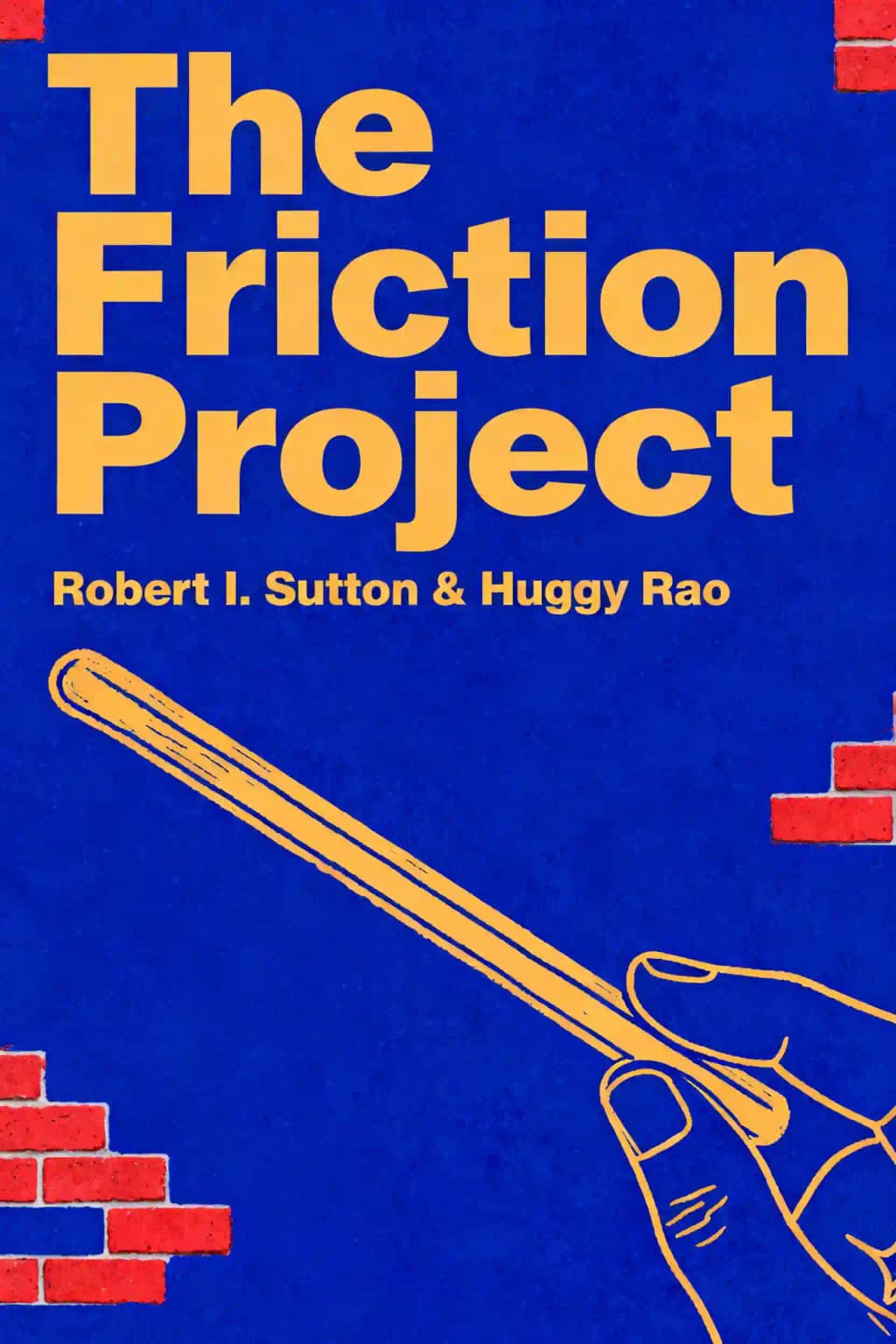
In "The Friction Project," Stanford legends Sutton and Rao reveal when to cut bureaucracy and when to embrace productive resistance. Adam Grant calls it transformative - could distinguishing between good and bad friction be your competitive edge in today's overloaded workplace?

Friction Project의 핵심 주제
- organizational efficiency
- strategic slowing
- time stewardship
- bureaucracy reduction
- constructive friction
Friction Project의 명언
Labor leads to love.
Effective leaders must become friction fixers.
It's like mowing the lawn.
Enlightened trial and error outperforms the planning of flawless intellects.
Schedule meetings if (and only if) other forms of communication won't cut it.
Friction Project의 등장인물
- Robert I. SuttonAuthor and Stanford professor
- Huggy RaoAuthor and Stanford professor
- Dr. Melinda AshtonLeader of the Getting Rid of Stupid Stuff program
- Drew HoustonDropbox CEO who led a meeting reduction initiative
- David KelleyIDEO CEO who treated organization as a prototype
저자 소개
Friction Project의 저자 소개
Robert I. Sutton and Huggy Rao, authors of The Friction Project: How Smart Leaders Make the Right Things Easier and the Wrong Things Harder, are renowned Stanford University professors and organizational behavior experts. Sutton, an organizational psychologist and professor emeritus of management science, partners with Rao, the Atholl McBean Professor of Organizational Behavior, to tackle leadership and operational efficiency challenges. Their book merges seven years of research with real-world case studies, offering actionable strategies to eliminate destructive workplace friction while preserving productive tension.
The duo previously coauthored the bestselling Scaling Up Excellence, a Wall Street Journal and Financial Times standout that remains essential reading for leaders managing growth.
Sutton’s work on workplace dynamics and Rao’s research on organizational change have been featured in Harvard Business Review, The New York Times, and TED-style talks, with insights adopted by companies like Google, Pixar, and the U.S. Marines. The Friction Project distills their decades of advising Fortune 500 executives and startups into a guide praised by LinkedIn cofounder Reid Hoffman as transformative for modern leaders. Published by St. Martin’s Press in 2024, the book builds on their legacy of turning academic rigor into practical tools for global organizations.
Friction Project 요약 다운로드
Friction Project 요약을 무료 PDF 또는 EPUB으로 받으세요. 인쇄하거나 오프라인에서 언제든 읽을 수 있습니다.
이 책에 대한 FAQ
The Friction Project provides actionable strategies for leaders to eliminate harmful workplace friction while preserving constructive friction. Co-authored by Robert Sutton and Huggy Rao, it identifies common obstacles like excessive meetings, jargon overload, and poor processes, offering tools like the "Help Pyramid" and case studies from organizations that streamlined operations. The book emphasizes balancing efficiency with thoughtful decision-making.
This book is ideal for executives, managers, and team leaders seeking to improve organizational efficiency. It’s also valuable for project managers, HR professionals, and entrepreneurs aiming to reduce burnout, enhance productivity, and foster innovation. Readers interested in evidence-based management or Sutton’s prior work (The No Asshole Rule) will find practical insights.
Yes—the book combines rigorous research with real-world examples, making it a actionable guide for addressing workplace inefficiencies. Reviewers praise its focus on both removing destructive friction (e.g., email overload) and preserving necessary friction (e.g., quality controls). Its blend of humor and practicality appeals to professionals at all levels.
The Help Pyramid is a five-level framework for tackling friction:
- Reframing issues to reduce psychological weight.
- Navigating around systemic obstacles.
- Shielding teams from unnecessary burdens.
- Redesigning processes for long-term improvement.
- Cultivating a friction-aware culture.
Good friction includes processes that ensure quality, accountability, and thoughtful decisions (e.g., peer reviews). Bad friction involves inefficiencies like redundant meetings, unclear goals, or bureaucratic hurdles. The authors argue leaders must act as "trustees of others’ time" to eliminate the latter while safeguarding the former.
- Oblivious leaders who ignore inefficiencies.
- Addition sickness—adding unnecessary steps.
- Broken connections between teams.
- Jargon monoxide confusing communication.
- Fast and frenzied cultures prioritizing speed over quality.
The authors recommend capping meeting durations, requiring clear agendas, and eliminating low-value gatherings. For example, one company cut 500+ meetings by enforcing a "no agenda, no attendance" rule. Time audits and empowering employees to decline non-critical meetings also help.
Examples include a consulting firm that reduced email overload by encouraging direct calls for urgent issues, and a tech company that streamlined decision-making by limiting approval layers. These illustrate how friction fixes boost morale and productivity.
Sutton and Rao argue that not every task requires perfection. Leaders should identify "good enough" thresholds for low-impact activities to free resources for high-stakes projects. For instance, shortening lengthy reports or simplifying approval processes for routine tasks.
This term describes overly complex language that obscures meaning and slows progress. The book advises using plain language, creating glossaries, and training teams to communicate clearly. Example: Replacing acronyms with intuitive terms to speed up onboarding.
While The No Asshole Rule focused on toxic workplaces, this book tackles systemic inefficiencies. It shares Sutton’s trademark blend of research and humor but offers more tactical tools (e.g., friction forensics) and collaborator insights from Huggy Rao.
Some reviewers note a lack of industry-specific examples (e.g., healthcare) and suggest deeper exploration of remote-work friction. However, most praise its actionable advice, calling it a "must-read for modern leaders".