Nigel Worden's definitive guide unveils South Africa's complex journey from colonization through apartheid to democracy. A cornerstone of the "historiographical revolution," this academic bestseller reveals hidden histories that surprised even South Africans. How did one nation's painful transformation become a global blueprint for reconciliation?
Nigel Worden, the author of The Making of Modern South Africa, is a distinguished British-South African historian and Emeritus Professor at the University of Cape Town. He is renowned for his expertise in colonial societies, slavery, and apartheid.
His work delves into the socio-political transformations of South Africa, blending rigorous academic research with accessible narratives. A Cambridge-educated scholar, Worden has authored pivotal works such as Slavery in Dutch South Africa and co-authored Cape Town: The Making of a City, which explore the intersections of power, identity, and urban development in colonial contexts.
His collaborative projects, including Honourable Intentions? Violence and Virtue in Colonial Societies, further cement his authority in global colonial studies. Recognized as a Fellow of the University of Cape Town for his contributions to historical scholarship, Worden’s books are widely cited in academic circles and serve as essential texts in courses on South African history. The Making of Modern South Africa remains a cornerstone resource for understanding the nation’s complex journey from conquest to democracy.
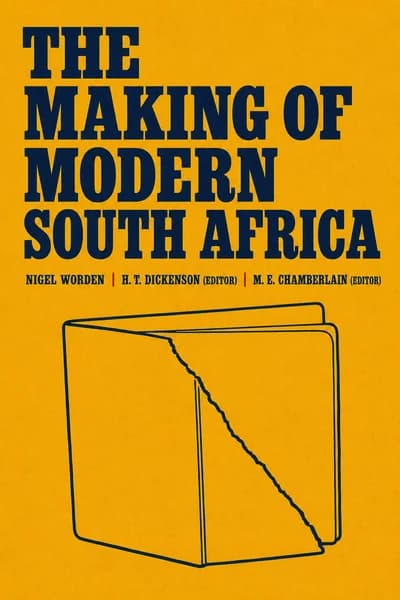
The Making of Modern South Africa provides a concise yet comprehensive analysis of South Africa’s history from pre-colonial times to the post-apartheid era. It examines colonialism, racial segregation, apartheid’s rise and fall, and the challenges of building democracy, emphasizing themes like land dispossession, resource conflicts, and social identity.
This book is ideal for students, academics, and general readers interested in South African history, politics, or social justice. Its accessible style suits both classroom use and self-education, particularly for those exploring colonialism, apartheid, or post-1994 nation-building.
Yes. Praised as a “masterly summary” by scholars, it combines rigorous research with clarity, offering balanced insights into contentious historical debates. Updated editions ensure relevance to modern issues like inequality and reconciliation.
Key themes include:
Worden analyzes land seizures from indigenous groups during the 18th–19th centuries, linking them to entrenched inequality. He explores how colonial policies reshaped territorial ownership, fueling conflicts that persist in modern debates over restitution.
Unlike narrow academic texts, Worden synthesizes vast timelines (pre-colonial to 1999+) while maintaining analytical depth. His focus on Indian Ocean trade networks and slavery’s legacy offers fresh perspectives on Cape Town’s global connections.
Worden argues apartheid’s formal end in 1994 didn’t erase systemic inequalities. He highlights unresolved issues like economic disparity and racial tensions, contextualizing them within historical patterns of exploitation.
Some note its brevity (166 pages) limits coverage of cultural/social history. Others seek more firsthand narratives from marginalized groups, though its conciseness is praised for academic utility.
As a leading historian of Cape slavery and colonialism, Worden integrates niche research (e.g., Dutch East India Company records) into broader narratives, ensuring scholarly rigor without sacrificing readability.
Yes. Later editions address Mandela’s presidency, the 1999 elections, and early 2000s challenges like AIDS and crime. Worden critiques the ANC’s governance while acknowledging democratic progress.
While Antjie Krog’s work focuses on Truth and Reconciliation hearings, Worden offers a sweeping historical overview. Both highlight post-apartheid struggles but differ in scope: Krog’s is literary and personal; Worden’s is academic and structural.
Its exploration of historical inequality, racial identity, and democratic fragility remains critical amid modern debates about land reform, corruption, and social cohesion in South Africa. The book provides context for understanding ongoing systemic challenges.
저자의 목소리로 책을 느껴보세요
지식을 흥미롭고 예시가 풍부한 인사이트로 전환
핵심 아이디어를 빠르게 캡처하여 신속하게 학습
재미있고 매력적인 방식으로 책을 즐기세요
Apartheid wasn't simply an aberration imposed in 1948.
Colonial policies thus created the foundation for what would later become apartheid.
The making of modern South Africa의 핵심 아이디어를 이해하기 쉬운 포인트로 분해하여 혁신적인 팀이 어떻게 창조하고, 협력하고, 성장하는지 이해합니다.
The making of modern South Africa을 빠른 기억 단서로 압축하여 솔직함, 팀워크, 창의적 회복력의 핵심 원칙을 강조합니다.

생생한 스토리텔링을 통해 The making of modern South Africa을 경험하고, 혁신 교훈을 기억에 남고 적용할 수 있는 순간으로 바꿉니다.
무엇이든 물어보고, 목소리를 선택하고, 진정으로 공감되는 인사이트를 함께 만들어보세요.

샌프란시스코에서 컬럼비아 대학교 동문들이 만들었습니다
"Instead of endless scrolling, I just hit play on BeFreed. It saves me so much time."
"I never knew where to start with nonfiction—BeFreed’s book lists turned into podcasts gave me a clear path."
"Perfect balance between learning and entertainment. Finished ‘Thinking, Fast and Slow’ on my commute this week."
"Crazy how much I learned while walking the dog. BeFreed = small habits → big gains."
"Reading used to feel like a chore. Now it’s just part of my lifestyle."
"Feels effortless compared to reading. I’ve finished 6 books this month already."
"BeFreed turned my guilty doomscrolling into something that feels productive and inspiring."
"BeFreed turned my commute into learning time. 20-min podcasts are perfect for finishing books I never had time for."
"BeFreed replaced my podcast queue. Imagine Spotify for books — that’s it. 🙌"
"It is great for me to learn something from the book without reading it."
"The themed book list podcasts help me connect ideas across authors—like a guided audio journey."
"Makes me feel smarter every time before going to work"
샌프란시스코에서 컬럼비아 대학교 동문들이 만들었습니다

The making of modern South Africa 요약을 무료 PDF 또는 EPUB으로 받으세요. 인쇄하거나 오프라인에서 언제든 읽을 수 있습니다.
What does it take to dismantle an entire system built on racial hatred? South Africa's transformation from apartheid state to democracy represents one of history's most astonishing political miracles. This isn't just a story about laws changing or leaders negotiating - it's about millions of ordinary people who refused to accept that their humanity could be legislated away. From the moment Dutch ships anchored at the Cape in 1652 to Nelson Mandela's inauguration in 1994, South Africa's journey spans centuries of oppression, resistance, and ultimately, reconciliation. Understanding this journey means grappling with uncomfortable truths: how systematic racial engineering became state policy, how economic interests fueled segregation, and how a nation learned - is still learning - to heal from wounds that run generations deep.